
Six Kings Slam Postponed to December as Houthi Missile Strikes Batter Riyadh Airport

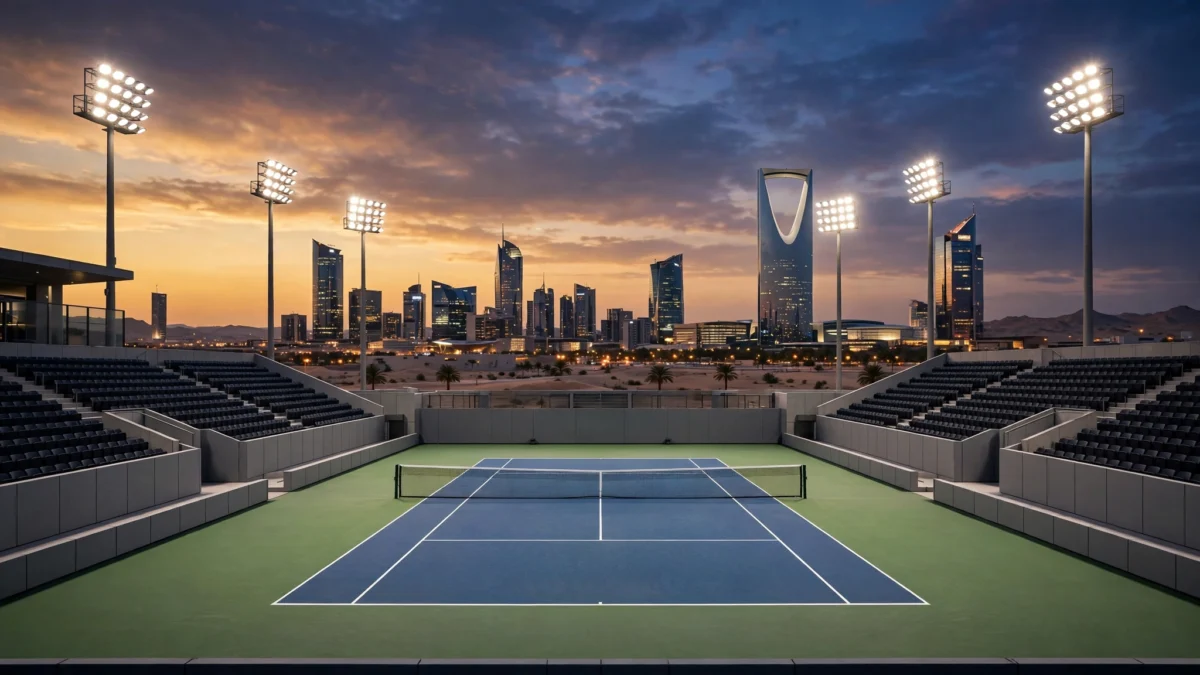
The missiles over Riyadh have reached the tennis court. Saudi Arabia’s flagship exhibition tournament, the Six Kings Slam, has been postponed from next week to late December after a wave of drone and missile strikes attributed to Yemen’s Houthi rebels battered the Saudi capital — including the international airport that every player, sponsor and broadcaster needs to reach the event.
Organizers announced on Wednesday, October 14, that the third edition of the tournament — originally scheduled for October 21, 22 and 24 — will now be held from December 27 to 30, according to a statement shared on X by Turki Al-Sheikh, chairman of Saudi Arabia’s General Entertainment Authority, as reported by Reuters.
The statement framed the decision in managerial language, saying it followed “an assessment of the organizational and logistical challenges associated with hosting the tournament and their potential impact on the quality of the audience experience.” A second Reuters report carried a fuller version of the organizers’ wording: “The decision reflects Riyadh Season’s commitment to delivering sporting events to the highest standards, following an assessment of the organizational and logistical challenges associated with hosting the tournament and their potential impact on the quality of the audience experience.”
Nowhere in the official wording do the words “missiles” or “war” appear. The calendar tells the story anyway. King Khalid International Airport in Riyadh has been closed after a series of drone and missile strikes attributed to the Houthi movement, according to Reuters. The New York Times reported that at least 14 people have been killed and hundreds more injured in the attacks over the past week, Reuters noted. A separate Reuters report put Saturday’s strike alone at at least 12 dead and more than 300 wounded — the deadliest attack on Saudi soil in more than a decade. Reporting carried by Agence France-Presse traced a missile strike on the airport’s passenger terminal on October 10 that killed at least 13 people and injured about 300, followed two days later by another projectile landing near the same terminal that killed one Pakistani national; airports in Abha in the southwest and Dammam in the east were also hit in succession, pushing the cumulative reported death toll above 20.
Some airlines have cancelled or rerouted services to Saudi Arabia, according to the AFP-based reporting. You cannot stage a global sports event in a city whose main airport is a target and whose skies are closed to scheduled traffic — not one built around flying six of the world’s most famous athletes into the desert for four days.
The richest four days in tennis, moved
The Six Kings Slam was set to bring together six leading men’s players for a knockout exhibition at Riyadh’s ANB Arena, with ticketing already open and preparations underway, according to AFP reporting. The announced field: Carlos Alcaraz, Novak Djokovic, Alexander Zverev, Taylor Fritz, Alex de Minaur — and American Learner Tien, who had been brought in as a replacement for Jannik Sinner. The two-time defending champion withdrew after ending his 2026 season early because of a knee injury.
Money is the entire premise of the event. According to Reuters, citing Field Level Media, each participant was guaranteed a $1.5 million appearance fee, with the winner earning an additional $4.5 million. Sports Business Journal put the figures slightly higher — $1.6 million per competing player and an extra $4.6 million for the winner. Either way, the Six Kings Slam remains the most lucrative exhibition in the sport’s history. Sinner walked away with $6 million in each of the event’s first two editions, defeating Alcaraz in the final both times, according to Reuters. Alcaraz himself acknowledged in 2024 that the financial aspect played a role in his participation — he earned $1.5 million over four days that year, Reuters reported.
Whether those stars will still show up in December is an open question. Reuters noted it is not known whether the players have committed to the replacement dates — and that matters more than the postponement itself, because the exhibition model runs on guaranteed appearances, not a ranking-points draw. If Alcaraz and Djokovic quietly decline, the event’s commercial logic collapses regardless of what happens in the skies over Riyadh.
The tournament was also scheduled to be broadcast worldwide on Netflix, according to AFP reporting, adding a global streaming partner to the list of parties now recalculating around the new dates.
A shockwave across Saudi Arabia’s sports calendar
The Six Kings Slam is only the first domino to wobble. Reuters reported that golf’s Asian Tour is monitoring the security situation ahead of the Saudi International in Riyadh next month, while the Asian Football Confederation has acknowledged it is open to postponing the Asian Cup — which Saudi Arabia is scheduled to stage for the first time in January 2027 — to 2028.
The 24-team tournament is due to kick off on January 7 across eight venues in three cities — Riyadh, Jeddah and Al-Khobar — but AFC president Salman bin Ibrahim Al Khalifa said the confederation was in “no hurry to make a decision” on whether to postpone it, according to Reuters. That formulation is worth reading twice: the region’s football leadership is publicly entertaining the idea of moving a continental championship a full year because the security outlook in the host nation is no longer bankable.
All of this is happening under the shadow of two much larger bets. Saudi Arabia’s Vision 2030 programme has made hosting major international sporting events a central pillar of its economic and diplomatic transformation, and the kingdom is scheduled to host the 2034 FIFA World Cup. Both are, at root, confidence trades: they ask athletes, broadcasters, sponsors and fans to treat Saudi cities as normal global venues. Missile strikes on the capital’s airport are a direct assault on that premise.
Analysis: Why It Matters
Airports are the load-bearing wall of the events industry. The official statement blamed “organizational and logistical challenges,” which is technically accurate in the way a doctor’s note is accurate: it describes the symptom and conceals the cause. An exhibition tournament imports everything — players, entourages, equipment, broadcast crews, hospitality staff, spectators — through the air. When King Khalid International Airport closed and airlines began rerouting, the Six Kings Slam did not become riskier; it became physically impossible to guarantee. The lesson for every future Saudi event contract is now written in ink: war-risk clauses are no longer boilerplate, and no organizer will sign another one without pricing in the skies over Riyadh.
The appearance-fee model is fragile in exactly this way. Tour events survive postponements because ranking points and tradition anchor them; players show up to slams because history demands it. Exhibition tennis has no such anchor. The Six Kings Slam buys its field with guaranteed money on fixed dates — roughly $1.5 million per player for four days’ work. Move the dates, and every one of those deals effectively expires. The organizers must now re-sign Alcaraz, Djokovic, Zverev, Fritz, de Minaur and Tien for December 27–30 — four days that sit awkwardly between Christmas and the start of the 2027 season in Australia. Players who once treated Riyadh as a lucrative October stop may not treat it as a pre-season disruption. If even two of the marquee names decline, this “postponement” starts to look like something else.
This is the first wartime disruption of the Vision 2030 sports project, and it is harder to manage than criticism. For years, Saudi Arabia’s sports investments have been attacked on political and human-rights grounds — and the kingdom has absorbed that criticism, bought more events, and waited for the noise to fade. Criticism is survivable. Closed airports are not. The Six Kings Slam postponement marks the moment the project met a threat that money cannot neutralize and public relations cannot reframe: physical insecurity in the host city. The AFC’s open discussion of pushing the Asian Cup to 2028 shows that federations are already doing the risk arithmetic for events two years out.
The war has found the Kingdom’s showcase. The timing is strategically legible. The Houthis have long said that Saudi Arabia’s airports, outside the holy cities of Mecca and Medina, are not safe; striking the capital’s airport during Riyadh Season — when the kingdom is advertising its entertainment calendar to the world — maximizes the pressure precisely where Saudi soft power is most exposed. The missile that closed King Khalid airport did more damage to Vision 2030’s brand than to any single flight schedule, because it forced a public, scheduled admission that Riyadh cannot currently guarantee the one thing every global event requires: safe arrival.
The 2034 World Cup countdown just got complicated. Nobody is seriously discussing moving a World Cup nine years out because of a four-day tennis exhibition. But FIFA’s hosts are judged on trajectories, and the trajectory question has changed: not “can Saudi Arabia build the venues?” — it can — but “can it guarantee the security environment across a decade that includes an ongoing regional war?” The Six Kings Slam was supposed to be routine proof of concept for that guarantee. Instead it became the first public failure of it.
What to Watch Next
- Player recommitment. Watch for confirmation from Alcaraz, Djokovic and the rest of the field on the December 27–30 dates. Silence from the marquee names in the coming weeks will speak as loudly as any announcement.
- The skies over Riyadh. Whether King Khalid International Airport reopens on a stable schedule — and whether airlines restore cancelled routes — will decide not just this tournament but the Saudi International golf event next month and the entire winter entertainment calendar.
- The Asian Cup decision. The AFC says it is in “no hurry,” but the tournament is scheduled to kick off January 7, 2027. Venue contracts, ticketing and broadcast planning cannot wait indefinitely — a decision point is coming within months.
- Golf’s next move. The Asian Tour is monitoring the security situation ahead of the Saudi International in Riyadh. If golf follows tennis in postponing, the pattern becomes a trend that sponsors and insurers will price accordingly.
- The Sinner question. With the defending champion already out for the season, December’s edition — if it happens — crowns a first-time Six Kings champion and ends the Sinner–Alcaraz final streak that defined the event’s first two years.
Sources
- Reuters — “Lucrative tennis exhibition postponed amid Middle East conflict” (Oct 14, 2026)
- Seoul Economic Daily (via AFP) — “Missile Strikes Force Saudi Arabia to Delay Six Kings Slam Tennis Event” (Oct 15, 2026)
- Sports Business Journal — “Six Kings Slam postponed to December amid Middle East unrest” (Oct 14, 2026)
- TennisTemple (via AFP) — “Six Kings Slam Postponed to December After Attacks in Riyadh” (Oct 14, 2026)

About the Author — Abdul Mannan
Related Articles

Swanson’s Late Volley Rescues 2-2 Draw as USWNT Rallies From Two Goals Down Against Spain
Down 2-0 at halftime for the second time in four days, the United States fought back through Ashley…
Guardians Storm Back to Beat Rays 7–3 and Steal ALCS Game 1 in Tampa
Cleveland rallied from 2–0 down with seven runs over the final four innings to take the ALCS opener…
Brewers Rally Past Dodgers 7–4 in Game 2 to Seize 2–0 NLCS Lead
William Contreras homered and drove in three runs while Milwaukee's bullpen retired all 15 batters it faced as…