
Ebola Outbreak Spreads to Eighth Congo Province as Kenya Confirms Second Case

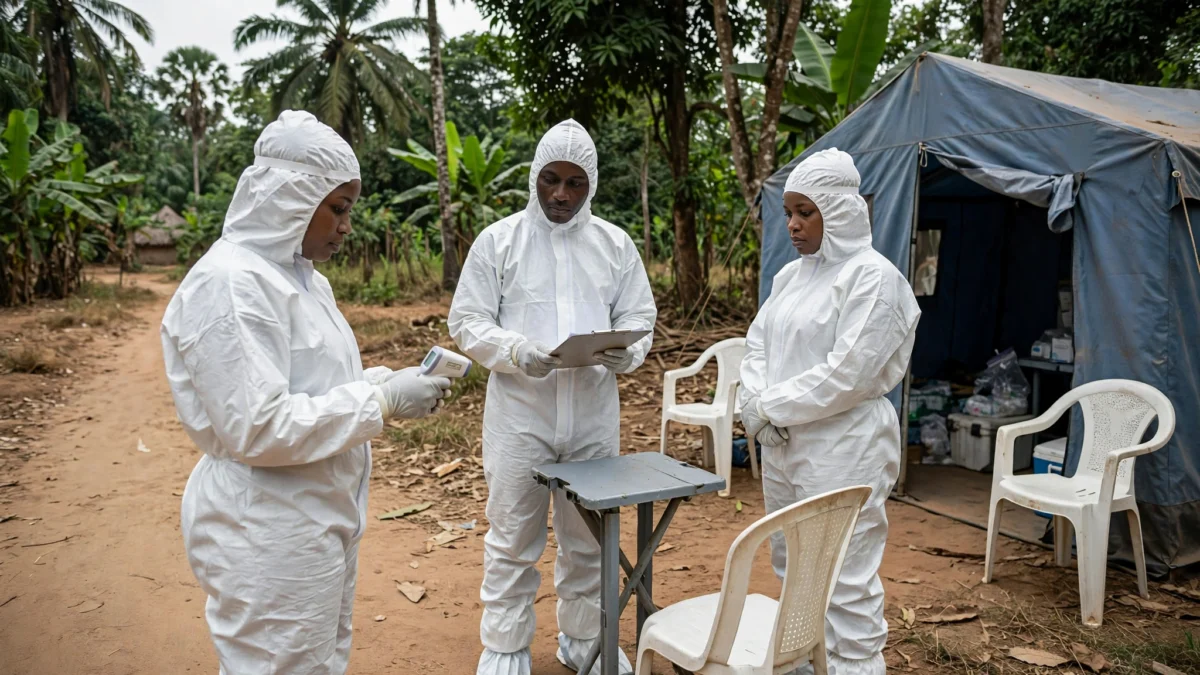
The Ebola outbreak in the Democratic Republic of Congo has reached an eighth province, health officials told Reuters on Thursday, as the virus that has already killed more than 4,000 people this year pushes into territory bordering the Central African Republic and deepens one of the most difficult public health fights Africa has faced in a decade.
Two cases of the Bundibugyo species of Ebola have been confirmed in North Ubangi province, according to two health officials who spoke to Reuters, making the remote north-western province the latest to be drawn into an epidemic that was declared in mid-May and has since become the second-largest Ebola outbreak ever recorded. The cases, detected in the Wapinda health zone near the border with Bas-Uele province, have not yet been officially announced by Congolese authorities.
A health official in North Ubangi told Reuters on Thursday that a series of suspected deaths had recently been reported in a mining area around Wapinda, prompting samples to be analysed at a provincial laboratory and in the capital, Kinshasa. The mining connection is a familiar and worrying pattern: mobile workers in informal extraction sites have repeatedly carried the virus across long distances during this outbreak, and North Ubangi sits directly on the Central African Republic’s frontier, raising the possibility that the epidemic’s geographic footprint could soon cross yet another international border.
More than 9,000 cases and more than 4,000 deaths have been confirmed since the outbreak began, according to the Reuters reporting, which cited two officials. The World Health Organization’s Africa regional bureau, in its latest situation report summarised this week, put the figures at 9,066 confirmed cases including 4,381 deaths, with 65 health zones affected since the outbreak began. Ituri province remains the principal focus of transmission, although the WHO noted that cases have also increased recently in North Kivu, and substantial transmission continues in Haut-Uele. Earlier this week, the Dakwa health zone in Bas-Uele province became the latest zone affected before the virus moved on to North Ubangi.
The outbreak has already spilled beyond Congo’s borders twice. Uganda, which was hit earlier in the epidemic, was declared Ebola-free in August, according to Reuters. Kenya, which announced its first-ever Ebola infection earlier this month after a man travelled from Congo and died in Nairobi, confirmed a second case on Wednesday, October 14. The second patient, a 39-year-old man, is a close family member of the first case and was already in quarantine when he fell ill, according to Kenya’s Ministry of Health.
WHO Director-General Dr Tedros Adhanom Ghebreyesus said Kenya’s handling of the second case showed that “surveillance and contact tracing efforts are working,” in remarks reported after the confirmation. Kenya’s Health Cabinet Secretary Aden Duale said the ministry had listed 128 contacts of the first case and, as of October 13, had traced 113 of them, placing 108 in quarantine in Kenya with daily clinical and temperature checks for 21 days from their last possible exposure. Five contacts are outside Kenya and their details have been shared with the relevant health authorities, as required under the International Health Regulations of 2005, while tracing of the remaining contacts continues. “Contact tracing and monitoring are working. Both cases are linked, and there is no evidence of spread in the wider community,” the cabinet secretary said in a statement.
The expansion into North Ubangi comes as Congo’s health system is being squeezed from a second direction. The country’s cholera epidemic is also gaining ground: more than 125,000 suspected cholera cases and 3,644 suspected deaths were recorded between January 2025 and the end of September 2026, according to WHO figures reported by UN News on October 14. Since the beginning of 2026 alone, more than 51,412 suspected cholera cases, including 1,487 deaths, have been reported across 21 provinces. During the surveillance week of September 21 to 28, health authorities recorded 2,932 suspected cases and 86 deaths, up from 2,506 cases and 62 deaths the previous week, and four new health zones were affected — three in Tshuapa province and one in South Kivu. South Kivu, North Kivu and Haut-Katanga account for nearly 60 per cent of the reported suspected cholera cases.
Cholera, a severe diarrhoeal disease that can be fatal within hours if untreated, is fuelled by the same conditions that help Ebola spread: broken water and sanitation infrastructure, displacement, and communities beyond the easy reach of the state. The WHO has warned that Congo is effectively fighting two epidemics at once, with the cholera emergency concentrated in the south and east while Ebola burns through the north and east.
For context, Ebola is caused by a group of viruses known as orthoebolaviruses, first identified in 1976 during near-simultaneous outbreaks in what is now the DRC and South Sudan, according to a UK Health Security Agency explainer published October 15. Four species of the virus are known to cause disease in humans. The current outbreak is caused by the Bundibugyo species — a distinct species from the Zaire species that caused the 2014–2016 West Africa epidemic, which produced more than 28,000 reported cases and saw intense urban transmission for the first time, the UKHSA said. The WHO declared the current outbreak a public health emergency of international concern on May 17, 2026. The UKHSA assessed the risk to the British population as low, noting that only four confirmed cases have been reported in the UK since 1976, with no British deaths from the disease.
The most troubling statistic in the WHO’s latest situation report is not the case count but where the dying is happening. About 60 per cent of deaths are occurring in communities rather than in treatment centres, and roughly one-third of all new cases are still being detected only after patients have died, according to Catherine Swallwood, the WHO’s incident manager in the country. That means health authorities are not finding the sick before they die — and every missed case is a missed chain of transmission.
Analysis: Why It Matters
The arrival of Ebola in North Ubangi is significant less for the number — two confirmed cases — than for what it reveals about the trajectory of this outbreak. Five months after the epidemic was declared, the virus is still finding new provinces. That is the signature of a response that is containing the fire in places where it has resources, but cannot seal the edges. Each new province means new contact lists, new surveillance posts, new treatment capacity, and new negotiations with communities that have often seen officials arrive in hazmat suits and heard promises that were not kept.
The Wapinda mining-area detail deserves attention. Informal mining camps across central Africa are epidemiological blind spots: transient, overwhelmingly young and male populations, poor sanitation, limited health infrastructure, and deep mistrust of authority. Workers move between sites and across borders carrying ore, cash, and — inevitably — viruses. Congo’s authorities have struggled throughout this outbreak to penetrate exactly these environments, and a mining-linked cluster near the Central African Republic border is about as difficult a scenario as a contact-tracing team can face. If the virus is established in North Ubangi’s mining corridors, the border with the Central African Republic — itself a country with a fragile health system and ongoing instability — becomes the next front to watch.
Then there is the community-death figure. Roughly 60 per cent of deaths happening outside treatment centres, and one-third of new cases identified only post-mortem, is not a data point — it is a verdict on the response’s reach. It tells us that five months in, a large fraction of the affected population either cannot reach care, does not trust it, or does not recognise the disease until it is too late. Ebola is a disease where early supportive care materially changes survival odds, and where every burial conducted without precautions can seed new infections. A response that misses one-third of its cases at the point of death is a response running behind the virus, not ahead of it. The contrast with Kenya is instructive and, in a way, hopeful: Nairobi’s health authorities listed 128 contacts, traced nearly all of them, and had the second patient already in quarantine before he became symptomatic. That is what a functioning surveillance net looks like. Congo’s eastern provinces, torn by conflict and displacement, cannot build that net at the same speed — and the virus knows it.
The Bundibugyo species itself adds a layer of difficulty that is easy to overlook. Most of the world’s Ebola countermeasures — the licensed vaccines, the stockpiled monoclonal antibody treatments — were developed against the Zaire species, the culprit in the 2014–2016 West Africa epidemic. Their effectiveness against Bundibugyo is far less established. That means the biomedical cavalry that helped end previous outbreaks cannot be assumed to ride to the rescue with the same confidence this time. The response is, to a much greater degree than in 2014–2016, dependent on the unglamorous fundamentals: surveillance, contact tracing, safe burials, community engagement, and clean water.
And that brings in the cholera parallel, which is arguably the most under-reported dimension of this crisis. A country recording more than 51,000 suspected cholera cases in nine months — with the weekly trend still rising into late September — is a country whose water and sanitation systems have substantially failed. Cholera and Ebola both thrive where clean water is scarce and public trust is thinner. The fact that Congo is fighting both simultaneously, in overlapping geographies, means the same overstretched health workers, the same broken supply chains, and the same exhausted international donors are being asked to do double duty. Donor fatigue is a real variable here: the 2014–2016 West Africa epidemic commanded global attention and billions in funding. This outbreak, grinding on through its sixth month in the middle of a congested global news cycle, risks being normalised into the background — precisely when its geographic expansion shows it is not yet under control.
None of this is cause for panic in London, Washington, or Karachi — the UKHSA’s low-risk assessment for Britain is consistent with the epidemiology, and imported cases remain rare events that well-prepared health systems can contain, as Kenya is currently demonstrating. But it is cause for sustained, funded, international attention to Congo itself. The difference between this outbreak becoming the largest in history and being brought under control will not be decided by border closures — Kenya’s health minister has already rejected that option — but by whether surveillance reaches the mining camps of North Ubangi before the virus reaches the Central African Republic.
What to Watch Next
- Official confirmation from Kinshasa. The two North Ubangi cases were reported by health officials speaking to Reuters and have not yet been officially announced by Congolese authorities. An official confirmation — and the detailed case investigation that should follow — will be the first test of how seriously the new front is being taken.
- The Central African Republic border. North Ubangi borders the CAR. Watch for screening posts, border-health announcements, and any signals from Bangui about preparedness. A first cross-border case would mark a dangerous new phase.
- Kenya’s 21-day contact window. With 108 contacts in quarantine under daily monitoring, the next three weeks will show whether Kenya’s surveillance net holds. A third, unlinked case would change the assessment; continued containment would be a model for the region.
- Community-death trends in the WHO’s weekly reports. The proportion of cases detected only after death — currently about one-third — is the single best indicator of whether the response is catching up. A sustained fall would signal genuine progress; a rise would signal the opposite.
- Funding and attention. With cholera also surging and conflict continuing in the east, watch whether international donors renew commitments or let this outbreak drift. The 2014–2016 epidemic showed that money and personnel, deployed early, work. The current trajectory shows what happens when they are stretched thin.
Sources
- Reuters — Congo Ebola outbreak spreads to new province bordering Central African Republic (October 15, 2026)
- UN News — DR Congo: Cholera cases spike amid fight against Ebola (October 14, 2026)
- UK Health Security Agency — Ebola: what are the symptoms and how does it spread? (October 15, 2026)
- News 9 Africa — WHO reacts to Kenya’s second case of Ebola virus disease (October 14–15, 2026)

About the Author — Abdul Mannan
Related Articles

Experimental Drug ANB033 Shields Celiac Patients From Gluten Damage in Early Trial
First Tracks Biotherapeutics' ANB033, an investigational CD122 antagonist, significantly protected celiac patients against gluten-induced intestinal damage and symptoms…

Lancet Commission Names Obesity the Largest Preventable Threat to Global Health, Ahead of Pandemics and Antimicrobial Resistance
A new Lancet Commission launched in Berlin ranks obesity as the largest avoidable threat to human health over…

Young Women Face Higher Odds of Delayed Breast Cancer Diagnosis, New Dana-Farber Study Finds
A new analysis of more than 1,000 women diagnosed with breast cancer before age 40 finds that lower…