
The Dog That Barked in Chinese: What the Galgotias ‘Orion’ Scandal Teaches Us About Dishonest Universities

Suppose a student walks into an examination hall, sits down, and begins to copy. The invigilator catches him. What happens? He is expelled, his paper is cancelled, his name is disgraced before his classmates, and the institution issues a solemn statement about “upholding the sanctity of examinations.”
Now reverse the scene. Suppose it is not the student who copies. Suppose it is the university itself — not in an examination hall, but on the grandest stage in the country, before the cameras of the state broadcaster, with the Prime Minister’s own summit as the examination hall. Suppose the university takes a machine built by someone else, renames it, and presents it to the nation as the fruit of its own genius. Who expels the university? Who cancels its paper? Who reads it the sermon on sanctity?
Dear reader, this is not a hypothetical question. It happened. And this week, the whole world is talking about it again.
The Dog That Was Introduced as a Native Son
In February this year, at Bharat Mandapam in New Delhi, India hosted the India AI Impact Summit 2026 — a five-day gathering inaugurated by Prime Minister Narendra Modi, attended by more than twenty heads of state and five hundred global AI leaders. It was India’s declaration to the world: we intend to manufacture the future, not merely consume it.
And then, a four-legged robot walked into the middle of that declaration and made a national scandal of it.
The robot was called “Orion.” It stood at the pavilion of Galgotias University, a private university in Greater Noida. Professor Neha Singh stood beside it before the cameras of DD News, the state-run broadcaster, and spoke the fateful words: “You need to meet Orion. This has been developed by the Centre of Excellence at Galgotias University.” She presented it as a landmark achievement of the university’s researchers, linked it to a declared investment of more than ₹350 crore in artificial intelligence, and described its surveillance capabilities. The crowds gathered. The headlines wrote themselves.
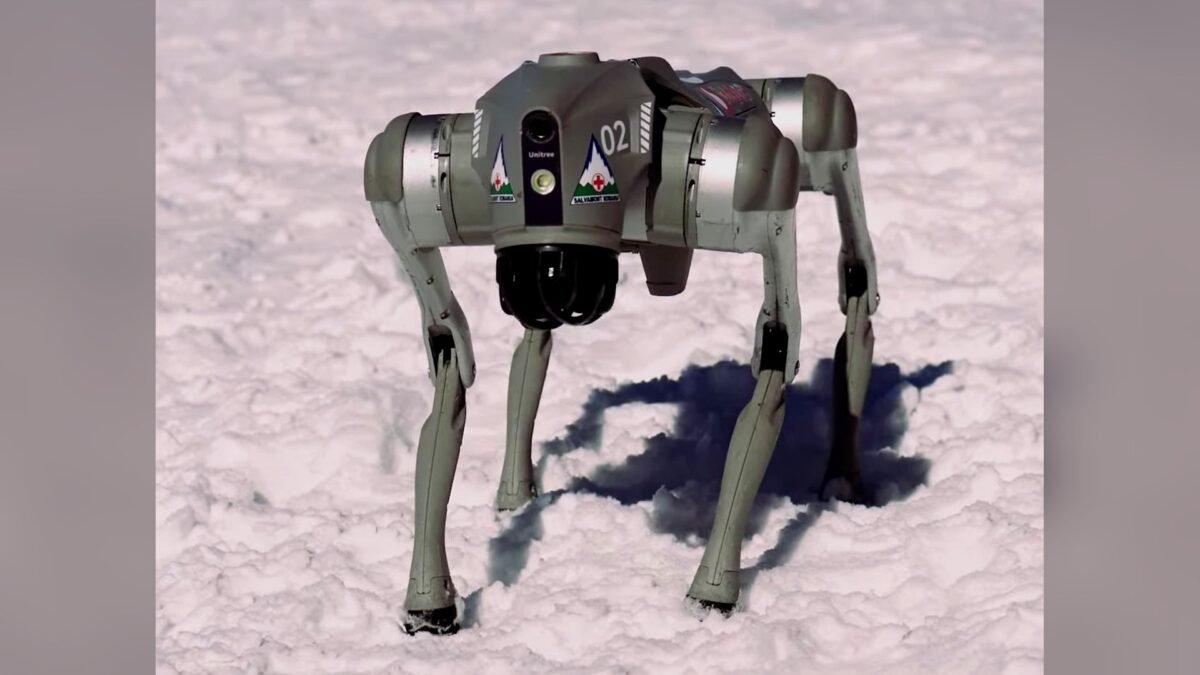
There was just one problem. Orion was not Indian. Orion was not built by Galgotias University. Orion was not built by anyone’s Centre of Excellence. Orion was a Unitree Go2 — a commercially available quadruped robot manufactured by Unitree Robotics of Shenzhen, China, sold openly to anyone with a credit card for a starting price of about $1,600, and used widely in research and education across the world.
The internet needed only hours to do what the summit’s vetting had failed to do. Users identified the machine from its shape and gait — and then came the decisive evidence: the visible Unitree branding on the robot’s own chassis. The dog was wearing its maker’s name on its forehead while being introduced under an assumed one. As the Associated Press reported, Galgotias University was ordered to remove its exhibition stand the next day. The organisers were unsparing: “The summit is a platform to celebrate authentic innovation. Misleading claims undermine public trust and devalue genuine Indian contributions to AI and robotics.”
The Emperor’s New Robot
You have heard the story, reader, even if you have forgotten where. Hans Christian Andersen wrote it in 1837: two weavers promise a vain emperor a suit of clothes invisible to anyone unfit for office or hopelessly stupid. The emperor, his ministers, his courtiers — all pretend to see the magnificent fabric, because none dares admit he sees nothing. The procession moves through the town, the crowds cheer — and then a child, too young for the court’s politics, points and says the sentence that collapses the whole theatre: the emperor has no clothes.
What happened at Bharat Mandapam was the Emperor’s New Clothes performed with a robot dog.
The university played the weavers. The summit pavilion was the court. The state broadcaster’s cameras were the procession. And the child — ah, the child is the most beautiful part of this story — the child was the internet itself: millions of ordinary people, armed with nothing but their eyes and a search engine, who looked at the “indigenous innovation” and said, plainly, that is a Unitree Go2, and it costs $1,600.
Andersen’s tale survives because it is not about an emperor — it is about the machinery of collective pretence. A university is supposed to be the one place where that machinery is dismantled: where a claim must survive the question, where evidence outranks authority, where the child who says “I see nothing” is rewarded. When the university itself becomes the weaver, the courtroom of truth has started manufacturing lies.
When the Teacher Cheats, the Examination Hall Collapses
This is why the story has gone viral again this week — not as a funny meme about a robot dog, but as something far more serious. The academic-integrity researcher Thomas Lancaster, writing this very week, has named the Galgotias fiasco for what it is: institutional cheating — the same disease as student contract cheating, but practised by the institution itself, on a national stage, with the Prime Minister present.
Read his question slowly, because it is the question this column is built on: “If a university will lie at a summit with the Prime Minister present, what happens in lower-stakes situations? What message does this send to students about integrity?”
Consider the asymmetry, dear reader, and let it anger you as it angers me. Every semester, universities expel students for academic dishonesty: a copied essay faces a disciplinary committee, a phone in the examination hall costs a year. The institution stands over the student like a judge, and the judge’s favourite lecture is integrity — cite your sources, do your own work, be honest.
And then the judge walks into the nation’s flagship technology summit, picks up a Chinese-manufactured robot, and presents it as its own creation.
By what moral arithmetic does the institution retain the right to punish the student? A university that plagiarises a machine has forfeited the standing to fail a student for plagiarising an essay. The sermon on integrity, delivered by a plagiarist in a gown, is not education. It is theatre — the same theatre as the emperor’s procession, with the faculty playing the courtiers and the students cast, unwillingly, as the cheering crowd.
The Anatomy of the Apology: Blame the Junior, Save the Institution
Watch, now, what the university did when the child’s voice had been heard and the nakedness was undeniable — because the choreography of institutional self-preservation is as instructive as the original lie.
First came the wounded dignity. The university declared itself “deeply pained” and described the exposure as a “propaganda campaign” that could harm the morale of students. Note the inversion: the institution that misled the nation presented itself as the victim of those who noticed.
Then came the scapegoat. Professor Singh was thrown to the wolves with surgical precision: she was “not authorized to engage with the media,” “ill-informed,” “unaware of the product’s technical origins” — in her “eagerness” she had mistaken a $1,600 retail product for a ₹350-crore research breakthrough. The university, you understand, had done nothing wrong.
Finally came the carefully lawyered retreat. In its official statement of 18 February, the university insisted there had been “no institutional intent to misrepresent,” reaffirmed its commitment to “academic integrity, transparency, and responsible representation,” and — “understanding the organisers’ sentiment” — vacated the premises.
Reader, I have watched this dance in a hundred institutions. The steps never change: the junior is sacrificed, the culture that produced the junior is declared innocent, and the words “integrity” and “transparency” are deployed as shields by the very people who breached them. But ask the question the statement begs you not to ask: if the professor was truly unauthorised and ill-informed, who authorised the pavilion? Who approved the exhibit? A university does not accidentally place a mislabelled robot at a prime ministerial summit. Somewhere, a chain of senior people saw the dog, saw the cameras, and said: let it run.
The Wound Beneath the Embarrassment
But there is a deeper wound here than one university’s disgrace, and it is the wound I most want you to feel, because it belongs to all of us who live in countries that dream of technological self-reliance.
India’s AI ambitions are real and formidable. The summit drew billions in investment interest; the country’s “Viksit Bharat” vision imagines an India that leads rather than follows in the technologies of the century. That is a noble ambition, and no honest observer begrudges it.
But ambition without credibility is choreography. Trust is the currency in which all innovation trades, and trust, once counterfeited, devalues everything around it — including the genuine work. As the organisers warned, misleading claims “devalue genuine Indian contributions to AI and robotics.” Every real researcher and honest startup at that summit has had their achievement cheapened by association. The weavers did not merely embarrass themselves; they made the whole court’s tailors suspect.
This is the universal law of counterfeit, and it operates far beyond India. When an institution fakes an achievement, it taxes the honest. When a university lies about a robot, it teaches every watching student a lesson no syllabus contains: that in the real world, presentation outranks substance, and getting caught is the only sin. What lecture on research ethics survives that lesson?
And here is the cruellest irony: the honest path was available the entire time. There is no shame in buying a Unitree Go2 for teaching — universities worldwide do exactly that. The shame was never in the purchase; it was in the renaming. Orion did not need to be a lie to be useful. It only needed to be a lie to be glorious.
The Verdict
So what should be done? The summit acted correctly: the stall was removed, the standard defended. But the deeper repair cannot be performed by organisers. It must be performed by the institution — not with another press statement, but with a reckoning.
A university that wishes to teach integrity must first practise it in public, at cost: naming honestly how the misrepresentation was authorised, submitting its own claims to the same scrutiny it applies to a first-year student’s essay, and understanding that “no institutional intent” is not a finding — it is an alibi.
And for the rest of us — the students, the parents, the citizens who fund these institutions with our fees and our taxes and our trust — the lesson is Andersen’s, and it is permanent. Never applaud the invisible suit. When the court tells you a marvel has been woven, look with your own eyes. The child in the crowd is not naive; the child is the only honest person in the procession. In February, the crowd had millions of children, and they were all holding smartphones. The emperor’s new robot stood exposed in hours.
I will end where I began: in the examination hall. Somewhere today, a student will be caught copying, and an institution will expel him with a lecture on integrity. I do not defend the copying student. But I ask the institution, before it reads the sentence, to answer one question honestly — the question the internet has already answered for Galgotias:
Who watches the watchman, when the watchman is the one holding the crib sheet?
Sources & References
- Associated Press — “India boots a private university from an AI summit over a robot dog controversy” (via Arya News): Galgotias University ordered to remove its stand a day after Prof. Neha Singh told DD News the “Orion” robot dog was developed by the university’s Centre of Excellence; the machine identified as the Unitree Go2 (starting price $1,600).
- Thomas Lancaster — “Institutional Cheating Goes Viral: Lessons from the India AI Summit Fallout” (18 October 2026): the case framed as institutional-scale academic fraud; the university later apologised and was ordered to vacate its stall.
- News Network Plus — “Govt Asks Galgotias University to leave India AI summit after Displaying Chinese robot as its own invention” (20 February 2026): Singh’s DD News remarks (“You need to meet Orion…”), the ₹350 crore investment claim, and the university’s official statement of 18 February (“no institutional intent to misrepresent… we have vacated the premises”).
- VarIndia — “Galgotias University Removed from AI Impact Summit”: government sources on the order to vacate the exhibition space at Bharat Mandapam; the university’s clarification that the robot was procured for academic purposes.
- Newsgab — summary of the episode: the university’s “deeply pained” / “propaganda campaign” response, the later apology describing Singh as unauthorised and “ill-informed,” and the credibility stakes for India’s AI ambitions.

About the Author — Abdul Mannan
Related Articles

The Lost Years: Why India Is Putting Its Five-Year-Olds in Class 1 Instead of Preschool
A five-year-old's fingers should be learning to hold a crayon, not bracing under the weight of a school…

The Law That Keeps Changing Its Mind: Who Owns America’s Classroom?
The US Department of Education has formally rescinded the Biden-era Title IX rule and restored the 2020 text.…