
The Comet Nobody Was Looking For: What Euclid’s Accidental Discovery Says About Us

A Telescope Built to Ignore Exactly This
Have you ever found something precious that you were never looking for — something that slipped into your hands precisely because your eyes were fixed elsewhere? If you have, then you already understand what happened in the cold dark above us last month, when one of the most sophisticated machines humanity has ever built found a comet it had deliberately designed itself to never see.
The European Space Agency’s Euclid space telescope was not sent to look for comets. Let me be plain about this, because the irony is the whole point. Euclid, launched in July 2023 on a six-year mission, was built for the grandest question of all: what are dark matter and dark energy, the invisible hands that shape the visible universe? Over its lifetime it will measure the shapes and motions of billions of galaxies stretching out to ten billion light-years away. It is, in every sense, a machine built to stare at the edge of time itself.
And here is the part that should stop you mid-scroll: to do its job properly, Euclid was deliberately pointed away from the Solar System’s plane — the comet-rich band of sky where asteroids and comets swarm. Dust there would scatter glare into its sensitive deep-sky images. The engineers, quite literally, taught the telescope to ignore our own backyard. Euclid’s “step-and-stare” strategy visits each patch of sky only once, so even a comet that photobombed its images could not be revisited on demand. Everything about this machine said: look outward, never inward.
And yet, inward came.
The Streak in the Deep Field
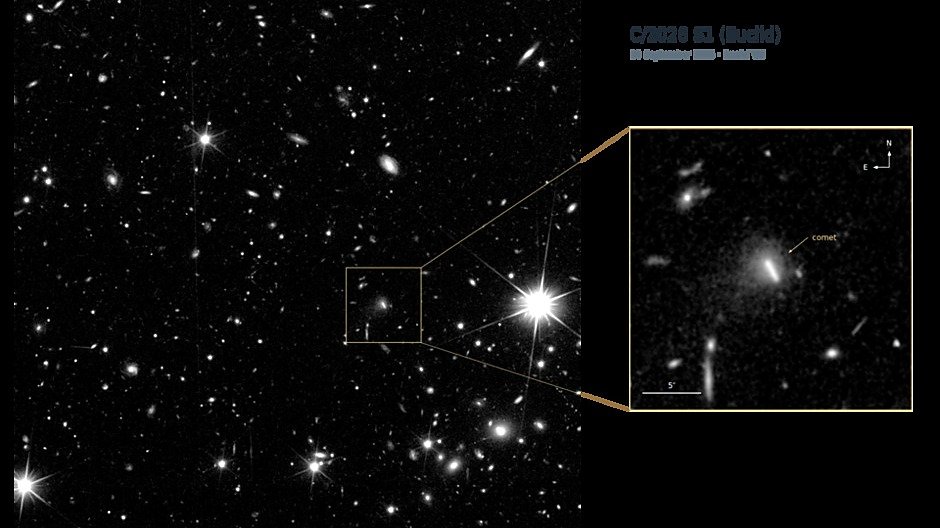
Between 16 and 24 September 2026, Euclid was doing exactly what it was built to do — imaging the Euclid Deep Field North, a patch of sky in the constellation Draco, counting distant galaxies for the dark-matter census. In sixteen exposures across five different fields of view, a faint streak smeared itself across the frames. To anyone else, it would have been noise. The mission’s image-cleaning pipeline is, in fact, designed to flag and remove precisely such intrusions — moving comet trails are “contamination” in the data of a galaxy-mapping mission.
But Mikko Pöntinen, a PhD student at the University of Helsinki, had written something different: software that monitors Euclid’s images for small Solar System objects, built to notice what the mission’s main pipeline treats as rubbish. His program flagged the streak. “I was excited to see my software flag a ‘streak’ smeared across several images — the result of a fast-moving object,” Pöntinen said in the ESA statement. “By predicting its position I could identify it in other images, in total finding it in five image sets.”
Further inspection revealed a fuzzy cloud around the object — the coma, that glowing envelope of dust and gas that distinguishes an active comet from a dead asteroid. Checks against every catalogue of known comets and asteroids came back empty. Nobody owned this visitor. Pöntinen reported it to the International Astronomical Union’s Minor Planet Center, the global clearing house for such reports, and on 8 October the Center confirmed it: a new comet, now officially designated C/2026 S1 (Euclid). The European Space Agency announced the discovery on 19 October 2026.
Consider the geography of it. This comet sits roughly 1.3 billion kilometres from Earth — out between the orbits of Jupiter and Saturn. But it does not travel in the same flat plane as the planets. Viewed from the Sun, it hangs almost straight above the Solar System, arcing over it on an orbit that will take thousands of years to complete. That is precisely why Euclid found it: the comet’s orbit slices up through the quiet sky Euclid was staring at, a region the telescope had chosen because almost nothing moves there.
History’s Mirror: The Greatest Discoveries Were Accidents
Now step back with me, because this is where history holds up its mirror. We are told — by textbooks, by funding agencies, by the tidy logic of grant proposals — that discovery is a straight road: ask a question, build the machine, get the answer. And yet the road of science is paved with glorious accidents.
Christopher Columbus sailed west hunting for a shorter route to India and stumbled onto two continents nobody in Europe knew existed. William Herschel, in 1781, believed he had found a comet; further watching proved it was an entirely new planet — Uranus, the first planet discovered with a telescope. Arno Penzias and Robert Wilson spent years trying to scrub a stubborn hiss out of their radio antenna, convinced it was interference; that “noise” turned out to be the cosmic microwave background, the afterglow of the Big Bang itself, and it won them the Nobel Prize. Alexander Fleming’s ruined petri dish gave us penicillin. In every case, the finder was looking at something else entirely.
And now you, reading this on your phone between notifications — when was the last time you noticed something you were not sent to notice? We have built an entire civilization of tunnels: feeds that show us only what we already believe, careers that reward only what is measured, telescopes that are aimed only at approved questions. Euclid’s comet is a quiet rebuke to all of it. The universe hid one of its visitors in the one corner of the sky that our most precise instrument had been instructed to ignore — and it was found only because one young researcher refused to let “noise” be thrown away unread.
Why This Unwanted Comet Still Matters
Do not mistake me: this is not merely a poetic story. There is hard science in it. Long-period comets like C/2026 S1 are icy, dusty leftovers from the birth of the Solar System some 4.6 billion years ago, drifting in from the distant Kuiper Belt and Oort Cloud. They have changed very little since they formed, which makes them time capsules — carriers of the raw ingredients that shaped the planets, and perhaps of the water and organic building blocks from which life on Earth itself arose.
There is also a practical dividend. The speed of this discovery — from flagging to Minor Planet Center confirmation in a matter of weeks — proves that Euclid can detect new comets while they are still far from the Sun. As ESA’s Euclid Archive Scientist Bruno Altieri put it, it was “a happy coincidence that the combination of the comet’s orbit and Euclid’s scanning over those days captured the object in multiple images.” Project Scientist Valeria Pettorino added the deeper point: this gives both teams a real test case for how they will coordinate in the future. ESA’s forthcoming Comet Interceptor mission is being designed to chase down a pristine, never-before-visited comet — and while this particular comet is not a suitable target, the process of finding and flagging it is exactly the dress rehearsal that mission needs.
And remember: Euclid had detected comets before — but every one of them was already in the catalogues. C/2026 S1 is the first comet Euclid can claim as its own discovery. A machine built to remove comets from its images has now contributed one to the census of the Solar System. If that does not make you smile, check your pulse.
Attention Is the Rarest Instrument
Here is the sentence I want you to carry away from this column. The most important instrument on the Euclid mission was not the telescope — it was the attention of a graduate student who decided that the “noise” was worth a second look.
We live, all of us, inside instruments of our own design: routines, algorithms, habits, certainties. Like Euclid, we point ourselves at the grand questions — the career, the plan, the five-year strategy — and we deliberately look away from the “dusty plane” of everyday life, where the uninvited things move. A chance conversation. A stray observation. A streak across the data of an ordinary day. How much of your own life’s “noise” have you discarded without inspection?
The heavens have always rewarded the watchful. Long before there were space telescopes, there were shepherds and sailors who read the sky because their lives depended on noticing. There is an old wisdom, carried in many traditions, that signs are scattered across the heavens and the earth for those who pay attention. Euclid’s story is the modern proof of it: the signs were there all along, in the images, between 16 and 24 September. Sixteen exposures. One streak. One person who refused to delete it.
The Verdict
So here is my verdict, and I offer it as a warning as much as a celebration. Certainty is the enemy of discovery. Every system — scientific, political, personal — that teaches itself to see only what it was built to see will be blindsided by its own blind spots. Euclid was built with a blind spot the size of the Solar System, and the universe slipped a comet through it.
C/2026 S1 (Euclid) will take thousands of years to complete its orbit. It will be gone from our sight long before any of us draws another breath. But its lesson stays: keep watching the places you were told not to look. The next great discovery — in science, in your work, in your life — is probably already in your images. It is only waiting for you to notice it instead of deleting it as noise.
Look up. The sky has never once rewarded the inattentive.
Sources & References
- ESA / Euclid Consortium — “Euclid discovers new comet” (official announcement; images and quotes from Mikko Pöntinen, Bruno Altieri, Valeria Pettorino)
- Popular Science — “New comet accidentally discovered by space telescope” (20 Oct 2026)
- Nanowerk News — “Euclid discovers new comet” (19 Oct 2026)
- Horizon Lab — “Euclid telescope discovers its first new comet” (detection software and exposure details)
- The Brighter Side of News — “University of Helsinki student finds a previously unknown comet in Euclid’s images”

About the Author — Abdul Mannan
Related Articles
The Watch Changes Hands: Eleven Souls Above the Earth
While the world looked at its own feet, eleven human beings stood on a watchtower 400 kilometres above…

Starship Flight 14: The Tallest Ship Ever Built Is About to Sail the Ocean Above Us
STARSHIP FLIGHT 14: THE TALLEST SHIP EVER BUILT IS ABOUT TO SAIL THE OCEAN ABOVE US When was…