
NASA’s Swift Observatory Ends Its 22-Year Hunt for Cosmic Explosions as It Falls Back to Earth

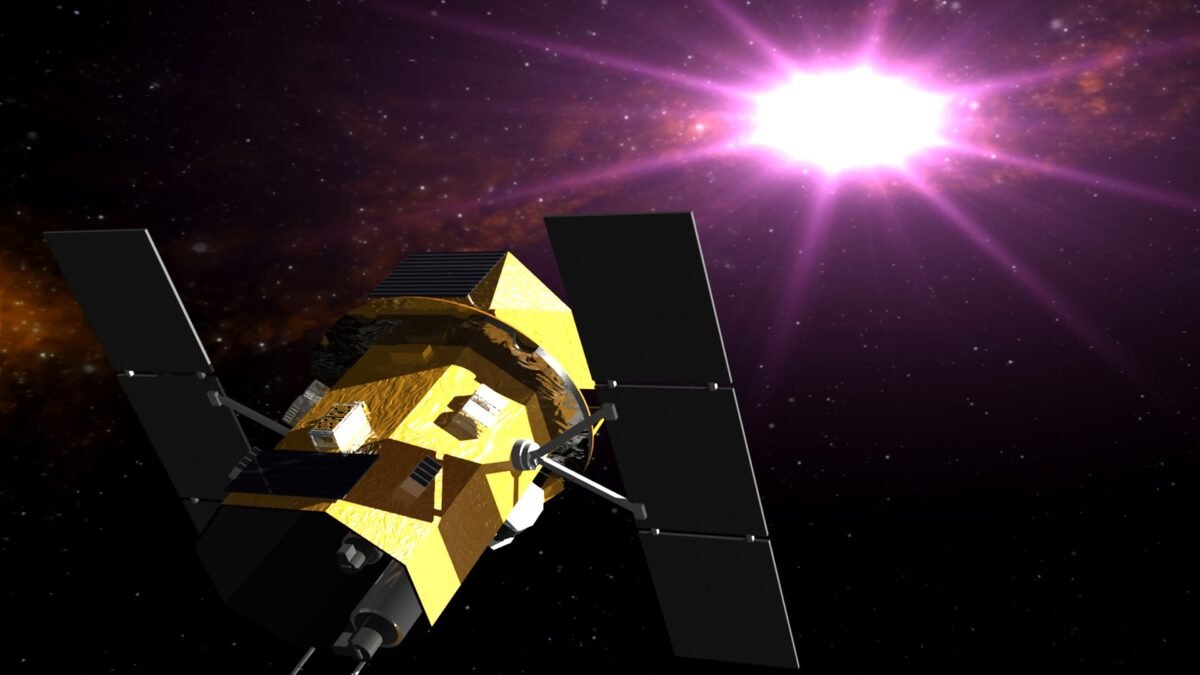
NASA has switched off one of the most productive telescopes it ever flew. The Neil Gehrels Swift Observatory, a satellite that spent more than two decades racing to catch the most violent explosions in the universe, has concluded operations and is now falling back towards Earth, according to NASA. The spacecraft is expected to re-enter the atmosphere within the next few weeks, closing a mission that was designed to last two years and instead ran for more than 22.
The end came quietly, and on the ground. On 20 October, Swift sank to 171 miles (275 kilometres) above Earth, so low that the thin upper atmosphere was dragging on it too hard for its telescopes to hold steady on a target. The spacecraft slipped into safe mode, and the operations team at Penn State in University Park sent a command that effectively ended Swift operations to prepare it for re-entry, NASA said in a statement published on 23 October 2026.
SpaceNews, reporting on 24 October, confirmed that NASA had shut the spacecraft down after a failed attempt to lift it to a higher orbit with a commercial servicing vehicle, and put the expected re-entry in November, 22 years after launch. The two accounts agree on the essential facts: the telescope is dead, the fall is under way, and nothing more can now be done to save it.
Swift was launched on 20 November 2004 from Cape Canaveral on a Delta II rocket, as a mission to solve a mystery that had stood for more than three decades: what causes gamma-ray bursts, the brief flashes of high-energy radiation that are the most powerful explosions known. In 2018 NASA renamed the observatory after Neil Gehrels, its first principal investigator, who had died the previous year.
The design was built around speed. A wide-field detector, the Burst Alert Telescope, watched a large swathe of sky for the flash of a burst. When one appeared, Swift relayed its position to observatories on the ground and swung its two other instruments — the X-ray Telescope and the Ultraviolet/Optical Telescope — around to catch the fading afterglow. That turn typically took about a minute, according to S. Bradley Cenko, the mission’s principal investigator at NASA’s Goddard Space Flight Center, quoted in reporting on the mission’s end.
Before Swift, that minute mattered enormously. Gamma-ray bursts last from a fraction of a second to a few minutes, and by the time large telescopes could be pointed at them, the light was usually gone. Swift changed the field by being fast enough, often enough, that astronomers could study the afterglow while it was still bright — and could tell, for the first time, what kind of catastrophe had produced it.
The numbers NASA cites for the mission are striking. Shawn Domagal-Goldman, director of the Astrophysics Division at NASA Headquarters, said Swift delivered “an incredible, lasting return on investment for the nation, designed for a two-year primary mission but productive for more than 10 times as long”. NASA’s tally runs to more than 2,000 gamma-ray bursts, more than 1,400 supernovae, stars torn apart by black holes, comets, asteroids, and about 7,000 published papers built on Swift data.
Among those bursts was one of the great discoveries of modern astronomy. Short gamma-ray bursts, which peak in under two seconds, had never been located precisely enough for their afterglows to be seen. Swift’s early catches of short bursts backed the idea that they come from collisions of neutron stars, the city-sized remains of exploded stars — a conclusion later confirmed spectacularly when gravitational-wave detectors caught a neutron-star merger in 2017. Swift also worked with NASA’s Fermi telescope on GRB 221009A, nicknamed the BOAT for “brightest of all time”, the most energetic gamma-ray burst ever recorded, about 2.4 billion light-years away, detected on 9 October 2022.
But Swift became much more than a burst hunter. Because it could be repointed quickly on request from the ground, it turned into astronomy’s emergency telescope. Astronomers could ask for urgent observations that were commanded within minutes, and the daily schedule could juggle up to 75 separate targets. It watched supernovae, flares from black holes, comets in our own solar system and active supermassive black holes in distant galaxies. Its archive holds more than 1.5 million images from its ultraviolet-optical telescope and about 12 terabytes of data in total, all of it public.
Why a telescope in orbit falls
Every satellite in low Earth orbit brushes against the outermost wisps of the atmosphere, and Swift had no engine to push back. A period of intense solar activity made the problem worse: an active Sun heats and expands the upper atmosphere, so a satellite meets more air at the same height. Swift was delivered to an orbit about 600 kilometres up; by the end it was below 275 kilometres, well under the roughly 400 kilometres where the International Space Station flies.
NASA did try to save it. The agency paid Katalyst Space, a company based in Flagstaff, Arizona, $30 million to build a robotic spacecraft called LINK that would meet Swift, grab it with robotic arms and lift it back towards its original altitude. Swift was never designed for this: it has no handles or fixtures for a servicer to latch on to. Success would have been the first time a commercial robot captured an uncrewed government satellite that was not built to be serviced.
Katalyst built LINK in less than a year and launched it on a Pegasus XL rocket dropped from a jet aircraft. About a week into the flight, a power switch failure hit one of its reaction wheels, the spinning flywheels a spacecraft uses to point itself. An unresponsive thruster valve then sent LINK into a spin, and a second switch failure followed. With two of its three reaction wheels out, the propellant spent to stop the spin left too little for a safe capture. NASA and Katalyst called off the rescue in August, without an attempt to boost the observatory, according to NASA.
LINK still flew within 12 to 15 kilometres of Swift and photographed it before burning up itself. “We came very, very close,” Kieran Wilson of Katalyst told an astronomy committee of the US National Academies. NASA Administrator Jared Isaacman said: “This is not the outcome we were working toward, but it does not change why this mission was worth attempting.”
On the ground, the Penn State team that flies Swift tried to buy time. Controllers swapped science targets for sky positions that held the spacecraft in its most streamlined attitude, giving up pointed science for months. John Nousek, the mission director at Penn State, described the effort as “pioneering new methods to minimize drag experienced by the spacecraft”. Once the rescue was scaled back, Swift went back to work with two of its three instruments until drag ended its observations. Since the restart, NASA said, it observed hundreds of science targets, from the remnants of stellar explosions to active supermassive black holes and comets.
What happens next is, in one sense, routine. The spacecraft weighs about 1,450 kilograms. Most of it should burn up on re-entry, although the space-tracking company LeoLabs told CNN that some hardware may survive, adding that the probability of debris causing significant property damage or physical harm to anyone is very small, and that surviving debris most likely falls into the ocean or on uninhabited land. NASA itself has published no debris assessment, and the exact day and place of re-entry remain unknown, depending as they do on solar activity.
Analysis: Why It Matters
A minute that remade a field
Swift’s true legacy is not a single discovery but a change in tempo. Before it, gamma-ray bursts were rumours that faded before anyone could look properly; after it, they became laboratories. The one-minute slew sounds like an engineering detail, but it was the difference between guessing at the most violent events in the universe and measuring them. Entire subfields — the study of short bursts, the hunt for the electromagnetic counterparts of gravitational waves, the routine monitoring of flaring black holes — grew up around the assumption that a telescope would be there, quickly, whenever the sky flashed.
The rescue was worth attempting, even in failure
It is tempting to file LINK under expensive failure: $30 million, a spacecraft that spun out of control, a telescope lost anyway. That would miss the point NASA itself is making. Swift was never built to be caught, and no commercial robot had ever captured an uncrewed government satellite that was not designed for servicing. LINK was built in under a year, reached within a dozen kilometres of its target, and photographed it. The hard part — the actual grab — was never proved, but the attempt demonstrated that a small company can build and fly a servicer on a fast timeline. As low Earth orbit fills with ageing satellites, that capability will matter far more than any single rescue.
The Sun, not the hardware, decided the ending
There is a neat irony in Swift’s fate: the observatory was brought down faster by the very solar activity it was built, in part, to understand. Solar maximum expands the upper atmosphere and shortens the lives of low-orbit satellites, and Swift, with no propulsion of its own, had no defence. Its end is a warning for the thousands of satellites now crowding low orbit without the means to climb: in an active solar cycle, altitude is a wasting asset, and the margin between a working spacecraft and a falling one can vanish in months.
A gap nobody has yet filled
NASA has not named a successor to Swift, and its astrophysics chief has said only that the agency is exploring how to use and augment its existing fleet, from fast-to-orbit commercial capabilities to new missions. Other spacecraft already hunt for cosmic flashes — the Chinese-French SVOM mission, the Chinese-led Einstein Probe, and Fermi still watching the gamma-ray sky. But none of them combines Swift’s trick: finding a burst and studying its afterglow, across wavelengths, within about a minute. Astronomers will only learn in practice how much of that capability the patchwork replaces, and the first bright burst that goes unstudied in detail will be the test.
An archive that outlives the spacecraft
The most durable part of Swift may be the least visible: 12 terabytes of public data, 1.5 million ultraviolet-optical images, and 7,000 papers, with more to come. Domagal-Goldman said the archive “will fuel new discoveries for decades more”, and the history of astronomy supports him — old data, searched with new tools, has repeatedly produced discoveries the original observers never imagined. Swift the spacecraft will burn up within weeks; Swift the dataset will be working for a generation.
What to Watch Next
- The re-entry itself: NASA’s Swift blog is the authoritative source for timing updates, and trackers will refine the predicted window as solar activity and drag evolve.
- Any NASA announcement of a Swift successor or a fast-response mission concept, and how it is funded in a tight astrophysics budget.
- Whether SVOM, the Einstein Probe and Fermi, working together, can match Swift’s speed on the next bright gamma-ray burst — and what astronomers say if they cannot.
- What Katalyst Space and other servicing companies do next with the LINK experience, and whether NASA or another customer funds a second capture attempt on a different satellite.
- New papers mined from the Swift archive, particularly on short bursts and tidal disruption events, as researchers revisit two decades of data with modern tools.
Sources

About the Author — Abdul Mannan
Related Articles
US Designates Helium a Critical Material as Chipmakers Warn of a ‘Single Point of Failure’
The US Department of Energy has designated helium a critical material, citing its essential role in semiconductor manufacturing…
Prime Editing Reaches a Milestone: DNA Rewritten Inside a Living Person for the First Time
Prime Medicine has administered its experimental prime-editing therapy to the first patient in a Phase 1/2 trial for…
Scientists Build ‘Scentronic’ System That Can Detect Smells and Transmit Them Over the Internet
Ohio State and Zhejiang Lab researchers have built Scentronic, an AI-powered system that can detect a smell in…