
Trump Says US Could Strike Iran ‘Maybe Tomorrow’ as Tehran Claims It Downed an American Drone

President Donald Trump said on Saturday that the United States could launch a new round of strikes against Iran as early as Sunday, or reach what he called a “big, beautiful agreement” with Tehran instead, putting the first public timeframe on a threat he has repeated for days. Hours later, Iran’s army said its air defences had shot down an American drone over the southern port city of Bandar Abbas, the latest flashpoint in a war that has now run for nearly eight months.
Speaking to reporters in West Palm Beach, Florida, after casting his ballot early in the midterm elections, Mr Trump was asked how close he was to ordering fresh military action against Iran. “We’re thinking about doing it, and maybe tomorrow,” he said, according to Anadolu Agency and the Asian News International news agency, which both reported his remarks. “Do you really think I’m going to tell you if I’m going to do it?”
He left both options open in the same breath. “There’s also a possibility we’ll have a nice, big, beautiful agreement,” he said. “They want to make a deal, but the problem is, will they hold the deal?” His stated goal, he added, was to ensure Iran never develops a nuclear weapon. “I’ve got to make it permanent,” he said. “That’s the only reason I’m doing it.” He closed with a shrug that has become familiar: “I may have to finish it off, or maybe they’ll make a deal. But I’m not sure. Either way, we’re winning.”
The remarks came a day after Mr Trump told a campaign rally in Fort Myers, Florida, that the United States “may do another little Epic Fury” — the codename of the American-Israeli campaign launched against Iran on 28 February — “or they’ll agree” to American terms. They also followed his earlier, contradictory signals: in early October he said he would not attack Iran before the 3 November midterm elections, a pledge his own officials have since repeated even as military preparations have visibly accelerated.
Iran answered the threat within hours, and in its own coin. On Sunday morning, the Iranian army said its air defence systems, operating under the country’s integrated air defence network, had shot down a United States LUCAS drone over Bandar Abbas, a port city close to the Strait of Hormuz, according to the semi-official Tasnim news agency, as reported by Reuters. LUCAS stands for Low-cost Uncrewed Combat Attack System, a one-way attack drone whose design is modelled on Iran’s Shahed-136; Iranian state media put its unit cost at about $35,000. Tehran said it was not the first such drone its forces had downed, pointing to another LUCAS shot down over southern Iran in July, and its Revolutionary Guards said on Tuesday that they had intercepted an American MQ-9 Reaper drone over the Strait of Hormuz on 20 October.
As of Sunday morning, Washington had not publicly confirmed or denied the Bandar Abbas claim in the reporting available, and the incident should be read as Tehran’s account, not as an independently verified event. That distinction matters, because both sides in this war have repeatedly used unverified claims as weapons in their own right. What is not in doubt is the timing: the claim landed within a day of Mr Trump’s “maybe tomorrow”, and it was plainly intended to signal that Iran’s air defences are alert and that any new strike would not go unanswered.
The drumbeat around the threat has been building all week. On Saturday, the US State Department updated travel advisories for more than a dozen countries across the Gulf and the wider Middle East, including Saudi Arabia, Qatar, the United Arab Emirates, Iraq and Israel, citing an increased threat from Iran-aligned Houthi forces, according to Reuters. Saudi Arabia, Jordan, Bahrain, Kuwait, Oman, Qatar and the United Arab Emirates remain at Level 3, advising Americans to reconsider travel, while Iran, Iraq, Lebanon, Syria and Yemen carry Level 4 “Do Not Travel” warnings. The State Department also warned of risks to commercial aviation from military tensions in the region.
The advisory update followed a week of withdrawals. On Wednesday, the department ordered non-emergency government employees and their families to leave diplomatic missions in Saudi Arabia, and it has since reduced staffing at missions in Jordan, Lebanon, Qatar and the United Arab Emirates, which remain open under restricted operations. Behind those moves sits a memo that Reuters has seen: Director of National Intelligence Jay Clayton wrote to Secretary of State Marco Rubio on 23 October that Iran had “substantially increased efforts to target US personnel” and that “the lethal plotting efforts by the Iranians against US citizens have reached advanced stages in both the Middle East and certain other countries”. The memo, first reported by Axios, was copied to CIA Director John Ratcliffe. A US official told Reuters that “the threat of Houthi attacks and of Iranian terror plots targeting US officials are informing our decisions on staffing adjustments for embassies” in the region. American officials have denied that the staffing cuts are directly connected to possible new strikes.
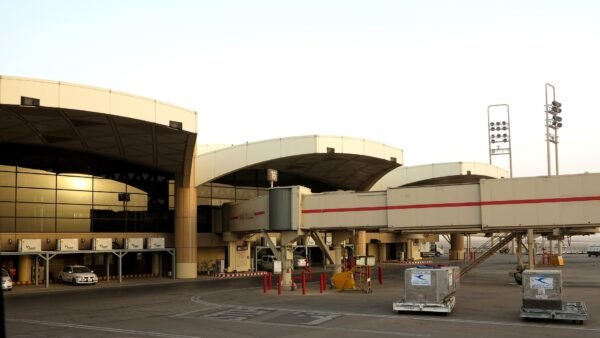
The Houthis, Iran’s allies in Yemen, have given Washington ample reason for caution. On Saturday, Houthi military spokesman Yahya Saree said the group had targeted King Khalid International Airport in Riyadh, an Aramco facility in the Saudi port city of Yanbu, the Rabigh oil refinery, crude oil pumping stations and the East-West Pipeline, as well as King Fahd International Airport in Dammam, an airport in Najran and an airbase in Khamis Mushait. On Sunday, hours after Riyadh’s airport resumed flights following a two-week closure, Saree renewed his warning that the airport remained a “military target” and would “never be safe”. Damage from the claimed Saturday attacks was not independently confirmed. Earlier in October, a Houthi missile strike on Riyadh’s airport killed 13 people, the deadliest attack on the kingdom in more than a decade, and a strike on Dammam airport on 21 October killed one resident and injured eight.
Diplomacy, meanwhile, is moving in parallel and in opposite directions. Iran’s foreign minister, Abbas Araghchi, told reporters outside the United Nations Security Council on Friday that Tehran had formally submitted a seven-day roadmap to end the war through Qatar, under which it would reopen the Strait of Hormuz and resume nuclear talks within a week if Washington accepted the plan. “The seven-day timeline will start as soon as the United States accepts this plan,” he said. Later on Friday, The Wall Street Journal reported that Mr Trump had privately rejected the proposal, was sceptical Iran would meet his demands, and expected a renewed bombing campaign after the midterm elections, according to unnamed US officials. Vice President JD Vance has said any agreement must include a “meaningful” reduction in Iran’s uranium enrichment capacity.
Tehran’s own messaging has been equally mixed. President Masoud Pezeshkian said at a ceremony in Tehran that the country must escape its “no war, no peace” limbo, blamed Washington for the collapse of interim deal talks, and added that he still believed a deal should be concluded, according to Dawn, citing the semi-official ISNA news agency and Agence France-Presse. At the same time, Iranian officials have threatened to sever Gulf internet cables, strike refineries and target any vessel in the region, and the armed forces chief, Major General Ali Abdollahi, said on Saturday that American warships would never re-enter the Persian Gulf. Confusion over a separate reported Hormuz offer deepened the fog: Al Arabiya reported that Tehran had offered, through Pakistani mediators, to reopen the strait if Washington lifted its naval blockade of Iranian ports, while Tasnim called that report “a lie and fabrication” and said no fresh proposal had gone to the Pakistani mediators.
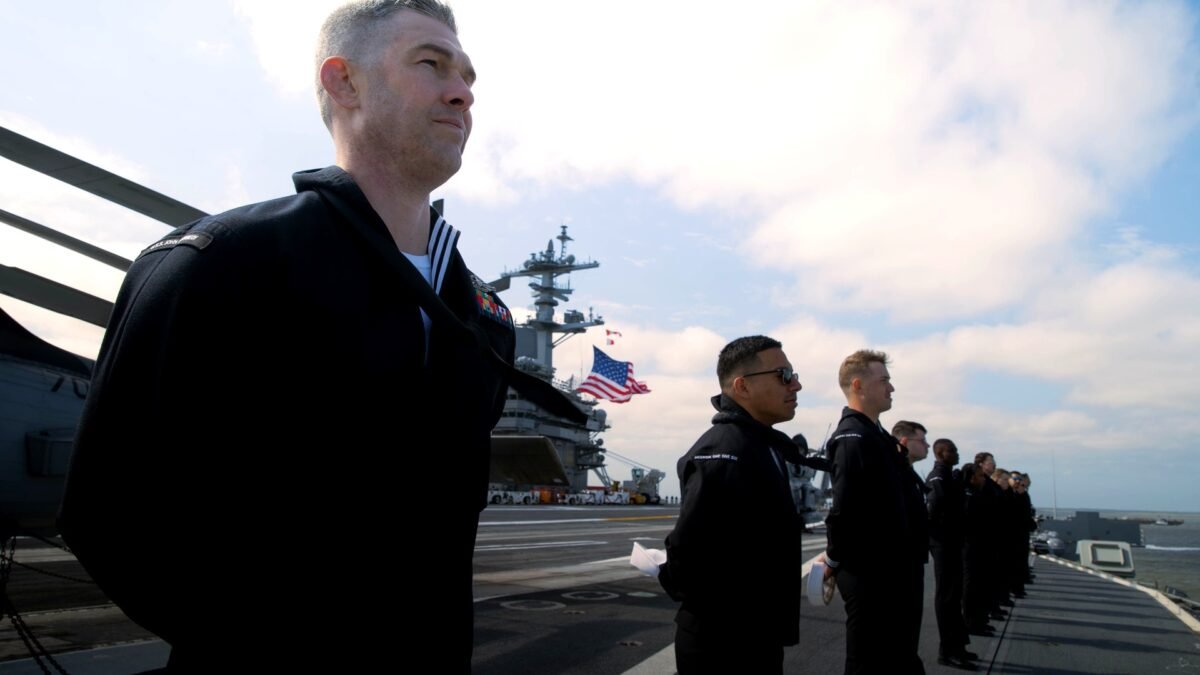
The military backdrop explains why the threat is being taken seriously even by those who doubt a strike is imminent. The Wall Street Journal reported that sailors aboard the USS George Washington carrier strike group in the Arabian Sea are loading munitions and readying aircraft for possible strikes, a step officials described as preparation rather than confirmation that strikes have been authorised. The United States has more than 50,000 personnel in the region and a third aircraft carrier heading to the Middle East, according to weekend reporting. Israel, which would be central to any renewed campaign, holds its own election on Tuesday 27 October, six days before the American midterms, and Prime Minister Benjamin Netanyahu has spent days warning that Iran may strike first.
Mr Trump’s own account of the war so far, delivered on Saturday, was characteristically sweeping and should be treated as his claim rather than established fact. He said American forces had “knocked out every jet fighter of Iran”, that “259 ships are at the bottom of the sea”, and that Iran was left with only “record inflation”. Independent assessments of the war’s toll differ sharply, and the Strait of Hormuz — the waterway through which a large share of the world’s seaborne oil passes — has seen more than 120 reported attacks on shipping in October alone, according to data cited by Al Jazeera, making it the worst month for shipping since the war began.
Analysis: Why It Matters
A deadline that is not a deadline
Mr Trump’s “maybe tomorrow” is best understood as a deliberate instrument, not a timetable. By naming the next day and then immediately refusing to confirm anything — “Do you really think I’m going to tell you?” — he forces Tehran, the Gulf capitals and his own domestic audience to react to a possibility rather than a plan. It is a tactic he has used before in this war, including in June, when he cancelled planned strikes hours after threatening them on the grounds that a deal was close, only for Tehran to say no deal existed. The cost of the tactic is credibility: each unfulfilled deadline makes the next one easier to discount, and each discounting makes a genuine surprise harder to achieve. The one-day timeframe is what is genuinely new this weekend; everything else in the warning has been heard before.
The drone claim and the fog of the Gulf
The Bandar Abbas claim illustrates how hard truth has become to establish in this conflict. Reuters reported it faithfully as what it is — an Iranian army statement carried by Tasnim — and no American confirmation had surfaced in the reporting available by Sunday morning. That does not make it false: Iran has downed American drones before, and a cheap, one-way attack drone is exactly the kind of asset both sides expend freely over the Gulf. But it does mean the incident cannot yet anchor any larger conclusion, and readers should resist the temptation to treat a claim as a confirmed shootdown. In a war fought as much through announcements as through weapons, the claim itself is the event: Tehran telling Washington, and its own public, that it is watching the skies.
Diplomats out, advisories up: Washington is pricing in retaliation
The least theatrical and most telling development of the weekend is the least dramatic: travel advisories rewritten, families ordered out, embassies thinned. Governments do not hollow out their diplomatic presence for theatre. The Clayton memo’s language — lethal plotting at “advanced stages” — and the parallel Houthi campaign against Saudi airports and oil infrastructure describe a threat picture in which American officials believe retaliation for any new strike could arrive not only on a battlefield but against soft targets across the region. That is also why the official line insists the drawdown is unrelated to strike planning: admitting the connection would concede that Washington expects its own next move to endanger its own people.
Two elections, one war clock
The calendar is doing as much work as any general. Israel votes on Tuesday, and Mr Netanyahu has warned for days that Iran may attack first, a warning that conveniently keeps security at the centre of the campaign. America votes a week later, and Mr Trump has promised no strikes before polling day while simultaneously floating a strike “tomorrow”. Both pledges cannot be kept if “tomorrow” means Sunday, and the contradiction is the point: it keeps every actor guessing about which audience the president is really addressing. The Wall Street Journal’s reporting that Mr Trump expects a bombing campaign after the midterms suggests the real clock runs to 4 November, not to Sunday — but a president who has repeatedly misled adversaries about timetables before cannot be assumed to be misleading them now.
The deal both sides describe differently
Strip away the threats and a negotiation is visible, but the two sides are not describing the same negotiation. Tehran’s seven-day roadmap trades a reopened Strait of Hormuz and resumed nuclear talks for an end to the naval blockade and, implicitly, sanctions relief. Washington’s price, as stated by Mr Vance, is a “meaningful” cut in enrichment capacity, and Mr Trump’s is permanence — a deal Iran can never walk back from. Mr Pezeshkian says he wants a deal; Mr Araghchi says Washington has already rejected one; Tasnim says no Hormuz offer was ever made through Pakistan. Until one of those accounts is confirmed by the other side, the “big, beautiful agreement” remains what it has been all year: a phrase both capitals use to describe incompatible outcomes.
What to Watch Next
- Whether any American or Israeli strike materialises on Sunday or Monday, or whether “maybe tomorrow” passes like previous deadlines.
- Any American confirmation, denial or silence on the claimed downing of the LUCAS drone over Bandar Abbas, and whether wreckage is displayed.
- Further Houthi attacks on Saudi airports and oil sites, and whether Riyadh’s reopened airport stays open through the week.
- A formal American response to Iran’s seven-day roadmap, and whether the reported Wall Street Journal account of its rejection is confirmed.
- Israel’s election on Tuesday 27 October and the American midterms on 3 November, the two dates around which every threat and offer in this war is now timed.
Sources
- Reuters: Iranian army says it shot down US drone over Bandar Abbas, Tasnim reports
- Reuters: Iran has ramped up efforts to target US personnel, intelligence memo warns
- Asian News International: “There’s a possibility”: Trump says US could strike Iran “maybe tomorrow”
- AnewZ: Iran war latest: Tehran shoots down US drone

About the Author — Abdul Mannan
Related Articles
Riyadh Airport Reopens After Two-Week Houthi Shutdown as Rebels Warn It Will ‘Never Be Safe’
Riyadh's King Khalid International Airport resumed flights on Sunday after a two-week closure, hours before Yemen's Houthis renewed…

Houthis Say They Struck Saudi Oil Sites and Airports as Missiles Hit Aden
Yemen's Houthis said they attacked Saudi oil facilities and airports on Saturday, while Yemen's government said missiles also…
US Strike on Iran ‘Absolutely’ Possible This Weekend, Says Trump Envoy Tom Barrack
US Ambassador to Turkey Tom Barrack has said American strikes on Iran could come as soon as this…