
Astronomers Find a Galaxy-Sized Cloud of Gas With Almost No Stars — a Possible ‘Dark Galaxy’ 310 Million Light-Years Away

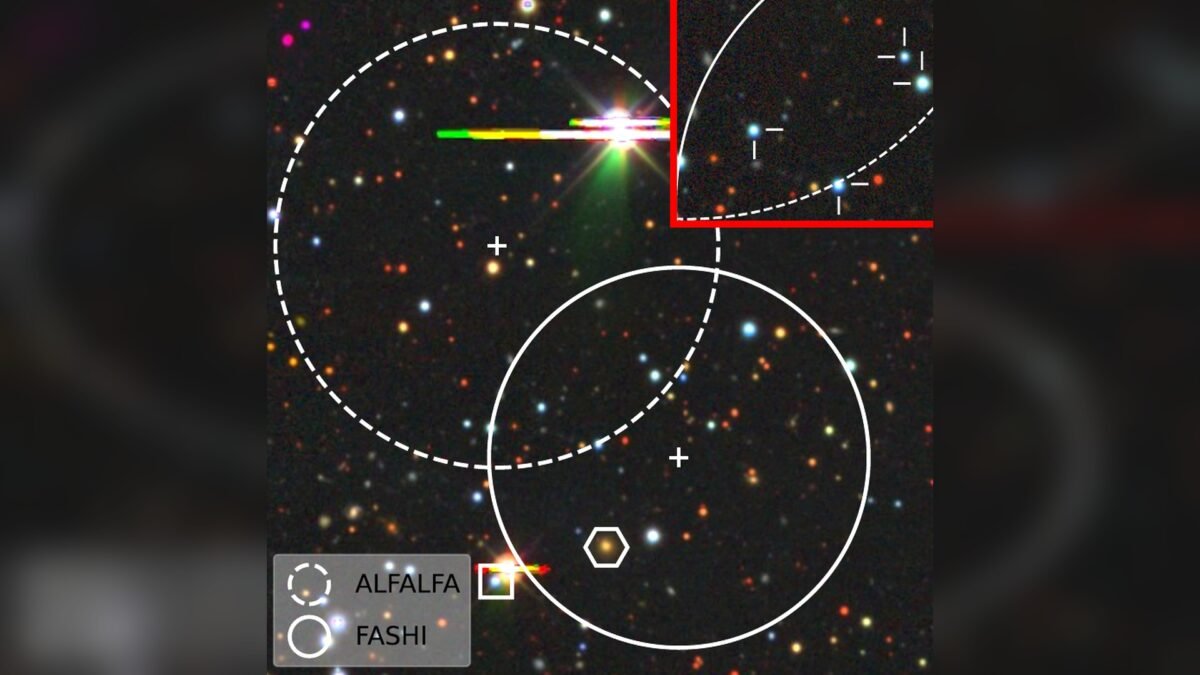
Astronomers have found a vast cloud of hydrogen gas, roughly 310 million light-years from Earth, that behaves like a galaxy in almost every respect except one: it appears to contain hardly any stars at all. The object, catalogued as AGC 322753, holds about two billion times the mass of the Sun in neutral hydrogen, according to a paper accepted for publication in the Monthly Notices of the Royal Astronomical Society, yet the deepest available images of that patch of sky show no matching glow of starlight.
If the interpretation holds, AGC 322753 would be one of the most promising examples yet of a so-called dark galaxy: a system massive enough to count as a galaxy that has, for reasons astronomers are still trying to understand, barely switched on. Its sheer quantity of gas makes the missing starlight especially hard to explain, because gas is the raw material from which stars are made, and two billion solar masses of it is a great deal of material to have produced almost nothing.
The discovery was reported on 26 October 2026 by Phys.org, drawing on the paper by Marco Monaci, Duncan A. Forbes, Warrick J. Couch and Jean P. Brodie of the Centre for Astrophysics and Supercomputing at Swinburne University of Technology in Australia. The paper was posted to the arXiv preprint server on 30 September 2026 and has been accepted as a Letter in the Royal Astronomical Society journal.
What makes this candidate stand out from earlier claims is that it was not found by one telescope alone. The team cross-matched two independent blind surveys of the sky in the radio emission of neutral hydrogen: ALFALFA, carried out with the Arecibo telescope in Puerto Rico, and FASHI, carried out with China’s Five-hundred-metre Aperture Spherical Telescope, known as FAST. Both surveys picked up the same object at the same recessional velocity, about 6,963 kilometres per second, with comparable gas masses and similar spectral shapes.
That double detection matters enormously. Radio astronomy is plagued by interference from human technology, and a signal seen by only one instrument can always be suspected of originating on Earth rather than in space. Because Arecibo and FAST are different telescopes, on different continents, using different receivers and observing at different times, a terrestrial source cannot plausibly explain both detections. As the authors put it in their abstract, a radio-frequency interference origin is excluded.
The two spectra also share a distinctive shape: a double-peaked profile, with the signal rising to two humps rather than a single peak. According to the paper, that shape is compatible with gas arranged in a rotating disc, the way gas moves in an ordinary spiral galaxy, where one side of the disc approaches us and the other recedes. The width of the line, about 85 kilometres per second at half its peak height, is consistent with that picture of ordered rotation, though the authors are careful to note that the existing observations cannot yet map the disc directly.
The search that led to AGC 322753 began with 13 sources that matched between the two catalogues. The researchers then worked through them one by one, checking nearby galaxies, the quality of the images and whether any visible object could account for the gas. Twelve fell away. AGC 322753 survived, and the overlapping sky coverage of the two telescopes allowed the team to pin down its most likely position far more precisely than either survey could manage alone. That smaller patch of sky is where they went looking for stars.
They found none. The team searched the DESI Legacy Imaging Surveys, among the deepest wide-area optical images available, and found no evidence of an optical counterpart down to a surface brightness of about 27.5 magnitudes per square arcsecond, an extremely faint limit. They also checked images from the Sloan Digital Sky Survey, Pan-STARRS, GALEX and WISE, again without finding a counterpart. To test what their images might have missed, they injected artificial galaxies of various sizes and masses into the data and checked which ones remained visible. Those experiments produced an upper limit of roughly 50 million solar masses in stars. On that basis, the object contains at least 40 times more neutral hydrogen than stars.
That ratio is the heart of the puzzle. A galaxy-sized reservoir of gas that has formed so few stars challenges the standard story of how galaxies assemble. In the prevailing cosmological model, invisible dark matter forms the scaffolding first: its gravity gathers gas, the gas cools and collapses, and stars ignite. A halo that gathers gas and then fails to make stars would show astronomers exactly where that process stalls, and why.
One long-standing idea is that the ultraviolet radiation bathing the universe after the epoch of reionisation heated the gas in small haloes so much that it could never become cold and dense enough to form stars. Such objects, sometimes called reionisation-limited hydrogen clouds, or RELHICs, are predicted to exist but are extraordinarily hard to confirm. AGC 322753, however, does not fit that picture neatly. According to the paper, its gas mass is higher than expected for a totally starless halo, and its double-peaked, rotating profile sits uneasily with the RELHIC model, in which gas motions are dominated by heat rather than rotation and line widths are far narrower, around 20 kilometres per second. The authors conclude that AGC 322753 could host a faint stellar population below the current detection limit rather than being completely dark.
There is also a second, more mundane explanation that the team cannot yet rule out: the gas could be debris pulled from neighbouring galaxies by gravitational interaction, a tidal tail rather than a galaxy in its own right. The nearest known luminous neighbours, UGC 12179 and PGC 069656, share almost exactly the same recessional velocity as AGC 322753, placing them in the same cosmic neighbourhood. Phys.org reports the nearest luminous neighbour at a projected separation of about 950,000 light-years. But the authors argue against the tidal explanation on several grounds: the double-peaked profile suggests rotation rather than a drawn-out stream, and tidal tails around interacting galaxies typically extend to about 150 kiloparsecs and carry at most around a billion solar masses of hydrogen. AGC 322753 is both more massive and more extended than that pattern would predict, and if it were a tidal feature, the paper notes, it would be one of the most massive and extended tidal tails ever discovered.
Caution is warranted, and the history of this field supplies the reason. The paper itself discusses an earlier candidate, FAST J0139+4328, which was initially claimed as an isolated dark galaxy candidate and later reclassified as a faint dwarf galaxy when deep optical imaging found a stellar body about half a degree from the radio position, subsequently confirmed spectroscopically and in stacked images. A previous claim for the very source discussed here, by Zhang and colleagues in 2024, is also addressed: the team’s figure marks that claimed optical counterpart with a white square, and their own search of the same region found no such object. AGC 322753 is therefore best described, in the authors’ own careful language, as a dark galaxy candidate: a good one, but a candidate nonetheless.
The two telescopes behind the discovery are themselves part of the story. Arecibo, built into a natural sinkhole in Puerto Rico, was for decades the world’s most powerful single-dish radio telescope before its collapse in 2020; its ALFALFA survey remains a treasure trove of hydrogen detections. FAST, its successor as the world’s largest filled-aperture radio telescope, is a 500-metre dish set in a karst depression in Guizhou province in south-western China, which began full operations in January 2020. That one survey’s archive can be cross-checked against the other’s is a reminder that in astronomy, old data can yield new discoveries when combined with fresh eyes and better methods.
What happens next is clear, and the authors spell it out. Sharper radio observations, using interferometers that combine multiple dishes, could establish whether the gas genuinely forms a rotating disc or is instead a shapeless cloud. Deeper optical images, from larger telescopes or longer exposures, could reveal a faint stellar population hiding below the current limit, or confirm that none exists down to even fainter levels. Either outcome would be interesting. Finding stars would still leave an extraordinary galaxy to explain: one holding an enormous supply of gas with remarkably little light to show for it. Finding none would strengthen the case for a genuinely starless system, and force theorists to explain how two billion solar masses of hydrogen can sit quietly in the dark.
Analysis: Why It Matters
A missing piece of the galaxy-formation story
Modern cosmology predicts far more small dark-matter haloes than there are small visible galaxies. That mismatch, sometimes called the missing satellites problem, has been eased in recent years by the discovery of ever fainter dwarf galaxies around the Milky Way, but the underlying question remains: do some haloes genuinely never form stars, or have we simply not looked deeply enough? A confirmed dark galaxy would settle part of that question in favour of the first answer. It would show that star formation can fail completely even on a galactic scale, and it would give theorists a concrete object against which to test their simulations. Simulations that produce too many stars, or too few, in low-mass haloes could be judged against a real system rather than an absence.
Why the gas mass is the surprise
Small, faint galaxies are common, and astronomers are used to objects in which stars are hard to see. What is unusual about AGC 322753 is the scale of the gas. A billion or two solar masses of hydrogen is not a wisp: it is comparable to the gas content of a respectable dwarf galaxy, and it is far more than models predict for a halo that never formed stars at all. That tension is scientifically productive. If the gas is truly there and truly starless, then either the models of how gas heats and cools in small haloes are missing something, or some mechanism is actively keeping this particular cloud stable against collapse. If, instead, deeper images reveal a faint galaxy, then the object becomes a laboratory for the opposite question: how can a galaxy hold on to so much gas while converting so little of it into stars? Either way, the object sharpens a question that vague, statistical arguments cannot.
The value of two telescopes agreeing
There is a methodological lesson here that extends beyond this one object. Single-instrument discoveries in radio astronomy live under a permanent shadow of doubt, because interference is everywhere and the sky is full of artefacts. By demanding that a candidate appear in two independent surveys, with different instruments, at different times, the Swinburne team has set a standard that future dark-galaxy claims will be measured against. The approach also shows the continuing scientific value of survey archives: ALFALFA’s data were gathered years ago, and FASHI is a different survey with different systematics, yet their combination produced something neither could deliver alone. As astronomy becomes ever more dominated by giant new facilities, the unglamorous work of cross-matching catalogues remains one of the cheapest ways to make a discovery.
What it does and does not say about dark matter
It is worth being precise about the word dark here, because it invites misunderstanding. A dark galaxy is not a galaxy made of dark matter, and this discovery is not a detection of dark matter particles. Dark matter is inferred from its gravitational effects; it emits, absorbs and reflects no light. A dark galaxy is simply a galaxy whose ordinary matter, its stars, is missing or extremely faint, while its gas, detectable through radio waves, is present. The object may well sit inside a dark-matter halo, as essentially all galaxies are thought to do, but the present observations do not measure that halo directly. What they measure is gas, and the puzzle is about gas and stars, not about the nature of dark matter itself. Keeping that distinction clear matters, because the public imagination often leaps from dark galaxy to dark matter detection, and the science deserves better than that leap.
A candidate, not a conclusion
Finally, the episode is a useful reminder of how science handles its own enthusiasm. The authors have found something genuinely intriguing, and they have presented it with unusual care: the caveats about a possible faint counterpart, the tidal-tail alternative, the limits of the current data and the precedent of a reclassified candidate are all in the paper, not buried. That restraint is not timidity; it is what makes the claim credible. The history of dark-galaxy hunting is littered with candidates that dissolved under closer inspection, and the researchers who found this one know it. Their reward for caution is that when follow-up observations come, whatever they show, the result will be believed.
What to Watch Next
- Interferometric radio observations that could map the gas and confirm whether it forms a rotating disc, as the double-peaked profile suggests, or a shapeless cloud.
- Deeper optical imaging of the beam-overlap region, which could reveal a faint stellar population below the current detection limit or push the starless case further.
- Follow-up of the other matched sources from the ALFALFA-FASHI cross-match, to see whether AGC 322753 is unique or the first of a small population of similar objects.
- Comparison with cosmological simulations of low-mass haloes, to test whether any model naturally produces a system with this much gas and so few stars.
- Confirmation of the object’s distance and environment through further spectroscopy of its neighbouring galaxies, UGC 12179 and PGC 069656, to settle the tidal-tail question.
Sources
- Phys.org: FAST and Arecibo point to possible dark galaxy with vast hydrogen reservoir (26 October 2026)
- Monaci et al., AGC 322753: a Dark Galaxy Candidate detected by ALFALFA and FASHI, arXiv:2609.39152
- Monaci et al., Monthly Notices of the Royal Astronomical Society (2026), DOI: 10.1093/mnras/stag1874

About the Author — Abdul Mannan
Related Articles
NASA’s Swift Observatory Ends Its 22-Year Hunt for Cosmic Explosions as It Falls Back to Earth
NASA has switched off the Neil Gehrels Swift Observatory after more than 22 years chasing gamma-ray bursts; the…

US Designates Helium a Critical Material as Chipmakers Warn of a ‘Single Point of Failure’
The US Department of Energy has designated helium a critical material, citing its essential role in semiconductor manufacturing…

Prime Editing Reaches a Milestone: DNA Rewritten Inside a Living Person for the First Time
Prime Medicine has administered its experimental prime-editing therapy to the first patient in a Phase 1/2 trial for…