
Older Than the Sun: The Interstellar Comet Carrying a Message From Before Our World Existed

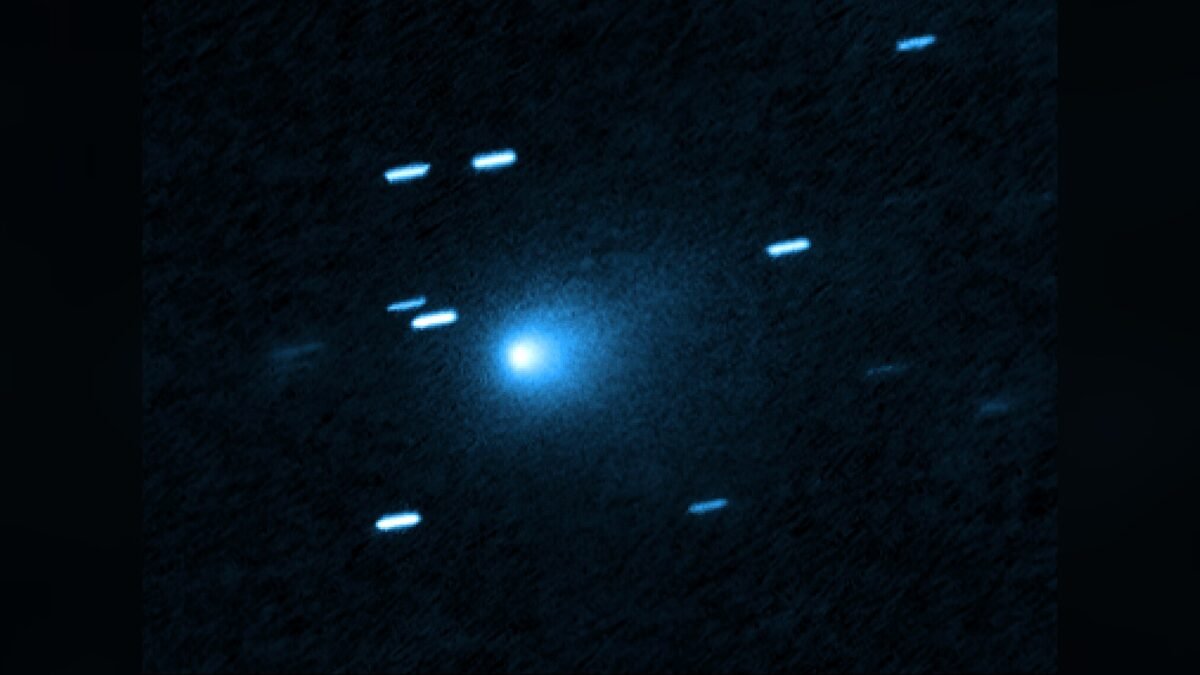
What if a letter arrived at your door — written before your house was built, before your street existed, before the very ground beneath your feet had cooled into rock? You would hold it with trembling hands. You would read it twice. And you would ask yourself the only question that matters: who sent it, and what did they want me to know?
That letter has arrived. It is not made of paper. It is made of ice. It has been travelling through the darkness between the stars for longer than our Sun has existed, and for a few brief months it passed through our neighbourhood, close enough for our greatest telescope to read the writing inside it. Its name is 3I/ATLAS. And what it carries may be the oldest message humanity has ever received.
A Stranger Knocks on the Solar System’s Door
I want you to picture the scene. On 1 July 2025, a survey telescope at Río Hurtado in Chile — part of the ATLAS network that sweeps the sky for asteroids — noticed a faint smudge moving too fast, and in too straight a line, to belong to us. It was not orbiting the Sun. It was falling past it. Within days, astronomers around the world confirmed what the numbers were screaming: this was only the third object in all of recorded history known to have come from beyond our Solar System. The first, ‘Oumuamua, had flashed past us in 2017. The second, 2I/Borisov, in 2019. Now a third stranger had knocked.
It rounded the Sun on 29 October 2025, at about one and a third times the distance of the Earth from the Sun, and it passed us at roughly 270 million kilometres — far enough that NASA could state plainly that it posed no threat to Earth. Now, a year after that closest approach, it is already racing back out into the dark, never to return. A visitor that will not come again. That alone should make us stop and listen.
But the real story is not that it came. The real story is what it is made of.
The Chemistry That Should Not Exist Here
When the James Webb Space Telescope turned its infrared eye upon 3I/ATLAS on 22 and 23 December 2025, it did something no telescope had ever done to a visitor from another star: it read the chemistry of its breath. As the comet warmed near the Sun, its buried ices vaporised, and the gases streaming from its surface carried a signature — a fingerprint — of the place where it was born.
A team led by Nathan Roth of American University and NASA’s Goddard Space Flight Center, publishing in the journal Nature Astronomy, measured something extraordinary. The comet’s methane — ordinary CH4, the same gas that warms our own atmosphere — was carrying a heavy passenger. Roughly one methane molecule in every eight carried a deuterium atom, a heavier twin of hydrogen, instead of an ordinary one. The measured deuterium-to-hydrogen ratio in the methane was 3.18 per cent. That is thirteen times higher than the value measured in comet 67P/Churyumov–Gerasimenko, the only other comet for which this measurement exists — and that one required the Rosetta spacecraft to fly to the comet and taste it directly. It is the highest methane deuterium ratio ever measured anywhere in the Solar System.
Let me translate that number into plain language, because numbers without meaning are just noise. Deuterium is enriched only where gases freeze onto dust grains in terrible cold — around minus 263 degrees Celsius — under a rain of cosmic rays, in a cloud poor in heavy elements. The chemistry of 3I/ATLAS tells us its ice did not form in a warm, young, metal-rich cradle like our own Sun’s nursery. It formed in a cold, ancient, radiation-soaked corner of the galaxy. The researchers’ own reading is blunt: the comet’s home system may have assembled it more than seven billion years before our Sun ignited — and isotope evidence discussed alongside the study is consistent with material ten to twelve billion years old. Nearly as old as the universe itself.
Read that again. Before the Sun. Before the Earth. Before the first mountain rose on any world we know. A lump of frozen gas was already drifting through the dark.
Ice Like the Worlds Beyond Neptune
And the surprises did not stop there. A second team, led by Silvia Protopapa of the Southwest Research Institute, studied the same comet with Webb across three visits — August 2025, December 2025, and April 2026 — and published their results in The Astrophysical Journal Letters on 26 October 2026. They found that the ice streaming off 3I/ATLAS behaves strangely. Water ice should show three tell-tale absorption bands in infrared light, at 1.5, 2.0 and 3 microns. This comet showed the 3-micron band with overwhelming strength — cutting the reflected light by 77 per cent at first, and 94 per cent by the final visit — while the other two bands were barely there at all.
Computer models offered an explanation that is elegant in its simplicity: the comet’s coma is filled with ice grains a micron across or smaller — finer than a speck of dust — heavily mixed with dark, dusty material. And here is the detail that made astronomers sit up. That peculiar ice signature matches the icy worlds orbiting far beyond Neptune, in the frozen suburbs of our own Solar System. A comet born around another star, in another age, carries ice that behaves like the ice of our own most distant worlds. The recipe for building planets, it seems, is written in the same handwriting everywhere — even across billions of years and trillions of kilometres.
Even as it left us, the comet kept changing. By the final observation in April 2026, after it had rounded the Sun, the data suggested a new population of larger, ice-rich grains had appeared — fresh material, exposed by the Sun’s heat, from beneath the surface that had faced the void for aeons. The visitor was not a dead rock. It was alive with change until the moment it left.
History Is the Mirror
Now, dear reader, let me step back from the telescope and ask the question I always ask: what does this mean for us?
History is the mirror in which the present must look at itself. When a great comet crossed the sky in 1066, the Normans and the Saxons both looked up and saw an omen — and the Bayeux Tapestry stitched it into cloth so that a thousand years later we would still remember that a ball of ice in the sky helped decide the fate of England. When Halley’s comet returned, century after century, kings and peasants alike read their own fears into its tail. Empires rose and fell beneath those same lights. The Mughals, the British Raj, every throne and every parliament that ever believed itself eternal — all of them are dust now. All of them lived and died in less time than this single comet spent crossing the emptiness between two stars.
That is the scale we are dealing with. Our entire human story — every war, every scripture written down, every city ever built — fits inside a blink of this comet’s journey. And yet here we are, a species barely out of the cradle, pointing a golden telescope the size of a tennis court into the dark and reading the chemical memory of a world that died before our Sun was born. If that does not humble you, nothing will.
And there is a quieter irony in this moment that I cannot ignore. Even as 3I/ATLAS was teaching us about eternity, our own instruments were dying on schedule. NASA’s Swift space telescope — twenty-two years of watching the most violent explosions in the universe — is falling back to Earth this very week, in early November 2026, after a thirty-million-dollar rescue mission failed to save it. And on 18 November, Voyager 1 — launched in 1977, the farthest human-made object in existence — will cross a distance of one light-day from Earth, its signal taking more than a full day to reach us, its instruments being switched off one by one to keep it alive a little longer. We build machines that die in decades. The universe sends messengers that live for billions of years. That is the difference between our time and cosmic time — and it should teach us something about arrogance.
What the Messenger Asks of Us
So what do we do with this knowledge? What does a lump of ancient ice ask of a species that spends its days arguing over borders drawn on maps that will not outlast a single century?
It asks us, first, to look up. Not with fear — the old way, when comets were omens of doom — but with curiosity. Because this visitor carried proof of something wonderful: that the chemistry of life’s building blocks is not a local accident. The same cold clouds that froze methane around another star, billions of years before our Sun existed, used the same physics, the same ingredients, the same rules. We are not a fluke of one star. We are one verse in a poem the galaxy has been writing for thirteen billion years.
It asks us, second, to be humble about our quarrels. You and I live on a planet that is four and a half billion years old, and we fight over lines drawn in sand as if they were drawn in stone. A comet older than the Sun passed through our sky, and it did not ask whose flag flew beneath it. It simply passed, and left, and will never return. How small our certainties look against that.
And it asks us, third, to keep looking. The Vera Rubin Observatory began its ten-year survey of the sky in June 2026, and astronomers expect it to find many more interstellar visitors — perhaps dozens. 3I/ATLAS was the third. It will not be the last. Each one will be a new letter, from a new star, carrying a new chapter of a history older than our own. The census of strangers has only just begun, and we are, at last, learning how to read.
The Verdict the Comet Leaves Behind
The comet will not return. It came, it showed us its chemistry, and it is leaving forever — out past Neptune, out past the edge of sunlight, back into a darkness it will cross for longer than our species will exist. The question is not what it is. We know what it is: a frozen traveller from a dead star’s cradle, carrying ice older than the Sun. The question is whether we were paying attention.
I believe we were. For once, we pointed our best instrument at the sky and listened instead of shouting. And the sky answered — not with a warning, not with a threat, but with a fact so beautiful it feels like a gift: that the universe was making the ingredients of worlds long before our world existed, and that somewhere, around some forgotten star, the same story that made us was already being written.
Look up tonight. The comet is gone. But the message remains. And it is addressed, whether we deserve it or not, to us.
Sources & References
- Roth, N. X., Cordiner, M., Milam, S., et al. (2026). An enriched methane D/H ratio in the interstellar object 3I/ATLAS. Nature Astronomy.
- Phys.org — Heavy hydrogen in 3I/ATLAS’s methane points to a frigid birthplace
- ScienceAlert — Interstellar Visitor 3I/ATLAS Just Got Even Weirder, And May Contain 10-Billion-Year-Old Material
- Protopapa, S., et al. (2026). JWST Reveals Refractory-rich Water Ice in Interstellar Comet 3I/ATLAS. The Astrophysical Journal Letters (26 October 2026), via Martin Cid Magazine
- Knowridge — Alien comet reveals a surprising link to icy worlds beyond Neptune
- Tech Explorist — Webb Finds Link Between 3I/ATLAS and Icy Worlds
- NASA / Associated Press reporting on the Swift Observatory re-entry (November 2026)

About the Author — advmannan1
Related Articles
The Comet Nobody Was Looking For: What Euclid’s Accidental Discovery Says About Us
A Telescope Built to Ignore Exactly This Have you ever found something precious that you were never looking…
The Watch Changes Hands: Eleven Souls Above the Earth
While the world looked at its own feet, eleven human beings stood on a watchtower 400 kilometres above…

Starship Flight 14: The Tallest Ship Ever Built Is About to Sail the Ocean Above Us
STARSHIP FLIGHT 14: THE TALLEST SHIP EVER BUILT IS ABOUT TO SAIL THE OCEAN ABOVE US When was…