
Hubble Finds Nearby Dwarf Galaxies Have Lost Nearly 90% of the Oxygen Their Stars Made

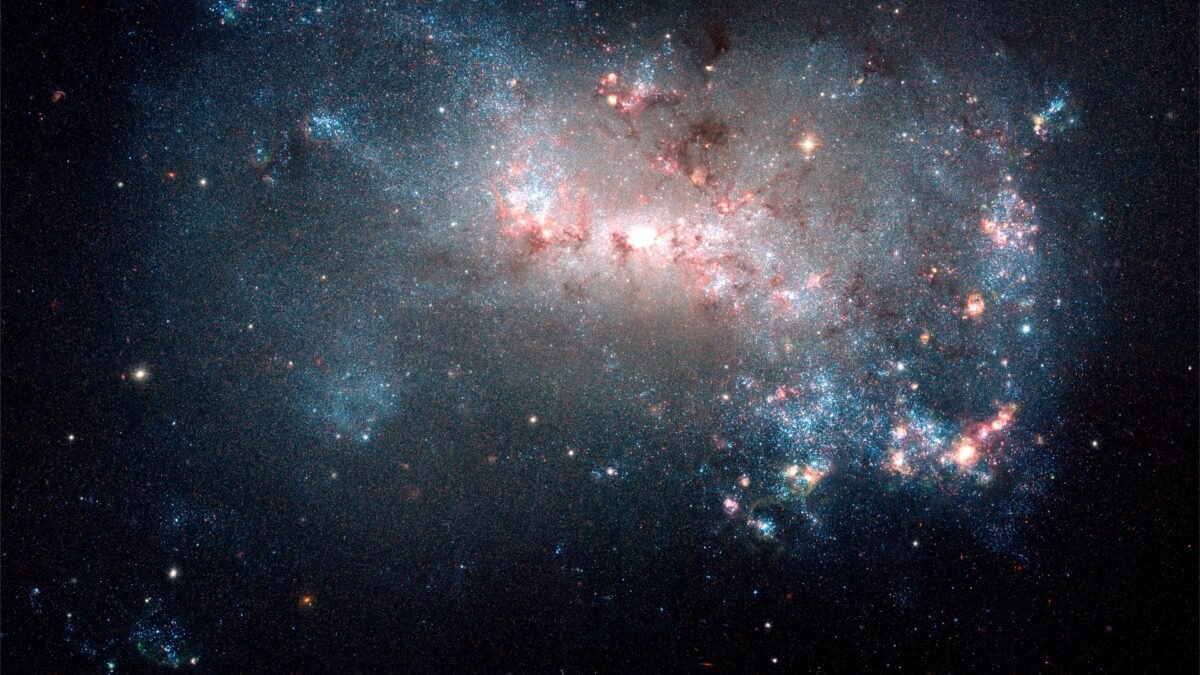
Most of the oxygen ever made by the stars in dozens of nearby dwarf galaxies is gone. A new census using NASA’s Hubble Space Telescope has found that 37 small galaxies in our cosmic neighbourhood retain, on average, only about 11 per cent of the oxygen their stars produced over their lifetimes — the rest has been blown out into space by the violent deaths of massive stars.
According to NASA, the galaxies studied kept between 4 per cent and 25 per cent of the oxygen their stars had forged, with an average of about 11 per cent. The result, published on Monday, 2 November, in The Astrophysical Journal, is the most precise measurement yet of how thoroughly small galaxies lose the chemical elements their stars create — and it shows that the computer simulations astronomers use to model how galaxies grow are underestimating the loss.
The work comes from the Galaxies Losing Oxygen via Winds project, known as GLOW, led by Kristen Wingfield McQuinn, an associate professor at Rutgers University and mission head of the Science Operations Center for NASA’s newly launched Nancy Grace Roman Space Telescope at the Space Telescope Science Institute in Baltimore. Her team traced the oxygen produced by each galaxy’s stars and compared it with the oxygen still present in the galaxies’ stars, gas and dust.
“Oxygen is produced by stars, which are inside of galaxies. We know that the oxygen had to be inside of the galaxies at some point in the past, so the oxygen must have been ejected,” said co-investigator Grace Telford, an assistant professor in the Department of Physics and Astronomy at the University of Utah, according to NASA.
The finding matters far beyond a bookkeeping exercise in 37 small galaxies. Oxygen is the third most abundant element in the universe, after hydrogen and helium, and it is a tracer for the whole family of heavy elements that stars forge. Every oxygen atom in the air we breathe, and in the water that covers most of our planet, was made inside a star that has long since died. Understanding where that oxygen ends up is, in effect, understanding how the raw materials of planets and life are distributed across the universe.
A census of 37 galaxies
The 37 galaxies in the study are dwarf galaxies — small systems containing a few thousand to hundreds of millions of stars, compared with the hundreds of billions in a galaxy like our Milky Way. They lie within about 22 million light-years of Earth, according to phys.org, close enough for Hubble to pick out their individual stars rather than seeing their light blended together. That level of detail is what made the census possible: most known dwarf galaxies are too far away for such a study.
The researchers used previously collected optical images from Hubble to distinguish individual stars within each galaxy. The brightness and colours of those stars allowed the team to reconstruct when each galaxy formed its stars and how its chemical makeup changed over time. They combined the Hubble data with observations from NASA’s retired Spitzer Space Telescope and from two ground-based radio observatories, the Very Large Array in New Mexico and the Australia Telescope Compact Array, to estimate both how much oxygen the galaxies’ stars had made and how much remained.
The galaxies were deliberately chosen because their masses fall in the range where simulations and theory predict that supernova explosions will expel an increasing share of their oxygen. According to Sci.News, their stellar masses run from about 3 million to 3 billion times that of the Sun. Nearly all of the oxygen that does remain in these galaxies sits in their gas, rather than locked up in stars or dust, the study found.
The team also found a pattern linked to environment. Galaxies sitting more than 3.3 million light-years from a massive neighbour consistently retained less than 15 per cent of their oxygen, according to Sci.News — suggesting that isolated dwarf galaxies, left to their own devices, lose their elements even more thoroughly than those with a large galaxy nearby.
Why oxygen, and where did it go?
Of all the elements in a galaxy, the GLOW team chose oxygen for practical reasons. It is, as McQuinn put it, “one of the primary elements formed by stars,” and because it is relatively easy to detect and measure — oxygen gives off light at specific colours that telescopes can separate and measure — it serves as a reliable indicator of how chemical elements are distributed through a galaxy.
The prime suspect for the missing oxygen is the galactic wind: streams of gas driven outward by the energy of massive stars and the supernova explosions that mark the ends of their lives. A dwarf galaxy’s gravity is weak — its shallow gravitational well is no match for the combined force of many supernovae going off over billions of years — so gas enriched with freshly made oxygen is pushed out of the galaxy altogether.
“And to do that, you need energy from massive stars and supernova explosions to drive material out of the host galaxies and into the space between galaxies,” Telford said, according to NASA.
Computer simulations had already predicted that much of the oxygen would escape. The surprise is how much more escapes than the models allow. Simulations predict that significantly more oxygen should reside in these galaxies than the census finds. Tech Times, summarising the study, put the gap at a factor of two to three — the models over-predict how much oxygen dwarf galaxies keep by that much.
That is not a small rounding error. It means the recipes for stellar feedback — the way exploding stars push gas around — that are baked into the largest cosmological simulations of the universe are systematically wrong for the most common kind of galaxy in existence.
Where exactly the missing oxygen has gone remains unresolved. Earlier ultraviolet observations of a highly ionised form of oxygen account for only about 1 to 7 per cent of what the galaxies produced, according to Sci.News. After correcting for other ionisation states, the authors estimate the diffuse haloes of gas surrounding the galaxies — the circumgalactic medium — could hold 5 to 35 per cent. That still leaves a large share unaccounted for, which may have escaped the galaxies’ gravitational reach entirely and joined the thin gas filling the space between galaxies, the intergalactic medium.
A previous study from 2014 examined galaxies similar to the Milky Way that are still forming stars, and found that much of their oxygen had likewise left the galaxies’ main bodies, with some detected in the vast clouds of gas surrounding them. The GLOW study extends that work to far smaller galaxies across a wide range of masses and environments — and finds the loss is even more severe there.
Using a simple model of galaxy evolution, the authors found that the data are best matched when outflows carry away proportionally more mass from smaller galaxies, when the outflowing gas is about twice as metal-rich as the galaxy’s interstellar medium, and when the inflow of fresh gas onto these galaxies is suppressed by about 40 per cent, according to Sci.News. In other words, small galaxies are not only leaking their enriched gas faster — they are also being starved of replacement material.
NGC 4449: a starburst in the spotlight
The image released with the study shows NGC 4449, one of the 37 galaxies in the census, photographed by Hubble. It is a clumpy, irregular dwarf galaxy speckled with bright blue points of light — young, hot star clusters — and larger pink patches where hydrogen gas glows around newborn stars. Dark brown and milky white areas are smudged through its centre, against a black background lightly dotted with distant stars and galaxies.
NGC 4449 is a starburst galaxy: a small system currently forming stars at a furious rate. It is exactly the kind of galaxy where supernova-driven winds should be at their most powerful, and it makes a fitting emblem for the study — a small galaxy visibly ablaze with the very stars whose explosions are emptying it of oxygen.
The GLOW project is funded by NASA and the National Science Foundation, and the paper — “GLOW. II. A Census of Oxygen in Low-mass Galaxies” by Kristen B. W. McQuinn and colleagues — appeared in The Astrophysical Journal (2026, ApJ 1011, 158).
The most common galaxies in the universe
Dwarf galaxies are easy to overlook. They are faint, small and, individually, unremarkable. But they are by far the most numerous type of galaxy in the universe, and they are the building blocks from which larger galaxies are assembled. In the standard picture of galaxy formation, big galaxies like the Milky Way grew over billions of years by merging with, and swallowing, smaller ones.
That makes dwarf galaxies a kind of fossil record. Their stars preserve a chemical history stretching back to the early universe, and because they have formed relatively few stars, each generation of supernovae leaves a proportionally larger mark on their chemistry. If astronomers cannot correctly predict how much oxygen a dwarf galaxy keeps, they cannot correctly predict how the chemical enrichment of the universe unfolded — or how the Milky Way itself came to contain the elements that make up its stars, its planets and, ultimately, us.
The result also sharpens a long-standing puzzle known as the missing metals problem. Astronomers have known for decades that galaxies appear chemically primitive — poor in heavy elements — relative to the number of stars they have formed. The GLOW census puts firm numbers on that deficit for the smallest galaxies: roughly nine out of every ten oxygen atoms ever made inside them are no longer there.
There is a second, larger question behind the numbers. The oxygen that leaves a dwarf galaxy does not vanish; it enriches the gas around and between galaxies. Over cosmic time, that enriched gas becomes the raw material for later generations of stars and planets. Tracing how much oxygen gets made, and how much is distributed inside and outside of galaxies, is therefore a direct measure of how galaxies fertilise the universe around them.
“Being able to trace how much oxygen gets made, and then how much is distributed inside and outside of galaxies, helps us understand galaxy evolution,” McQuinn said, according to NASA. “It also helps us learn where and how much galaxies are enriching the space between galaxies, called the intergalactic medium.”
Hubble, still working after three decades
The study is also a reminder of the extraordinary longevity of the Hubble Space Telescope. Operating for more than three decades, Hubble continues to make discoveries that reshape fundamental understanding of the universe — in this case using archival images, data collected years ago and re-examined with a new question in mind.
Hubble is a project of international cooperation between NASA and the European Space Agency. NASA’s Goddard Space Flight Center in Greenbelt, Maryland, manages the telescope and mission operations, and the Space Telescope Science Institute in Baltimore, which is operated by the Association of Universities for Research in Astronomy, conducts Hubble science operations for NASA.
The next steps for the GLOW team point to the newest telescopes as well as the oldest. McQuinn has an approved programme to use the Nancy Grace Roman Space Telescope — whose wide field of view is roughly 100 times that of Hubble’s infrared camera — to find faint, tiny galaxies across a large area of sky. Once she has identified these galaxies, she hopes to use Hubble and NASA’s James Webb Space Telescope to study their stars in greater detail, reconstructing when they formed their stars and how their star formation changed over billions of years.
Telford, meanwhile, plans to use Hubble to zoom in on the individual massive stars in some of the GLOW galaxies, examining the properties of the stars that produce oxygen and push it out of their host galaxies. Her observations will test whether massive stars behave differently in small galaxies than they do in large ones — a difference that could help explain why the winds are so much stronger than the models predict.
Analysis: Why It Matters
1. The models are wrong — and now we know by how much
The most consequential part of the GLOW result is not that dwarf galaxies lose oxygen. Astronomers suspected that. It is that the loss is measurably larger than the best simulations predict — by a factor of two to three, on one reading of the study. That is the kind of discrepancy that forces a rethink, not a tweak.
Modern cosmology runs on simulations. The great computer models that track how galaxies form and evolve across cosmic time are used to interpret almost every observation, from the distribution of galaxies in the sky to the chemical composition of the gas between them. Those models contain recipes for stellar feedback — simplified rules for how supernovae heat and push gas — because no computer can simulate every exploding star individually. If the recipe underestimates how effectively supernovae strip oxygen from dwarf galaxies, then every conclusion drawn from the models about small galaxies, about the early universe, and about the enrichment of intergalactic gas is built on a shaky foundation. The GLOW census gives modellers a hard number to aim at: 11 per cent retained, on average. The next generation of simulations will have to hit it.
2. The smallest galaxies carry the biggest questions
It is tempting to treat dwarf galaxies as cosmic footnotes, too small to matter. The opposite is true. They are the most common galaxies in the universe, and in the prevailing theory of structure formation they are the seeds from which everything larger grew. The Milky Way is, in this picture, a composite of hundreds of dwarf galaxies absorbed over billions of years.
That means the chemistry of dwarf galaxies is, in a real sense, the chemistry of our own origins. The stars in the Milky Way’s halo — the ancient stars that orbit far above and below the galactic disc — include the shredded remains of dwarf galaxies that fell in long ago. If those small galaxies were losing 90 per cent of their oxygen before they were absorbed, then the chemical starting point of the Milky Way was far poorer in heavy elements than a naive count of its stars would suggest. Getting dwarf galaxies right is a precondition for getting our own galaxy’s history right.
3. A quantified answer to the missing metals problem
Astronomers have wrestled for decades with a simple accounting problem: add up all the heavy elements that stars should have made over the history of the universe, and compare that with the heavy elements actually observed inside galaxies. The books do not balance. A large share of the metals is missing from galaxies themselves.
The GLOW study does not solve that problem, but it converts it from a vague suspicion into a measured quantity for the smallest galaxies. Roughly nine in ten oxygen atoms are gone from the galaxies that made them. The follow-up question — whether that oxygen sits in the halo around the galaxy or has escaped into intergalactic space — is now sharply defined, because the study has also constrained how much could plausibly be hiding in the halo. If the circumgalactic medium holds only 5 to 35 per cent, as the authors estimate, then most of the missing oxygen has truly left home. That is a testable prediction, and it is exactly the kind of prediction the Roman Space Telescope was built to test.
4. A preview of what the Roman Space Telescope will do
McQuinn wears two hats in this story: she leads the GLOW project, and she runs the Science Operations Center for the Roman Space Telescope. That is not a coincidence. Roman’s enormous field of view makes it the ideal instrument for the next step — sweeping large areas of sky to find the faintest, tiniest dwarf galaxies, the ones too dim for Hubble to have catalogued in large numbers.
The GLOW census covered 37 galaxies that are close and bright enough for Hubble to resolve star by star. The universe contains vastly more dwarf galaxies than that, most of them fainter and lower in mass. If the pattern found here holds — or steepens — for even smaller galaxies, then the smallest systems may retain almost nothing of what their stars produce. Roman will find those galaxies; Hubble and the James Webb Space Telescope will then examine their stars. The present study is, in that sense, a pilot: it establishes the method and the baseline against which the Roman-era census will be measured.
5. Archival data is still making discoveries
There is a quieter lesson in the GLOW result. No new telescope time was the headline here. The team used archival Hubble images — data collected years ago for other purposes — combined with retired and ground-based observatories, and asked a question nobody had asked of those data in quite this way. The result is a peer-reviewed paper in one of astronomy’s leading journals, and a genuine advance in understanding galaxy evolution.
That matters at a moment when astronomy is often framed as a race for the newest, biggest instrument. The James Webb Space Telescope and the Roman Space Telescope dominate the headlines, and rightly so. But the archives of Hubble, Spitzer and the great radio arrays still contain discoveries waiting for the right question. The GLOW census is a reminder that in science, the data you already have can be as valuable as the data you have not yet collected — provided someone thinks to ask.
What to Watch Next
- Roman’s dwarf-galaxy hunt: McQuinn’s approved programme on the Nancy Grace Roman Space Telescope will search wide areas of sky for faint, low-mass galaxies. Watch for the first Roman catalogue of these systems — and whether the oxygen-retention pattern found by GLOW steepens further at lower masses.
- Telford’s massive-star programme: Grace Telford plans to use Hubble to study individual massive stars in the GLOW galaxies. If massive stars in dwarf galaxies behave differently from those in the Milky Way — hotter, more luminous, or more prone to powerful winds — it could explain why the outflows are stronger than the models predict.
- James Webb follow-up: Once Roman identifies new faint dwarf galaxies, Hubble and the James Webb Space Telescope will be used to study their stars in greater detail. Webb’s infrared vision can probe the dust-obscured regions where some of the retained oxygen may be hiding.
- The hunt for the missing oxygen: The open question is whether the lost oxygen lingers in the circumgalactic medium or has escaped into the intergalactic medium. Ultraviolet spectroscopy of background quasars shining through dwarf-galaxy haloes is the most direct way to find it — and the GLOW team’s estimate that haloes hold only 5 to 35 per cent sets a clear target for those searches.
- Simulations strike back: The most immediate consequence may be in the modelling community. Watch for updated cosmological simulations that strengthen supernova feedback in low-mass galaxies to match the GLOW numbers — and for whether those recalibrated models then change predictions elsewhere, from the number of satellite galaxies around the Milky Way to the timing of cosmic reionisation.
Sources
- NASA — “NASA’s Hubble Uncovers Case of Missing Oxygen in Nearby Dwarf Galaxies”, 2 November 2026
- phys.org — “Stars make oxygen for small galaxies, but they lose most of it”, 2 November 2026
- Sci.News — “Nearby Dwarf Galaxies are Missing Most of Their Oxygen, Hubble Data Show”, 2 November 2026
- Tech Times — “Dwarf Galaxies Lose Up to 96% of Oxygen Produced, Hubble Survey Reveals”, 2 November 2026
- Kristen B. W. McQuinn et al. — “GLOW. II. A Census of Oxygen in Low-mass Galaxies”, The Astrophysical Journal (2026), doi: 10.3847/1538-4357/ae93a6

About the Author — Abdul Mannan
Related Articles

Hackers Turn Supermarket Freezers Into Ovens Across Six European Countries in Second Wave of Attacks
Hackers remotely switched supermarket refrigeration into defrost mode overnight, pushing freezer temperatures to 50°C across six European countries…
Voyager 1 Goes Silent for Two Days in Deep Space, Then Returns as NASA Counts Down to a Light-Day From Earth
NASA's Voyager 1 fell silent for two days in October after its thrusters shut down — and on…
Google’s AI Satellite Writes Its First Haiku From Orbit as Project Suncatcher Passes Its ‘Hello World’ Test
Google's Project Suncatcher satellite has sent back its first AI response from orbit — a haiku written by…