
China Lays Out Four-Mission Plan to Land Astronauts on the Moon Before 2030 as New Space Race With US Takes Shape

China has laid out its clearest plan yet for putting astronauts on the Moon, unveiling a four-mission schedule that would end with two of its taikonauts walking on the lunar surface before 2030 — and turning humanity’s return to the Moon into a direct race with the United States.
The plan was presented on Saturday, 31 October, by Wang Xiang, deputy chief designer of China’s manned space programme and chief designer of its lunar exploration programme, at the Seventh Manned Spaceflight Conference in Beijing, according to Xinhua, China’s state news agency. More than 800 experts and scholars attended the two-day gathering, hosted by the China Manned Space Agency at Beihang University.
Under the scheme, which Wang described as “two launches, lunar orbit rendezvous”, two of China’s new Long March 10 rockets would separately launch the Mengzhou crewed spacecraft and the Lanyue lunar lander towards the Moon. The two vehicles would meet and dock in lunar orbit, after which two of the three astronauts aboard Mengzhou would transfer into Lanyue and descend to the surface, while the third remains in orbit. After their work on the surface, the pair would lift off in Lanyue, dock again with Mengzhou, and all three would fly home together.
The announcement matters because, until now, China had confirmed only the destination and the deadline — a crewed landing before 2030 — without publishing the sequence of missions that would get it there. Now the world can see the staircase: uncrewed test flights in 2027, 2028 and 2029, then the crewed landing itself. If China keeps to it, it would become only the second country, after the United States, to land people on the Moon — more than half a century after the last American moonwalkers left in December 1972.
A two-rocket plan, and a meeting in lunar orbit
The heart of the Chinese plan is an engineering compromise. China does not have a single rocket with the power of NASA’s Apollo-era Saturn V, the giant that carried three astronauts and their lander to the Moon in one launch. So it will split the job in two.
One Long March 10 rocket will carry Lanyue, the lander, into an Earth-Moon transfer orbit. A second Long March 10 will carry Mengzhou, the crew ship, on the same journey. The two spacecraft will rendezvous and dock in orbit around the Moon, and the astronauts will move from one to the other for the descent.
Wang told the Beijing conference that the approach matches China’s existing technical capabilities and infrastructure, and that developing the spacecraft and the lander separately makes production easier to standardise and supports a long-term family of vehicles, according to Xinhua. He said the method of the two vehicles “shaking hands” in lunar orbit was advantageous for sustained crewed lunar exploration.
The plan also sets out two principles that will govern the test campaign. First, technologies needed in lunar orbit will be verified in low Earth orbit first, using the Tiangong space station, wherever that is possible. Second, missions that will eventually be crewed will first be flown without crews wherever possible. Both carry the qualifier “as far as possible”, meaning not every phase will be fully reproduced in advance — but the intent is clear: China wants to rehearse the whole landing before it risks lives on it.
There is one notable omission. The schedule contains no crewed flight around the Moon without a landing — nothing comparable to Apollo 8 in 1968 or NASA’s Artemis II, which carried four astronauts around the Moon in April 2026. China plans to go straight from a fully uncrewed dress rehearsal to a crewed landing. Mengzhou is still expected to fly astronauts closer to home, on trips to the Tiangong station, before it ever leaves Earth orbit for the Moon.
The four missions: 2027, 2028, 2029 — and the landing
The year-by-year schedule was reported by Ars Technica on 2 November, based on images said to be presentation materials from the conference that were shared on social media. It is important to be precise about the sourcing here: Xinhua and CCTV, China’s state broadcaster, confirmed the architecture, the principles and the completed tests, but did not publish specific years for each mission. The dates below come from the conference slides as reported by Ars Technica, and the actual timing must await formal announcements from Beijing.
According to that schedule, the first step, targeted for early 2027, is an uncrewed flight of the Mengzhou crew spacecraft into low Earth orbit aboard a Long March 10A, a single-core version of the new rocket without side boosters. The Mengzhou spacecraft for that test has already been delivered to the Wenchang launch site on the island of Hainan, according to reports from the conference.
In 2028, China plans an uncrewed test of the full Long March 10 and the Lanyue lunar lander, including a descent to the lunar surface and a climb back off it. This would be the first time the lander flies in space, and the first time it proves it can land and take off again — the two manoeuvres on which the whole mission depends.
A rehearsal of the full mission profile would follow in 2029, when two Long March 10 rockets would launch an uncrewed Mengzhou and an uncrewed Lanyue, which would then dock in lunar orbit. In that rehearsal, Lanyue would go through the entire planned crewed profile without a crew: launch, insertion into lunar orbit, docking with Mengzhou, landing and staying on the surface, lifting off again, and docking with Mengzhou a second time.
The final step, the crewed landing itself, would repeat the two-rocket mission with astronauts aboard Mengzhou, at a date given only as “before 2030”. Three astronauts would fly; two would land. According to reports from the conference, the two moonwalkers would spend three days on the surface, carrying out three moonwalks with the help of a small rover called Tansuo, collecting samples and running experiments. China has also asked domestic institutions to submit experiment proposals for the Lanyue test mission, with a limit of 50 kilograms of total mass and 100 watts of power per mission.
The hardware: Long March 10, Mengzhou and Lanyue
Three new vehicles carry the whole plan, and none of them has yet flown in its full form. That is the single most important fact about the schedule: the dates are targets, and the hardware still has to prove itself.
The Long March 10 is China’s new heavy rocket for the Moon programme. According to specifications reported by China Daily in 2024, it stands 92.5 metres tall, has a liftoff mass of about 2,189 tonnes and a liftoff thrust of about 2,678 tonnes, and can send more than 27 tonnes towards the Moon. A variant without boosters, the Long March 10A, is about 67 metres tall, with a liftoff mass of about 740 tonnes, a liftoff thrust of about 892 tonnes, and a low-Earth-orbit capacity of more than 14 tonnes. The Long March 10A is designed so that its first stage can be reused. For the crewed lunar landing, two of the larger Long March 10 rockets will be needed.
Mengzhou, whose name means “dream vessel”, is China’s next-generation crewed spacecraft, designed to carry three astronauts — and, in its low-Earth-orbit version, up to seven — further than any Chinese crew ship before it. Lanyue, whose name means “embracing the Moon”, is the lander: a 26-tonne vehicle that must carry two astronauts down to the surface, keep them alive there, and then lift them back into orbit. A full-scale mock-up of Lanyue was tested near Beijing in August 2025, using tethers to simulate lunar gravity.
The names are not accidental. Chang’e, the programme’s overall name, is the goddess of the Moon in Chinese legend. Lanyue comes from a line by Mao Zedong about seizing the Moon in the heavens. China’s space programme has always wrapped its engineering in poetry — and, just as deliberately, in the language of national revival.
What China has already proved — and what it has not
The conference was also a progress report, and on that front China has real achievements to point to. According to Xinhua’s report of 31 October, the tests completed so far include a zero-altitude abort test of Mengzhou, a landing and takeoff test of Lanyue, a low-altitude flight test of the Long March 10, and a maximum dynamic pressure abort test of Mengzhou.
The Lanyue landing and takeoff test was conducted on 6 August 2025 at a landing test site in Huailai County, Hebei province. According to the Chinese government, the test successfully verified the integrated sequence of landing on a simulated lunar surface and lifting off again, checking the whole series of operations at a ground facility. It was not, however, conducted in a real lunar environment.
The most dramatic test came on 11 February 2026, at the Wenchang launch site. According to Xinhua, a Long March 10 ignited and climbed at 11:00 Beijing time, and when it reached maximum dynamic pressure — the point in flight where aerodynamic forces peak — Mengzhou received a command from the rocket, separated and escaped. The rocket’s first stage and Mengzhou’s return capsule then splashed down in their designated sea areas. Xinhua described it as the first flight involving ignition of the Long March 10, China’s first abort test under maximum dynamic pressure, the first time a Chinese crewed spacecraft’s return capsule and a rocket’s first stage splashed down at sea, and the first use of a newly built launch pad. At the Beijing conference, Wang said the low-altitude flight had also achieved the country’s first rocket re-entry and recovery.
But the tests completed so far were ground and low-altitude verifications. The full-scale first flights of the Long March 10, Mengzhou and Lanyue still lie ahead, and Xinhua continues to treat the Long March 10’s maiden flight as a future event. The rocket and spacecraft used in the February test were early prototypes, and the rocket consisted only of a first stage. The hardest parts of the mission — docking two spacecraft in lunar orbit, landing on the Moon, and lifting off from it — have never been attempted by China at all.
Nor is everything in China’s lunar programme running to plan. The China Manned Space Agency said on Sunday that its robotic Chang’e-7 lunar probe does not meet launch conditions, and its launch therefore cannot take place during the planned window this year. Chang’e-7 is a separate mission, aimed at exploring the lunar south pole, but the delay is a reminder that schedules in spaceflight are promises, not guarantees.
The American side: Artemis II done, Artemis IV targeted for 2028
China’s announcement lands in the middle of an American programme that is further along — but not by as much as Washington might like.
The United States completed its crewed lunar flyby on 1–10 April 2026, when Artemis II launched from Pad 39B at Kennedy Space Center in Florida. According to NASA, the mission, the first crewed flight of the Orion spacecraft, took about ten days to pass near the Moon and return to Earth. The four crew members — Reid Wiseman, Victor Glover, Christina Koch and Jeremy Hansen of the Canadian Space Agency — splashed down off San Diego at 8:07 p.m. Eastern Daylight Time on 10 April. The farthest point from Earth reached during the flight was 252,756 miles, about 406,800 kilometres. The spacecraft did not enter lunar orbit; the flight profile was a flyby.
Next comes Artemis III, planned for 2027. According to NASA, it will send Orion with four astronauts into low Earth orbit to conduct docking and other tests with test versions of the lunar landers being developed by SpaceX and Blue Origin. The mission is scheduled to last 14 days. Jeremy Parsons, manager of NASA’s Artemis programme, has explained that testing in Earth orbit is intended to reduce risk before sending astronauts back to the lunar surface.
At a briefing on 23 October 2026, NASA stated its aim of a crewed American landing in 2028, with Artemis IV as the first lunar landing mission. NASA Administrator Jared Isaacman said last week: “We have the mandate, we have the resources, and the support from our stakeholders to be able to execute, and that’s what we intend to do.”
On paper, then, the United States is aiming to land about a year ahead of China. But the American timeline depends on commercial landers being built by SpaceX and Blue Origin, and Ars Technica has noted that an American landing could slip to 2030 or later. NASA’s Aerospace Safety Advisory Panel has also raised concerns about the readiness of the lunar landers for Artemis IV and beyond, and about the fact that only one uncrewed landing test is required of each company. SpaceX’s Starship lunar lander still needs to demonstrate ship-to-ship refuelling in orbit, a manoeuvre on which the whole design depends. The two countries’ plans share the feature of launching the spacecraft and lander separately, but they differ in where the vehicles dock: China will have Mengzhou and Lanyue meet in lunar orbit, while under NASA’s revised operating plan, SpaceX’s Starship lander waits in Earth orbit for Orion, and after the two dock, the combined vehicles head to a low lunar orbit. Blue Origin’s Blue Moon lander is planned to rendezvous with Orion in lunar orbit.
How China reached the launch pad
China’s crewed Moon plan did not appear from nowhere. It is the summit of a lunar programme that has advanced step by step for more than two decades, and almost always on schedule.
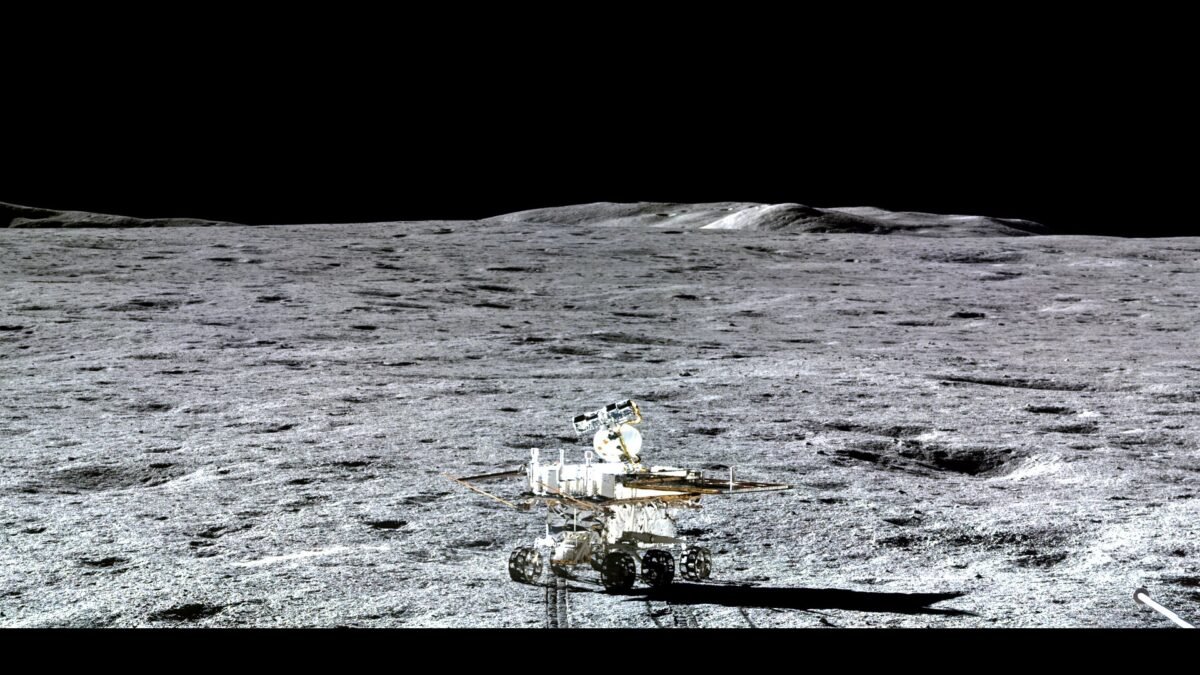
China sent its first astronaut into orbit in 2003, when Yang Liwei flew aboard Shenzhou-5, making China only the third country, after the Soviet Union and the United States, to put a human in space independently. Its Tiangong space station has been continuously occupied since 2022. Its robotic Chang’e programme has landed on the Moon four times: Chang’e-3 in 2013, which delivered the Yutu rover to the lunar surface; Chang’e-4 in 2019, the first landing on the far side of the Moon, where the Yutu-2 rover is still operating; Chang’e-5 in 2020, which brought lunar samples back to Earth; and Chang’e-6 in 2024, which returned the first samples ever collected from the far side. No other country has landed on the far side at all.
That record is why the new announcement is taken seriously in Washington and beyond. China has a habit of announcing space goals years in advance and then meeting them. When it said in 2011 that it would build a space station, few believed the timetable; Tiangong was completed in 2022. When it said it would return samples from the far side of the Moon, it did so. The crewed landing is a vastly harder undertaking — but the country announcing it has earned the right to be believed, at least in outline.
The stakes go beyond prestige. Both the United States and China are aiming, in the first instance, at the lunar south pole, where water ice sits in permanently shadowed craters. That ice can be turned into drinking water, oxygen and rocket fuel, which makes it the most valuable real estate in the solar system for anyone planning to stay. The first country to establish a lasting presence there will set the practical rules for everyone who follows — which is why the two programmes are also building rival frameworks: the American-led Artemis Accords, now signed by more than 50 countries, and the Chinese-Russian International Lunar Research Station, planned for the south pole in the 2030s. Since 2011, the Wolf Amendment has barred NASA from bilateral cooperation with China, so the two programmes are developing in parallel, with almost no contact between them.
Analysis: Why It Matters
A timetable, not just a target
For years, China’s crewed Moon landing was a goal without a route. The country had said “before 2030” so often that the phrase had become a slogan rather than a plan. What changed in Beijing on 31 October is that the slogan acquired a sequence: a test in 2027, a lander trial in 2028, a full dress rehearsal in 2029, and the landing itself. That matters because a sequence can be watched, measured and held to account in a way a slogan cannot. Every one of those dates is now a public commitment, and every slip will be visible. China has chosen to be judged by its own calendar — a confident move, and a risky one.
The race is real — and the finish line is the south pole
It is fashionable to say that the new Moon race is not a race, that there is room for everyone on the Moon, and that science, not rivalry, is driving both programmes. There is truth in that, but it is not the whole truth. The United States and China are aiming at the same narrow strip of territory — the water-rich craters of the lunar south pole — with incompatible legal frameworks, no cooperation, and a gap of barely two years between their target landing dates. The first crew to land there will choose the landing site, set up the first infrastructure, and establish the working precedents for mining ice, allocating territory and managing traffic. That is not a symbolic prize. It is the foundation of every lunar activity that follows, and both capitals know it.
Two very different ways to get there
Look closely, and the two programmes are not doing the same thing in different colours; they are doing different things. NASA’s plan leans on commercial companies, giant new vehicles, orbital refuelling and a lander that has never flown. It is ambitious, fast and full of unproven technology. China’s plan leans on a state-directed programme, a rocket built from existing technology, and a philosophy of testing everything uncrewed before anyone climbs aboard. It is slower, more cautious, and — so far — more predictable. The American approach could deliver a landing in 2028 and change the game, or it could slip repeatedly as its contractors wrestle with new technology. The Chinese approach is unlikely to deliver a surprise, but it is also unlikely to produce a disaster. The contest is not only between two countries; it is between two theories of how to explore space.
The schedule is the risk
The greatest danger to China’s plan is the plan itself. Three of its four missions must fly on vehicles that have never flown, in a sequence with almost no slack: a slip of a year in the 2027 test ripples into 2028, and a slip in 2028 ripples into 2029, and a slip in 2029 leaves no room at all before the 2030 deadline. The hardest manoeuvres — docking in lunar orbit, landing, and lifting off from the Moon — are all scheduled for the first time in the uncrewed missions, which means China will be learning its most dangerous lessons late, with the crewed flight already on the calendar. The Chang’e-7 delay, announced the same weekend as the plan, is a small warning: even in a programme famous for meeting its dates, dates slip. The question is not whether China can build the hardware; it is whether it can build it, test it and fly it three times, flawlessly, in three years.
The Moon is becoming a test of national systems
There is a reason both programmes are accelerating at the same time, and it has little to do with geology. The Moon has become the place where the world’s two great powers demonstrate what their systems can do: one, a state-directed programme that plans in decades and delivers on schedule; the other, a partnership between government and private companies that can attempt things no state programme would dare. Whoever lands first will claim more than a patch of grey dust. They will claim that their way of organising science, industry and ambition works better. That is a heavy burden to place on three astronauts and two rockets — but it is the burden both countries have chosen to carry, and it is why the next four years will be watched far beyond the world of spaceflight.
What to Watch Next
- Early 2027 — the Long March 10A test: the first flight of the new rocket family, carrying an uncrewed Mengzhou into low Earth orbit. A clean flight would prove the rocket and the spacecraft together; a failure would put the whole sequence under pressure immediately.
- 2028 — Lanyue’s solo landing: the uncrewed lander must descend to the Moon and climb back off it. This is the single most dangerous manoeuvre in the plan, and the first time any Chinese vehicle will have attempted it.
- 2029 — the full dress rehearsal: two Long March 10 rockets, two uncrewed vehicles, docking in lunar orbit and a complete landing cycle. If this works, the crewed flight becomes a repeat of a proven mission rather than a leap into the unknown.
- 2027 — Artemis III: NASA’s low-Earth-orbit docking tests with the SpaceX and Blue Origin landers will show whether the American timeline for a 2028 landing is credible — or whether the race is about to close up.
- Chang’e-7 and the south pole: the delayed robotic mission to the lunar south pole, and the water ice it is meant to survey, will shape where both countries choose to land — and who gets there first.
Sources
- TBS News — “China outlines plan for crewed moon landing” (Xinhua wire, 1 November 2026)
- QNC News — “China Lays Out Four Missions to Land Astronauts on the Moon” (reporting Ars Technica, 3 November 2026)
- The Space Road — “China’s crewed Moon landing plan explained: two launches, three astronauts” (2 November 2026)
- XenoSpectrum — “China Details Plan to Land Astronauts on the Moon by 2030 With Two Long March 10 Rockets” (3 November 2026)
- NASA — Artemis programme (Artemis II, III and IV mission plans)

About the Author — Abdul Mannan
Related Articles

Hubble Finds Nearby Dwarf Galaxies Have Lost Nearly 90% of the Oxygen Their Stars Made
A Hubble census of 37 nearby dwarf galaxies finds they retain only about 11 per cent of the…

Hackers Turn Supermarket Freezers Into Ovens Across Six European Countries in Second Wave of Attacks
Hackers remotely switched supermarket refrigeration into defrost mode overnight, pushing freezer temperatures to 50°C across six European countries…
Voyager 1 Goes Silent for Two Days in Deep Space, Then Returns as NASA Counts Down to a Light-Day From Earth
NASA's Voyager 1 fell silent for two days in October after its thrusters shut down — and on…