
Harmeet Dhillon Resigns as Justice Department Civil Rights Chief in First Senior Exit After Democrats’ Midterm Sweep

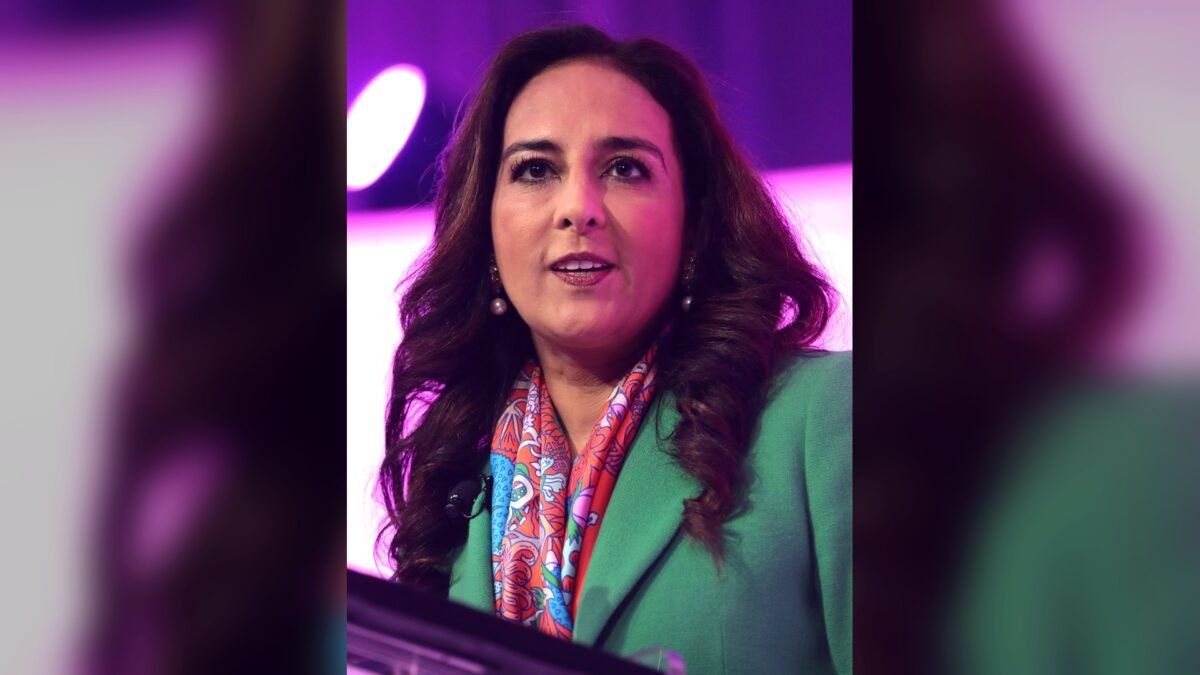
Harmeet Dhillon has resigned as head of the United States Justice Department’s Civil Rights Division, becoming the first senior official to leave President Donald Trump’s administration since Democrats swept both chambers of Congress in this week’s midterm elections, according to the Associated Press.
Attorney General Todd Blanche announced the resignation on Thursday, saying in a social media post that he had accepted it. “Today, I accepted the resignation of Assistant Attorney General Harmeet Dhillon, who led the Civil Rights Division with conviction the past 18 months,” Blanche wrote on X, according to the Associated Press and the New York Post.
“She has defended the civil liberties of every American and enforced the law without fear or favor,” Blanche added. “The Department is grateful for her dedicated public service, and we wish her every success in her future endeavors.”
Dhillon herself said in a social media post on Thursday that serving in the position had been “the honor of a lifetime.” “We ushered in the downfall of illegal DEI, we fought to protect women and girls’ sports, and so much more. I want to thank President Trump for giving me this opportunity. I look forward to what’s next!” she wrote, using the acronym for diversity, equity and inclusion, according to the Associated Press.
The resignation, announced two days after voters handed Democrats control of the House of Representatives and the Senate, closes one of the most consequential and most contested tenures in the modern history of the Justice Department. In about eighteen months as assistant attorney general, Dhillon remade a division created during the civil rights era to protect the rights of minorities, redirecting it toward the Trump administration’s priorities and presiding over the departure of more than three quarters of its career lawyers.
Her exit is also the first visible crack in the administration’s senior ranks after a midterm defeat that has already begun to reshape the balance of power in Washington. Democrats will take control of both chambers when the new Congress is seated in January, and with that control comes the power to investigate the very department Dhillon has just left.
Dhillon Says the Decision Was Hers — and Made Weeks Ago
Dhillon moved quickly on Thursday to frame the departure as her own choice, made long before voters went to the polls. In an interview with Fox News Digital, she said she had decided to leave weeks earlier but had been asked by the White House to remain in her post until after the elections, according to the Associated Press.
“My decision, my choice,” she said. She added that she had not been asked to resign and that she wanted to return to the private sector.
Bloomberg Law reported that Dhillon had previously told allies she would leave the department after the midterm elections, and that she had indicated in an August roundtable interview with Bloomberg reporters and editors that she planned to return to her California-based law firm, the Dhillon Law Group, after her government service.
That account sits alongside a different picture painted by other reporting on Thursday. Reuters, citing two people familiar with the matter, reported earlier in the day that Dhillon planned to resign imminently, describing her as one of the first high-ranking departures from the administration following the Republican Party’s rout in Tuesday’s elections.
CNN, meanwhile, reported that Dhillon’s departure had been “all but guaranteed to come in the days following the election,” and that her control over the Civil Rights Division had been declining for months, in part because of her repeated losses in court and a perception among colleagues that she was good at announcing initiatives and less effective at accomplishing them.
Whatever the precise sequence of events, the timing is unmistakable. The resignation was announced on the heels of a midterm result that the Associated Press described as a “startling rebuke” of Trump, and it comes as the administration braces for what Bloomberg Law reported could be multiple further departures of top political appointees during the lame-duck period before the New Year.
Dhillon is the second Senate-confirmed Justice Department official to depart in recent weeks, according to Bloomberg Law, following the resignation last month of Patrick Davis from the department’s Office of Legislative Affairs.
A Division Remade in Eighteen Months
Dhillon, a conservative lawyer and longtime Trump ally, was nominated by Trump in December 2024, confirmed by the Senate in April 2025 and sworn in days later, according to the Associated Press and USA Today. She arrived with a clear and publicly stated mission: to reverse what she described as the division’s liberal drift and to enforce federal civil rights laws as the Trump administration understood them.
“The job here is to enforce the federal civil rights laws — not woke ideology,” she said in an interview last year with conservative commentator Glenn Beck, according to the Associated Press.
The overhaul that followed was sweeping. Under Dhillon, the division shifted its focus away from its traditional work — combating discrimination against racial minorities, expanding access to the ballot box and investigating local police departments — and toward the administration’s priorities: gun rights, religious liberty, combating antisemitism on university campuses, challenging diversity programmes and pursuing what Dhillon called illegal DEI, according to Reuters and the Associated Press.
One of her earliest and most symbolic acts was to open a new section of the division dedicated to the Second Amendment, promoting gun ownership as a civil rights cause, according to CNN and Bloomberg Law. It was a striking redefinition of the division’s mandate: a unit created to protect minorities from discrimination was now, in part, a champion of gun rights.
At the same time, the division moved to dismantle the work of its predecessors. It dropped lawsuits brought under President Joe Biden that accused the police departments in Louisville and Minneapolis of violating civil rights, and it abandoned the court-enforced agreements that had governed policing practices in those cities, according to USA Today. The Associated Press reported that the division scrapped police reform settlements and investigations more broadly.
The division also launched a series of high-profile investigations into elite universities, accusing them of fostering antisemitism on campus, of discriminating against white applicants in admissions and of improperly prioritising diversity and inclusion, according to the Associated Press and Reuters. Dhillon played a leading role in the administration’s investigations of universities, Reuters reported, and her pressure campaign led to numerous settlements with schools and, in one case, the resignation of the president of the University of Virginia, according to the Associated Press.
She also led an effort to pressure states to turn over detailed voter records, despite repeated court losses, according to the Associated Press. CNN reported that judges across the country tossed lawsuits in which Dhillon claimed the records would help states “clean” their rolls of non-citizens, sharply criticising what they saw as an effort to use the law to disenfranchise voters or to access their personal data.
Dhillon maintained a constant and unusual public presence throughout. She repeatedly received tips on X about alleged civil rights abuses and would then publicly pledge to investigate them, according to the Associated Press. CNN noted that she took on a high-profile, non-traditional presence on social media, announcing initiatives alongside her love of knitting, while embracing right-wing causes.
The Staffing Collapse
No aspect of Dhillon’s tenure drew more attention — or more criticism — than the exodus of career lawyers from the Civil Rights Division. More than three quarters of the division’s workforce at the beginning of Trump’s second term have left, according to the Associated Press and CNN.
USA Today reported that Dhillon said on a podcast in August 2025 that about 75 per cent of the division’s lawyers — about 300 out of 400 — had left in the first seven months of the new administration. Dhillon herself celebrated the departures, calling them the “biggest single personnel self-purge in DOJ history,” according to the Associated Press and the New York Post.
She accused the past administration of pursuing a misguided liberal agenda and welcomed the departures of attorneys who were not aligned with the Trump administration’s priorities, the Associated Press reported.
CNN reported that the division was left “faltering due to a lack of staffing,” and that although Dhillon recruited several conservative lawyers to join in place of those who left, those hires had “far from made up for the ouster of decades of knowledge on civil rights laws.”
Indeed, CNN reported that the gutting of the division became part of the problem for Dhillon herself, because some conservatives complained that inexperienced lawyers in her section were not able to handle cases referred to the division.
Former Justice Department attorneys were unsparing in their assessment. Stacey Young, a former Civil Rights Division attorney who now leads a network of Justice Department alumni, called Dhillon “the most destructive, lawless and hateful” head of the division in department history, according to the Associated Press.
“Americans’ civil rights don’t enforce themselves. For almost 70 years, the Civil Rights Division brought to fruition the civil rights laws that Americans demanded,” Young said in an emailed statement on Thursday. “Dhillon decimated it.”
Courtroom Losses and a Shrinking Brief
By the final months of her tenure, Dhillon’s authority inside the department appeared to be shrinking even as her public profile remained high. CNN reported that in recent weeks she appeared “increasingly sidelined” as the department pursued a series of high-profile election-related legal cases of high interest to the president.
“Where’s Harmeet?” one Republican official working on some of the legal cases the department pursued to try to support Trump’s claims of Democrats trying to steal the election asked, according to CNN.
As the midterms approached, CNN reported, Dhillon was increasingly sidelined from the department’s voting efforts. It was Acting Deputy Attorney General Trent McCotter who signed on to the highest-profile lawsuits, not Dhillon. Associate Attorney General Stanley Woodward, with whom Dhillon had a strained relationship, took the lead appearing in court defending the administration’s legal moves, according to CNN.
The largest losses Dhillon suffered in court were over her attempts to gain access to voter rolls, CNN reported. Her university efforts, too, came with mixed success: she sent letters to and filed lawsuits against universities she accused of antisemitism and discrimination largely against white students, but those efforts rarely resulted in a court win — or even in a lawsuit at all, according to CNN. Some universities committed to help root out antisemitism, but sources told CNN there was little framework or follow-up from the department.
That record matters because it cuts against the image Dhillon cultivated of a division transformed by force of will. The reshaping was real — the staffing collapse alone guarantees that — but the legal results were, by the department’s own critics’ account and by CNN’s reporting, thinner than the announcements suggested.
The Midterm Backdrop
Dhillon’s resignation cannot be separated from the election that preceded it by two days. On Tuesday, Democrats won back the House and the Senate in what the Associated Press called a startling rebuke of Trump, a result that will hand the opposition the investigative machinery of Congress when the new session begins in January.
That machinery is already being aimed at the Justice Department. Democratic congressman Robert Garcia, who is likely to become the new chair of the powerful House Committee on Oversight and Accountability, pledged on Wednesday to pursue four major investigations, including abuses of power by Immigration and Customs Enforcement agents and the Jeffrey Epstein files, according to Al Jazeera.
The Epstein files are a particularly sensitive subject for the department. The incoming Democratic Congress is expected to probe the Justice Department’s handling of the Epstein files, as well as shootings by immigration agents, according to Al Jazeera. Dhillon’s division was not the centre of either issue, but the department she is leaving will now face sustained congressional scrutiny of its conduct across the board.
USA Today noted that the resignation is the first major departure from the Justice Department since Republicans suffered massive losses in the midterms, “ushering in Democratic congressional committee control next year that could heighten scrutiny of the department’s actions.”
The political context also explains why the White House, on Dhillon’s own account, asked her to delay her announcement until after the election. A senior resignation in the final weeks of a midterm campaign would have been read — fairly or not — as a verdict on the administration. By waiting until Thursday, Dhillon and the White House ensured the news landed after the votes were counted, even if it could not be separated from the result.
Who She Was Before Washington
Dhillon was a prominent figure in conservative legal and political circles long before she was tapped for the Justice Department, according to the Associated Press. A Sikh who was born in India and immigrated to the United States as a child, she built her reputation as a California lawyer involved in high-profile causes, including a legal fight over that state’s stay-at-home order during the coronavirus pandemic.
She launched a bid to become chair of the Republican National Committee but lost in January 2023 to Ronna McDaniel in a race that exposed fierce internal divisions in the party, according to the Associated Press.
Her law firm also represented Trump himself when a House committee investigating the January 6, 2021 attack on the US Capitol issued a subpoena for his testimony. The panel ultimately abandoned that effort and wrapped up its work without forcing the issue, prompting Dhillon to boast on X that the committee had “waved the white flag,” according to the Associated Press.
That history — party insider, Trump’s personal lawyer, culture-war litigator — is central to understanding her tenure. Dhillon did not arrive at the Civil Rights Division as a career civil rights lawyer. She arrived as a political lawyer, and she ran the division as one: publicly, combatively and with an open contempt for the career staff she inherited.
Analysis: Why It Matters
1. The first departure is the most important one
Every administration that suffers a midterm defeat faces a wave of departures, and the first one sets the tone for all the rest. Dhillon’s resignation matters not because she was the most powerful official in the administration — she was not — but because of what she represented: the most aggressive ideological project inside the Justice Department, the remaking of its civil rights mission in the image of the Trump movement’s priorities.
Her exit, two days after the election, signals that the administration’s senior ranks understand the political ground has shifted. Bloomberg Law reported that the department is bracing for multiple other top political appointees to exit during the lame-duck period. If Dhillon’s departure is followed by others, it will amount to a quiet acknowledgement that the second half of Trump’s term will be fought on different terrain — with a hostile Congress, an empowered opposition and a Justice Department under sustained investigation.
It is also worth noting what did not happen. Dhillon was not fired. She was not pushed out in a public rupture. The Attorney General praised her, she praised the President, and both sides described the parting as amicable. That choreography matters: it preserves Dhillon’s standing with the movement she served and it spares the administration an open fight with one of its own. But the substance — the first senior official out the door after a historic defeat — is not changed by the politeness of the farewell.
2. A division hollowed out cannot simply be refilled
The most durable legacy of Dhillon’s eighteen months is not any single case or settlement. It is the staffing collapse. More than 300 of the division’s roughly 400 lawyers left in the first seven months, taking with them decades of institutional knowledge about civil rights law, about how to build a voting-rights case, about how to investigate a police department, about how to litigate a pattern-or-practice suit.
That knowledge is not easily replaced. CNN’s reporting that inexperienced replacements struggled to handle referred cases is the predictable consequence of losing three quarters of a workforce in months. A new assistant attorney general — whoever that turns out to be — will inherit a division that is smaller, less experienced and less capable than the one Dhillon found, regardless of whether the new leader shares her politics or reverses them.
This is the paradox of Dhillon’s tenure. She set out to transform the division, and she succeeded — but the transformation was achieved largely by subtraction. The division she leaves behind is defined as much by who is no longer there as by what it now does. Rebuilding it, in either direction, will take years, not months.
That has consequences beyond the department. The Civil Rights Division is the federal government’s principal enforcer of civil rights law. When it cannot staff its cases, enforcement weakens everywhere: in voting rights, in housing, in education, in policing. Whoever fills Dhillon’s chair will face the same structural problem she created, and the American public will live with the results either way.
3. The legal record does not match the rhetoric
Dhillon’s public account of her tenure is one of triumph: the downfall of illegal DEI, the defence of women’s sports, a division remade. The court record tells a more complicated story. Her voter-roll lawsuits were tossed by judges across the country. Her university cases rarely produced court wins. Her division’s most consequential acts — dropping police reform cases, abandoning consent decrees — were exercises of discretion, not victories in court.
This gap between announcement and achievement is not unique to Dhillon, and it is not a partisan observation: CNN’s reporting, based on officials familiar with the matter, described colleagues who saw her as “good at announcing initiatives and less effective at accomplishing them.” It is a pattern familiar in modern politics, where the social media post is the deliverable and the follow-through is somebody else’s problem.
But the gap matters here for a specific reason. The Civil Rights Division’s authority rests on its credibility in court. Judges who repeatedly reject a division’s lawsuits begin to view its future filings with scepticism. That scepticism does not disappear when the assistant attorney general changes. Dhillon’s successor will inherit not only a depleted staff but a diminished standing with the federal bench — and will have to earn it back case by case.
4. The Democrats now hold the gavel — and the subpoena
The most immediate consequence of the midterm result is also the most concrete: Democrats will chair the committees that oversee the Justice Department. Robert Garcia’s pledge to investigate ICE abuses and the Epstein files is only the beginning. The department’s handling of election-related cases, its voter-roll litigation, its university investigations and its mass departure of career lawyers are all plausible subjects for hearings, document requests and subpoenas.
Dhillon’s resignation does not remove her from that picture. As the official who presided over the transformation of the Civil Rights Division, she is a likely witness — voluntarily or otherwise — for any inquiry into the department’s conduct. Her social media posts, her public statements and her own account of her tenure will all be part of the record.
There is also a narrower, more practical question: who replaces her, and can that person be confirmed? Any nominee will need the approval of a Senate now controlled by Democrats, and the confirmation process for the next head of the Civil Rights Division will inevitably become a referendum on Dhillon’s tenure itself. Democrats will want a nominee who repudiates her approach; the administration will want one who continues it. That standoff could leave the division leaderless — or led by an acting official — for months.
5. A test case for the whole administration
Dhillon’s eighteen months were, in miniature, the story of the Trump administration’s second term: a maximalist ideological project, pursued aggressively and publicly, that ran into the limits of institutions — courts that rejected its lawsuits, a workforce that walked out, colleagues who sidelined its leader, and finally voters who handed Congress to the opposition.
The project did not fail outright. The division’s priorities were genuinely transformed, its staffing genuinely reshaped, and its traditional work genuinely curtailed. But it did not succeed on its own terms either: the courtroom record is thin, the division is weaker than it was, and its leader has now resigned days after a sweeping electoral defeat.
That mixed verdict is the story to watch as the lame-duck period unfolds. If more senior officials follow Dhillon out the door, it will suggest an administration already turning inward, managing decline rather than pressing forward. If, on the other hand, the administration rallies and finds a combative successor for the Civil Rights Division, it will signal that the ideological project continues — merely with new personnel.
Either way, Dhillon’s resignation marks the end of the first phase of the administration’s control of the Justice Department. What comes next will be shaped by the election that preceded her departure, by the Congress that will now investigate the department, and by the hollowed-out division she leaves behind.
What to Watch Next
- The successor: President Trump must nominate a replacement, who will need confirmation by a Senate now controlled by Democrats. Watch whether the administration picks a like-minded successor to continue Dhillon’s project — and how Democrats respond in the confirmation process.
- The lame-duck departures: Bloomberg Law reported the department is bracing for multiple other top political appointees to leave before the New Year. Further resignations would confirm that Dhillon’s exit is the start of a wider turnover, not an isolated departure.
- Democratic oversight: With Robert Garcia likely to chair the House Oversight Committee, expect hearings and document requests covering the Justice Department’s handling of the Epstein files, ICE shootings and the Civil Rights Division’s transformation. Dhillon herself may be called to testify.
- The voter-roll litigation: The division’s lawsuits seeking state voter records were repeatedly rejected by judges. Watch whether the new leadership continues that effort — and whether courts continue to block it.
- The universities: Dhillon’s investigations into antisemitism and race-based admissions produced settlements but few court wins. Watch whether the next assistant attorney general pursues those cases to judgment or lets them fade — and how universities respond to a change of leadership.
Sources
- Associated Press — Harmeet Dhillon exits after radical overhaul of Justice Department’s Civil Rights Division
- Reuters — Trump ally leading Justice Department civil rights unit to resign, sources say
- CNN — Harmeet Dhillon, who runs the Justice Department’s Civil Rights division, resigns
- USA Today — Justice Department civil rights head Harmeet Dhillon resigns
- Bloomberg Law — Dhillon Resigns From DOJ Civil Rights After Democrats’ Sweep

About the Author — Abdul Mannan
Related Articles
Democrats Vow ‘Lawyer Up’ Era of Trump Investigations as Garcia Outlines Four Probes and Jeffries Launches Speaker Bid
House Democrats will launch four investigations — into the Trump family's business dealings, immigration enforcement, corporate corruption and…

Federal Judge Permanently Blocks Trump Administration From Tying Police Grants to Immigration Enforcement
Chief Judge John J. McConnell Jr. permanently barred the Justice Department from tying police grants to immigration cooperation,…
Speaker Mike Johnson Steps Aside After Midterm Wipeout as Scalise and Jordan Race to Lead House Republicans
House Speaker Mike Johnson told staff on Wednesday he will not seek the minority-leader post after the Republicans'…