
Hormuz on a Knife’s Edge: Trump’s Looming Iran Decision and the Strait the World Cannot Lose

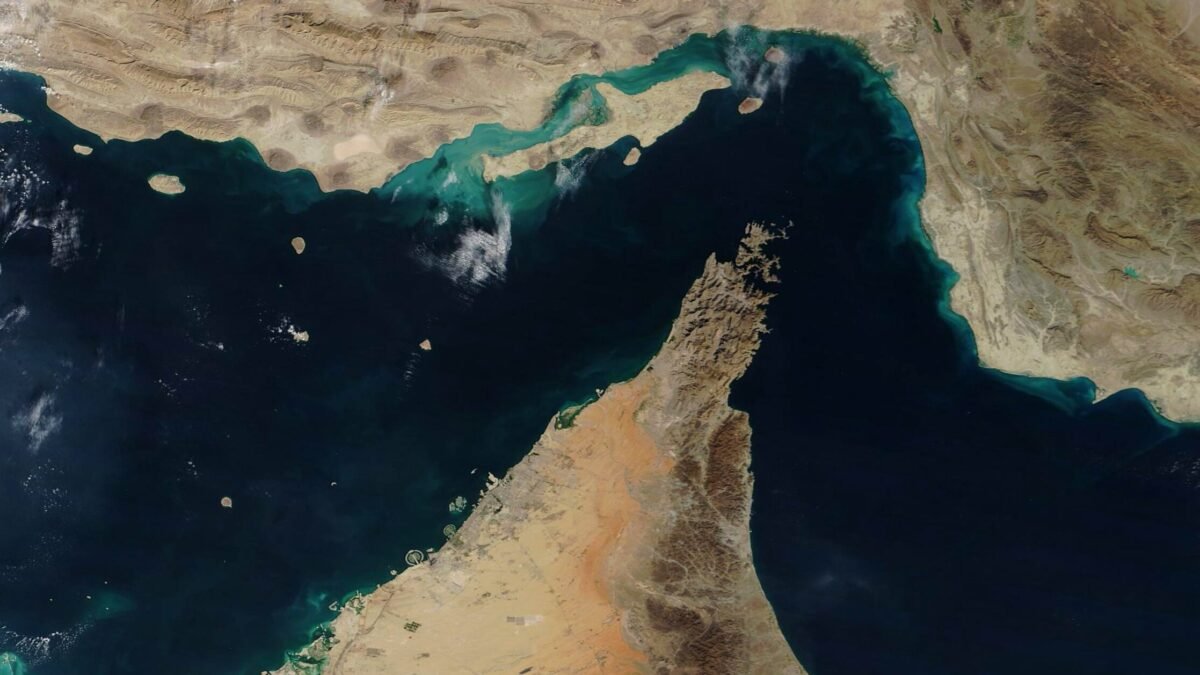
What happens when the throat of the world is squeezed? I ask you this question not as a riddle, but as the single fact upon which your petrol price, your grocery bill, your flight home and the peace of an entire region now hang. There is a strip of water on this earth barely twenty-one miles wide at its narrowest point, and through it passes nearly a third of all the oil that moves by sea on this planet, and almost a quarter of its liquefied natural gas. Its name is the Strait of Hormuz. And this week, as I write these words, the most powerful man on earth is deciding whether to set it — and with it, the Middle East — alight once more.
On Thursday, 5 November, President Donald Trump sat with his national security council in the White House and afterwards told the world that a decision on further military action against Iran would come soon. Soon. One small word, carrying the weight of warships. The midterm elections are over; the restraint that the calendar imposed is gone. And across the Gulf, from Doha to Riyadh to Abu Dhabi, governments are bracing for what that decision might be — because they have heard this drumbeat before, and they know what follows it.
History, that stern teacher who is never truly absent from the present, stands at my shoulder as I write. For whoever holds Hormuz has always held the purse of nations. The Portuguese seized it in the sixteenth century and taxed every hull that passed. The British made it the hinge of an empire. In the 1980s, the Tanker War turned these same waters into a graveyard of burning ships. In 2019, Iran seized the British tanker Stena Impero in this strait and held it for weeks. And now, in 2026, the old pattern returns wearing new clothes: Iran’s Persian Gulf Strait Authority, created this May, now demands that vessels seek its permission to pass — and its blacklist of forbidden ships has grown from 125 to 240 in a matter of days, including 72 vessels belonging to Gulf states. On 3 November, according to maritime intelligence firm Windward, only three ships crossed the strait at all. Three. In a waterway through which 21 million barrels of oil a day once flowed, the sea has gone almost silent.
The Price the World Is Already Paying
Do not imagine, dear reader, that this is some distant quarrel. You are already paying for it. The average global cost of shipping a standard forty-foot container has risen from $1,899 near the start of the Iran war in late February to $4,389 as of 5 November, according to data cited by the Institute for the Study of War. It peaked in early July and has stayed above $4,200 ever since. Every dollar of that increase is a tax on bread, on medicine, on the phone in your pocket — because everything you buy has, at some point, crossed a sea.
Iran, for its part, has turned the strait into a toll booth enforced by force. The Institute for the Study of War reports that Tehran has compelled some civilian vessels to pay between $150,000 and $2 million simply for the right to pass — a ransom dressed up as a fee. Insurance rates have soared; some underwriters have cancelled cover for Saudi-linked tonnage altogether. Gulf oil exports, measured by Vortexa, fell in October to 17.1 million barrels a day — roughly three-quarters of their pre-war level. Gulf stock markets slid this week on the fear of renewed war, even as Qatar’s index rebounded sharply. And Etihad Airways has cancelled its Abu Dhabi to Riyadh and Dammam services until 19 November.
Doha’s Race Against the Clock
And yet — and this is the part of the story that deserves your closest attention — the door to peace has not closed. It stands ajar, and one man is holding it open with both hands.
Qatar’s Prime Minister, Sheikh Mohammed bin Abdulrahman Al-Thani, said on Saturday that his country’s mediation between Washington and Tehran continues, and that “significant progress” has been made. “We cannot wait to reach a perfect agreement; we hope to reach a good agreement,” he said. He expressed confidence that a settlement could be reached, and said the American administration remains willing to find a solution even after the midterm elections.
What is on the table? Tehran has sent Washington a nuclear proposal through Qatar, and Iran has been pressing its own seven-day plan since September: Washington would lift its blockade of Iranian ports, unfreeze Iranian assets, and approve an Iranian-backed route through the Strait of Hormuz — after which the waterway would be reopened. Iran, in return, links all of this to seven demands, including sanctions relief, before it will agree to reopen the strait. These are hard terms on both sides. But notice what they are: terms. Numbers. Conditions. The language of negotiation, not of ultimatum.
President Trump himself sounded a note that the peacemakers will cling to. Speaking after his security council meeting, he said discussions with Iran were producing positive results — even as he warned that Washington might have to “destroy the rest” of the country if its nuclear programme cannot be permanently contained, and claimed Iran could need 25 to 30 years to rebuild. He acknowledged, with a gravity that should not pass unnoticed, that 18 American service members have died in this conflict. Eighteen families. Eighteen empty chairs. Every leader who speaks of “soon” should be made to count those chairs first.
The War Is Widening While the Talking Continues
But I must be honest with you, as a columnist owes honesty to his reader: while the diplomats talk, the war is quietly widening. This is the oldest pattern in the book of statecraft — negotiate with one hand, prepare with the other — and it is playing out across the whole region even as you read this.
In the Bab al-Mandeb Strait, the other great chokepoint at the foot of the Red Sea, the Houthis have begun issuing what they call voluntary “transit permits” to civilian vessels — a system, reported by the Wall Street Journal on 6 November, that mirrors Iran’s own permit regime at Hormuz and sets the conditions for the Houthis to control who sails and who pays. The Houthis have blockaded Saudi shipping since July, and they are now, according to the Institute for the Study of War, concentrating forces and materiel around al Turbah in Yemen, astride the road to Aden — the possible prelude to a large offensive against the Yemeni government’s de facto capital.
Elsewhere, the signs multiply like storm clouds. Iran may have deployed at least four commercial vessels to map subsea cable routes in the Gulf of Oman last month, according to shipping data reported by the Financial Times — reconnaissance that would be needed before any operation to cut the undersea cables that carry the region’s internet and data. Iranian officials have openly threatened those cables if American strikes resume. Satellite imagery examined by BBC Verify shows Iran excavating at two major missile sites, Garmdareh and Shahroud, building tunnel entrances to move its missile production underground, beyond the reach of the next airstrike.
And then, on Saturday itself, came the report that two missiles had struck Qeshm Island, the great Iranian island that guards the strait, according to Iran’s semi-official Tasnim news agency — which added, carefully, that there was no official information on possible damage. The United States has not announced any attack on targets inside Iran. I report this to you exactly as it stands: unverified, unclaimed, unresolved. But its timing — on the very day Qatar announced progress toward a deal — tells you everything about how fragile this moment is. One spark, one miscalculation, one missile nobody claims, and the “good agreement” becomes ash.
Reader, This Is Your Story Too
You may be reading this in Faisalabad or in London, in Karachi or in Toronto, and you may ask: what has this narrow strait to do with me? Everything. Everything. When Hormuz closes, the oil price rises in every country that buys a single barrel — and every country buys. When container costs more than double, the price of wheat rises in markets that never saw the Gulf. War in the age of globalisation is not a local fire. It is a fire in a house where all our rooms connect.
And there is a deeper question here, one that history forces upon us. The Strait of Hormuz has been fought over for five hundred years precisely because it is narrow — because geography made it a gate, and gates invite gatekeepers. Every empire that held it believed it would hold it forever — and every one of them, in time, sailed home. The strait remains. The lesson is written in the water itself: no power owns a chokepoint; it only rents it, at a price paid in blood and treasure, until the next tenant arrives. The wise leader is the one who understands that the gate is worth more open than closed — that a strait through which all may pass enriches its guardian, while a strait through which none may pass impoverishes everyone, guardian included.
That is the choice before President Trump in this hour. It is the choice before Iran’s leaders as well. And it is the choice before the mediators in Doha, who understand — as the Qatari prime minister’s words show — that a good agreement today is worth more than a perfect agreement that arrives after the missiles have flown. Perfection is the enemy of peace. It always has been. The peacemakers of history were not men who got everything they wanted; they were men who knew when to stop wanting everything.
The Verdict of the Strait
I close, then, not with a prediction — for no honest man predicts the decisions of the powerful — but with a warning and a hope, the two companions with which every column of mine must end.
The warning is this: the window is narrow, and it is narrowing. Three ships a day through Hormuz. A blacklist of 240 vessels. Missiles falling on Qeshm Island, claimed by no one. Forces massing on the road to Aden. Cables mapped beneath a dark sea. These are not the signs of a crisis ending; they are the signs of a crisis deciding.
The hope is this: that in Doha, in Washington and in Tehran, there are still men who understand what the strait itself has always understood — that water flows past every empire, and that the nations which prosper are those which let it flow. A good agreement, not a perfect one. A strait open, not a strait owned.
Twenty-one miles of water. A third of the world’s oil. Eighteen empty chairs. One decision, coming soon. May it be the right one — for history, that stern teacher, is watching, and history never forgets the men who chose war when peace was within reach.
Sources & References
- Reuters — “Qatar says its mediation efforts between US and Iran continue to prevent escalation,” 7 November 2026
- Just Security — “Early Edition: November 6, 2026,” 6 November 2026
- Institute for the Study of War (ISW) / Critical Threats Project — “Iran Update, November 6, 2026,” 6 November 2026
- Dubai Standard — “US-Israel-Iran conflict: Key updates UAE residents need to know today (November 6, 2026),” 6 November 2026
- NASA / MODIS, via Wikimedia Commons — Satellite image of the Strait of Hormuz (2 December 2020), public domain

About the Author — Abdul Mannan
Related Articles

Europe Rejects Trump’s ‘Big, Beautiful’ Security Deal With Russia as Zelensky Warns Against a ‘Yalta 2.0’
Europe has rejected President Trump's proposal for a sweeping security deal with Russia, with the EU's Kaja Kallas…
At Least 30 Killed in Attack on Market in Yemen’s Taiz as Houthis and Government Trade Blame
At least 30 people were killed when strikes hit a crowded market in Yemen's Taiz province on Friday,…
ANC Crashes to 32% in South Africa’s Local Elections as Voters Punish the Liberation Party and Coalition Talks Begin
South Africa's ruling ANC has crashed to about 32% in local elections — its worst result ever —…