
Gaza Floods Kill Four as Winter Storm Swamps Tens of Thousands of Tents and Trump’s Board of Peace Calls Israel’s Response ‘Insufficient’

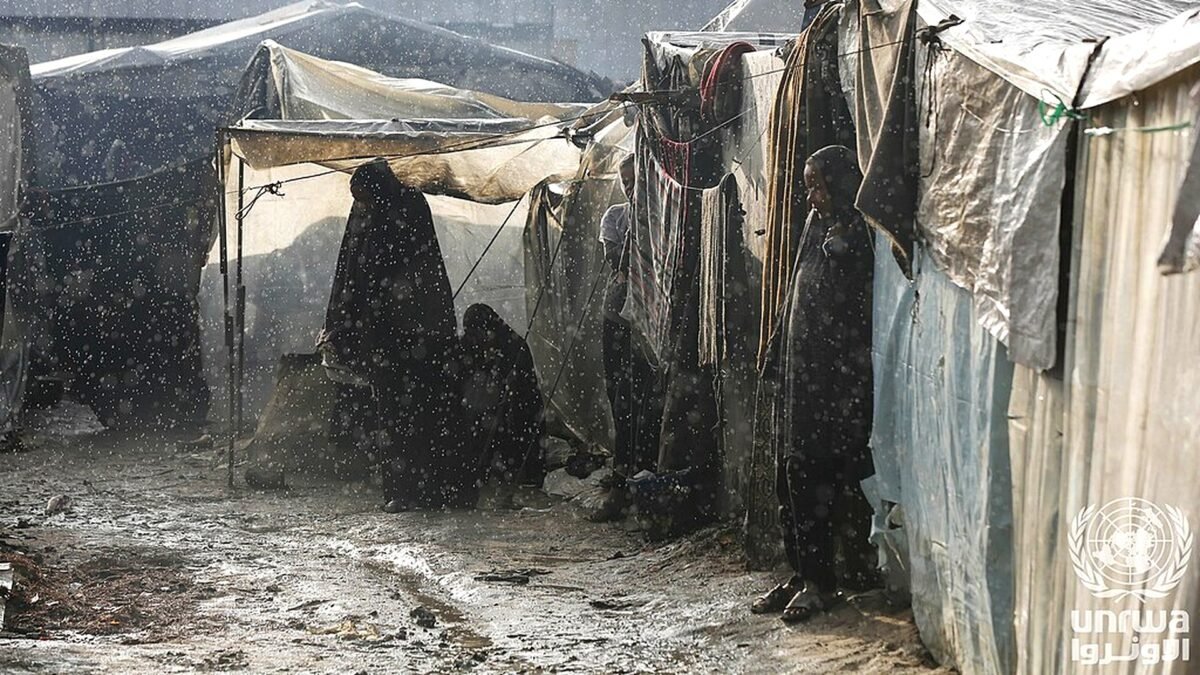
Four people, three of them children, were killed in Gaza on Sunday night when a rain-soaked sandbank collapsed onto tents sheltering displaced families, as the first heavy storm of the winter flooded tens of thousands of shelters across the territory. The deaths, in a camp south of Deir al-Balah in central Gaza, came a day after torrential rain left families with nowhere dry to sleep, and they have turned a weather emergency into a political one: on Monday, the Board of Peace, the body created by President Donald Trump to oversee the Gaza ceasefire, said Israel’s preparations for the winter had been “insufficient” and called on the Israeli government “to act immediately to authorise and facilitate the entry of all necessary winterisation and humanitarian supplies”.
The United Nations backed that criticism on Monday, saying it agreed with the board’s assessment and urging Israel to let more shelter materials and equipment into Gaza. Hamas, meanwhile, pushed back against the board’s statement, saying it ignored Israel’s wider role in stalling the United States-backed peace plan. The argument over who is responsible for the flooding is now running alongside the flooding itself, while the rain keeps coming and the tents keep failing.
The four people killed in the collapse were named by Gaza’s health ministry as Tahrir Nabhan, a 36-year-old woman, and three children: Mariam Nabhan and her brother Salah, aged six and eight, and four-year-old Habiba al-Zein. Relatives told Arab News that Tahrir Nabhan was five months pregnant. Five injured people were pulled from the wreckage alive, according to the BBC, while Reuters reported six people injured. Gaza’s Government Media Office said two other people remained missing after the collapse.
The figures were corrected once before they settled. Gaza’s Civil Defence service initially reported on Sunday that three children and two women had been killed, but the health ministry said on Monday morning that only one woman was among the dead. The correction matters because it shows how quickly numbers move in the first hours after a disaster in Gaza, and why the verified count, four dead, is the one this report uses.
The collapse happened late on Sunday at a camp for displaced families south of Deir al-Balah. Heavy rain had washed away a rocky sandbank beside the camp, and the bank gave way onto three tents. A witness, Sohaib Abu Darbali, told Reuters the collapse sounded like an explosion. “We found that three tents were covered completely after the mountain collapsed on top of them. People were under the rubble and we couldn’t see them,” he said. Rescuers worked with their bare hands and with hammers and shovels, digging through sand and broken rock by the light of mobile phones. Mustafa al-Masri, one of the rescuers, told the BBC: “It was extremely difficult. This mound was huge and wide. It collapsed onto the tent, and we didn’t know what to do. When we got here, we, along with the young men from the camp, pulled them out with our own hands. We pulled out the children and the woman.” He said the children’s father arrived shouting for his children as they were carried to an ambulance.
Al-Masri, who was displaced from the northern town of Beit Hanoun, told the BBC he had stayed in central Gaza because there was “nowhere for me to return to”. He said he had searched the open areas and hills for somewhere safe to pitch a tent and could find nothing better than the ground beside the sandbank. His account captures the choice facing displaced families in Gaza: there is almost no safe ground left, so people shelter where they can, including at the foot of sandbanks they believe will protect them from the wind. Mahmoud Basal, a spokesman for Gaza’s Civil Defence service, told Reuters that people put up their tents next to sandbanks believing they could offer protection. “Tents can’t protect people, neither from rain nor of the heat, the only solution is reconstruction,” he said.
The night the sandbank gave way
The storm that killed the Nabhan family and Habiba al-Zein arrived on Friday evening, 6 November, as the first heavy rain of the season. It strengthened through Saturday, when torrential rain swept across all five of Gaza’s governorates, and it was still falling on Sunday night when the sandbank collapsed. The sequence is important: the rain came first, the tents flooded first, and the collapse came after two days of soaking, when the ground had already given up.
Local authorities said at least 70,000 tents had been flooded in the first hours after the heavy rain began on Saturday, according to Reuters. Gaza’s Government Media Office put the damage from the storm at about $3 million and said dozens of walls already damaged in the war had collapsed. The United Nations Office for the Coordination of Humanitarian Affairs (OCHA) said humanitarian partners had received appeals from more than 26,000 households reporting damage to their shelters or belongings after the weekend storms. UNICEF estimated that more than 19,000 family tents were flooded over the weekend and that more than 100,000 people were forced to seek alternative shelter, according to Haaretz. The two tent figures count different things over different periods, the Gaza authorities’ estimate covering the first hours of the storm and UNICEF’s covering the whole weekend, but both describe the same fact: a very large share of Gaza’s displaced population lost its shelter in a single weekend.
The scale of the distress overwhelmed the rescue services. Gaza’s Civil Defence said water levels reached up to 1.5 metres in some places and that its first responders were able to answer only about 10 per cent of the more than 2,100 distress calls they received, according to the BBC. The United Nations said its staff had to take cover on Saturday after gunfire near an area for displaced people west of the “yellow line” in Gaza City, although no injuries were reported among them. The Civil Defence service, which operates under the Hamas-run interior ministry, described the collapse as a “humanitarian tragedy” and warned: “Protecting the lives of displaced people is an urgent humanitarian responsibility. Their tents must not become death traps beneath sand and rainwater.”
An infant drowned in the floodwaters, according to Farhan Haq, the deputy spokesperson for the United Nations secretary-general, speaking at a news briefing in New York on Monday. The United Nations also said thousands of families had lost their shelters and belongings, and OCHA said in an update on Monday that heavy rain had flooded displacement camps across all five governorates. Gaza’s Civil Defence warned that more than 2,000 buildings damaged in the war were at risk of collapse, and doctors in Gaza warned of a sharp rise in meningitis cases, with diagnosed viral meningitis cases rising from 150 in August to 267 in October and bacterial cases from 29 to 111 over the same period, according to the Gaza health ministry, as reported by Haaretz. The health ministry also warned on Sunday morning that a fuel shortage could bring transport for medical teams to a halt.
A storm across the whole Strip
The flooding is not confined to one camp. It is the predictable result of how Gaza’s population now lives. About 2.1 million people are confined to roughly 30 per cent of the territory, according to Karl Baker, the International Organization for Migration’s regional crisis coordinator, who spoke to the BBC from Gaza. He said many people were “unfortunately living in areas which would not be normal if we were not in this time of conflict”. More than 1.9 million people have been displaced, many of them multiple times, and 1.2 million of them are currently living in tents or makeshift shelters, according to the United Nations, as reported by the BBC. The United Nations estimates that about 80 per cent of all structures in Gaza have been destroyed or damaged during the war.
For many families, this is the fourth winter they will spend in a tent. Reuters noted that the vast majority of Gaza’s two million people live in tent encampments or in the ruins of bombed-out buildings, with reconstruction yet to begin following Israel’s two-year military assault, launched after the Hamas-led attacks on southern Israel on 7 October 2023. The war was triggered by that attack, in which about 1,200 people were killed and 251 others were taken hostage, according to the BBC. Since then, more than 74,640 people have been killed in Gaza, according to the territory’s health ministry, whose figures are considered reliable by the United Nations.
The United Nations says the territory needs about 120,000 tents, 500,000 tarpaulins and 1.7 million mattresses to get through the winter, according to figures cited by Haaretz. That is the gap the storm exposed: not a shortage of warnings, but a shortage of the most basic shelter supplies, in a place where most people have no roof at all. The UN agency and its partners are trying to make sure there are enough tents and tarpaulins, as well as improved drainage in the camps, to help people get through the winter, Baker told the BBC. But he warned that the aid currently getting into Gaza was not sufficient, describing it as “the very smallest of Band-Aids”. “We need more support, in-kind donations. We need funding in order to help the communities to help themselves,” he said. “We need a lot more to happen.”
Save the Children said shelter supplies were being blocked at the border, according to a briefing citing the organisation. The United Nations has called on the Israeli authorities to allow in the specialist equipment and materials required to improve living conditions for displaced families, including water drainage pumps, heavy machinery, tents, tarpaulins, blankets and winter clothing. Ramez Al-Akbarov, the deputy UN special coordinator for the Middle East peace process, called for the removal of all unnecessary restrictions and delays on those items, according to Farhan Haq.
The Board of Peace steps in
The most striking development of the weekend was not the weather but who criticised whom about it. The Board of Peace, the body President Trump created to implement the October 2025 ceasefire between Israel and Hamas, issued a rare public statement on Monday in which it said the situation in Gaza “no longer represents simply a threat posed by the approaching winter, but an immediate humanitarian emergency”. It said it had been warning Israel, which controls all entry into Gaza, of the need to prepare for winter and for seasonal flooding, and it called on “the leadership of the current Government of Israel to act immediately to authorise and facilitate the entry of all necessary winterisation and humanitarian supplies”. The board acknowledged steps Israel had taken but said they remained “insufficient”.
The rebuke is striking because of its source. The board is Mr Trump’s own creation, charged with overseeing the reconstruction of Gaza after the war, and its statement amounts to the president’s own peace machinery telling the Israeli government that it is not doing enough. The board did not place responsibility on Israel alone. It also called on Hamas to meet its own commitments without further delay, including disarming and handing over governing authority, and it said recent military activity in civilian areas and close to Israeli positions put civilians at risk and undermined the humanitarian gains made over the past year. The Times of Israel reported that the board said Hamas’s refusal to give up its weapons made it harder to supply the civilian population.
The United Nations endorsed the board’s criticism on Monday. Asked whether the UN backed the board’s assessment of Israeli efforts to provide adequate shelter, Farhan Haq told reporters: “Yes, we certainly agree.” Haq said additional temporary housing could be moved into Gaza, but the Israeli authorities must first approve its passage through checkpoints. He said Israeli restrictions on aid entering Gaza were hampering flood relief efforts and forcing humanitarian workers to operate with “wholly inadequate” equipment and shelter supplies, according to the official Palestinian news agency WAFA. He repeated the United Nations’ call for the protection of civilians under international humanitarian law and said more aid could enter Gaza if the Israeli authorities allowed it.
Hamas pushed back against the board’s statement on Monday, according to Turkey’s state-run Anadolu Agency. The group said it noted the board’s criticism of Israel but argued that the statement did not address Israel’s wider role in blocking Mr Trump’s plan. Hamas said it and other Palestinian factions had already accepted the roadmap and rejected blame for delays in carrying it out. The group cited a 3 August statement from the mediators Egypt, Qatar and Türkiye, which warned that Israeli violations were eroding the plan’s second phase. Hamas argued that using lifesaving aid as political leverage breached humanitarian and legal obligations, while shelter supplies remained outside Gaza as displaced families faced flooding and cold. The group urged the board to explain its own failure to respond to the disaster and to press Israel to meet its first-phase commitments.
Israel’s response came from two directions. COGAT, the Israeli military body that coordinates deliveries into Gaza, said on Sunday that more than 91,000 tents, 12 vacuum trucks for waste removal, and fuel and engine oil for pumping facilities had been delivered since the start of the “Gaza Winterization Plan”, according to the BBC. The Times reported the same delivery figures as more than 90,000 tents and 8,200 trucks of winter supplies, and said COGAT added that half of the requests, amounting to tens of thousands more trucks carrying winter-specific supplies including shelter, water and sanitation, were stalled because of “logistical and budgetary challenges” by the United Nations and global groups “unrelated to Israel”. COGAT added that Israel would not permit the entry of equipment that could be used for military purposes by Hamas and other Palestinian armed groups. The Israeli foreign ministry took a harder line: its spokesperson, Michal Maayan, said on Monday that Hamas was responsible for the delays and for any winter-related hardships the population was suffering. A day earlier, the foreign ministry had posted on social media that “Hamas doesn’t get to escape responsibility every time it rains”. COGAT has also said that, by its own assessment, the humanitarian situation in Gaza is the best it has been since the start of the war in terms of food availability, living conditions and water and sanitation infrastructure.
Why the shelters cannot cope
The argument about deliveries is, in the end, an argument about arithmetic. On one side, Israel says it has let in more than 90,000 tents and thousands of trucks of winter supplies. On the other, the United Nations says Gaza needs about 120,000 tents, half a million tarpaulins and 1.7 million mattresses, and that the aid getting in is “the very smallest of Band-Aids”. Both things can be true at once: a large delivery programme and a need that is larger still. The storm made the gap visible in a single weekend, when the tents that were already there failed in large numbers and the tents that were not there could not be pitched in time.
The gap is not only about tents. The United Nations says humanitarian teams are pumping out floodwater, upgrading drainage, shoring up displacement sites with sandbags and handing out emergency supplies, but they lack the equipment needed for a crisis of this scale. The items the UN says it needs most, drainage pumps and heavy machinery, are the same items whose entry is slowest, because Israel says they could be used for military purposes. That is the practical meaning of the dispute: the equipment that would stop a camp flooding is treated as a security risk, and the people in the camp absorb the consequence.
The health consequences are already showing. Doctors in Gaza are warning of a sharp increase in both viral and bacterial meningitis, with cases rising steeply between August and October, according to the Gaza health ministry. Flooding and overcrowding are expected to fuel the spread of infectious diseases, and the Gaza municipality has warned that fuel shortages and a lack of oil and spare parts are undermining its ability to deal with flooding, forcing the shutdown of essential pumps and generators and raising the risk of rainwater accumulating in streets and displacement camps, along with sewage overflows. UNICEF is particularly concerned about the possible flooding of the Sheikh Radwan pool in central Gaza City, according to Haaretz.
None of this is new. The warnings were issued before the storm, in public, by the same bodies now dealing with its consequences. The Board of Peace said it had been warning Israel of the need to prepare for winter and for seasonal flooding. UNICEF’s Jonathan Veitch had warned before the storm that families were desperate and that deaths from hypothermia were a risk. The storm did not surprise Gaza’s aid agencies; it arrived on a schedule they had predicted, and the preparations they had asked for were, in the board’s own word, “insufficient”.
The ceasefire that has not rebuilt anything
The flooding is also a measure of how little the ceasefire has changed life in Gaza. The United States-brokered ceasefire agreed in October 2025 called for the eventual reconstruction of Gaza, but little progress has been made, according to Reuters. Negotiators have failed to agree on terms for Hamas to disarm or for Israel to withdraw its troops, who control about two-thirds of the territory and from which residents have been ordered to leave. The 20-point plan that the ceasefire was built on has stalled in its second phase, and the Board of Peace, which was created to enforce it, has been accused of failing to enforce it at all.
The ceasefire has not stopped the killing either. The United Nations has warned that the humanitarian situation in Gaza remains dire despite the ceasefire, as Israeli air strikes and other attacks continue to hit populated areas, causing casualties and property damage and driving further displacement, according to the BBC. Gaza’s health ministry says at least 1,613 Palestinians have been killed and 5,833 wounded by Israel since 11 October 2025, the first full day of the ceasefire, according to figures cited in a weekly summary of the conflict. Twenty more Palestinians were killed over the past week alone, the ministry said. Those are the ministry’s figures, and they are disputed by Israel, but they are the figures the United Nations treats as reliable for the overall death toll.
Against that background, the flood deaths carry a particular weight. The four people killed on Sunday night were not killed by a bomb or a bullet. They were killed by rain falling on a sandbank beside a tent, in a territory where most people have no home to shelter in and no safe ground to pitch a tent on. Their deaths do not belong to the war’s casualty lists in the usual sense, but they are a product of the same conditions the war created: destroyed homes, a displaced population, blocked reconstruction and a shelter system made of tarpaulin and rope. Amal al-Zein, a 35-year-old relative of the victims, told Reuters: “What can one say about the situation in Gaza? Whoever did not die from bombs and missiles is dying from buildings collapsing on them, from the collapse of sand and mountains on them.”
Sir Tony Blair, who serves as an envoy for the Board of Peace, visited Israel last week and was reported to have met Gadi Eisenkot, the leader of Israel’s opposition, and Binyamin Netanyahu, the prime minister, according to The Times. The board’s statement on Monday was its first significant public intervention on the humanitarian situation since the ceasefire, and it came after months in which the board had been criticised for failing to enforce the plan it was created to implement. Whether the statement changes anything will be judged by what crosses into Gaza in the coming days: tents, tarpaulins, pumps and heavy machinery, or more statements about them.
Analysis: Why It Matters
Trump’s own board criticising Israel is the story
The Board of Peace was designed to be the instrument of Mr Trump’s Gaza plan, not a critic of Israel. Its statement on Monday is therefore significant in a way that a United Nations complaint is not. The United Nations has criticised Israeli restrictions on aid many times; the board is the first body created by Mr Trump himself to say, in public, that Israel’s response to a humanitarian emergency in Gaza is “insufficient”. That matters because it changes the politics of the argument. When the UN says aid is blocked, Israel can dismiss it as a familiar adversary. When the board Mr Trump created says the same thing, the criticism comes from inside the ceasefire’s own machinery, and it is much harder to dismiss. The board’s statement also shows how far the ceasefire has drifted from its purpose: a body created to oversee reconstruction is now issuing emergency appeals because reconstruction has not happened.
The numbers that do not add up
The dispute over tents is a dispute about whether 90,000 tents is a lot or a little. Israel says it has delivered more than 90,000 tents and 8,200 trucks of winter supplies, and that half of the remaining requests are stalled by the United Nations’ own logistical and budgetary problems. The United Nations says Gaza needs 120,000 tents and that the aid getting in is the smallest of sticking plasters. The truth is probably that both sides are describing the same shortfall from opposite ends. Ninety thousand tents is a large number, and it is also not enough, because 1.2 million people are living in tents and makeshift shelters and 80 per cent of Gaza’s structures are destroyed or damaged. The argument is not really about the number of tents delivered. It is about who is responsible for the fact that, after a year of ceasefire, more than a million people still have no roof, and about whether the answer is more deliveries or the reconstruction that the ceasefire promised and has not delivered.
Winter as a season of arithmetic
Winter in Gaza is not a natural disaster. It is a season, it arrives on schedule, and its effects are predictable. The rain that fell this weekend was the first heavy rain of the season, and the aid agencies knew it was coming. They knew that tens of thousands of tents would flood, that sandbanks would collapse, that children would die of cold and disease, and they said so in advance. The deaths on Sunday night were therefore not an accident in the usual sense. They were the foreseeable result of a shelter system that cannot survive a normal winter. That is why the Board of Peace’s word, “insufficient”, is so pointed: it does not describe a failure of effort, but a failure of preparation, and it implies that the deaths were preventable. The coming weeks will test that claim, because the winter has only just begun, and the next storm will arrive whether the tents are ready or not.
The blame circuit
Every party to the Gaza ceasefire has someone else to blame for the flooding. The Board of Peace blames Israel for slow admission of supplies and Hamas for refusing to disarm. Hamas blames Israel for blocking the peace plan and the board for failing to enforce it. Israel blames Hamas for the delays and the United Nations for logistical failures. The United Nations blames Israeli restrictions. The result is a circuit in which responsibility is passed around until it belongs to no one, while the people in the tents get wet. The circuit is not new, and it is not unique to Gaza, but it has a specific consequence here: as long as each side can point to another side’s failure, none of them has to fix its own. The board’s statement broke the circuit briefly by naming Israel, but it also named Hamas, and Hamas’s reply named the board, so the circuit is already closing again.
What the ceasefire was supposed to prevent
The October 2025 ceasefire was supposed to end the war and begin the rebuilding of Gaza. A year later, the war’s killing has slowed but not stopped, with more than 1,600 people killed since the ceasefire began, according to Gaza’s health ministry, and reconstruction has barely begun. The flooding is the clearest evidence of that failure, because it has nothing to do with the fighting and everything to do with what the fighting destroyed. A ceasefire that leaves 1.2 million people in tents through a fourth winter is not a peace. It is a pause in the bombing, and the rain is now doing what the bombs did, more slowly and less visibly. The test of the ceasefire was never whether the shooting stopped. It was whether the people of Gaza would have a home again. On that test, the first storm of the winter has already given its answer.
What to Watch Next
- Whether Israel authorises the entry of the winterisation supplies the Board of Peace demanded on Monday, and how quickly tents, tarpaulins, drainage pumps and heavy machinery actually cross into Gaza.
- Whether the United Nations’ call for the removal of restrictions on water drainage pumps and heavy machinery is answered, and whether COGAT’s claim that half of the requests are stalled by UN logistical problems is tested by new deliveries.
- Whether Hamas and the Board of Peace reach any understanding on the roadmap, after Hamas rejected the board’s account of the floods and urged it to press Israel on its first-phase commitments.
- Whether the death toll from the storm rises, as Gaza’s Government Media Office said two people remained missing after the sandbank collapse and Civil Defence warned that more than 2,000 war-damaged buildings were at risk.
- Whether the meningitis surge reported by Gaza’s health ministry spreads as flooding and overcrowding continue, and whether fuel shortages disrupt medical transport.
- Whether the next winter storm, and the flooding it will bring, produces a further intervention from the Board of Peace or from the United Nations, and whether Sir Tony Blair’s visit to Israel last week leads to any change in the delivery of aid.
- Whether the ceasefire’s second phase moves forward at all, with Hamas disarmament and Israeli withdrawal still unresolved and Israel controlling about two-thirds of Gaza’s territory.
Sources
- Reuters — Four killed in Gaza after sand embankment collapses on to tents
- The Times — Board of Peace criticises Israel’s ‘insufficient’ help after Gaza floods
- WAFA via Daily Imroz — UN says Israeli aid restrictions hamper flood relief in Gaza
- Anadolu Agency via Daily Imroz — Hamas pushes back on Board of Peace’s account of Gaza floods
- The Eastleigh Voice — Children among the dead as heavy rains flood tents and shelters in Gaza (OCHA update)
- Jehad Malaka / Haaretz — 19,000 without tents in terrible flooding in Gaza (UNICEF and health ministry figures)

About the Author — Abdul Mannan
Related Articles
Saudi Arabia Says Its East-West Oil Pipeline Was Attacked Again as the Houthi War Reaches the Kingdom’s Energy Lifeline
Saudi Arabia said its East-West oil pipeline was targeted in the Medina region on Monday, causing a limited…

Drone Strike on Iraq’s Khor Mor Gas Field Cuts Power to More Than 70% of Kurdistan as Production Halts
A drone strike on the Khor Mor gas field has halted production and cut power to more than…

Trump Says Fresh Strikes on Iran ‘Highly Unlikely’ if Talks Progress — But Warns Three Carriers Are ‘Locked and Loaded’
Trump told CNN renewed attacks on Iran are 'highly unlikely' if talks progress — while warning three US…