
Caltech Robot Builds a Structure in Space for the First Time, Opening the Way to Giant Telescopes and Solar Arrays

A robot built by researchers at the California Institute of Technology has assembled part of a structure in orbit without any help from astronauts, in what the team describes as the first time a structure has been autonomously constructed in space. The result, announced by Caltech and the United States Defense Advanced Research Projects Agency (DARPA) on 5 November, is a small step in physical terms, a single new section added to a partly finished frame, but it is a large one for the future of spaceflight, because it shows that the biggest objects humanity wants to put in orbit may no longer need to fit inside a rocket at all.
The machine is called ASTRA, short for Autonomous In-Space Tensioned Reflector Assembly. For six months it has been circling the Earth in low orbit, working on a reflector antenna 1.4 metres (4.6 feet) across, built from composite fibre tubes, aluminium joints and a Kapton reflective surface. According to Caltech, the robotic builder launched with two sections of the antenna already assembled on the ground, deployed them in orbit, and then built a third section, known as a bay, entirely from components it pulled from dispensers on board the spacecraft. “This is the first time that a structure has been autonomously constructed in space,” said Sergio Pellegrino, the Caltech professor of aerospace and civil engineering who leads the ASTRA team, according to Caltech.
The demonstration did not finish the antenna. Time ran short, technical problems intervened, and with the mission due to end in December, the team says it is unlikely the full eleven-bay ring will ever be completed. But the researchers say that was never really the point. What they set out to prove was narrower and, in the long run, more consequential: that a machine can take individual parts, join them together and extend a structure in the hostile environment of orbit, with no astronaut standing beside it. On that test, according to the team, the mission worked.
“Although the team ran into time limitations and was only able to build the initial section of the antenna, the demonstration has shown the feasibility of the proposed assembly concept, which is scalable to very large perimeter trusses holding giant reflective surfaces,” Caltech said in its announcement.
A third way to build big things in orbit
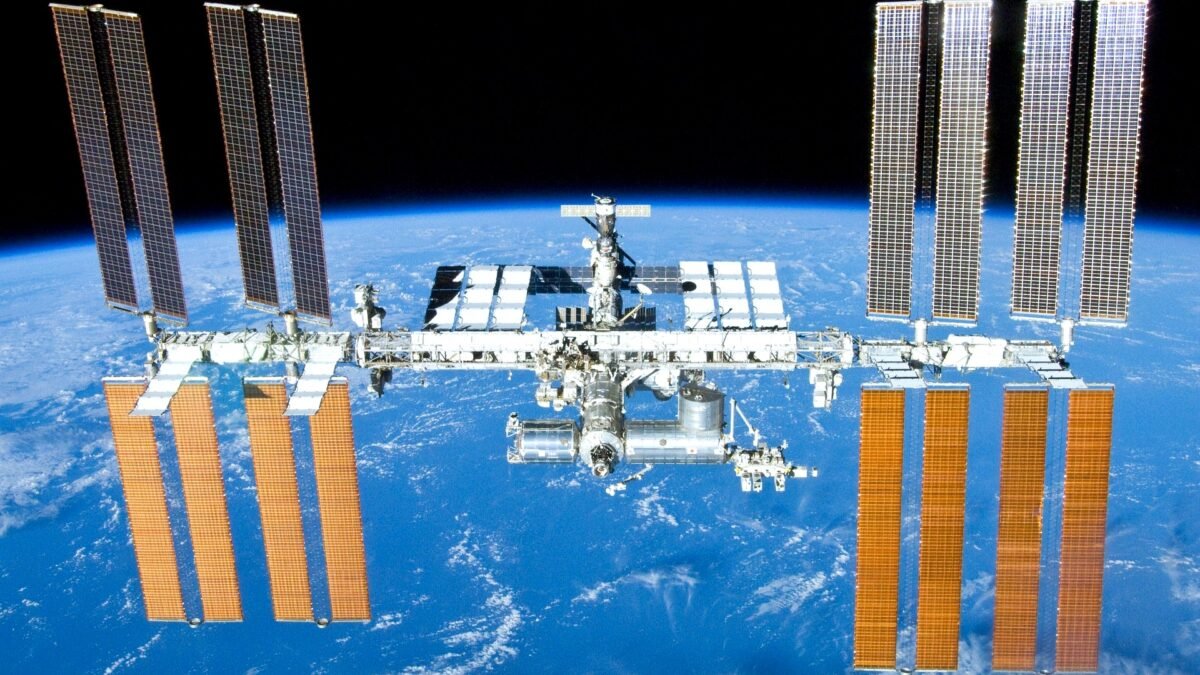
The problem ASTRA exists to solve is one of the oldest constraints in spaceflight. The size of anything launched into space is limited by the size of the rocket that carries it, and in particular by the fairing, the nose cone that protects the payload on the way up. Since the beginning of space exploration, engineers have had two ways around that limit, according to Caltech. They could fold a structure up for launch and unfurl it in space, as the James Webb Space Telescope did with its 6.5-metre mirror, or they could send a structure up in pieces over a series of launches and have astronauts bolt it together, as was done with the International Space Station. Both approaches work, but both have ceilings. A folded structure can only be so large before the folding itself becomes unmanageable, and astronaut assembly is slow, expensive and dangerous.
There is now a need for a third option, Caltech said: building structures right there, in space. That is the idea behind DARPA’s NOM4D programme, short for Novel Orbital and Moon Manufacturing, Materials, and Mass-efficient Design. DARPA started the programme in 2022 with the stated goal of ultimately ferrying raw materials from Earth for manufacturing in orbit. ASTRA is one of only two projects that made it through to the programme’s third phase, the small-scale orbital demonstrations. The other, led by the University of Illinois Urbana-Champaign, will use one of the modules attached to the International Space Station to test a method for hardening carbon tubes in space.
“NOM4D’s objective is to enable efficient, scalable construction of very large structures in space,” Andrew Detor, the DARPA programme manager for NOM4D, said in a written statement. “By ‘very large,’ I mean hundreds of meters or kilometers in scale. Nothing approaching that scale can be achieved today.”
The scale of that ambition is worth pausing on. A structure hundreds of metres across, let alone kilometres, is not a modest extension of what exists today. The International Space Station, the largest object ever assembled in orbit, spans about 109 metres. A kilometre-scale structure would be roughly ten times that, and no rocket ever built could carry it in one piece. DARPA’s argument is that the only way to get there is to stop thinking of launch as the moment a structure is finished, and start thinking of it as the moment its parts arrive.
How the robot built its bay
ASTRA’s approach is deliberately simple in concept, even if the engineering is not. DARPA likens it to piecing together a high-tech K’Nex or Tinkertoy set: an autonomous manipulator picks up struts and joints held in nearby dispensers and repeatedly assembles identical sections, or bays, of a perimeter truss. Once a bay is complete, the manipulator attaches a netlike perforated film to the truss to form two reflective cable nets, prestressed against each other by springs, and the finished bay is pushed out into the space environment. The sequence then repeats for the next bay. The antenna is complete when eleven bays have been built, tethered to their netlike reflectors and pushed out.
“Within the automated assembly box, each section is built piece by piece, a reflective mesh is attached, and the assembled sections are deployed as they are complete. There are no complicated robotics or advanced algorithms; it’s just solid engineering from the Caltech team to combine operations in a way that scales,” Detor said, according to DARPA.
The reflective material itself is part of the story. It was co-invented by the Caltech team and collaborators at the University of Pennsylvania, led by Professor Igor Bargatin, according to Caltech. The perforated film offers several advantages over the knitted metallic mesh normally used in foldable reflectors: it requires a smaller amount of prestress, which allows engineers to design structures that are much lighter. Weight is the currency of spaceflight, and a lighter reflector is a cheaper one to launch, which matters when the whole point is to build things too big for a single launch.
Getting the machine into orbit was itself a feat of speed. The space demonstration is the third phase of the DARPA project. In the first two phases, the ASTRA team developed the concept and design methodology, then showed that the concept worked in laboratory settings on Earth. The space payload was completed, tested and delivered to the payload host, Momentus Inc., in less than twelve months. “Developing a payload of this complexity on such a short timeline was an enormous undertaking for our small team,” Pellegrino said.
Early in the morning on 30 March 2026, ASTRA hitched a ride from Vandenberg Space Force Base to low Earth orbit as one of ten payloads carried by Momentus Inc.’s Vigoride 7 orbital space vehicle, which itself was launched aboard the SpaceX Transporter-16 mission. The ASTRA payload, roughly one cubic metre (35 cubic feet) in size, survived the launch. It carried two prebuilt bays of the truss with diagonal supports made from struts and joints, along with an armlike manipulator, and all the parts needed to construct the rest of the truss, held within motorised dispensers.
On the ground, the small team of engineers cheered the launch. Jaden Suh, a former Caltech postdoctoral scholar on the team who is now an assistant professor at the University of Texas at Austin, had tears in his eyes, according to Caltech. “As a child, I was super curious about and interested in space structures. Just like many other engineers working in this field, sending your stuff to space is what I’ve been dreaming of my entire life,” Suh said. “I was extremely lucky to have the opportunity to work on this project, beginning from scratch. A lot of my original ideas are included in this system, and it was just incredible seeing it reach space.”
Commands from Earth, fifteen minutes at a time
Once ASTRA was in space, the team began sending commands to the onboard computer through the Vigoride vehicle. First, the launch restraints holding its components during launch were released. Next, the two prebuilt bays were pushed out of the truss builder, and then the assembly of the third bay was carried out. The commands to build the structure were sent by team members Charles Sommer, a former Caltech systems engineer; Alan Truong, a Caltech research engineer; and graduate student Tara Venkatadri, and the outcomes were checked against photographs downloaded from space. The payload carries eleven cameras, and additional composite fibre tubes and netlike reflective material are clearly visible in the photographs captured in space, according to Caltech.
The operation was repeated to overcome unforeseen problems, of which there were many. “That’s basically the reason you do proof-of-concept testing. There are a lot of differences in the space environment compared to down on Earth,” Suh said, according to Caltech. “There are always lots of little surprises.”
Those surprises had to be solved at a distance, and slowly. There are only about seven or eight short windows of about fifteen minutes each day when researchers on the ground can communicate with the system in space. To help troubleshoot, the team had built ASTRA’s twin, a flight spare, that they could work with in Pellegrino’s Caltech laboratory. “Every time we confirm there is an issue in space, we come to the laboratory and try to mimic the problem on the ground,” Sommer said, according to Caltech. The team would work out a solution by testing alternatives on the flight spare, then relay the workaround to the twin in space.
That detail matters, because it puts a limit on the word “autonomous” in the team’s description. The robot performed the assembly while its terrestrial support crew was kept busy, as New Atlas noted in its coverage, with contact restricted to a few daily windows of just fifteen minutes, while engineers checked photographs and solved problems using a duplicate model in their laboratory before issuing the robot with commands. The assembly motions themselves were carried out by the machine, without an astronaut present, but the mission was not a matter of pressing a button and walking away. It was a partnership between a robot in orbit and a small team on Earth, working through a very narrow communications window.
Even so, the distinction is real and important. No human being was in orbit with the machine. No astronaut handled a part, turned a bolt or held a structure steady while the robot worked. The parts were picked up, positioned and joined by the machine itself, and the result was verified in photographs taken in space. That had never been done before, according to the team.
What the demonstration did not do
Honesty about the limits of the result is part of what makes it credible, and the team has been open about them. The demonstration built one new bay, not eleven. The antenna was not finished, and with the mission ending in December it appears unlikely that the full truss assembly will be completed. Technical difficulties and scheduling constraints stopped the system short of its target, and the team says it has learned sufficient lessons to show that the proposed on-orbit assembly approach is viable, and that it needs to simplify and refine the design.
There is a second, subtler limit. The demonstration tested whether the assembly technology works in space, using thin composite tubes with a surrogate mesh hanging inside the perimeter truss. It did not build a working radio-frequency antenna with its required electronics, so no results have been reported on the antenna’s transmit or receive performance, its gain or the accuracy of its reflective surface. What was confirmed is the mechanical feasibility of extending a truss structure in the space environment, with a robotic mechanism grasping individual components, placing them in position and joining them. The claim, in other words, is about construction, not about a working communications dish. That is a narrower claim than some headlines might suggest, but it is the claim the team actually made, and it is the one the evidence supports.
Nor has the team published figures for the cost of the demonstration, the mass of the robot or the time taken to build a single bay. Those numbers matter for judging how practical the approach is, and their absence is a reminder that this was a research demonstration, not a commercial product. A proof of concept answers the question of whether something can be done at all. It does not answer the question of whether it can be done cheaply, quickly or reliably enough to be worth doing at scale.
Analysis: Why It Matters
The reason a single truss bay built by a small robot in low Earth orbit deserves attention is not the bay itself. It is what the bay represents: the first evidence that the size ceiling on space structures, which has shaped every telescope, antenna and solar array ever flown, might be negotiable. For sixty years, the rule has been that what you launch is, roughly, what you get. ASTRA suggests that the rule could change, and that change, if it holds, would reshape what is possible in space.
The fairing problem, and why it has lasted so long
Every structure ever put in space has had to survive the same indignity: being squeezed into the nose of a rocket. The James Webb Space Telescope, the most ambitious observatory ever launched, folded its 6.5-metre mirror like origami to fit, and its sunshield unfurled through hundreds of single-point failures, any one of which could have ended the mission. It worked, brilliantly, but it also showed the cost of the folding approach. Each fold is a mechanism, each mechanism is a risk, and each risk is a reason not to go bigger. The International Space Station took the other route, arriving in pieces over more than a decade and being bolted together by astronauts on spacewalks, at enormous cost in money, time and human risk.
ASTRA points to a third route, and its appeal is that it removes both problems at once. If a structure can be built from small, identical parts by a machine already in orbit, there is no need to fold anything, and no need to send a person to hold it steady. The parts can be simple, the machine can repeat the same sequence again and again, and the structure can grow as large as the supply of parts allows. That is the logic behind DARPA’s comparison to a children’s construction set. It sounds almost too simple, and that is the point. As Detor put it, there are no complicated robotics or advanced algorithms involved, just solid engineering combined in a way that scales. The hardest problems in spaceflight are often not the ones that require genius. They are the ones that require a method that survives contact with reality, repeated hundreds of times, in an environment that punishes every mistake.
A first that is deliberately small, and why that is a strength
It is tempting to measure ASTRA against the ambition it announces and find it wanting. One bay, out of eleven. An unfinished antenna. A mission that will end in December with its main objective uncompleted. But that reading misses how engineering firsts actually work. The first aeroplane flight lasted twelve seconds and covered less distance than the wingspan of a modern jet. The first 3D-printed object in space, a faceplate printed aboard the International Space Station in 2014, was a part for the printer itself, not a useful tool. Firsts are almost always small, and their value lies in what they prove possible, not in what they deliver on the day.
What ASTRA proved is the part that was genuinely uncertain. Nobody doubted that composite tubes and aluminium joints could be joined together. The doubt was whether a machine could do it reliably in orbit, where gravity is absent, temperatures swing wildly, and every operation must be commanded through a fifteen-minute window, several hours after the problem appeared. The team encountered many unforeseen problems, by its own account, and solved them by testing fixes on a duplicate machine in a laboratory in California. That is not a weakness of the demonstration. It is the demonstration doing exactly what demonstrations are for: finding the problems on a small, cheap mission, so that the next one does not have to.
There is also something to be said for the team’s candour. It would have been easy to present a single assembled bay as a triumph and leave the unfinished antenna unmentioned. Instead, Caltech’s own announcement states plainly that only the initial section was built, that time limitations intervened, and that completing the full truss before December appears unlikely. That honesty is what makes the claim of a first believable. A team willing to report its failures is a team whose successes can be trusted, and in a field where grand claims are cheap, that matters.
What it unlocks: telescopes, antennas and power from the sky
The applications the team names are not speculative in the distant sense. Scientists would love the ability to deploy large-scale structures such as reflector surfaces in space, according to Caltech. These could be used as enormous mirrors for powerful space telescopes, allowing astronomers to observe ever more distant objects. Alternatively, they could form the aperture of large radio-frequency antennas. Pellegrino added a third: very large solar arrays for space solar power, a field he knows well as co-director of Caltech’s Space Solar Power Project, which aims to harvest solar power in space and wirelessly transmit it to the Earth’s surface.
Each of these is worth thinking about separately, because each is limited today by the same ceiling. A telescope mirror is limited by the fairing that carries it, which is why the Webb telescope’s 6.5 metres was such an engineering achievement, and why astronomers dream of mirrors tens of metres across. A radio antenna is limited the same way, which is why the largest single-aperture telescopes sit on the ground, where the atmosphere blurs their view. And a solar power station in space, which would collect sunlight unfiltered by weather or night, needs collecting areas measured in square kilometres, a scale that no launch vehicle could ever deliver in one piece. If structures can be built in orbit, all three ceilings move at once.
That is also why the material science in this mission matters as much as the robotics. The perforated reflective film, co-invented with the University of Pennsylvania, needs less prestress than the knitted metallic mesh normally used, which means lighter structures. In spaceflight, weight is not a detail. It is the difference between a mission that can be afforded and one that cannot. A lighter reflector means more of it can be launched for the same money, and more of it means a larger structure, which is the entire point.
The defence shadow, and the question of who benefits
It would be incomplete to discuss ASTRA without noting who paid for it. The programme is run by DARPA, the Pentagon’s research agency, and its stated goal is to ferry raw materials from Earth for manufacturing in orbit. Large antennas and large solar arrays have obvious military uses, from surveillance to communications to powering systems in orbit, and DARPA’s interest in kilometre-scale structures is not purely scientific. The technology is dual-use by design, and the same truss that holds a telescope mirror could hold a sensor, and the same solar array that beams power to Earth could power a military installation in space.
None of that diminishes the scientific value of the demonstration, but it is worth stating plainly, because the history of spaceflight is a history of dual-use technology. The rockets that carried the first satellites were adapted from missiles. The Global Positioning System was built for the military before it became a civilian utility. ASTRA follows the same pattern, and its future will depend on who funds the next steps. If the next mission is a scientific one, a giant telescope, the technology will be remembered as an instrument of astronomy. If the next mission is a military one, it will be remembered differently. The technology itself does not decide. The institutions that pay for it do.
What the robot teaches about building anything hard
There is a final lesson in ASTRA that has little to do with space. The mission succeeded, to the extent that it did, because the team built a twin. Every time something went wrong in orbit, engineers reproduced the problem on the flight spare in a laboratory in California, tested alternatives, and then sent the fix up through a fifteen-minute window. That is an old idea in engineering, a test article, a rehearsal, a spare, but it is one that is easy to skip when budgets are tight and schedules are short. The ASTRA team did not skip it, and it is the reason the mission produced a result at all.
The same logic applies to the mission’s incompleteness. The team says it needs to simplify and refine the design, which is the honest conclusion of a proof of concept. A demonstration that reveals its own flaws is more useful than one that hides them, because the flaws are the work list for the next version. If ASTRA’s successor flies with a simpler design, fewer parts and a faster assembly sequence, it will be because this mission was allowed to be imperfect in public. That is a model worth remembering in any field where the temptation is to present a first attempt as a finished product.
What to Watch Next
- The end of the mission in December. ASTRA’s mission is due to conclude in December 2026, and the team has said it is unlikely the full eleven-bay truss will be completed. The final report, and any further bays assembled before the end, will show how much of the antenna the system could ultimately build, and whether the lessons learned are enough to justify a follow-on mission.
- The second NOM4D demonstration. The University of Illinois Urbana-Champaign project, which will test a method for hardening carbon tubes in space using a module attached to the International Space Station, is the other half of DARPA’s phase-three programme. Its results, together with ASTRA’s, will determine whether in-orbit manufacturing moves from demonstration to development.
- Whether a follow-on mission is funded. The team says it needs to simplify and refine the design. The question is whether Caltech, DARPA or another funder backs a second, larger demonstration, and whether it aims at a complete antenna, a larger truss, or a different structure altogether. A kilometre-scale structure is still a long way off, and the gap between one bay and one kilometre is the gap that funding must close.
- Applications beyond antennas. Pellegrino’s mention of very large solar arrays for space solar power is the most ambitious application named, and the Space Solar Power Project at Caltech is the natural next customer for the technology. Watch for any announcement linking ASTRA’s assembly method to a solar power demonstrator, which would be the first sign that the technology is moving from research towards a real system.
- The cost and reliability numbers. The team has not published figures for the cost of the demonstration, the mass of the robot or the time taken to build a single bay. Those numbers will matter enormously when anyone tries to judge whether in-orbit assembly is practical at scale, and they are the most important missing piece of the story.
- The room-temperature supersolid, and the wider science week. ASTRA was not the only first announced in recent days. Physicists from the University of Warsaw, the Military University of Technology in Poland, IBM Research Zurich and the French National Centre for Scientific Research reported in Science Advances that they had observed a supersolid, a state of matter that is both a superfluid and a crystal, at room temperature, without the extreme cooling such states normally require. The two stories are unrelated, but together they make the same point: the boundaries of what is possible in the physical sciences are moving, and they are moving in more than one direction at once.
Sources
- Robot successfully builds space structure in first autonomous construction demo — phys.org, 6 November 2026
- A robot just built a structure in space for the first time — New Atlas, 10 November 2026
- US robot builds space structure without human assistance for first time — Interesting Engineering, 9 November 2026
- NOM4D program demonstrates automated in-space assembly — DARPA, 5 November 2026
- Novel Orbital and Moon Manufacturing, Materials, and Mass-efficient Design (NOM4D) — DARPA programme page
- Finally! Physicists Create an Exotic Quantum State of Matter That Works at Room Temperature — ScienceAlert, 8 November 2026

About the Author — Abdul Mannan
Related Articles

Australia to Create AI Safety Regulator and Force Frontier Firms to Report Rogue-Agent Breaches After OpenAI’s Medicare Hack
Australia will create a dedicated AI safety regulator and force frontier AI companies to report breaches by their…

One AI Model Now Simulates Sand, Cloth, Fluids and Folding Proteins as MIT Chases a ‘GPT Moment’ for Simulation
MIT researchers have built WorldParticle, a single AI system that simulates six kinds of physical behaviour — from…

Physicists Create a Supersolid at Room Temperature — a State of Matter That Is Solid and Liquid at Once
An international team led by the University of Warsaw has observed a supersolid — a state of matter…