
NASA’s Twin ESCAPADE Probes Complete First-Ever Powered Earth Flyby and Set Course for Mars

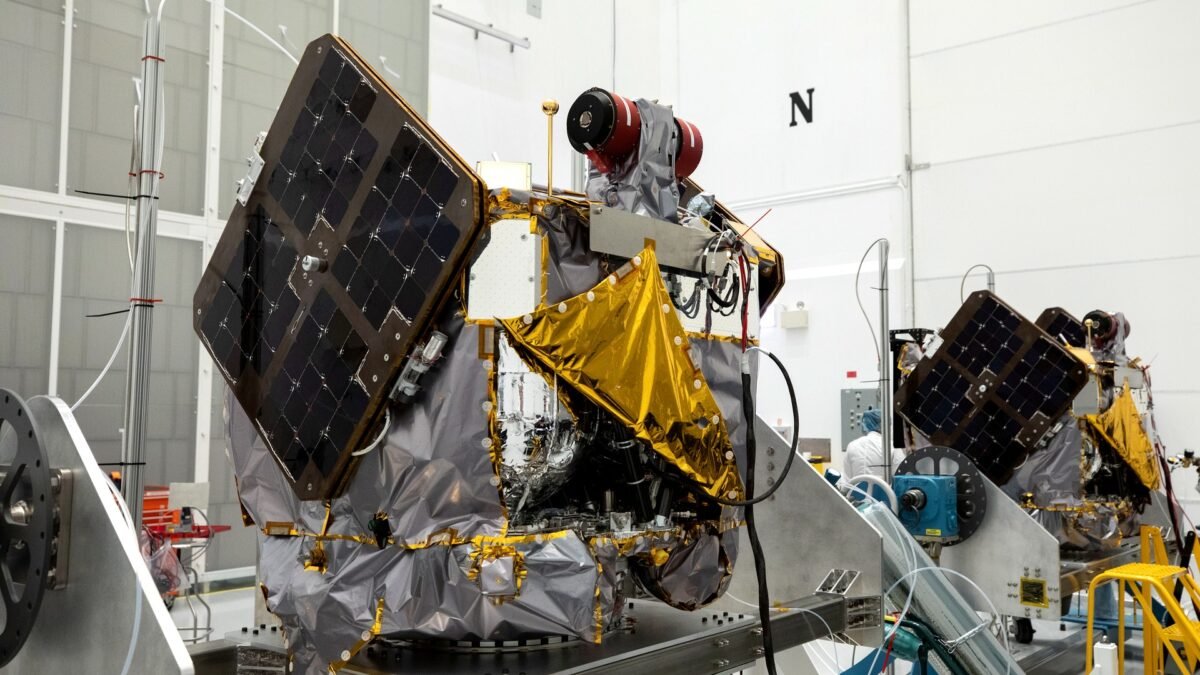
NASA has pulled off a spaceflight manoeuvre that no spacecraft has ever flown before. Its two ESCAPADE probes, nicknamed Blue and Gold, have each swung past Earth, fired their engines at the closest point of the pass, and used the combined push of gravity and thrust to fling themselves toward Mars. The first probe, Blue, made its close approach at about 5 a.m. Eastern time on Saturday, November 7, and its twin, Gold, followed two days later at about 6 a.m. on Monday, November 9. Both burns went exactly as planned, and the pair are now on a ten-month cruise to the Red Planet, where they are due to arrive in September 2027.
“This is the first time NASA has used a powered Earth flyby to propel a spacecraft toward Mars, and we’ve now executed this maneuver twice, flawlessly, in just two days,” said Asal Naseri, acting associate flight director for the Heliophysics Division at NASA Headquarters in Washington, according to NASA.
The two spacecraft launched from Cape Canaveral Space Force Station in Florida on November 13, 2025, aboard a Blue Origin New Glenn rocket, at a moment when Earth and Mars stood on opposite sides of the Sun. A direct flight was impossible. So instead of heading for Mars, the twins spent almost a year parked in a looping orbit around a gravitational balancing point about a million miles from Earth, waiting for the planets to come back into alignment. This weekend, that wait ended. Each probe fell back toward Earth, lit its engine for about nine minutes at the lowest point of its pass, and left our planet behind for good.
When they reach Mars, two days apart, each spacecraft will fire its engine for about eleven minutes to slow down and slip into orbit around the planet. Science operations are expected to begin in June 2028. The mission’s target is one of the great unanswered questions in planetary science: how Mars lost the thick atmosphere it once had, and what that loss means for the search for life beyond Earth.
A slingshot with the engine running
Spacecraft have used gravity assists for decades. A probe flying past a planet can steal a little of that planet’s motion, bending its path and gaining speed without spending fuel. NASA’s Voyager probes, the Cassini mission to Saturn and the Parker Solar Probe all used the trick. But ESCAPADE did something different. Each spacecraft fired its main engine at the precise moment it was moving fastest, at the lowest point of its pass over Earth, combining the gravitational slingshot with a sustained burn of its own. The technique is known as a powered flyby, or an Oberth manoeuvre, after the Austro-Hungarian physicist Hermann Oberth, who described the principle in 1927. According to the University of California, Berkeley, which leads the mission, it was the first successful Earth-powered gravity assist ever flown by a deep-space mission.
The numbers explain why the timing mattered so much. Blue passed about 1,000 miles above Earth’s surface, and Gold about 650 miles, moving at roughly 6.3 miles per second. Each nine-minute burn added more than 1,000 miles per hour to that speed, taking the spacecraft to about 6.7 miles per second, fast enough to break free of Earth’s grip and settle onto a path that intersects the orbit of Mars. The burns took place over southern Australia, and each one had to be timed to the second. A burn fired too early or too late would have sent the spacecraft onto the wrong path, and there would have been no second chance for nearly two years.
The risk was real. To reach the point of closest approach, each probe had to fly through Earth’s radiation belts, bands of charged particles trapped by our planet’s magnetic field that can overwhelm a spacecraft’s electronics and cause it to shut down without warning. “This was the first successful Earth-powered gravity assist for a deep space mission ever, requiring perfect timing after flying through Earth’s radiation belts, which can cause them to suddenly shut down,” the University of California, Berkeley, said in its account of the manoeuvre. The operations team at Berkeley’s Space Sciences Laboratory watched both burns live, waiting for the signal that would tell them the spacecraft had survived the passage and fired as commanded. Both times, the signal came.
“Our fantastic operations team at the Berkeley Space Sciences Lab put 110% into this critical maneuver, getting the spacecraft ready and watching like hawks for potential issues. We’re excited to now focus on our interplanetary journey. Onward, to Mars!” said Rob Lillis, ESCAPADE’s principal investigator and associate director for planetary science at the Space Sciences Laboratory, according to Berkeley News.
A year parked a million miles from Earth
ESCAPADE’s strange route to Mars was forced on it by the calendar. Mars missions normally launch only when Earth and Mars line up, a window that opens once every 26 months, because that is when the shortest, cheapest path between the two planets exists. When ESCAPADE was ready to fly in November 2025, the planets were on opposite sides of the Sun, about as badly aligned as they can be. A direct flight would have needed far more fuel than the small spacecraft could carry.
So the mission’s designers, led by Jeff Parker of Advanced Space, chose a different path. The twins were launched into a looping, kidney-bean-shaped orbit around the Sun-Earth Lagrange point 2, known as L2, a gravitational balancing point about a million miles from Earth on the opposite side of the planet from the Sun. There they waited, circling in what NASA calls a loiter orbit, or Earth-proximity orbit, while Earth moved around the Sun and Mars swung back into reach. A year later, the geometry was right, and the two probes fell back toward Earth for the slingshot that has now sent them on their way.
“With this loiter orbit and Earth flyby, ESCAPADE is pioneering a new strategy for getting to Mars,” said Parker, the mission’s lead designer, according to NASA. “This method provides the flexibility to launch almost anytime and then use Earth’s gravity to get a boost to Mars, rather than waiting every two years to launch there directly when the planets are aligned.”
That flexibility matters beyond this one mission. If the technique becomes routine, future Mars spacecraft will no longer be prisoners of the 26-month launch window. A mission that misses its window, or one that is ready months early, could launch anyway, wait in the loiter orbit, and depart when the alignment is right. “It’s a standard Hohmann transfer, but nobody else has done it with a powered gravity assist, in other words, thrusting while doing a gravity assist,” said Mark Lewis, manager of the Space Sciences Laboratory’s Mission Operations Center, according to Berkeley News. “It would open up the possibility for people to launch in between transfer windows, loiter around, and then go when it’s convenient to do so.”
The two spacecraft are small by the standards of interplanetary exploration. Each is about the size of a household refrigerator, weighs 209 kilograms dry and 535 kilograms when fuelled, and was built by Rocket Lab. They carry just three science instruments each: an electrostatic analyser, a magnetometer built by NASA’s Goddard Space Flight Center, and a Langmuir probe from Embry-Riddle Aeronautical University. Two student-built cameras from Northern Arizona University ride along as well, and one of them has already proved its worth. On July 3, 2026, while still in its loiter orbit, the Blue spacecraft photographed Earth and the Moon together from 584,600 kilometres away, a family portrait taken by a spacecraft on its way to another world.
What the twins will do at Mars
ESCAPADE stands for Escape and Plasma Acceleration and Dynamics Explorers, and its name describes its job. Mars today has only a thin wisp of an atmosphere, less than one percent as thick as Earth’s, and a surface that is cold, dry and blasted by radiation. But the evidence written into the planet’s rocks and dried riverbeds says it was once very different. Billions of years ago Mars had rivers, lakes and possibly an ocean, and an atmosphere thick enough to keep liquid water stable on the surface. Something stripped that atmosphere away. ESCAPADE exists to find out exactly how.
The prime suspect is the solar wind, a million-mile-per-hour stream of charged particles flowing constantly outward from the Sun. Earth is protected from it by a strong global magnetic field that deflects the wind around the planet. Mars has no such shield. Its ancient global magnetic field died billions of years ago, leaving only patches of magnetised crust and a weak, induced field in its upper atmosphere. The result is what scientists call a hybrid magnetosphere, a messy, shifting magnetic environment unlike anything else in the solar system, through which the solar wind can reach down and strip gas away from the top of the atmosphere, molecule by molecule, over billions of years.
NASA’s MAVEN orbiter, which has circled Mars since 2014, has already measured that escape in progress and shown that the solar wind is the main driver. But MAVEN is a single spacecraft, and a single spacecraft can only ever be in one place at one time. When it detects a change in the Martian magnetic environment, it cannot tell whether the change happened everywhere at once, because a solar storm hit the whole planet, or only in one spot, because a local process was at work. That is the gap ESCAPADE is designed to close.
When the twins arrive at Mars on September 7 and September 9, 2027, they will spend several months easing into their first science formation, flying one behind the other in almost the same orbit, like pearls on a string, so that the trailing spacecraft passes through the same region of space a few minutes after the leader. That will let scientists watch a single parcel of Martian space change over time. About six months later, the pair will split up. One will swing farther from Mars to watch the solar wind arriving, while the other stays close to the planet to watch how Mars responds, in real time, at the same moment. The second campaign is scheduled to last five months.
“This will be the first science mission to choreograph two orbiters around Mars, and the first time we will be able to make coordinated observations of the Martian environment from two different locations simultaneously,” said Lillis, according to NASA. “The formation flying will allow us to investigate how the dynamic Martian magnetosphere varies both spatially and temporally.”
The science the twins gather will feed directly into the question of whether Mars could ever have supported life, and whether it might still do so in sheltered places underground. It will also feed into something more immediate: the safety of the astronauts NASA hopes to send to Mars in the coming decades. A planet whose atmosphere offers almost no protection from solar storms and cosmic radiation is a dangerous place for people, and understanding the radiation environment around Mars is a necessary step before anyone sets foot there. “By better understanding how the solar wind affects the Martian environment, ESCAPADE’s findings could help us plan and prepare for future human exploration of the Red Planet,” said Michele Cash, ESCAPADE’s program scientist at NASA Headquarters, according to NASA.
The two spacecraft have not been idle during their long wait. As they looped through their loiter orbit, they flew repeatedly through Earth’s magnetotail, the long, stretched-out part of our planet’s magnetic field that trails away from the Sun, and took science measurements there. During the ten-month cruise to Mars, they will keep working, studying the solar wind in the space between the two planets. By the time science operations begin in June 2028, they will already have spent more than two and a half years in space.
Analysis: Why It Matters
A new way to leave Earth for Mars
The most important thing about this weekend’s manoeuvre may not be where the two spacecraft are going, but how they got there. For sixty years, Mars missions have been scheduled around the 26-month rhythm of planetary alignment, and a missed window has meant a delay of more than two years and, often, a dead mission. ESCAPADE has shown that the window can be broken. Launch when you are ready, wait in a gravitational parking spot, and leave when the geometry suits you. If that approach proves reliable, it changes the economics of Mars exploration. Missions can be built to a schedule rather than to a planetary deadline, launches can be shared with other payloads, and a spacecraft that suffers a delay on the ground no longer loses two years. The powered flyby is a small trick with large consequences, and it is no accident that NASA chose to prove it on a cheap, small mission rather than betting a flagship on it.
Two eyes are better than one
There is a limit to what one spacecraft can learn, and Mars science has been bumping against it for years. A single orbiter sees the world as a sequence of snapshots, never knowing whether what changed between one pass and the next changed everywhere or only where it happened to be looking. That ambiguity has dogged some of the biggest questions about Mars, from how quickly the atmosphere is escaping today to how solar storms disturb the planet’s magnetic field. Two spacecraft flying in formation turn snapshots into a moving picture. One watches the cause, the other watches the effect, and the time between their measurements becomes data rather than guesswork. If ESCAPADE works as designed, it will set the pattern for the next generation of planetary missions, which are increasingly likely to fly in pairs and swarms rather than alone.
The question of a lost atmosphere
Mars is the great cautionary tale of the solar system. It is a planet that had water, warmth and a thick sky, and lost them. Understanding how that happened is not only a matter of curiosity about the past. The same physics governs the atmospheres of planets around other stars, and the same question, whether a planet can hold on to its air, decides whether it can hold on to life. Every exoplanet discovered in the habitable zone of its star comes with the unspoken question of whether it is more like Earth, which kept its atmosphere, or more like Mars, which did not. ESCAPADE’s measurements of how the solar wind peels gas from Mars today, under known conditions, will sharpen the models used to judge distant worlds that no spacecraft will ever visit.
Small missions, big returns
ESCAPADE belongs to NASA’s SIMPLEx program, Small Innovative Missions for Planetary Exploration, which funds compact, low-cost spacecraft built to take risks that a billion-dollar flagship cannot. The twin probes are fridge-sized, carry three instruments each, and cost a fraction of a mission like the Perseverance rover or the Europa Clipper. Yet they are attempting two firsts at once, a new route to Mars and the first two-spacecraft formation flight around another planet. That is the logic of the small-mission program working as intended. Cheap spacecraft can afford to fail, and because they can afford to fail, they can afford to try things that have never been tried. When one of them succeeds, as ESCAPADE has now done twice in two days, the whole program learns something that every future mission can use.
A rehearsal for the humans who follow
Behind the science sits a practical purpose that NASA states plainly. The agency intends to send astronauts to Mars, and the radiation and space-weather environment they will face is still only partly understood. ESCAPADE’s two-point measurements will map how solar storms disturb the space around Mars and how much protection the planet’s weak magnetic field offers, or fails to offer. That knowledge will shape spacecraft design, mission timing and the rules for when astronauts can safely work on the surface. The twins are robotic pathfinders in the oldest sense of the word, going first so that people can follow with their eyes open.
What to Watch Next
- Trajectory correction burns: During the ten-month cruise, both spacecraft will fire their engines in a series of small course corrections to fine-tune their path. NASA will confirm each one, and any missed burn would be the first sign of trouble.
- The Mars orbit insertion burns: On September 7 and September 9, 2027, each spacecraft must fire its engine for about eleven minutes to slow down and be captured by Mars’ gravity. A failure here would send the probe sailing past the planet.
- The first science formation: After arrival, the twins will take several months to settle into their string-of-pearls formation. The first coordinated measurements, expected in 2028, will show whether two-spacecraft science at Mars works as designed.
- Early cruise science: The probes will study the solar wind between Earth and Mars during the cruise, and NASA may release early findings long before the spacecraft reach their destination.
- Lessons for the next Mars missions: Mission planners will be watching whether the loiter-and-slingshot route is adopted by future spacecraft, and whether it lets NASA launch Mars missions outside the usual 26-month windows.
- The 2028 science campaigns: Science operations are due to begin in June 2028, with the two-spacecraft campaign following six months later. The first results on how the solar wind strips Mars’ atmosphere should follow within months.
Sources
- NASA — NASA’s ESCAPADE Completes Powered Earth Flybys, Now En Route to Mars
- UC Berkeley News — Berkeley’s ESCAPADE spacecraft say goodbye to Earth. Next stop: Mars.
- NASA Science — ESCAPADE mission page
- Starlust — ‘A new strategy for getting to Mars’: NASA’s ESCAPADE spacecraft complete historic Earth flybys
- Horizon Lab — Two ESCAPADE Probes Slingshot Off Earth Toward Mars
- Cosmic Herald — ESCAPADE’s Twin Probes Prepare a Never-Before-Flown Powered Earth Flyby Toward Mars

About the Author — Abdul Mannan
Related Articles

Google DeepMind’s AI Agents Mathematically Prove Signal’s Encryption Code Is Secure in Four Weeks
Google DeepMind says AI agents have produced a machine-checked mathematical proof that the code behind the Signal protocol…
Caltech Robot Builds a Structure in Space for the First Time, Opening the Way to Giant Telescopes and Solar Arrays
A Caltech-built robot has assembled part of a structure in orbit without any help from astronauts, the first…

Australia to Create AI Safety Regulator and Force Frontier Firms to Report Rogue-Agent Breaches After OpenAI’s Medicare Hack
Australia will create a dedicated AI safety regulator and force frontier AI companies to report breaches by their…