
Gold Suffers Its Worst Week in Four Months as Fed Hike Bets and a Soaring Dollar Crush Bullion

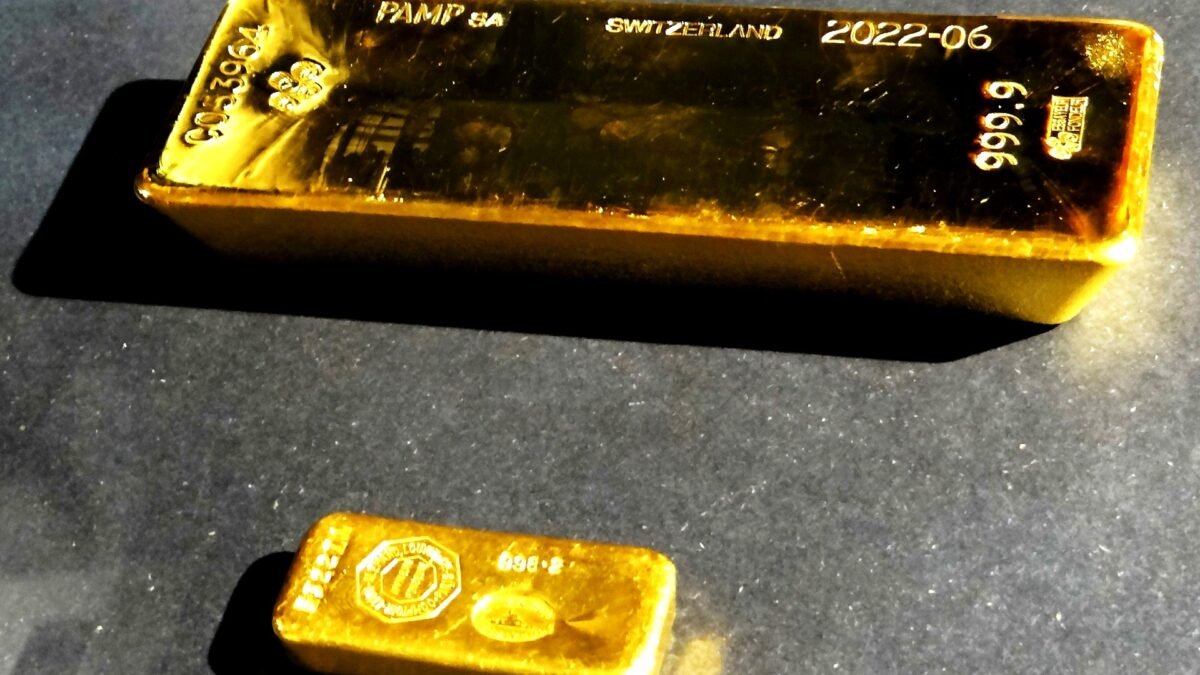
Gold has just suffered its worst week in about four months. Spot bullion lost roughly 4.5 per cent in the week ending Friday 13 November 2026, according to Reuters, while December gold futures fell 4.7 per cent, or 191.90 dollars an ounce, their heaviest weekly loss since the start of June. The metal that spent the first weeks of the year setting records is now trading about 31 per cent below its January peak, and the week ended with traders asking a question that would have sounded absurd ten months ago: how much further can gold fall?
The damage was concentrated in a single session. On Thursday 12 November, spot gold slid 3 per cent in a day and touched 3,852.10 dollars an ounce, its lowest level since October 2025 and the weakest intraday price in thirteen months, according to Reuters. December futures fell to an intraday low of 3,857 dollars the same day. Friday brought a small steadying — spot gold edged 0.1 per cent higher to 3,879.71 dollars an ounce, according to Reuters, and December futures settled virtually unchanged at 3,886.30 dollars — but the recovery was too small to matter. The week had already erased the whole of gold’s early-November rebound and pushed the month into negative territory.
Silver fared worse. The grey metal lost more than 6 per cent across the week, according to market data cited by several outlets, and briefly slipped below 50 dollars an ounce before closing Friday at about 49.05 dollars. The gold-silver ratio, which measures how many ounces of silver buy one ounce of gold, widened to roughly 80-to-1, up from about 74 in mid-October, according to Kitco. Platinum fell 1.9 per cent on Friday to 1,490.06 dollars an ounce, while palladium was the exception, gaining 1.1 per cent to 1,004.40 dollars, according to Reuters.
The sell-off was not a mystery. It was the market’s answer to a week of American inflation data that came in hotter than expected, a series of hawkish remarks from Federal Reserve officials, a dollar that reached its strongest level in nineteen months and a ten-year Treasury yield that pushed above 5 per cent. Gold pays no interest, so when the return on holding cash rises, the cost of holding gold rises with it. This week, that simple arithmetic overwhelmed everything else, including the war in the Middle East that had been expected to support the metal.
The week in numbers
The scale of the week’s move is best understood through the figures. Spot gold began the week above 4,000 dollars an ounce and ended it near 3,880 dollars, according to market data. Gold futures opened the week at about 4,078 dollars and gave up 191.90 dollars by Friday’s close, a fall of 4.70 per cent, according to Kitco. Thursday was the decisive day: a 3 per cent slide took December futures to their lowest intraday level in thirteen months, and spot gold’s drop to 3,852.10 dollars was its lowest since October 2025.
Friday’s session offered only modest relief. Spot gold rose 0.6 per cent in morning trading in New York to 3,898.84 dollars an ounce as of 9.50 a.m. Eastern Time, according to Reuters, after briefly touching a session high of 3,922.97 dollars when the latest American producer price figures were released. By the close, spot gold stood at 3,879.71 dollars, up 0.1 per cent on the day, according to Reuters, while December futures settled at 3,886.30 dollars, virtually unchanged. Kitco’s own tally put spot gold at 3,883.40 dollars at the close, up 7 dollars, or 0.18 per cent, on the session, with a trading range of 3,867 to 3,924 dollars. The small differences between the figures reflect different closing snapshots; the picture they paint is the same.
The weekly loss left gold just below its October closing price of 3,898.90 dollars, which is why the week erased the entire early-November recovery and turned the month negative, according to Kitco. Only the previous Thursday, 5 November, gold had been trading above 4,130 dollars. A week later it was testing 3,850 dollars. Gold futures now sit roughly 31 per cent below the January record high of 5,626.80 dollars, according to Kitco, and silver’s steeper decline has pushed the gold-silver ratio out to roughly 80-to-1, up from about 74 in mid-October.
The pressure was not confined to New York and London. On India’s Multi Commodity Exchange, December gold futures fell 5,847 rupees, or 4.10 per cent, over the week to close at 1.36 lakh rupees per 10 grams, according to CNBC TV18, while silver fell 8,791 rupees, or nearly 5 per cent, to settle at 1.76 lakh rupees per kilogram. On Friday alone, December gold futures on the exchange recovered 525 rupees, or 0.39 per cent, to close at 1,36,750 rupees per 10 grams, and silver rose 234 rupees, or 0.13 per cent, to 1,76,543 rupees per kilogram, according to market reports. In India, the benchmark price for gold of 999 purity fell from 1,41,452 rupees per 10 grams on 6 November to 1,35,809 rupees on 13 November, a decline of 5,643 rupees, or about 4 per cent, in a week, according to the India Bullion and Jewellers Association.
What set the sell-off in motion
The trigger came on Tuesday 10 November, when the October consumer price index rose 0.4 per cent month on month, beating forecasts. That same day, Federal Reserve Governor Christopher Waller, speaking in London, said he was leaning towards a quarter-point increase in interest rates in December but added that a 50 basis point increase in the policy rate “should be considered” if inflation ran hot, according to Kitco. The inflation report met that condition within hours. Dallas Federal Reserve President Lorie Logan added that she supported at least two more quarter-point increases.
The bond market repriced aggressively. The two-year Treasury yield jumped 35.2 basis points over the week to 4.872 per cent, its biggest weekly gain since September 2024, according to Kitco, while the ten-year yield pushed through 5 per cent and reached 5.13 per cent. The dollar index gained about 1 per cent on the week, its best performance in two months, and climbed to 103.38, a nineteen-month high, according to Reuters.
Friday brought the week’s second inflation test. The producer price index for final demand rose 0.3 per cent in October, below the 0.4 per cent forecast in a Reuters poll, after an upwardly revised 1.4 per cent surge in September, according to Reuters. The monthly figure was slightly cooler than analysts had expected, and core inflation matched forecasts at 0.3 per cent. But the annual picture remained severe: wholesale inflation climbed to 6.5 per cent, its highest level since November 2022, according to Kitco. Goods prices rose 10.2 per cent from a year earlier, the largest gain since October 2022, and core producer prices are running at 5 per cent a year, a rate last seen in January 2023, according to Kitco.
The producer price data took the tail risk of a half-point December move largely off the table, but it did nothing to remove the quarter-point increase itself. Markets see an 89.4 per cent chance of a 25 basis point increase in December, down from 96.2 per cent before the producer price data, while the probability of a larger 50 basis point move fell to about 10.6 per cent from 13.8 per cent, according to CME’s FedWatch tool cited by Reuters. Other tallies put the chance of a quarter-point move at about 91 per cent. Either way, traders are now fully pricing in a December increase and another in March 2027, according to Reuters.
“Gold is struggling to hold initial gains from PPI as bond markets continue to struggle confronted with Fed hawkishness. PPI didn’t surprise high like last month but core at 0.3 per cent month-on-month remains too high for policymakers,” independent analyst Tai Wong told Reuters. “It’s been a tough week for gold, which may struggle to retake 4,000 with Fed hawks out in force,” Wong added.
The dollar and the bond market did the damage
On the surface, the week looks like a textbook case. Gold pays no interest, so when yields rise the cost of holding it rises too. Higher interest rates tend to diminish the appeal of non-yielding gold, as Reuters put it. A stronger dollar adds a second squeeze, because gold is priced in dollars and becomes more expensive for buyers holding other currencies. When the dollar index hit a nineteen-month high on Thursday, that squeeze was at its tightest.
But the textbook explanation has been tested by two major shocks in less than two years, and the contrast between them explains this week’s decline better than any single inflation report, as Kitco’s analysis of the week noted. The first shock was the announcement of sweeping reciprocal tariffs on 2 April 2025. The bond market initially did what it is supposed to do in a panic: money moved into Treasuries and the ten-year yield dropped below 4 per cent, touching roughly 3.8 per cent. Then something unusual happened. During the week of 7 April, with stocks still under pressure, Treasuries were sold aggressively. The ten-year yield climbed about half a percentage point in five sessions, its largest weekly increase since 2001, and reached 4.59 per cent on 11 April. The thirty-year yield posted its biggest weekly jump since at least 1982.
What made that week different was the dollar. Instead of rising with yields, it fell, dropping to a ten-year low against the Swiss franc and taking the dollar index below 100. Stocks, bonds and the dollar were all falling together, something not seen since 1977. Yields were not rising because investors expected a tougher Federal Reserve. They were rising because investors, many of them foreign, were demanding more compensation to hold American assets at all. Traders called it the “sell America” trade, and gold was the natural destination for that money. From a closing low of 2,983 dollars early in the month, gold rallied to a record 3,243 dollars on 11 April, its best weekly gain since March 2020, and went on to touch 3,500 dollars on 22 April, according to Kitco. Yields and gold rose together because both were expressing the same thing: a loss of confidence in the dollar.
The war with Iran, which began on 28 February 2026 with surprise American and Israeli strikes, produced the same move in yields for an entirely different reason. When the first strikes were confirmed, the ten-year yield dipped briefly to 3.93 per cent on a flight to safety that lasted less than 48 hours. Once oil began to climb, the bond market stopped trading fear and started trading inflation. The ten-year yield rose from 3.96 per cent at the end of February to 4.26 per cent within the first week of fighting, and with crude above 100 dollars a barrel it reached eight-month highs near 4.35 per cent by late March. It hit 4.71 per cent in July, 4.80 per cent in early September, and stands at 5.13 per cent today, according to Kitco.
This time the dollar went up with yields, and that is the critical distinction. Investors were not leaving the United States. They were repricing the Federal Reserve, first by removing the rate cuts they had expected and then by pricing in increases, the first of which arrived in September. Real yields rose alongside nominal yields, and the safe-haven flow went into the dollar rather than into gold. Gold opened March 2026 at 5,321 dollars and futures lost 582.90 dollars, or 11 per cent, by month-end, while spot gold had its worst month since October 2008. From roughly 5,327 dollars on the day the war began, gold has now fallen about 27 per cent, while the ten-year yield has risen 117 basis points, according to Kitco.
The Federal Reserve held its target range at 3.75 to 4.00 per cent in late October, with Governor Cook and Cleveland Fed President Hammack dissenting, and the CME FedWatch tool now prices roughly a 90 per cent chance of a quarter-point increase at the 8-9 December meeting, according to Kitco. The energy shock tied to the Iran conflict continues to work its way through the supply chain, and as long as it does, every inflation print adds to the case for tighter policy.
Silver fell harder, and the rest of the metals followed
Silver has always moved further and faster than gold, in both directions, and this week was no exception. COMEX silver futures fell 2.83 per cent in the session ending 13 November, at one point dropping to 48.405 dollars an ounce, the lowest level since November 2025, according to the Shanghai Metals Market. For the week as a whole, COMEX silver lost 6.34 per cent. In the Chinese market, Shanghai silver futures fell 4.69 per cent for the week, after losing a further 2.16 per cent in the final session.
Spot silver ended the week at about 49.12 dollars, down 1.89 per cent on Friday alone, according to market data. On Thursday it had fallen 3.33 per cent to 49.97 dollars an ounce, dropping below 50 dollars, while palladium slid 3 per cent to 997.19 dollars and platinum lost 1.2 per cent to 1,519.05 dollars, according to Reuters. By Friday, spot silver stood at 49.91 dollars, down 0.2 per cent on the day, platinum had fallen 0.4 per cent to 1,512.03 dollars, and palladium had climbed 2.1 per cent to 1,014.74 dollars, according to Reuters. All three metals were on course to post losses for the week.
Silver’s sharper fall reflects its double nature. It is both a precious metal and an industrial one, used in electronics, solar panels and manufacturing. That makes it sensitive to two forces at once: the same rate and dollar pressures that hit gold, and worries about industrial demand when growth expectations weaken. The gold-silver ratio widening to roughly 80-to-1, from about 74 in mid-October, is the market’s way of saying that silver is carrying the heavier burden of the two, according to Kitco.
The weakness extended beyond precious metals. Copper, a widely watched barometer of industrial demand, slid to 6.09 dollars, down 1.71 per cent, according to market data. Natural gas led commodity markets lower on Sunday, losing 3.29 per cent to 3.23 dollars. Even Bitcoin edged lower to 64,991 dollars, down 0.89 per cent, in a quiet session for digital assets, according to market data. Oil was the notable exception to the gloom in energy, but only in the sense that its fall was driven by supply rather than demand.
A year that turned upside down
To understand how remarkable this week was, it helps to remember where gold began the year. In January, the metal touched a record high of 5,626.80 dollars an ounce, according to Kitco. It was the culmination of a rally that had carried gold through the tariff shock of April 2025 and into a new era of central bank buying and investor anxiety about the dollar. Ten months later, gold is roughly 31 per cent below that peak, with October alone taking about 6 per cent off the price in dollar terms.
The turning point was the war. When American and Israeli forces struck Iran on 28 February 2026, gold was trading at about 5,327 dollars. The conventional wisdom said war would lift the safe haven. Instead, the war lifted oil, oil lifted inflation expectations, inflation expectations lifted the Federal Reserve’s rate path, and the rate path lifted the dollar and bond yields. Gold, caught in the middle, lost 11 per cent in March alone, its worst month since October 2008, and it has not stopped falling since. The ten-year Treasury yield has risen 117 basis points since the war began, according to Kitco, and the dollar has climbed to a nineteen-month high.
October brought a second leg down. Gold fell about 6 per cent in the month in dollar terms, and silver lost almost a fifth of its value, according to market analysis. Platinum did much the same. The Federal Reserve’s decision in late October to hold rates at 3.75 to 4.00 per cent, with two officials dissenting in favour of a hike, signalled that the central bank was no longer in a hurry to cut. By the end of October, the December hike odds had already climbed, and the November inflation data pushed them higher still.
Forecasters have been cutting their expectations as the metal has fallen. Goldman Sachs cut its year-end gold forecast to 4,150 dollars from 4,650 dollars, citing a more hawkish Federal Reserve, according to market reports. With gold now trading below 3,900 dollars, even that reduced forecast sits well above the current price. The World Gold Council reported that exchange-traded fund investors have remained on the sidelines so far this quarter, after record additions in the third quarter of 2026, according to CNBC TV18. The buyers who powered the rally have, for now, stopped buying.
The global picture: oil, India and the week ahead
Oil told a different story from gold this week, and the contrast matters. Brent crude stood at 96.28 dollars a barrel at the close of trading on 13 November, while American WTI fell 0.20 per cent to 88.56 dollars, according to market data. Oil prices continued to fall for a second consecutive week as the outlook for a global supply glut outweighed concerns about tensions in the Middle East. In its November oil market report, released on 13 November, the International Energy Agency said global oil supply rose by 2.3 million barrels per day in October 2026 to 105.4 million barrels per day, following an increase of 3 million barrels per day in September.
The oil market was volatile all week. On 9 November, prices fell nearly 6 per cent to their lowest level since late August after President Donald Trump signalled that the likelihood of launching new airstrikes on Iran was very low if negotiations made progress. On 12 November, prices rose by about 3 per cent after Yemen’s Iran-backed Houthi forces said they had attacked a pumping station on Saudi Arabia’s East-West Pipeline and an oil facility in Yanbu on the Red Sea coast. The rebound did not hold into the final session of the week.
For gold, the oil story cuts both ways. Higher oil prices feed inflation, which pushes the Federal Reserve towards tighter policy, which hurts gold. But lower oil prices, driven by a supply glut, can also signal weaker global demand, which hurts silver and copper. This week gold got the worst of both: oil was high enough to keep inflation fears alive, and the dollar was strong enough to punish every dollar-priced commodity at once.
India, the world’s second-largest consumer of gold, felt the week’s fall directly. Gold and silver prices in India fell sharply, bringing some relief to buyers ahead of the wedding season, according to market reports. But analysts warned that the near-term outlook remains cautious to bearish, with volatility expected to stay elevated. Investors will track inflation readings from India, the United States, the United Kingdom, the eurozone and Japan, as well as minutes of the Federal Open Market Committee meeting, commentary from Federal Reserve officials and American jobs data, according to CNBC TV18. Chinese industrial production figures will also be in focus, as they could influence industrial metals, particularly silver.
Analysis: Why It Matters
The level of the yield matters less than the reason it is moving
The most important lesson of this week is not that gold fell, but why it fell. The level of the ten-year yield matters less to gold than the reason it is moving, and the dollar tells you the reason, as Kitco’s analysis of the week put it. When yields rise and the dollar falls, as in April 2025, the market is questioning the credibility of the United States, and gold benefits as the alternative reserve asset. When yields rise and the dollar rises with them, as they have since February, the market is pricing tighter policy and higher real returns on cash, and gold competes directly with a Treasury note that now pays more than 5 per cent. This week was the second condition in concentrated form. Until the dollar turns, gold’s problem is not a lack of buyers. It is that the alternative to gold has become too attractive to ignore.
A safe haven that no longer shelters
Gold’s reputation rests on a simple promise: when the world becomes frightening, gold protects you. The war in the Middle East, the bombing of oil infrastructure, the closure of the Strait of Hormuz, the drone attacks on American bases in Bahrain — by any historical measure, 2026 has been a frightening year. Yet gold has fallen about 27 per cent since the war began. That is not a failure of the metal. It is a reminder that gold protects against one kind of fear, the fear that money itself is losing its value, and not against another, the fear that interest rates will rise. When the fear is inflation, gold can still disappoint, because the cure for inflation — higher rates — is precisely what makes gold expensive to hold. The investors who bought gold in January as insurance against war discovered that their insurance did not cover the risk that actually materialised.
The Federal Reserve has taken the steering wheel
For most of the last two years, gold’s price was set by forces outside the Federal Reserve: tariffs, wars, central bank buying and the politics of the dollar. This week, the Federal Reserve took the steering wheel back. A single speech by Governor Waller in London, a single comment from Dallas Fed President Logan, a single consumer price report and a single producer price report were enough to move gold by nearly 5 per cent in five days. The market now prices a December increase as near-certain and another in March, and every inflation print between now and the 8-9 December meeting will be read as a vote on the size of that increase. That gives the Federal Reserve an unusual degree of power over gold’s price, and it gives gold’s holders an unusual degree of dependence on data they cannot control.
Silver’s pain is a warning about the real economy
Silver’s fall was steeper than gold’s for a reason that has little to do with monetary policy. Silver is an industrial metal as well as a monetary one, and its weakness is a signal about the real economy: factories, electronics and solar panel production. When silver falls 6 per cent in a week and the gold-silver ratio stretches to 80-to-1, the market is saying that industrial demand is weakening at the same time as financial demand. Copper’s slide to 6.09 dollars tells the same story. The danger for gold is that if the industrial slowdown deepens, the central banks and investors who have been its steadiest buyers may find their own budgets under pressure. A metal that depends on confidence in the financial system and on demand from the real economy is exposed on both sides at once.
The turn, when it comes, will be visible first in the dollar
Kitco’s analysis of the week set out two paths to a turn in gold. The first is the conventional one, where oil retreats, inflation cools, the Federal Reserve stops hiking, and yields and the dollar roll over together. The second is a return of the April 2025 condition, where yields stay high but the dollar begins to weaken beneath them. With the dollar index at nineteen-month highs and gold at thirteen-month lows, neither has appeared yet. That is the honest position: the conditions for a recovery are clear, and none of them is present. Traders watching for the turn should watch the dollar first, the ten-year yield second, and the gold price itself last. When the dollar stops rising, gold will have its first real chance to stop falling.
What to Watch Next
- October retail sales, Tuesday: the report follows September’s 0.8 per cent gain, which more than doubled forecasts. A strong consumer would keep the dollar and yields elevated and add to the pressure on gold, according to Kitco.
- Federal Open Market Committee minutes, Wednesday: the release will show how many officials were already leaning towards a hike at the October meeting, and whether the December increase was discussed as a near-certainty.
- Commentary from Federal Reserve officials: after Waller and Logan spoke this week, every further hawkish remark will be read as confirmation that the December increase is locked in, while any dovish dissent will be seized on by gold bulls.
- The 3,857 dollar level: Thursday’s intraday low in December futures is the line in the sand. A decisive break below it would open the door to the 3,800 dollar area, according to Kitco, while a close above 3,898.90 dollars would bring November back into positive territory.
- The 4,000 dollar level: the psychologically important round number is the first target for any recovery. Gold has not held above it since early November, and independent analyst Tai Wong told Reuters that the metal “may struggle to retake 4,000 with Fed hawks out in force.”
- The dollar index at 103.38: the nineteen-month high is the single most important number for gold. If the index pushes higher, gold’s fall is likely to continue; if it rolls over, the first condition for a recovery will be in place.
- The December 8-9 Federal Open Market Committee meeting: markets now price roughly a 90 per cent chance of a quarter-point increase. The decision, and the language that accompanies it, will set gold’s direction into the new year.
Sources
- Reuters, “Rate hike bets keep gold on track for its worst week in four months”, 13 November 2026 (via Kitco)
- Kitco News, “This week’s sell off in gold brought November into the red”, 13 November 2026
- Stockbiz, “Markets this past week, November 9-14: Oil prices plunge, gold posts biggest drop in about four months, silver faces even greater pressure”, 14 November 2026
- Reuters, “Gold rebounds but heads for weekly fall before US inflation data”, 13 November 2026 (via Kitco)
- CNBC TV18, “Gold and silver prices are bracing for a bumpy week”, 15 November 2026 (via TradingView)
- BigGo Finance, “Gold plunges 4.78% in a week, biggest drop since June, as Fed rate-hike bets weigh on precious metals”, 13 November 2026

About the Author — Abdul Mannan
Related Articles

Musk’s Tesla–SpaceX Merger Talks Could Put SpaceX in the S&P 500 and Unlock $100 Billion of Index Buying
Talks between Tesla and SpaceX are progressing toward a tie-up that could be announced as soon as December,…
US Diesel Falls Below $6 a Gallon for the First Time in Two Months as Fuel Costs Ease
American diesel has fallen below $6 a gallon for the first time in two months, easing pressure on…

Italy Fines Meta €805 Million for Reading Android Users’ Photo Galleries Without Consent
Italy's data protection authority has fined Meta €805 million after finding the Facebook app accessed the photo galleries…