
Pakistan Test-Fires Fatah-3 Supersonic Cruise Missile in Third Fatah Launch in Six Weeks

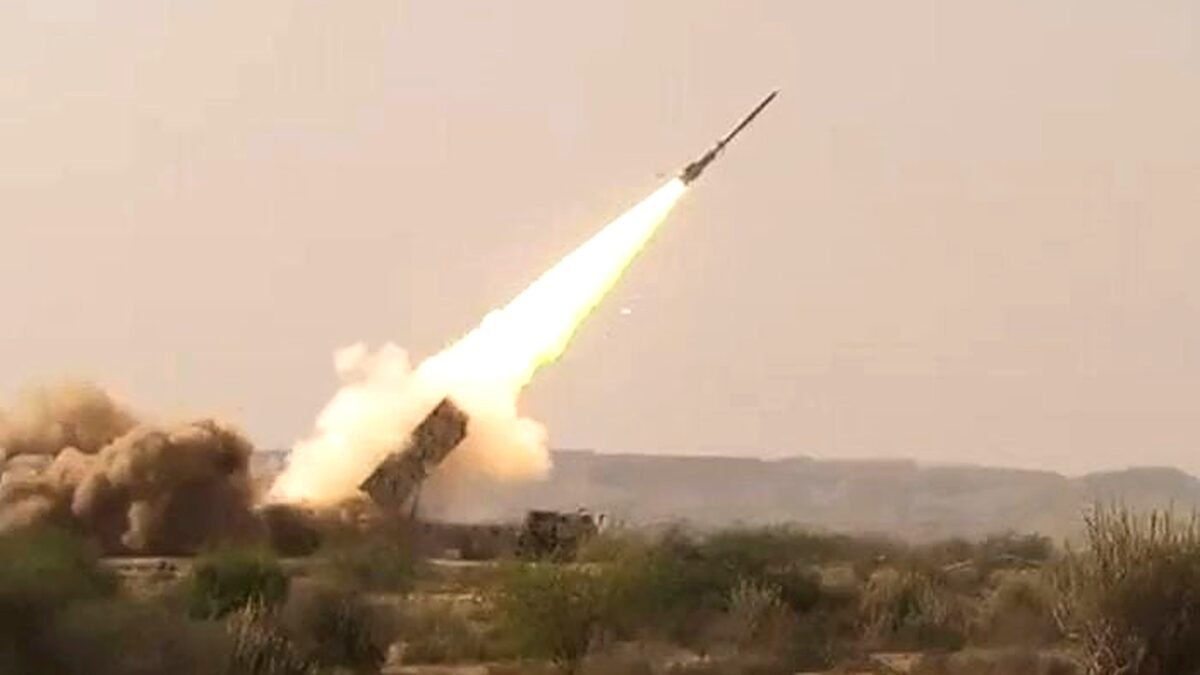
Pakistan’s army successfully test-fired the Fatah-3 supersonic cruise missile on Wednesday, 18 November 2026, the military announced, in the third launch in the fast-growing Fatah missile family in about six weeks and the latest step in a rapid build-up of the country’s conventional long-range strike power.
The Inter-Services Public Relations, the military’s media wing, announced the launch in a statement on Wednesday, calling it “another significant milestone in strengthening Pakistan’s national defence capabilities”, according to The News and Dawn.
According to the statement, the weapon system is equipped with advanced navigation and propulsion systems and is capable of engaging targets at long range with high precision and lethality at supersonic speed. The military said the successful test would “significantly enhance the operational flexibility and strike reach of the Pakistan Army’s Rocket Force Command, further strengthening the country’s overall conventional deterrence and defence posture”.
The launch was witnessed by the commander of the Army Rocket Force Command and senior officers of the Pakistan Armed Forces, along with scientists and engineers, the ISPR said.
President Asif Ali Zardari, Prime Minister Shehbaz Sharif, Chief of Army Staff and Chief of Defence Forces Field Marshal Syed Asim Munir and the services chiefs congratulated the team on the successful launch, according to the ISPR. They appreciated the dedication and commitment of all those who contributed towards what the military described as another significant milestone in the development of Pakistan’s national defence capabilities.
Interior Minister Mohsin Naqvi also congratulated the nation on the successful launch. According to the interior ministry, he said the launch represented a “significant advancement in the defence sector” and a major milestone in the country’s defence capabilities.
The ISPR statement did not disclose the missile’s range, its exact speed, or where the test took place, and no date was given for when the Fatah-3 will formally enter service.
What the ISPR Announced
The announcement, issued on Wednesday, was short on technical detail and long on significance. That is a familiar pattern for Pakistani missile tests: the military confirms the launch, describes the system in broad terms, and leaves the numbers to analysts.
What the ISPR did say, in full, was that the Pakistan Army “successfully conducted the launch of the Fatah-3 supersonic cruise missile, marking another significant milestone in strengthening Pakistan’s national defence capabilities”. The statement described the weapon as equipped with “advanced navigation and propulsion systems” and “capable of engaging targets at long range with high precision and lethality at supersonic speed”.
The reference to the Army Rocket Force Command is the detail that matters most. The Fatah-3 is not a Pakistan Air Force weapon and it is not a strategic, nuclear-capable system. It belongs to the army’s conventional missile force, the command created in August 2025 to give the army its own long-range precision-strike arm. The ISPR’s language — “operational flexibility”, “strike reach”, “conventional deterrence” — places the missile squarely in that conventional role.
The attendance list underlined the point. The launch was watched by the commander of the Rocket Force Command, senior officers, scientists and engineers, and the congratulations came from the very top of the state and the military: the president, the prime minister, the army chief and the services chiefs. Missile tests in Pakistan are routinely marked this way, but the breadth of the congratulations reflects how the Fatah programme has become a flagship of the country’s defence establishment.
There was no mention of any other country in the statement, and no target was named. The ISPR did not say where the missile was fired from, where it landed, or how far it flew. Those omissions are deliberate. Pakistan has never published the range of the Fatah-3, and Wednesday’s statement did not change that.
A Missile First Seen in May
Wednesday’s test was not the first time the Fatah-3 has been seen in public. Pakistan first showed the missile in May 2026, when the ISPR released a video revealing it as a ramjet-powered supersonic cruise missile, shown in a still image as it left a road-mobile launcher, according to Defence-Blog. The unveiling came on 7 May 2026, during a briefing marking the first anniversary of Operation Bunyan al-Marsoos, the name Pakistan gave to its military operations during the May 2025 conflict with India.
The May video gave analysts their first clear look at the weapon. The Pakistani defence outlet Quwa noted that the missile looks a great deal like the HD-1, a supersonic land-attack and anti-ship missile made by China’s Guangdong Hongda Blasting, with the same four side-mounted ramjet intakes and solid rocket booster, according to Defence-Blog. The resemblance has been widely noted by defence analysts, but neither Pakistan nor China has said anything official about the design’s origins, and the ISPR has described the system as part of Pakistan’s own development programme.
A ramjet is what makes the Fatah-3 different from the other cruise missile in the family. Unlike a rocket, which carries its own oxidiser, a ramjet breathes air as it flies, burning fuel in a stream of compressed incoming air. That lets a missile keep flying at supersonic speed for much of its flight, rather than slowing down after the booster burns out, as Defence-Blog explained. For the defender, that means less time to detect, track and intercept. For the attacker, it means a weapon that arrives fast and stays fast.
Quwa’s profile of the Fatah family puts the Fatah-3’s speed at Mach 2.2 to Mach 3.5, which would make it roughly two to three-and-a-half times the speed of sound. That figure comes from the specialist outlet’s assessment, not from the ISPR, and it should be treated as an estimate. The military has confirmed only that the missile flies at supersonic speed.
The road-mobile launcher matters as much as the missile. A weapon that can be moved, hidden and fired from a truck is far harder to find and destroy before launch than one tied to a fixed site. Mobility is a central feature of the whole Fatah family, and it is one reason the army, rather than the air force, controls these systems.
The Fatah Family, Piece by Piece
The Fatah-3 is the third member of a family that now spans four confirmed variants, from a battlefield rocket to a cruise missile estimated to fly more than 1,000 kilometres. The family is developed by Pakistan’s National Engineering and Scientific Commission, known as NESCOM, and marketed internationally by Global Industrial and Defence Solutions, or GIDS, according to Quwa.
The Fatah-1 was the first of the line, unveiled in January 2021. It is a guided multiple-launch rocket system with a range of about 140 kilometres, designed for battlefield precision against advancing formations, logistics hubs and other front-line targets. It was also the first Fatah-series weapon to see combat, having been deployed during the May 2025 conflict with India, according to Quwa.
The Fatah-2 followed in 2023. It is a larger system, now upgraded from a rocket to a missile, with a range of about 400 kilometres, according to Defence-Blog. In April 2026, the Army Rocket Force Command conducted a training launch of the Fatah-2, described as the first launch since the system was upgraded from rocket to missile, according to the specialist publication Defense Arabia.
The Fatah-3, the supersonic cruise missile tested on Wednesday, fills the gap between the Fatah-2 and the Fatah-4. It flies fast and flat, rather than arcing high like a ballistic missile, and it is designed to strike targets at long range with precision. Its exact range has not been disclosed.
The Fatah-4 is the long arm of the family. It is a subsonic ground-launched cruise missile with a range of 750 kilometres, revealed in August 2025 and first tested on 30 September 2025, which was the first missile test carried out since the Army Rocket Force Command was formed. An extended-range variant, the Fatah-4 ER, was tested on 6 October 2026, and defence analysts estimate its range exceeds 1,000 kilometres, according to Wikipedia’s account of the command’s history.
There is one wrinkle in the family tree worth noting. According to Quwa, the Fatah-3 designation was initially assigned to a different weapon, a 450-kilometre-range missile that was subsequently re-designated as the Abdali missile system. The supersonic cruise missile tested on Wednesday carries the name now, and it is a different system from the one that first bore the designation. The point matters because older references to a “Fatah-3” may describe a different weapon altogether.
Together, the four systems give the army a layered set of options: a short-range battlefield rocket, a medium-range ballistic missile, a supersonic cruise missile and a long-range subsonic cruise missile. Each flies differently, each is hard to defend against in a different way, and each is controlled by the same command.
The Rocket Force Behind the Launch
The Fatah-3 belongs to the Army Rocket Force Command, the conventional missile force Pakistan created in August 2025. Understanding the command is essential to understanding why Wednesday’s test matters.
On 13 August 2025, Prime Minister Shehbaz Sharif announced the formation of the command during a ceremony at Jinnah Sports Stadium in Islamabad, held a day ahead of Pakistan’s 78th Independence Day and three months after the 2025 conflict with India, according to Wikipedia. The command brought ground-launched conventional missiles under one roof, consolidating conventional and rocket units from several formations and specialist detachments into a single operational command.
The first commander named to lead the force was Lieutenant General Muhammad Ishaq Khattak, who had been Director General of Weapons Development at the Strategic Plans Division, with Major General Ameer Muhammad Umrani as chief of staff, according to Defense Arabia.
The operational rationale came directly from the May 2025 conflict. Before the command existed, Pakistan’s long-range strike power depended heavily on the air force: aircraft had to be available, airbases had to be intact, and air superiority had to be contested or won before deep strikes could be attempted. The Rocket Force was designed to fill that gap and give the army an independent long-range strike capability, one that does not depend on aircraft availability, airbase integrity or air superiority, according to Quwa.
Crucially, the command does not control Pakistan’s nuclear weapons. Those remain with the Army Strategic Forces Command under the National Command Authority. The Fatah series, along with the Babur-derived cruise missile family, is managed by the Rocket Force as a conventional force, according to Defense Arabia. That distinction is the point of the command: it gives Pakistan a powerful conventional option that sits below the nuclear threshold, so that a future crisis does not have to escalate immediately from silence to the most extreme weapons in the arsenal.
The command’s first test came quickly. On 30 September 2025, the ISPR announced a successful test of the Fatah-4 surface-to-surface cruise missile, with a range of 750 kilometres, the first missile test since the command’s formation. Since then the pace has only quickened: a Fatah-2 training launch in April 2026, the Fatah-4’s appearance in May, the Fatah-3’s unveiling the same month, and now three Fatah-series tests in about six weeks.
A Six-Week Testing Tempo
Wednesday’s launch was the third Fatah-series test in about six weeks, according to Defence-Blog, and the fourth major Pakistani missile test in that period when the air force’s trial is counted.
On 6 October 2026, the Army Rocket Force Command test-fired an extended-range variant of the Fatah-4 ground-launched cruise missile, designated the Fatah-4 ER, with analysts estimating its range at more than 1,000 kilometres. A week later, on 13 October, the command tested an extended-range variant of the Fatah-2, described by the ISPR as a hypersonic ballistic missile designed to defeat missile defences through its trajectory and manoeuvrability, according to Defense Arabia. The hypersonic label is the most consequential capability claim in the programme, and Defense Arabia noted that the claim rests on a combination of high terminal speed and evasive trajectory rather than a newly verified hypersonic glide vehicle with published data.
Then, earlier this month, the Pakistan Air Force performed a successful flight test of the Fa’az, the country’s first indigenously developed air-to-air missile, fired from a JF-17 Thunder fighter. The ISPR said that test marked “another significant milestone in the advancement of national aerospace and defence capabilities”, according to Dawn. That test was covered in detail on this site on 5 November 2026.
Four tests in six weeks, across two services and four different systems, is a tempo that says something on its own. It suggests a development and production pipeline that is delivering on schedule, a testing infrastructure that can support back-to-back trials, and a political leadership willing to publicise each success as it happens. Missile programmes are usually measured in years between milestones. Pakistan’s Fatah programme is currently measuring them in weeks.
The tempo also has a calendar behind it. The Fatah-3 was unveiled on the first anniversary of Operation Bunyan al-Marsoos, the May 2025 operations. The tests of October and November follow the pattern of a programme that is being driven hard in the months after that conflict, when the lessons of May 2025 are still fresh and the institutions created to apply them — above all the Rocket Force — are still new.
Analysis: Why It Matters
Speed is the point
The most important thing about the Fatah-3 is in its name: supersonic cruise missile. Pakistan already had a subsonic cruise missile in the Fatah-4, which flies at about Mach 0.7, and a ballistic missile in the Fatah-2, which arcs high and comes down fast. What it did not have, until now, was a missile that flies flat and fast at the same time.
That combination is hard to defend against. A subsonic cruise missile can be slow enough for air defences to engage, if they see it in time. A ballistic missile is fast but follows a predictable arc that modern radars can track. A supersonic cruise missile, flying low and sustaining its speed with a ramjet, compresses the defender’s reaction time at every stage: less time to detect, less time to track, less time to fire, and less time for an interceptor to reach it. As Defence-Blog put it, a ramjet lets the missile keep flying at supersonic speed for much of its flight, rather than slowing down after the booster burns out, and that makes it harder for air defences to react in time.
India, Pakistan’s principal strategic rival, fields the BrahMos supersonic cruise missile, developed jointly with Russia and widely regarded as one of the fastest cruise missiles in service. Pakistan’s development of its own supersonic cruise missile closes a gap that has been visible for years. It does not need to match the BrahMos missile for missile to matter. What matters is that Pakistan now has a weapon in the same class, under its own command, which changes the calculations on both sides of the border.
The Rocket Force is now the centre of gravity
Wednesday’s test is the clearest evidence yet that the Army Rocket Force Command, barely fifteen months old, has become the institutional centre of Pakistan’s conventional missile programme. Every Fatah test since the command’s formation has been conducted under its banner, and the ISPR’s statement framed the Fatah-3 explicitly as an addition to the command’s “operational flexibility” and “strike reach”.
That matters because institutions outlast individual weapons. A single missile test is a headline. A command that tests four systems in six weeks is a capability. The Rocket Force gives Pakistan something it did not have before August 2025: a permanent, dedicated organisation whose sole job is conventional long-range precision strike, with its own commander, its own staff, its own budget line and its own test schedule. The Fatah family is its arsenal, and Wednesday’s test shows that arsenal is still growing.
The separation from the nuclear forces is equally important. By keeping the Fatah series conventional and under a separate command from the Army Strategic Forces Command, Pakistan has built a ladder of options. In a future crisis, the army can reach for a conventional missile without reaching for a nuclear one. That distinction, which sounds bureaucratic, is in practice one of the most important features of the whole programme. Deterrence works best when the other side believes you have options short of the ultimate weapon, and the Rocket Force exists to provide exactly those options.
The message is aimed at home as well as abroad
Missile tests are always a form of communication, and the audience is never only foreign. The ISPR’s statement, the attendance of the Rocket Force commander and senior officers, the congratulations from the president, the prime minister and the army chief, and the interior minister’s public message all serve a domestic purpose as well as a strategic one.
For a public that lived through the May 2025 conflict, the tests are reassurance: the military is visibly investing in the capabilities that were tested in that conflict, and it is doing so quickly. For the defence establishment, the steady drumbeat of announcements sustains morale and signals to the political leadership that the money and institutional backing are producing results. And for the wider region, each test is a reminder that Pakistan’s missile programme did not pause after May 2025. If anything, it has accelerated.
It is worth noting what the ISPR did not do. It did not name India, or any other country, as the reason for the test. It did not frame the launch as a response to any specific event. That restraint is itself a message: Pakistan presents these tests as routine milestones in a long-term programme, not as reactions. Whether other capitals read them that way is another matter.
What is not said matters as much as what is
The ISPR disclosed no range, no speed and no test location for the Fatah-3. That silence is deliberate, and it is worth taking seriously rather than treating it as a gap to be filled by guesswork.
Analysts have filled the gap with estimates. Quwa puts the speed at Mach 2.2 to Mach 3.5. Defence-Blog notes the resemblance to China’s HD-1, a missile whose published characteristics are better known. But none of these figures is official, and none of them has been confirmed by Pakistan. The responsible way to read them is as informed estimates, not facts, and this article treats them that way.
Ambiguity has a strategic purpose. A missile whose range is unknown forces an adversary to plan for the worst case. A missile whose speed is undisclosed cannot be dismissed as slow. And a test whose location is not published reveals nothing about where the system is based or how it would be deployed. Pakistan has used this approach for decades, and the Fatah-3 is no exception. The danger is that ambiguity can also breed miscalculation, if the other side assumes the worst and acts on it. That is the perennial tension in deterrence, and it applies to this programme as much as any other.
There is also a narrower caution. The Fatah-3 name itself has a history that could confuse. As Quwa has documented, the designation was first assigned to a 450-kilometre-range missile that was later re-designated as the Abdali system. The weapon tested on Wednesday is a different system that now carries the name. Anyone tracing the programme’s history needs to be careful not to confuse the two.
The testing tempo is the real story
Step back from the single test and the pattern is striking. In about six weeks, Pakistan has tested an extended-range Fatah-4, an extended-range Fatah-2 described as hypersonic, the Fa’az air-to-air missile and now the Fatah-3 supersonic cruise missile. Four systems, two services, one season.
That tempo is the real story of Wednesday’s announcement, because tempo is what separates a programme that works from a programme that merely exists. A missile can be unveiled once and never seen again. A programme that tests four systems in six weeks has a functioning design bureau, a functioning production line, a functioning test range and a functioning chain of command. NESCOM, the developer, and GIDS, which markets the systems for export, are delivering at a pace that would be notable for any defence industry, let alone one operating under the constraints Pakistan faces.
The questions the tempo raises are the ones that will decide whether the Fatah-3 matters in five years’ time. How quickly will it be inducted into service, and in what numbers? Will it be displayed at the Pakistan Day parade on 23 March, as new systems often are? Will GIDS offer it for export, and to whom? And will the pace of testing be sustained into 2027, or was this autumn a burst of activity tied to the anniversary of the May 2025 conflict? The answers will come from the Rocket Force’s next announcements, and they will be worth watching closely.
What to Watch Next
- Whether the ISPR discloses the Fatah-3’s range, or shows the missile at the Pakistan Day parade on 23 March, as new systems are often displayed.
- Formal induction of the Fatah-3 into Army Rocket Force Command service, and which unit receives it first.
- Any official response from India, or a counter-test of an Indian system, in the coming weeks.
- Whether GIDS begins marketing the Fatah-3 for export at international defence exhibitions, and which countries show interest.
- The Rocket Force’s next test, and whether the current tempo of one launch every fortnight is sustained into 2027.
- Comment from China watchers on the missile’s resemblance to the HD-1, and whether Beijing says anything about the design.
- Signals in Pakistan’s defence budget and parliamentary debate about funding for the Rocket Force and the wider Fatah programme.
Sources
- The News — “Pakistan Army launches Fatah-3 supersonic cruise missile” (ISPR statement, 18 November 2026)
- Defence-Blog — “Pakistan test-fires Fatah-3 supersonic cruise missile” (18 November 2026)
- Quwa — “GIDS Fatah Guided Surface-to-Surface Missiles” (Fatah family profile and specifications)
- Defense Arabia — “Pakistan’s Rocket Force Command: Institutionalising the Lessons of Modern Warfare” (30 October 2026)
- Wikipedia — “Army Rocket Force Command” (formation, commanders and test history)

About the Author — Abdul Mannan
Related Articles

Three PTI Leaders Arrested Outside Peshawar High Court Hours After Judges Granted Them Bail
Police arrested three PTI leaders outside the Peshawar High Court on Tuesday, hours after judges granted them interim…

Bilawal Calls for ‘Political Reset’ and Warns Forced Division of Sindh Would Spill Blood
PPP chairman Bilawal Bhutto-Zardari has called for a 'political reset' of Pakistan's system, saying it was 'deliberately destroyed'…
Pakistan Cuts Petrol and Diesel by Rs2 in Tenth Straight Reduction as Daily Pricing Draws Fire From Pump Owners
Petrol falls to Rs328 a litre and diesel to Rs358 in the tenth consecutive reduction, as petrol pump…