
Trump Vows ‘Tremendous Tax’ on Firms Building Data Centres Abroad in 90-Minute White House Press Conference

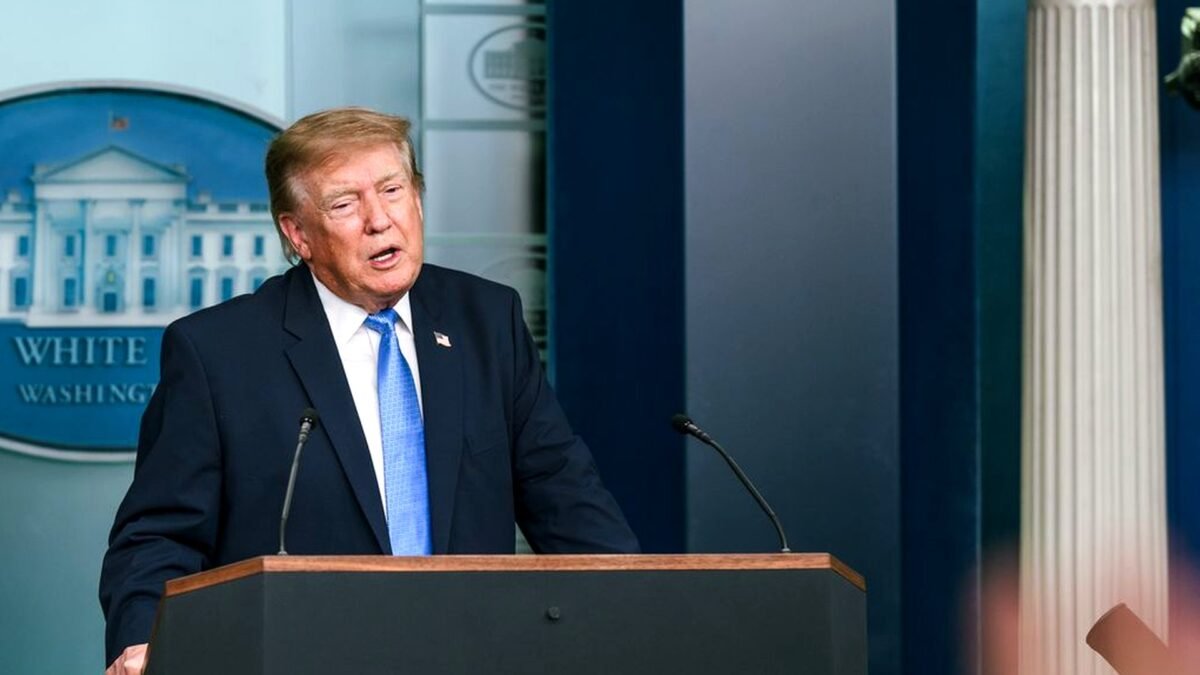
President Donald Trump returned to the White House briefing room on Friday for a freewheeling 90-minute press conference, his first major address to a domestic audience since his Republican Party was heavily defeated in the midterm elections earlier this month, and used it to threaten American technology companies with a “tremendous tax” if they build data centres outside the United States, to defend his description of Vladimir Putin as a friend, and to promise a wave of vetoes against the Democratic Congress that takes power in January — while insisting he was ready to strike deals with the same Democrats, according to Reuters, CNN and USA Today.
The appearance, which followed a four-day trip to China and the Philippines, was billed by the White House as a chance for the president to sell the successes of his journey to the American public. A placard beside the podium listed a series of broad agreements he said he had reached with Chinese President Xi Jinping and the Russian president, Vladimir Putin, including a reaffirmation that nuclear war would be futile for all nations involved. Another poster promoted deals the White House said had been signed during the trip. But as Reuters reported, the president quickly moved away from the scripted message, praising the speed of his new Qatari-built Air Force One, musing that the Covid-19 vaccine had not been rolled out in time to help his re-election chances during his first term, complaining that interest rates were too high, and then turning to Iran.
Flanked by Vice President JD Vance, Secretary of State Marco Rubio and his newly installed chief of staff, Stephen Miller, Mr Trump spoke for an hour and a half in what Reuters described as an unencumbered and unstructured performance. It came after the departures of some of the staff credited with maintaining message discipline at the White House, including former press secretary Karoline Leavitt and, more recently, chief of staff Susie Wiles. The president appeared upbeat for most of the briefing, thanked the large crowd of journalists for attending, and invited them to a reception with refreshments on the South Lawn in the afternoon, according to Reuters. At the end, the pricklier version of the president briefly re-emerged: when an NBC reporter tried to shout a question, Mr Trump replied, “You’re a really rude person,” and added, “So I’m not talking to you.”
The data centre crackdown
The one clear new policy announcement of the afternoon concerned data centres, the vast facilities that power the artificial intelligence boom. Mr Trump vowed to hit American companies with a “tremendous tax” if they try to build data centres in other countries, arguing that there is plenty of domestic demand for the structures, according to CNN and USA Today.
“We’re going to fight very hard for the data centers,” Mr Trump said, according to USA Today. “We’re not going to allow our companies to build data centers outside of our country. We’re not going to allow that to happen.”
“We’ll put a tremendous tax on them if they do it,” he said. “If they won’t go in Texas or they won’t go in California, they’re going to go in West Virginia. We have a lot of places that want them badly, and they’re great places.”
As CNN noted, it was unclear what tax penalties companies would face if they did not comply, and Mr Trump conceded he had not even briefed his own team on the idea yet. The announcement also appeared out of step with public opinion. Polls show Americans are overwhelmingly more concerned about data centre construction than excited by it: a Gallup poll in August found that seven in ten Americans do not want data centres in their communities, according to USA Today, and voters weighed in on data centres in referendums in at least 45 cities and towns in the midterm elections, with the answer in at least 44 contests being to rein in the industry through moratoriums, new regulations or outright bans, according to Data Centers on the Ballot, a website tracking the legislation.
Mr Trump argued that communities should support data centres because whoever leads the development of artificial intelligence, which he calls “super intelligence,” will lead in the future. “You ought to take advantage of data centers,” he said. “Make them pay. Make them pay your communities, but don’t shut them off.”
He also warned that if companies were allowed to build overseas, they would all build in China, and said the United States had made a mistake in the past when it allowed companies to make chips in other countries, causing it to fall behind. “The next thing we know, they’ll build them in space,” he said. “That could happen, too.”
The threat came a day after the Senate approved legislation to ease the approval of data centres as part of a broader overhaul of permitting, according to USA Today. The bill now heads to the House, where Mr Trump said lawmakers must pass it because it will lead to “tremendous amounts of new building.” Mr Trump added that President Xi had congratulated him on how well the United States was doing technologically. “In fact, President Xi congratulated me on how well we’re doing in every way, but also with super intelligence,” he said, according to USA Today.
The announcement landed in a rocky week for the technology industry. As reported on this site on Friday, the Nasdaq suffered its second-largest one-day points drop in history that day, Nvidia fell sharply after Reuters reported that the Securities and Exchange Commission is examining its accounting practices, and Anthropic slid in its second session after a record stock market debut. Mr Trump, who in October awarded prestigious science medals to engineers at some of the biggest artificial intelligence companies and ordered the government to use the term “super intelligence” rather than “artificial intelligence,” praised Anthropic for its stock launch, according to USA Today.
Defending Putin as a ‘friend’
Before any of that, Mr Trump wanted to talk about his continued close personal friendships with Mr Xi and Mr Putin. “We have a very great relationship,” he said from the White House after returning from the four-day trip, according to CNN. “Some of them in this room say, ‘Oh, it’s terrible he gets along.’ I get along with Russia. I get along with China. I get along with a lot of people.”
The president spent large parts of the 90-minute, digression-filled press conference lavishing praise on the two leaders, despite longstanding concerns within his own administration that their countries are working against American interests on key issues, according to CNN. He hailed the warm reception he received in China, defended his description of Mr Putin as “a friend” and touted a historic trilateral summit that, as CNN put it, generated little substantive progress on any thorny issue.
Mr Trump defended his closeness with Mr Putin on several occasions, even as their regular conversations have brought him no closer to ending Russia’s war on Ukraine. He again decried the war’s massive casualties and expressed surprise at how difficult it has been to broker peace, chalking the lack of progress to the “tremendous hatred” between Mr Putin and the Ukrainian president, Volodymyr Zelensky, according to CNN. He dismissed the difficult negotiations as partly a “public relations war,” while suggesting at one point that Russia’s invasion should have “lasted one day” — a remark likely to give Ukraine little assurance of Mr Trump’s ongoing support for its defence, according to CNN.
Mr Trump also signalled that his friendship with Mr Putin is rooted in part because they found themselves on the same side during his first-term impeachment over withholding aid to Ukraine. “I’ve been dealing with Putin during the fake Russia, Russia, Russia hoax, and to be honest, he was very nice about it,” Mr Trump said, according to CNN. As to whether Mr Putin is as friendly to the United States as a whole, the president was less sure: “I can’t speak to America,” he told CNN’s Kaitlan Collins.
According to Reuters, Mr Trump rejected criticisms that he is too deferential towards Moscow — a view polls show is held by most Americans, including many Republicans — repeating his often-stated assertion that Mr Putin is ready for a deal in Ukraine. He doubled down on that claim even as Russia carried out a major nighttime bombardment of Ukraine just hours before the press conference, according to Scripps News. A reporter pressed him on his claim that Mr Putin wants peace. “He’d love to end the war,” Mr Trump responded, according to Scripps News. “It’s a very hard thing to do, to be honest. You have two guys that don’t know how to end it. We’re trying to help them. You have two people that hate each other.”
Mr Trump’s trip to China came after the first-ever trilateral summit between the United States, China and Russia, held in Shenzhen on Thursday, which produced an agreement to continue discussing the reduction of nuclear risks. As NPR reported, the meeting resulted more in agreements to continue discussions than in any concrete changes. At the press conference, Mr Trump said China was building nuclear weapons at a pace that was “hot and heavy” and warned: “They’ll catch us within 10 years.” Mr Rubio, who travelled with the president, said the three countries “possess the overwhelming majority of nuclear weapons on this planet,” according to Scripps News.
An offer to Democrats: olive branch or veto pen
Pressed on how he planned to spend his final two years in office opposite a Democratic Congress, Mr Trump laid out two futures for himself: as a bipartisan dealmaker, or as a hardline issuer of vetoes. The choice, he insisted, would be up to the Democrats, according to CNN.
“They could go two years and one month, because that’s what we have, and I’m going to veto them,” Mr Trump said, according to CNN. But “if they want to get things done, I want to get things done.” He added that the next two years working with Democrats could be even more productive than before, lamenting the constant opposition he faced from a handful of Republicans, including Representative Thomas Massie of Kentucky, according to CNN.
Mr Trump floated deals on bigger topics as well: health care and immigration. But he gave few details on what those deals might entail, and whether there might be any true common ground between Democrats and Republicans on the two issues they have already spent decades fighting over, according to CNN. As Reuters reported, Mr Trump said Democratic Texas governor-elect Gina Hinojosa had called him two days earlier about the border and he thought they could find a solution. He also expressed sympathy for long-settled immigrants who work hard, while insisting enforcement would focus on people who had committed crimes. “They had jails being emptied out from the Congo, from all over South America, from Asia, into our country. Those are the people we focus on, and we focus on them strongly,” he said, according to Reuters. “Now, other people have broken the law, and I will tell you, I think probably one of the earliest things that Democrats are gonna see me, are gonna be very hard-working people that came in, in some cases years ago. What are we gonna do?”
He even had two possible deals in mind already, according to CNN: a federal film credit meant to strengthen Hollywood, and college sports legislation setting national standards for how athletes can profit from their name, likeness and image. On health care, Mr Trump said he was “open to great health care,” but added: “Can it be what they want? No. But it can be a combination of what we all want,” according to USA Today.
As Reuters reported, Mr Trump pledged on Friday to veto legislation passed by Democrats when they take control of Congress in 2027, but said his veto power should be seen as a starting point for lawmakers who want to achieve change. The Democrats will hold significant majorities in the House and the Senate starting in January, after their midterm victories earlier this month. Their first priorities, their leaders have said, include reducing health care costs. House Democrats have formally nominated Representative Hakeem Jeffries as their candidate for Speaker, putting him on track to become the first Black lawmaker to wield the gavel in January, as reported on this site last week.
Another sign that Mr Trump may end up taking the veto path, according to CNN, is his empowerment of Mr Miller, an immigration hardliner who has overseen the administration’s deportation campaign. Mr Jeffries has said Democrats cannot work with Mr Miller. Mr Trump praised him lavishly during the press conference. “They think he’s hard on immigration,” Mr Trump said. “He’s got a tremendous heart.”
The 2028 shadow primary, live on stage
Over Mr Trump’s right shoulder sat Mr Vance. To his left, Mr Rubio. The press conference offered a striking visual of the shadow primary likely to play out over the next several months, as possible 2028 presidential contenders led by Mr Vance and Mr Rubio weigh their options and jockey for Mr Trump’s favour, according to CNN.
Mr Trump leaned into the show of it all, inviting both men to talk before orchestrating a twist ending. Mr Rubio, who travelled to Asia with Mr Trump, delivered an extended account of the trip and its takeaways, focusing in particular on the benefits it could deliver to the American economy and its national security. He also mounted a more polished defence of Mr Trump’s meeting with Mr Putin and Mr Xi than Mr Trump did himself. “The better these three leaders get along, the easier and more conducive the environment will be to actually agree to things that are concrete down the road,” Mr Rubio argued, according to CNN.
As for Mr Vance — who stayed behind as others went to Asia, as is customary for vice presidents — he sought to make light of the dynamics that were sure to be dissected by 2028 watchers. “I would liken it a little bit to Home Alone, but with better food and more gold,” he joked. “So, I miss you, sir.” Mr Vance went on to highlight the passage of a bipartisan permitting reform bill, and he got a boost from Mr Trump, who denied reports that he was upset with Mr Vance for blaming the Republicans’ midterm losses on the Iran war. In Mr Trump’s telling, he only wished Mr Vance would have said the war was still worth it, which Mr Vance pointedly did not do, according to CNN.
But neither Mr Vance nor Mr Rubio were the true stars of the day in Mr Trump’s eyes. That was his new chief of staff, Stephen Miller. “The most powerful man in the room right now,” Mr Trump said of Mr Miller, who, at least until now, has not signalled 2028 ambitions. “He was better than these two guys. Do you want to run for president?” Mr Trump added, in an apparent joke, that Mr Miller was a better public speaker than Mr Vance and Mr Rubio, according to Reuters. Mr Miller is a longtime loyalist whom even fellow Republicans consider a hardliner on immigration and other hot-button issues.
Doubling down on the Iran war
Mr Trump openly acknowledged during the press conference that the Iran war had soured Americans’ mood and cost his party politically. But he showed no signs of backing off a fight that he repeatedly insisted was necessary to prevent the Iranian regime from obtaining a nuclear weapon, according to CNN.
“Watch my lips,” Mr Trump said at one point. “Iran will never have a nuclear weapon, ever.” He went on to deem Iran’s leaders “crazy” and insisted he had no regrets about how he has prosecuted the war, even as he appeared to acknowledge that some in his administration feel differently. “People that work for me, they have a right to their opinion,” he said. “But I say, I know the Iranians. And frankly, they’re crazy.”
“They’ve been bullshitting people for 51 years,” Mr Trump said of the Islamic Republic’s leaders, according to Reuters. Still, Mr Trump had far less to say on the more pressing question: how he plans to definitively win the war and extract the United States from the Middle East. The White House has yet to articulate that strategy, and on Friday all Mr Trump could offer was that Iran was “bullshitting” him, and that he was surprised the economic damage from the conflict had not been worse, according to CNN. “The war drove up prices, fuel prices, far less than I thought,” he said. “I thought it would go up to $300 a barrel.”
Asked about a post on X by Mr Vance following the midterms, in which the vice president blamed the Iran conflict for the Republicans’ losses, Mr Trump said he had no problem with the message. He said he would have only added that he would have attacked Iran no matter the political fallout, according to Reuters.
The defiance came a day after the Senate rejected a bid to end the Iran war in a 51-48 vote, handing Mr Trump a symbolic victory after the midterm rebuke, as reported on this site on Thursday. The war has become the central fault line in American politics: it dominated the midterm campaign, it has divided the president’s own party, and it has now produced a House vote to impeach the defence secretary, Pete Hegseth, forced by Representative Thomas Massie, which was also reported on this site earlier this month.
Tech outages, a sacked cyber chief, and backing for Huang
The administration has come under fire in the past week for its halting response to a series of technology outages. Mr Trump said the various outages were separate events that had been resolved, according to Reuters. But he confirmed a Reuters report that the White House national cyber director, Sean Cairncross, had been ousted, saying he “didn’t think that person was good enough.” The White House named a new national cyber director, Kirsten Davies, on Thursday, according to the Associated Press.
Mr Trump also used the briefing to defend two men at the centre of the week’s biggest corporate scandal: the ousted Nvidia chief executive, Jensen Huang, and the commerce secretary, Howard Lutnick. The growing bipartisan push for tighter restrictions on advanced chip sales to China has not dimmed Mr Trump’s admiration for either man, according to CNN. Mr Trump endorsed reinstalling Mr Huang atop Nvidia despite his reported extramarital affairs, including one suspected of having ties to Chinese intelligence. “I’d like to see Jensen make a big apology and go back,” Mr Trump said, according to CNN. “I would love to see him be back.” He added: “We have to protect our brilliant people. Jensen is one of them,” according to Scripps News.
Nvidia has made clear it has no plans to reinstate Mr Huang, according to CNN. And by keeping Mr Lutnick atop the Commerce Department, even Mr Trump acknowledged that it could create complications for the administration, as Democrats and even some Republicans in Congress launch investigations into his conduct. Mr Lutnick has come under fire from Republicans for resisting efforts meant to prevent chips from being diverted to China, and Reuters has reported that he delayed new restrictions on exports of Nvidia’s advanced artificial intelligence chips. “I have not lost confidence,” Mr Trump said of Mr Lutnick, according to CNN. “He has a natural business instinct. I think he’s doing a very good job.”
Separately, the administration on Thursday moved to effectively drop its lawsuit that sought to block the certification of Democrat Mary Peltola’s victory in Alaska’s Senate race, ending a much-criticised gambit by the president to prevent one of his political rivals from taking office, according to Scripps News.
What the Asia trip actually produced
The press conference was, in theory, a victory lap. Mr Trump returned home on Thursday night from what he called one of the most successful presidential visits to Asia in American history, according to NPR. He met more than 20 world leaders, signed trade agreements — including one with Thailand in Manila — and attended the first trilateral meeting of the leaders of the United States, China and Russia.
But as NPR reported, the trip resulted more in agreements to continue discussions than in any concrete changes. The meeting with Mr Putin and Mr Xi only resulted in an agreement to continue discussing the reduction of nuclear risks. The United States entered the trip, Mr Trump said, from a position of unmatched economic and diplomatic strength. Yet the posters beside his podium could not disguise the thinness of what had actually been agreed: a reaffirmation that nuclear war must never be fought, and a promise to keep talking.
That gap between the staging and the substance was the defining feature of Friday’s performance. The president arrived with a story to tell about a triumphant return from Asia and a new era of great-power cooperation. What the country actually heard, over 90 minutes, was a president improvising his way through the wreckage of a midterm defeat, a war without an exit, a technology sector in turmoil, and a Congress about to change hands.
Analysis: a reset that raised more questions than it answered
Friday’s press conference was supposed to be a reset. After the midterm elections, in which voters punished the Republican Party for the cost of living, for the Iran war and for the data centre boom in their own neighbourhoods, the White House needed its president to show he had heard the message and had a plan for the two years that remain. What it got instead was a performance that contained, in miniature, every contradiction of the second Trump presidency.
Start with the data centres. Here is a president who has made artificial intelligence the centrepiece of his economic argument, who tells voters that whoever leads in “super intelligence” will lead the world, and who has ordered his own government to adopt that very phrase. Yet the voters he needs have turned against the physical infrastructure that makes the technology possible. Seven in ten Americans do not want a data centre in their community. In at least 44 of 45 local referendums held in the midterms, voters chose to rein them in. Mr Trump’s answer to that backlash was not to slow the build-out or to address the electricity prices and noise that drive the complaints. It was to threaten companies that build abroad with a tax he has not designed, has not costed and has not even discussed with his own officials.
The threat is best understood as industrial policy by announcement. It may never become law: a tax on overseas data centre construction would need Congress, and the Congress that arrives in January is run by Democrats who have their own reasons to be sceptical of both the president and the technology companies. But as a signal it matters. It tells the industry that the administration’s support for artificial intelligence is conditional on the jobs and the buildings staying inside the United States, and it tells voters in places like West Virginia — singled out by name by the president — that their communities are next in line for investment. Whether either audience believes him is another matter. The companies have heard this kind of threat before, and the voters have heard promises before. The test will be whether anything follows: a bill, a rate, a regulation. On Friday there was none of that.
The same pattern ran through the foreign policy. Mr Trump insists that his friendships with Mr Xi and Mr Putin are an asset, and that the better the three leaders get along, the easier it will be to agree concrete things down the road, as Mr Rubio put it. That is a coherent theory of diplomacy, and it has a long pedigree. But after a four-day trip and a first-ever trilateral summit, the concrete things amount to an agreement to keep discussing nuclear risks — while China, by the president’s own account, is building nuclear weapons “hot and heavy” and will catch up within a decade, and while Russia was bombarding Ukraine on the very night before the press conference. The friendship has not yet produced a ceasefire, a trade breakthrough or an arms-control deal. It has produced photographs and posters.
That is not to say the approach cannot work. Great-power diplomacy is slow, and the fact that the three leaders met at all is, as Mr Trump’s supporters will note, genuinely historic. But the press conference exposed the gap between the president’s confidence that Mr Putin “wants a deal” and the evidence on the ground. When a reporter pointed out that Russia had just carried out a major attack on Ukraine, the president’s answer was essentially that the two sides hate each other too much to stop. That is an honest observation and a poor strategy. If the hatred is the obstacle, then friendship between leaders is not, on its own, a solution.
The domestic politics were equally unresolved. Mr Trump offered the Democrats two futures — dealmaker or veto — and then spent much of the press conference making the veto future more likely. He praised Mr Miller, the architect of the deportation campaign, as “the most powerful man in the room” and floated him, half-jokingly, as a presidential candidate, even as the Democrats have said they cannot work with Mr Miller at all. He promised to veto Democratic legislation for two years and a month. He offered deals on health care and immigration without a single detail of what he would accept. And he did all of this flanked by Mr Vance and Mr Rubio, the two men most likely to compete for his succession, in a piece of stagecraft that turned a press conference into the opening scene of the 2028 primary.
That staging was the most revealing moment of the afternoon. A president who has lost the midterms and faces a hostile Congress does not normally spend his first big appearance elevating his chief of staff above his vice president and his secretary of state. It suggests that Mr Trump’s attention is already turning to the question of who carries his movement forward, and that he is not yet ready to anoint either of the obvious heirs. Mr Miller’s elevation also sends a message to the Democrats: the man they most want removed from the room is the man the president most wants in it. That is not the posture of a president preparing to compromise. It is the posture of a president preparing for a fight, and daring the other side to join him in one.
On Iran, the press conference confirmed what the Senate vote the day before had already shown: the president will not be moved. He acknowledged the political cost, he acknowledged that his own vice president blamed the war for the midterm losses, and he insisted he would have attacked Iran no matter the political fallout. There is a certain clarity in that. But clarity is not a strategy. The White House has still not explained how the war ends, what victory looks like, or how the United States leaves the Middle East. Mr Trump’s answer on Friday was that the economic damage had been less than he feared. That is a low bar for a war, and it is not one the voters who punished his party in the midterms are likely to accept.
Finally, there is the matter of the people around the president. The departures of Ms Leavitt and Ms Wiles, the two staffers credited with keeping the White House on message, were visible in every digression of Friday’s 90 minutes: the Air Force One aside, the Covid vaccine musing, the feud with an NBC reporter at the very end. Mr Trump has always been at his most effective when he is disciplined, and at his most vulnerable when he is not. On Friday he was, by turns, charming, combative, boastful and defensive — sometimes within a single answer. The invitation to the South Lawn reception was a gracious touch. The “really rude person” line was a reminder of why the discipline mattered.
The press conference, in the end, told the country less about what Mr Trump will do next than about where he stands now: a president with two years left, a Congress about to turn against him, a war without an exit, a technology boom his own voters distrust, and a succession contest already under way in the room behind him. He has not given up on any of it. He has not explained how any of it gets resolved either. That is the work of the next two years, and Friday suggested it will be harder than the posters beside his podium made it look.
What to watch next
Several things will show quickly whether Friday was a turning point or a performance. The first is the data centre tax: watch for a bill, an executive order or even a briefing to officials — anything that turns the threat into policy. The second is the permitting bill the Senate passed on Thursday, which now goes to a House that will change hands in January; its fate will tell us whether the data centre boom has any friends left in Washington. The third is the Democratic response: Mr Jeffries and his colleagues will set out their legislative programme in the coming weeks, and the first bills they send to the president’s desk will test whether the veto threat or the dealmaking offer is real.
On foreign policy, watch for any follow-up to the Shenzhen trilateral: a date for further talks on nuclear risks, a ceasefire proposal for Ukraine, or any sign that Mr Putin’s supposed desire for a deal is matched by action. And on the succession question, watch Mr Vance and Mr Rubio in the months ahead. Friday’s staging was a reminder that the 2028 race has already begun, and that the president intends to be its kingmaker — even if he has not yet decided whom to crown.
Sources
Reuters — Fresh off China trip, Trump bobs and weaves in freewheeling press conference
USA Today — Trump threatens to tax US companies that build data centers overseas
NPR — Trump touts meeting with Xi and Putin but offers little results

About the Author — Abdul Mannan
Related Articles
Nikhil Gupta Sentenced to More Than 19 Years in US Prison for Plot to Kill Sikh Separatist Pannun in New York
A Manhattan federal judge has sentenced Indian national Nikhil Gupta to 19 years and seven months in prison…

US Army Delays Detonation of Nearly Five Tons of Unstable Explosives in Iowa After Lead-Dust Fears and a Lawsuit
The Army has pushed back Monday's planned blast of 68 barrels of degraded lead azide at the Iowa…
Trump Gives Posthumous Pardon to Baseball Legend Pete Rose, Clearing His Tax Convictions Two Years After His Death
President Donald Trump has posthumously pardoned Pete Rose, baseball's all-time hits leader, wiping out the tax-evasion convictions that…