
Russian Corvette Merkury ‘Almost Certainly Destroyed’ in Suspected Drone Strike at Libya’s Benghazi Port

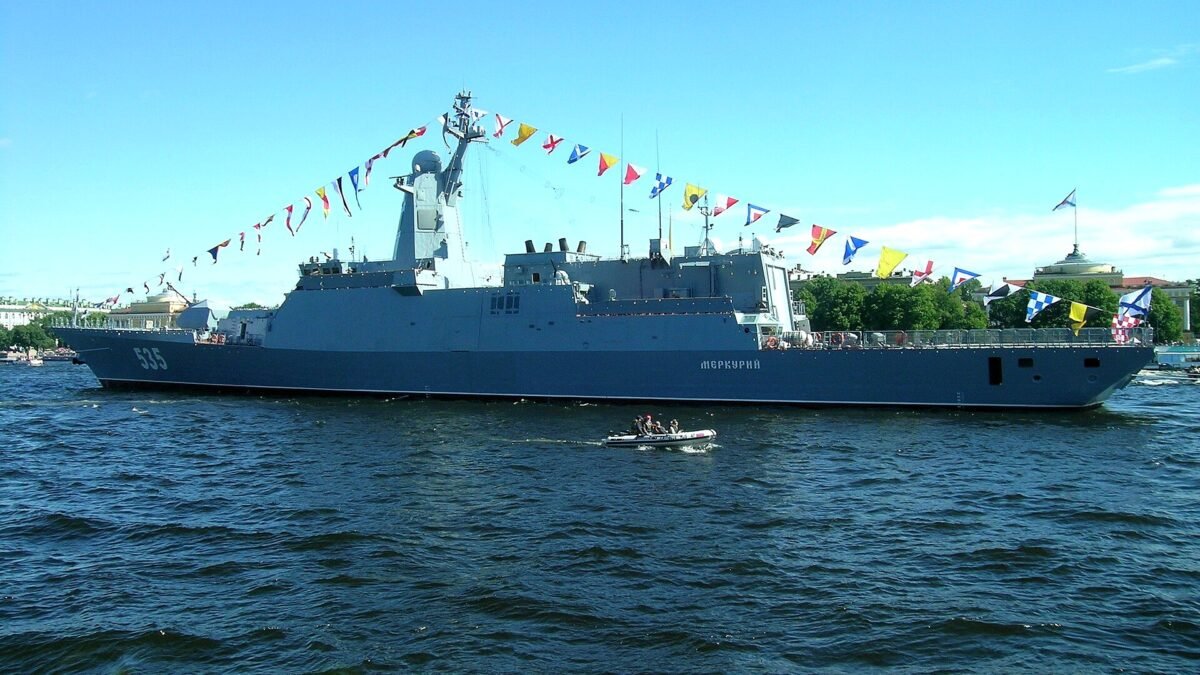
A Russian Navy warship was engulfed in flames after a major explosion at the naval base in Benghazi, Libya, in the early hours of Sunday, 22 November, in what Libya’s eastern-based government said was a suspected drone attack on a Russian vessel docked at the port. Naval analysts who examined satellite imagery of the scene said the ship was almost certainly destroyed, provisionally identifying it as the Steregushchiy-class corvette Merkury, one of the newest warships in Russia’s fleet.
According to Reuters, Libya’s eastern-based government said on Sunday that a preliminary investigation indicated the explosion had occurred aboard a Russian ship docked at Benghazi’s port, and that a drone attack was suspected. The government said the vessel had stopped at Benghazi to refuel and resupply while on its way back to Russia, under maritime cooperation agreements between the two countries.
Two medical sources told Reuters that no deaths had been reported, but that there were injuries. The number and nationalities of those injured were not immediately known. There was no immediate reaction from Russian authorities, and no one had claimed responsibility for the suspected attack by the time the reports were published.
The explosion, reported at around 3 a.m. local time on Sunday, set off a large fire at the naval base and sent plumes of smoke over the port. Residents described hearing several loud explosions, followed by fire and flying fragments, and some accounts mentioned aircraft overhead and anti-aircraft fire, though those details remain unverified. Footage circulating online showed a vessel at the northern docks of Benghazi harbour apparently ablaze, and open-source analysts who geolocated the video said the ship at the centre of the fire appeared to be a warship.
Naval News, citing naval analyst H. I. Sutton, reported that the warship was provisionally identified as the Merkury, a Project 20380 Steregushchiy-class missile corvette, and assessed it as “almost certainly destroyed”. Sutton reported that the Merkury could be seen on fire in multiple satellite images and other sources shared with him, though those images have not been made public. It remained unclear on Sunday whether the corvette had sunk at its berth or had simply burned out at the pier.
The eastern-based government, led by Osama Hammad and based in Benghazi, said in Statement No. 19 of 2026 that the port and naval base facilities, including warehouses, were safe, and that normal operations would resume once the fire was brought under control and the site secured. It condemned the suspected attack as a violation of Libya’s sovereignty and a threat to maritime safety, and said it would take legal and diplomatic measures against anyone found responsible.
“The Libyan government will not allow Libyan ports, territory or territorial waters to be turned into an arena for settling scores or exporting international conflicts,” the government said in its statement, according to Reuters. It also ordered its security and military agencies to open a full investigation and said it would coordinate with Russian authorities on a joint inquiry into the circumstances of the attack, its source and the party behind it. The statement stressed that Libya “is not a party to the Russian-Ukrainian war”.
Two Different Accounts of the Blast
The first official word from Benghazi told a different story. On Sunday morning, the city’s civil defence service said through the Benghazi-based channel Al-Masar TV that it was dealing with “an explosion at an ammunition depot at the Benghazi naval base”. It urged residents not to gather near the base until the fire was under control and gave no cause for the blast.
Tawfiq al-Shamekh, an official of the National Safety Authority in eastern Libya, told the Libyan outlet Al Wasat that emergency teams had brought the fire under control and put it out, and that the cause would be determined only after an expert report. No damage assessment or casualty figures had been released by Sunday afternoon.
The two accounts are not necessarily contradictory. A strike on a warship berthed at a naval base could plausibly have set off secondary explosions in nearby ammunition stores, and residents did report secondary detonations continuing for several minutes after the first blasts. According to local accounts reported by the Libya Observer, armed groups loyal to Khalifa Haftar opened fire into the night sky with anti-aircraft missiles and heavy weaponry as the fire burned over the port. But the gap between the two explanations — an accident at an ammunition depot, or a deliberate attack on a Russian warship — matters enormously, and it remained unresolved on Sunday.
What is no longer in doubt is that a Russian vessel was at the centre of the incident. The eastern government’s own statement, issued later on Sunday, was the first official confirmation that the blast had struck a Russian ship. It did not name the vessel. That identification came from open-source analysts, not from any government, and it remains provisional until Moscow or an official investigation confirms which ship was hit.
The Ship: What We Know About the Merkury
The Merkury is a Project 20380 Steregushchiy-class corvette, hull number 535, commissioned into the Russian Navy in May 2023 after construction at the Severnaya Verf shipyard in St. Petersburg. At 104.5 metres long, with a full-load displacement of about 2,200 tonnes and a crew of around 90, she is one of the most modern surface warships Russia has built in recent years, armed with a 100 mm gun, anti-ship missiles and torpedoes, along with air-defence and anti-submarine warfare systems.
Nominally assigned to Russia’s Black Sea Fleet, the Merkury has been operating out of Northern Fleet bases in the Arctic because of the war in the Black Sea, according to Naval News. She had been at Benghazi for several days before the explosion, escorting a convoy of Russian government-linked ships used to transport military supplies and arms exports, the same publication reported.
That escort role is central to understanding why the ship was in Benghazi at all. Russian government-linked cargo vessels move military cargo through the Mediterranean to Libya and onwards to Russian operations in Africa, and the Merkury‘s job was to protect them. The arrangement also explains why the loss, if confirmed, would matter beyond the fate of a single hull: the corvette was not passing through on a courtesy visit. She was doing the job for which Russia has been building up its presence in eastern Libya.
If the identification holds and the ship is a total loss, the Merkury would be the second Steregushchiy-class corvette knocked out of service in 2026. Her sister ship, the Boikiy, was seriously damaged by Ukrainian aerial drones on 3 June 2026 while in dry dock at Kronstadt, near St. Petersburg, in an attack that produced a powerful explosion and a huge fire that heavily damaged the ship’s superstructure.
Who Is Being Blamed — and What Is Not Yet Known
No government or group had claimed responsibility for the Benghazi explosion by Sunday afternoon, and neither Russia nor Ukraine had officially commented. But suspicion quickly fell on Ukraine, and the evidence for that suspicion is a mixture of a single sourced report, an unattributed local claim, and a pattern of similar attacks.
A source told Axios that Ukraine’s Security Service, the SBU, conducted the long-range strike, according to the Scottish Sun, which reported the Axios account. That is a single anonymous source, and it has not been independently confirmed. A Libyan source in Benghazi told Italy’s Agenzia Nova news agency that the blast could have been caused by a drone attack on a Russian vessel or its cargo, possibly carried out by Ukraine, but offered no physical evidence to support the claim.
What can be said with confidence is narrower: an explosion occurred aboard a Russian ship at Benghazi naval base before dawn on Sunday; Libya’s eastern government suspects a drone attack; a respected naval analyst, working from satellite imagery, provisionally identifies the ship as the Merkury and assesses it as almost certainly destroyed; and no one has yet produced public proof of who carried out the attack or how.
One detail pointed to the seriousness with which Moscow was treating the incident. According to flight-tracking data reported by Defence Blog, a Russian Emergencies Ministry Ilyushin Il-76, registration RA-76362, flew directly from Moscow to Benghazi after the blast. The aircraft’s mission was not stated.
The General Command of Khalifa Haftar’s forces, which controls eastern Libya and the port, had issued no statement on what happened by Sunday afternoon, according to The Insight International. Neither had the port administration. That silence, from the authorities who actually control the ground in Benghazi, left the eastern government’s statement as the only official Libyan account of the day.
A Pattern Across the Mediterranean — and the Baltic
The Benghazi explosion did not happen in isolation. It came one day after a Russian cargo ship was struck by two drones in the Gulf of Finland, and it fits a pattern of attacks on Russian shipping that has stretched from the Black Sea across the Mediterranean over the past two years.
On Saturday 21 November, the Russian-flagged cargo ship Sparta II was hit by two drones in international waters west of Gogland Island in the Gulf of Finland, while travelling towards Kaliningrad. The vessel, operated by Oboronlogistika, a logistics company of the Russian Defence Ministry, was still burning on Sunday morning as it floated in Finnish waters. Finland’s military assessed that Ukraine was likely responsible. The Sparta II is the same class of government-linked cargo vessel that the Merkury was escorting in Benghazi, and the two strikes, a day apart and more than 2,000 kilometres apart, suggest a coordinated campaign rather than coincidence.
The Mediterranean pattern is longer. On 23 December 2024, the Russian government-linked cargo ship Ursa Major was sunk in the Mediterranean, likely by limpet mines. On 3 March 2026, the liquefied natural gas tanker Arctic Metagaz was destroyed off the Libyan coast, likely by uncrewed surface vessels. In April 2026, two Libyan officials told reporters that Ukrainian drone teams were operating from bases in western Libya, which is controlled by the rival government in Tripoli, and that those teams had struck the Arctic Metagaz in March. Another Russian-linked vessel, the Lady Mariia, was also struck off the Libyan coast this year, according to the Maltese Herald.
Taken together, the record shows that Ukraine’s maritime campaign against Russian shipping has expanded far beyond the Black Sea, where it has sunk or damaged more than two dozen Russian vessels since 2022. The Mediterranean, once regarded as a relatively safe operating environment for Russian ships, has become a second front in that campaign — and Libya’s coast, where Russian vessels must call to refuel and resupply, has become one of its most exposed stretches.
Why Russia Uses Benghazi
To understand why a Russian corvette was sitting in a Libyan port at all, it is necessary to understand what eastern Libya has become for Moscow. Russia has built up a substantial military presence in the east of the country through its close relationship with General Khalifa Haftar, whose Libyan National Army controls the region, using air bases and ports under his control as a hub for operations in the Mediterranean and across Africa.
In 2023, President Vladimir Putin signed an agreement with Haftar to establish a naval base in eastern Libya, according to 112.ua, signalling Moscow’s strategic ambitions to bolster its military infrastructure along the Mediterranean coast. Benghazi, a major seaport on the Gulf of Sidra, serves as a vital maritime hub in that network, where Russia uses local infrastructure to support its Mediterranean operations and its supply lines to the Sahel, where Russian forces and affiliated mercenary groups are active in Mali, Niger and Burkina Faso.
The arrangement suits both sides. For Haftar, Russian backing is a source of weapons, money and diplomatic weight in his long-running contest with the internationally recognised government in Tripoli. For Moscow, eastern Libya offers something it has lacked since the fall of the Assad government in Syria: a friendly deep-water port on the Mediterranean’s southern shore, from which its ships can refuel, resupply and project power towards Africa and southern Europe.
That is why the Merkury was in Benghazi, and why the attack, if it was an attack, is more than a tactical success for whoever carried it out. A warship destroyed in a port that Moscow considered secure raises questions about the protection of the entire logistical network Russia has been building in eastern Libya — and about whether Haftar’s forces, whose anti-aircraft guns fired into the night sky on Sunday, can defend the assets Russia has placed in their care.
Analysis: Why It Matters
The most important fact about Sunday’s explosion is also the most uncertain one: whether the ship that burned at Benghazi was really the Merkury, and whether she is really destroyed. Everything else — the condemnation from Libya’s eastern government, the speculation about Ukraine, the pattern of attacks — flows from that identification, and it still rests on satellite images that have not been made public and on the judgement of a single analyst, however respected. Until Moscow confirms the loss or imagery is published, the story should be read with that caveat attached to every sentence. But if the identification is right, the consequences are considerable, and they reach well beyond one corvette.
First, the strike would show that Ukraine’s long-range drone campaign has reached a new level of ambition. The Sparta II attack in the Baltic on Saturday and the Benghazi explosion on Sunday, if both were Ukrainian operations, were carried out on the same weekend, more than 2,000 kilometres apart, against the same class of target: the government-linked cargo fleet that sustains Russia’s military logistics. That is not opportunism. It is a campaign aimed at the arteries of Russian power projection, and it is being fought with weapons — long-range drones and uncrewed surface vessels — that cost a tiny fraction of the ships they destroy. A corvette that took years to build and tens of millions of pounds to commission can, on this evidence, be destroyed in a single night by a weapon that costs less than a family car.
Second, the incident exposes the fragility of Russia’s Mediterranean position. Moscow’s presence in eastern Libya depends on Haftar’s goodwill and on the assumption that Benghazi is a safe harbour. Both assumptions looked weaker on Sunday. Haftar’s forces fired their anti-aircraft guns into the dark, but the ship burned anyway. Libya’s eastern government, which depends on Russian support, was left to condemn an attack on its own soil that it could neither prevent nor explain, and to insist — in language that sounded as much like a plea as a policy — that its ports must not become “an arena for settling scores”. A patron that cannot protect its client’s ports, and a client that cannot protect its patron’s ships, is a partnership under strain.
Third, the episode illustrates how the war in Ukraine has spilled into theatres that have little to do with the Donbas. Libya is a sovereign country with its own civil war, its own divided government and its own fragile ceasefire. It is now also, whether it likes it or not, a battleground in a war between Russia and Ukraine that neither Libyan government started. The eastern government’s statement made that point explicitly, and its insistence that Libya “is not a party to the Russian-Ukrainian war” reads as a warning to both sides: fight your war somewhere else. The warning is unlikely to be heeded. As long as Russian warships use Benghazi to refuel and Russian cargo vessels use it to move arms, the port will remain a target — and the people of Benghazi, who woke on Sunday to explosions and anti-aircraft fire, will go on paying the price for a war that is not theirs.
Fourth, the silence from Moscow is itself significant. By Sunday afternoon, Russia had said nothing about the loss of what may be one of its newest warships. That silence is consistent with a pattern: the Kremlin rarely acknowledges naval losses promptly, and often never acknowledges them at all. But silence also has a cost. Every hour without an official account leaves the field to open-source analysts, satellite imagery and anonymous sources, and it leaves Russia’s partners — in Libya, in the Sahel and elsewhere — to draw their own conclusions about whether Moscow can protect the assets it deploys in their countries.
Finally, the episode is a reminder of how much of modern war is now fought in the open, and how much of it is not. The public record of Sunday consists of a few photographs, a government statement, a naval analyst’s assessment and a handful of anonymous tips. The satellite images that supposedly prove the Merkury‘s destruction have not been published. The drones, if drones they were, were never seen. The truth about what happened in Benghazi before dawn on Sunday will emerge, if it emerges at all, in the slow accumulation of evidence — imagery, wreckage, insurance claims, the absence of a ship from a future naval parade — rather than in any single announcement. Until then, the honest account is the provisional one: a Russian ship burned at Benghazi, a government suspects a drone attack, an analyst says the ship was the Merkury and that she is almost certainly gone.
What to Watch Next
Several things will settle the questions Sunday left open. The first is whether Moscow acknowledges the loss. A statement from the Russian Defence Ministry, or the conspicuous absence of the Merkury from future deployments, would confirm what satellite imagery is said to show. The second is whether satellite images of the port are published, which would allow independent analysts to confirm the ship’s identity and her condition. The third is the outcome of the joint Libyan-Russian investigation announced by the eastern government, and whether it attributes the blast to a drone attack or to an accident.
Watch, too, for any claim of responsibility from Kyiv. Ukraine has in the past acknowledged maritime strikes only after a delay, if at all, and the SBU does not routinely confirm long-range operations. But if the operation was Ukrainian, Kyiv may eventually choose to claim it, as it has claimed other strikes on Russian shipping, to demonstrate the reach of its drone campaign.
Watch also for the response in Benghazi itself. If Haftar’s forces tighten security around the port, or if Russian vessels stop calling there, it will be a sign that Moscow regards the attack as a failure of protection rather than a one-off. And watch the Sparta II, still burning in the Gulf of Finland on Sunday morning, for a second data point in what may be a single, coordinated weekend of strikes on Russia’s government-linked fleet.
The war in Ukraine has now been fought for more than four years. Its newest front may be a Libyan port where, before dawn on a Sunday, a Russian warship burned and no one, officially, knows why.
Sources
- Reuters — Libya’s eastern government suspects drone attack caused explosion on Russian ship at Benghazi port
- Naval News — Russian Warship Explosion in Libya Destroys Corvette Merkury
- Defence Blog — Libya says Russian corvette in Benghazi hit by drones
- The Scottish Sun — Putin’s warship with 90 crew ‘destroyed’ in huge blast in Libya port (reporting the Axios account of SBU involvement)

About the Author — Abdul Mannan
Related Articles

Search Resumes at Indonesian Candy Factory as Dozens Remain Missing After Deadly Fire
Rescue teams returned to the burned-out PT Fonusa Agung Mulia candy factory in Cikande on Monday morning, with…

Trump Pushes Ukraine Peace Deal by Early January as Zelensky Pleads for Patriot Missiles After a Week of 2,700 Russian Drones
Washington wants a Ukraine peace deal by early January, before Democrats take Congress — but as Zelensky pleads…
COP31 Collapses in Antalya as EU Rejects Draft That Never Mentions Fossil Fuels — First Failed Summit Since Copenhagen
Two weeks of talks in Antalya ended without a deal on Sunday as the European Union and island…