
Search Resumes at Indonesian Candy Factory as Dozens Remain Missing After Deadly Fire

Rescue teams returned to the burned-out shell of a candy factory in western Java on Monday morning, resuming the search for dozens of workers still unaccounted for after a fire tore through the three-storey plant on Saturday evening, killing at least three people and leaving families waiting outside the gates for news that may take weeks to arrive.
The fire broke out at about 5pm local time on Saturday at the PT Fonusa Agung Mulia factory in Cikande, in Serang regency, Banten province, about 50 kilometres west of the Indonesian capital, Jakarta, according to the Associated Press. The plant, which makes Milkita, a popular Indonesian brand of milk-based candies and snack products, sits in the Pancatama Industrial Estate, a sprawling manufacturing zone that employs thousands of workers from the surrounding towns and villages.
By Sunday evening, Indonesian police had removed 24 body bags from the wreckage, according to Reuters. The confirmed death toll, however, stood at only three, and officials were careful to explain why the two figures do not match: the intensity of the fire left the recovered remains unidentifiable by sight, and police have warned that a single body bag may contain the remains of more than one person.
The search was suspended at 6pm on Sunday because of hazardous conditions inside the damaged building, with parts of the structure at risk of collapse, according to Indonesian news outlet Detik. Crews were expected to resume their work at 7am on Monday, and the police chief of Banten province, Hendra Kurniawan, told Metro TV that search operations would resume on Monday morning.
What happens next will be slow and painful. Police disaster victim identification official Wahyu Hidayati told reporters that the victims could not be identified through visual inspection, and that authorities were collecting DNA samples from relatives, along with the personal belongings of the missing workers, in an identification process that could take two to three weeks. For the families gathered outside the factory, that means the waiting has only just begun.
The Fire and the Rescue Effort
About 300 people were on shift when the fire started, according to the factory’s chief executive, Steven Erwin Wijaya, who spoke at a press conference on Sunday. Of those, 65 were believed to have been working in the area of the plant directly affected by the blaze.
The fire spread with terrifying speed. Flames engulfed the structure and sent thick black smoke billowing into the sky, leaving behind twisted metal and blackened, corrugated iron roofing, according to the Associated Press. Parts of the roof fell in as the fire took hold, and drone footage published by news outlets showed flames consuming the factory while smoke rose over the industrial estate.
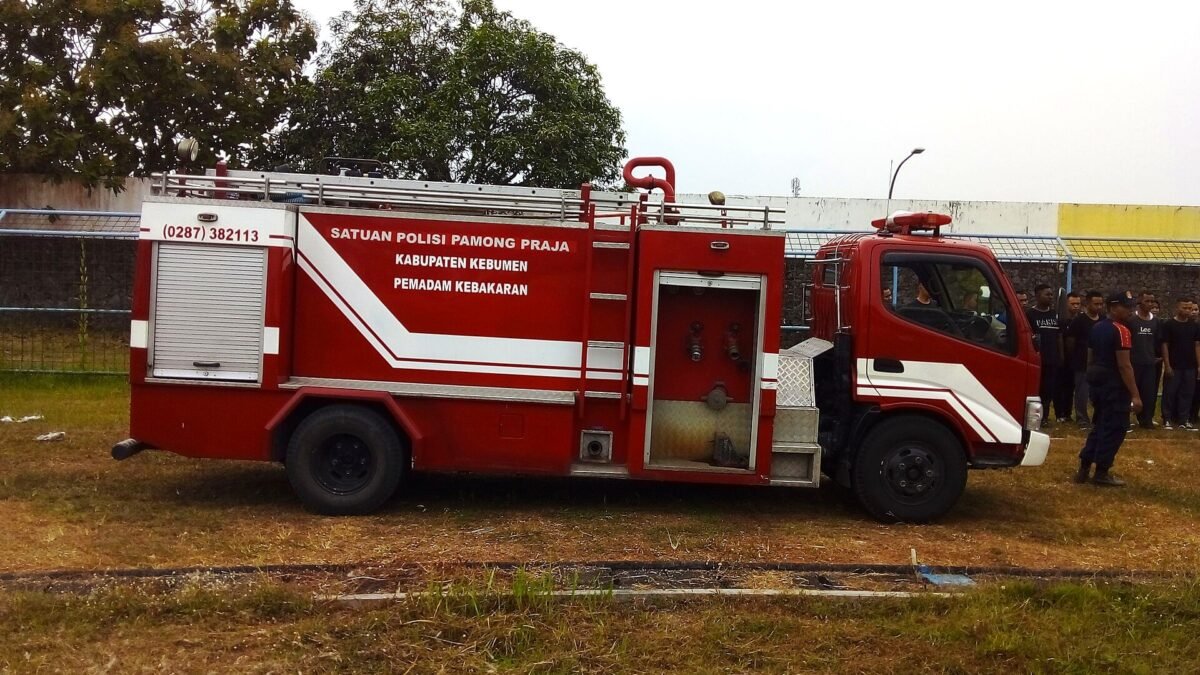
More than 12 hours after the fire began, 15 fire trucks backed by water cannons were still working to douse hotspots concentrated in the central and rear sections of the building, according to the Associated Press. A joint response team made up of police, military personnel, the Indonesian Red Cross and volunteers worked at the site, though structural instability made their work difficult.
“We are conducting sweeps in the areas that have already been brought under control,” Tubagus Mahfud, the operations chief of the Serang fire department, said, according to the Associated Press. “Parts of the structure had collapsed, while poor lighting conditions required firefighters to proceed cautiously.”
Mahfud warned that the factory’s production materials posed a high risk of reignition, making thorough cooling operations critical before crews could access the entire building. The danger was real enough that the search had to be halted overnight on Sunday, with firefighters continuing to battle remaining hotspots a day after the blaze tore through the building, according to Reuters.
Indonesia’s National Search and Rescue Agency, known as Basarnas, is running the search alongside local firefighters. “Authorities continue to coordinate with families and the company to determine the whereabouts of employees believed to have been inside the factory when the fire broke out,” Rizky Dwianto, an official with the Banten search and rescue office, said, according to the Associated Press.
Conflicting Counts, and Why the Numbers Differ
One of the most striking features of the first two days of this disaster has been the confusion over the numbers. Different agencies, speaking at different times and working from different lists, have given different figures for the dead, the injured and the missing, and none of them has yet been reconciled into a single official toll.
The earliest count came from Basarnas on Sunday morning: three workers confirmed dead, 15 rescued, including four taken to hospital, and 36 people unaccounted for. The agency said 54 workers had initially been reported missing and 15 had since been rescued, leaving 36 still missing in its early Sunday count, according to Reuters.
Indonesian police and the factory’s owner, however, put the number of missing closer to 50. Police recovered seven body bags in the early hours of the operation, and by Sunday evening that figure had risen to 24, according to Reuters. The factory’s chief executive, Steven Erwin Wijaya, said at his press conference that the figure of 50 referred to those whom the company had not yet been able to account for.
In a later statement, the factory gave yet another breakdown: of the 65 workers believed to have been involved in the fire, 24 had returned home, four were receiving medical treatment, 29 remained missing and the whereabouts of another eight had yet to be confirmed, according to Reuters.
Officials have cautioned that the figures will change as each floor of the burned building is cleared and shift lists are checked against the people who made it out. That is the honest position, and it is also the reason this report does not present a single definitive death toll. The three confirmed deaths are the only fatalities officially verified so far; the 24 body bags are a measure of what has been recovered, not of how many people died; and the missing figures, ranging from 29 to around 50 depending on the source and the hour, reflect an accounting exercise that is still under way.
The confusion is not unusual in a disaster of this kind, and it is not necessarily a sign that anyone is hiding anything. A factory with 300 people on shift, working across floors and production lines, does not produce a clean headcount in the first hours after a fire. Some workers escape through exits that no one is monitoring. Some go home without telling anyone. Some are on lists that turn out to be out of date. The reconciliation of those lists against the people who survived is painstaking work, and it is work that cannot be rushed when parts of the building are still too dangerous to enter.
What matters is that the authorities have been open about the uncertainty. The police have said plainly that the number of dead is not immediately clear. The rescue agency has said plainly that its counts will change. That candour is worth noting, because it is the only basis on which the public can judge what follows.
Families Wait Outside the Gates
While the numbers were being argued over in press conferences, the human reality of the disaster was playing out at the factory gates. Metro TV footage showed distraught family members weeping outside the factory as they waited for news of relatives feared to have been caught in the blaze, according to Reuters.
Video shared by Metro TV News showed dozens of family members lining up near the site in the hope of learning news of their missing loved ones, according to People magazine, which reported on the disaster. The factory said it had established a hotline for relatives seeking information about missing family members and was maintaining regular communication with affected families.
For those families, the hardest part may be what comes after the search. Because the victims cannot be identified by sight, the police are collecting DNA samples from relatives and from the personal belongings of the missing workers. That process, according to the police disaster victim identification official Wahyu Hidayati, could take two to three weeks.
Two to three weeks is a long time to wait to learn whether a husband, a wife, a son or a daughter is alive or dead. It is also a long time to live with the particular cruelty of this kind of disaster, in which the fire has destroyed not only lives but the ordinary means of recognising the dead. The families will have to give DNA samples, hand over toothbrushes and clothing, and wait for a laboratory to tell them what the fire has already decided.
That wait is the quiet centre of this story. The headlines will move on to the next disaster within days, but for the families in Cikande, the next two to three weeks will be measured in phone calls that do not come and in visits to a factory gate that no longer leads anywhere.
What Caused the Fire?
Authorities have said the cause of the fire is under investigation, and no official cause has been announced. That is the correct position at this stage, and it should be respected: speculation about the cause of a fire that killed people serves no one, least of all the families waiting for answers.
Survivors told Indonesian media that the flames originated from a cooling unit on the third floor of the factory, according to the Associated Press. That account has not been confirmed by investigators, and it should be treated as what it is: the recollection of people who were inside a burning building, reported second-hand, before any formal investigation has concluded.
What is known is that the fire moved fast enough to trap workers on the upper floors, that parts of the roof collapsed, and that the building’s production materials kept reigniting long after the main blaze was brought under control. Those facts, on their own, raise questions that an investigation will have to answer: how quickly did the alarm sound, how clear were the escape routes, and why did so many workers remain unaccounted for hours after the fire began?
Those questions will not be answered in the first days. Fire investigations take time, particularly when the building itself is too dangerous to enter. But they are the questions that matter most, because they are the ones that determine whether this disaster was an unavoidable accident or a preventable one.
The Factory and the Company Behind It
The PT Fonusa Agung Mulia factory is part of Indonesia’s United Family Food company, founded in 1981, according to its website, cited by Reuters. The group employs about 5,000 people, operates from its national headquarters and four international offices, and serves a market of more than 250 million consumers, according to Reuters.
Its best-known product is Milkita, a milk-based candy that is sold across Indonesia and is familiar to a generation of Indonesian children. The factory in Cikande is one of the plants that produces it, and the workers inside on Saturday evening were making a sweet that most Indonesians would recognise instantly.
That familiarity is part of what makes this disaster resonate in Indonesia. Milkita is not an obscure industrial product. It is a household name, and the factory that makes it sits in an industrial estate that is itself a familiar feature of the landscape west of Jakarta, where manufacturing zones like Cikande have drawn workers from across Java for decades.
The company has said little beyond its statements on the numbers and the hotline for families. That is understandable in the first days of a disaster, but the company will face harder questions in the weeks ahead: about the safety of the plant, about the evacuation of its workers, and about what it knew about the risks in its own factory. Those questions will be asked by investigators, by regulators and by the families, and they deserve full and honest answers.
A Familiar Pattern in Indonesia
This disaster does not stand alone. The Associated Press, reporting on the Cikande fire, noted that the tragedy “adds to a string of deadly industrial fires in Indonesia in recent years that have raised ongoing concerns over workplace safety and emergency preparedness”. That is a careful way of saying something blunt: Indonesia has a problem with factory fires, and it has had one for a long time.
The worst example came in the same province, less than a decade ago. On 26 October 2017, an explosion and fire at a fireworks factory in Tangerang, also in Banten province, killed 49 people and injured 46 others. The disaster at the PT Panca Buana Cahaya Sukses factory in Kosambi, Tangerang, was the deadliest industrial accident in Indonesian history.
That fire began, according to the Indonesian National Police, when a welding spark ignited gunpowder in a warehouse connected to the factory. The explosion was heard for miles. Most of the dead were young female workers who were unable to escape because the fire started near the front door of the factory, and local residents had to smash through a side wall to help workers out, according to the Associated Press at the time.
The investigation that followed revealed a catalogue of failures. The factory had been registered as a toy factory, not a fireworks factory, which meant that manufacturing fireworks inside it was illegal. It had been licensed to employ only 10 workers, yet 103 people were inside when the explosion happened. It had been operating for less than two months. The government froze its licence and ordered an evaluation of every fireworks factory in and around Tangerang.
The Associated Press reported at the time that safety laws in Indonesia are inconsistently enforced or even completely ignored, in a country where worker rights are often treated as a lower priority than economic growth and jobs. That judgement, made in 2017, hangs over the Cikande fire in 2026. Nine years separate the two disasters, and they happened in the same province, in the same kind of industrial zone, to the same kind of workforce. The question Indonesians will ask, once the search is over, is what changed in between.
There are differences, of course. A candy factory is not a fireworks factory. There is no suggestion so far that the Cikande plant was operating outside its licence, or that it was overcrowded beyond its permitted capacity. But the pattern is familiar enough to demand scrutiny: a fire in a factory, workers trapped inside, a death toll that rises as the building is searched, and families left waiting for DNA results to tell them who died.
Indonesia’s manufacturing boom has brought jobs and growth to places like Cikande, and that is a real achievement. But growth built on factories where workers cannot escape a fire is growth with a hidden cost, and the cost is paid in lives. The test of a country’s industrial success is not how many factories it builds, but whether the people who work in them come home at the end of the day.
Analysis: Why It Matters
The fire at the PT Fonusa Agung Mulia factory matters for three reasons, and none of them is about candy.
First, it matters because of what it says about the safety of the people who make the things the world buys. Indonesia is one of the largest manufacturing economies in South-East Asia, and its factories supply goods to markets around the world. The workers in those factories are, for the most part, invisible to the consumers who buy what they make. A disaster like this one makes them visible, briefly, and the visibility fades quickly. The challenge is to keep the attention on their safety after the smoke clears.
Second, it matters because of the numbers. The confusion over how many people are dead, how many are missing and how many survived is not a failure of journalism. It is a failure of systems. A factory with 300 people on shift should be able to say, within hours, who was inside and who got out. That it could not, and that different agencies gave different figures a full day later, points to gaps in record-keeping, in evacuation procedures and in the coordination between the company, the police and the rescue agency. Those gaps are fixable, but only if someone is willing to fix them.
Third, it matters because of the wait. The fact that identification will take two to three weeks, and that it will depend on DNA testing, tells its own story about the ferocity of the fire. It also tells a story about the families, who will spend those weeks in a state of suspended grief, unable to mourn and unable to hope. A society’s duty to those families does not end when the fire is put out. It continues through the identification process, through the investigation, through the compensation of the bereaved, and through the reforms that would prevent the next fire.
There is also a wider question here, about how the world pays attention to industrial disasters. A fire that kills dozens of workers in a factory in Indonesia will receive a fraction of the coverage given to a disaster of the same scale in Europe or North America. That is not a complaint about the news media. It is an observation about the value the world places on different lives. The workers in Cikande were making sweets for children. They deserved the same protection as any worker anywhere, and their deaths deserve the same attention.
The Cikande fire is not the largest industrial disaster in Indonesia’s history, and it may not turn out to be the deadliest. But it is a test of whether the country has learned the lessons of Tangerang in 2017. The investigation will establish what caused the fire. The longer question is whether the regulatory system that allowed a fireworks factory to operate with ten times its permitted workforce, under the wrong licence, in 2017, has changed enough to prevent a repeat in 2026. The answer to that question will not come from a press conference. It will come from what happens to the factories that are still operating, in Cikande and across Indonesia, in the months after this fire.
What to Watch Next
The search resumes on Monday morning, and the first thing to watch is whether the missing count comes down as the building is cleared, or whether the number of body bags continues to rise. The police have said the counts will change, and they will. The direction of that change will determine how this disaster is remembered.
The second thing to watch is the identification process. Two to three weeks is the official estimate, but DNA identification can take longer when the remains are badly damaged and when the reference samples have to be collected from families spread across Java. The authorities should be judged on whether they keep the families informed through that process, and whether they deliver the results with the care and the honesty that the families deserve.
The third thing to watch is the investigation into the cause of the fire. The survivors’ account, that the flames began in a cooling unit on the third floor, will be one line of inquiry. But investigators will also want to know about the alarm system, the escape routes, the fire exits, the training the workers received, and the inspections the factory had undergone. The credibility of the investigation will depend on whether it is conducted independently and whether its findings are made public.
The fourth thing to watch is the response of the company and the government. United Family Food is a large and established business, and it will be expected to support the families of the dead and the injured, and to cooperate fully with the investigation. The government, for its part, will be expected to explain what it knew about the safety of the plant, and what it intends to do about the safety of the thousands of other factories in industrial estates like Cikande.
Finally, watch for the pattern. If this fire is followed, as the 2017 disaster was, by promises of reform that fade within months, then nothing will have changed. The measure of this disaster will not be the headlines it generates this week, but whether, a year from now, the workers in Cikande and Tangerang and the other industrial zones of Java are any safer than they were on Saturday evening.
Sources
Reuters, “Indonesia rescuers search for 36 missing after factory fire kills 3” (via LA Post)
Associated Press, “Indonesia candy factory fire leaves multiple dead, dozens missing” (via Fox News)
People, “Dozens Feared Dead After Massive Blaze Engulfs Candy Factory”
Wikipedia, “Tangerang fireworks disaster” (2017 background)
Associated Press, “47 Die in Fireworks Factory Explosion” (2017, via Industrial Equipment News)

About the Author — Abdul Mannan
Related Articles

Trump Pushes Ukraine Peace Deal by Early January as Zelensky Pleads for Patriot Missiles After a Week of 2,700 Russian Drones
Washington wants a Ukraine peace deal by early January, before Democrats take Congress — but as Zelensky pleads…

Russian Corvette Merkury ‘Almost Certainly Destroyed’ in Suspected Drone Strike at Libya’s Benghazi Port
Libya's eastern government says a suspected drone attack caused an explosion aboard a Russian ship at Benghazi naval…
COP31 Collapses in Antalya as EU Rejects Draft That Never Mentions Fossil Fuels — First Failed Summit Since Copenhagen
Two weeks of talks in Antalya ended without a deal on Sunday as the European Union and island…