
NATO Meets in Emergency Session as Poland Confirms All Three Intruding Objects Were Russian Kh-101 Missiles

NATO’s North Atlantic Council is meeting in an emergency session in Brussels today after Polish prosecutors confirmed that all three objects that entered Polish airspace on Friday were Russian Kh-101 cruise missiles. The confirmation, issued on Sunday, removes the last uncertainty about what crossed into allied territory during one of Russia’s largest recent air attacks on Ukraine, and it sets up a day of hard questions about why none of the three weapons was shot down.
Poland will be represented at the meeting by Deputy Defence Minister Pawel Zalewski, who told Polish radio station RMF FM that Warsaw would present its own assessment of the incident, seek a clear confirmation of allied solidarity, and put forward specific proposals to strengthen air defence on the alliance’s eastern flank. NATO Secretary General Mark Rutte is expected to present the results after the talks, according to reports. No joint communique is expected from the meeting.
The session comes three days after the incursion, on the morning of Friday 20 November, when three Russian aerial objects crossed into south-eastern Poland during a large-scale Russian missile and drone attack on western Ukraine. All three came down in Polish territory. No one was injured and no damage to critical infrastructure was reported, according to Polish authorities. But the fact that cruise missiles armed with warheads flew over a NATO member state, were tracked by allied jets, and still reached the ground has forced the alliance to examine its defences in public.
Poland has not formally invoked Article 4 of the North Atlantic Treaty, the consultation mechanism allies use when a member’s security is under threat. Warsaw instead requested additional NATO assets and allied consultations. That choice, deliberate and visible, is itself part of the story: Poland is treating the incident as grave enough to demand an emergency council meeting, but not so grave as to trigger the treaty’s formal alarm bell.
What the prosecutors found
The decisive new fact arrived on Sunday, when district prosecutors in Lublin said that all three objects that flew into Polish airspace on Friday were Russian Kh-101 missiles. Reuters reported the statement, which said preliminary findings from the examination of debris indicated that the missiles had been manufactured in the fourth quarter of 2026 at facilities in Dubna, in Russia’s Moscow region.
Investigators recovered propulsion and guidance parts at the crash site near Nowy Lipowiec, in the Lublin Voivodeship, and said the weapon had been produced in Russia in the last quarter of 2026. Investigations are continuing at the other two crash sites, near Molodycz and Rudnik nad Sanem in the Subcarpathian Voivodeship.
The finding corrects the first military assessments. Early statements described two missiles and a suspected jet-powered drone. The regional governor of Podkarpackie, Teresa Kubas-Hul, later suggested the mix may instead have been a single cruise missile and two jet-powered drones. The prosecutors’ forensic work has now settled the question: three cruise missiles, all of the same Russian type, all recently built.
That detail matters. The Kh-101 is a long-range, air-launched cruise missile designed to fly low and follow complex flight paths intended to complicate interception. Polish officials have said the weapon can carry a warhead weighing up to 990 pounds, according to the Washington Times. The missiles that entered Poland were not stray ordnance left over from an earlier phase of the war, nor were they drones that had drifted off course. They were freshly manufactured weapons, fired as part of a deliberate strike on western Ukraine, that crossed a NATO border and fell on allied soil.
The three crash sites are spread across south-eastern Poland. One missile came down near Nowy Lipowiec, close to the Ukrainian border in the Lublin region. The others fell near Rudnik nad Sanem and Molodycz, in the Subcarpathian region. According to the Washington Times, one of the missiles crashed about 22 miles from the site of multinational military exercises near Nowa Deba, a detail that has sharpened the political argument in Warsaw about whether the incursion was an accident or a message.
The pilot who was cleared to fire, and did not
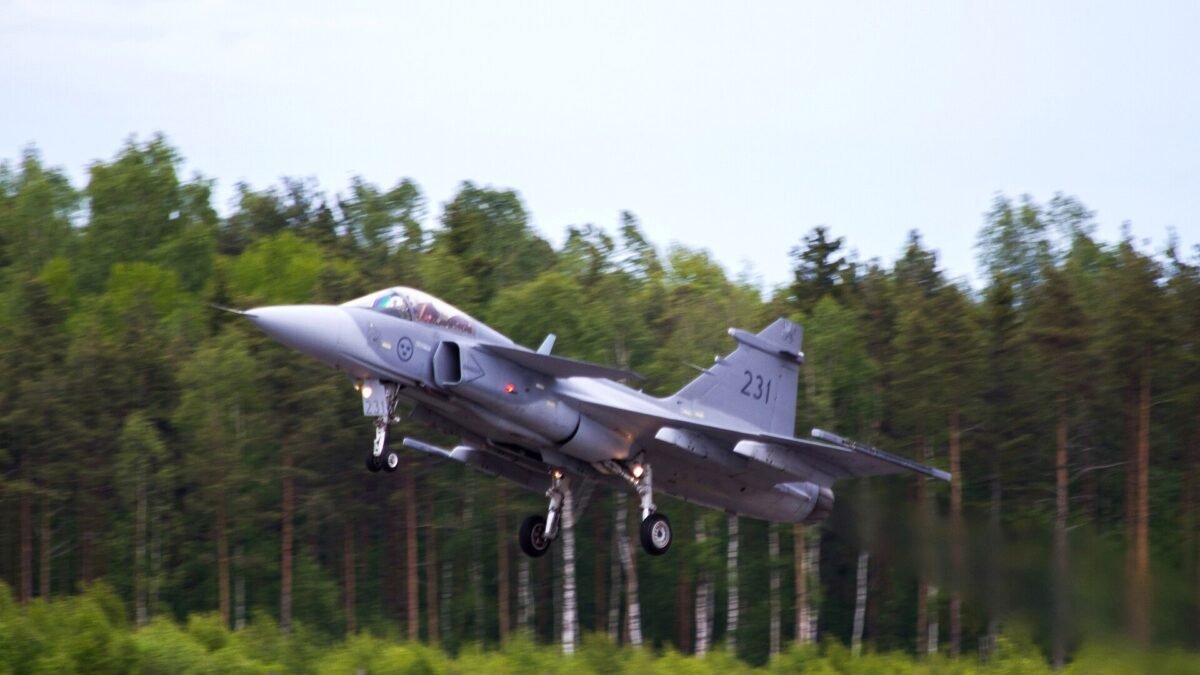
The most revealing account of Friday morning has come not from a politician but from a Polish general. Lieutenant General Ireneusz Nowak, the operational commander of the Polish Armed Forces, told the Polish newspaper Rzeczpospolita that a Swedish fighter pilot had NATO authorisation to shoot down a suspected Russian cruise missile over Poland on 20 November, but held fire because severe weather prevented him from identifying the target.
According to General Nowak, two Swedish JAS 39 Gripen fighters were operating under the direction of NATO’s Combined Air Operations Centre at Uedem in Germany. The command centre had issued a condition-based order, allowing pilots to engage designated threats independently once specified operational conditions were satisfied. One Swedish pilot attempted to intercept an object that military authorities assessed was probably a Kh-101 missile. The aircraft approached the suspected target, but the pilot could not positively identify it using either visual observation or the aircraft’s electro-optical systems. As a result, no missile was fired.
The Swedish Armed Forces subsequently confirmed that its aircraft had tracked several targets over Polish territory during a mission lasting several hours. Deputy Air Force Chief Niclas Magnusson acknowledged that Swedish pilots had operated in exceptionally difficult weather and visibility conditions. The mission also involved aerial refuelling in darkness and preparation of aircraft at a forward operating base in Poland.
Polish F-16 fighters were also in the air, supported by a Polish Saab 340 airborne early-warning aircraft and a Dutch multirole tanker transport, according to specialist aviation reporting. Patriot air defence systems guarding strategic sites were switched on. Yet none of the three objects that entered Polish airspace was intercepted.
Poland revised its air defence procedures earlier this year to permit certain engagements without visual identification, provided other requirements for identifying the threat are fulfilled, according to Air Data News, citing AeroTime. In this case, however, the pilot could not establish the necessary identification through either visual or electro-optical means, and the conditions for firing were not met. General Nowak also cautioned that it is impossible to link the Swedish pilot’s target to a specific crash site, so the object the Gripen pursued may or may not have been one of the three missiles that came down.
The account is important for two reasons. First, it shows that NATO’s rules of engagement worked as designed: a pilot with permission to fire still held back because the identification standard had not been met, even with a suspected cruise missile in front of him. Second, it shows the limits of that design. A low-flying cruise missile, at night, in bad weather, inside Polish airspace for only a short time, can defeat a system built around positive identification. Detection is not the same as engagement, and on Friday morning that gap was wide enough for three missiles to pass through it.
What Poland wants from today’s meeting
Deputy Defence Minister Zalewski told RMF FM that the Polish delegation would focus on three issues. The first is Warsaw’s own assessment of the circumstances of the incident, including an explanation of why Russian aerial objects were able to cross the Polish border. The second is obtaining a clear confirmation of political support and solidarity from all NATO states. The third is presenting specific proposals to strengthen the air defence of the alliance’s eastern flank. Zalewski declined to disclose technical details of the forthcoming proposals, saying such matters cannot be discussed publicly.
Defence Minister Wladyslaw Kosiniak-Kamysz, who announced the extraordinary meeting on Saturday evening, said Poland would soon receive strong support from its NATO allies to bolster the protection of its eastern border. He said he had discussed the situation with General Alexus Grynkewich, NATO’s Supreme Allied Commander Europe, and thanked Secretary General Rutte for his public support.
Poland has asked for reinforcements under Operation Eastern Sentry, the alliance’s eastern defence mission set up in September 2025 after Russian drones entered Polish airspace. The operation brings together allied jets, surveillance aircraft and ground-based air defences on NATO’s eastern flank, and it has since expanded into a broader air defence posture. Poland’s foreign minister has also signalled that Warsaw intends to raise the incident at the United Nations Security Council, according to reports.
The North Atlantic Council is NATO’s main forum for political decisions, bringing together envoys from each of the alliance’s 32 member states. The meeting was confirmed by Poland’s Permanent Representation to NATO. A NATO official told Agence France-Presse that the discussion would take place as part of regular consultations among allies, a formulation that understates the urgency: extraordinary council meetings are not routine, and this one was called within two days of the incursion.
Rutte’s pledge in Warsaw
Secretary General Rutte travelled to Warsaw on Saturday, the day after the incursion, and delivered the alliance’s most direct public reassurance. “I can guarantee that NATO will defend every inch of Polish territory,” he told the Polish Press Agency, describing the incident as clearly dangerous. He confirmed that he had consulted directly with both Prime Minister Donald Tusk and President Karol Nawrocki.
Rutte said General Grynkewich would examine the circumstances of the airspace violation to determine whether adjustments were required to NATO’s deterrence and defence arrangements. Asked whether a similar breach could happen again, the NATO chief said he could not rule it out, but repeated his guarantee that the alliance would defend every inch of Polish territory.
The candour about a repeat is striking. Rutte did not claim the alliance’s defences are now airtight. He promised instead that the alliance would find out exactly what happened and fix what it found. That is the language of a secretary general who knows the council meeting on Monday will be judged not by its communique, which is not expected to exist, but by what changes afterwards.
A deliberate provocation?
Prime Minister Tusk has suggested that Moscow may have staged the incursion deliberately, timed to coincide with multinational military exercises near Nowa Deba. One of the missiles came down about 22 miles from the exercise site, according to the Washington Times. Officials in Warsaw have conceded, however, that no link between the exercises and the airspace breach has yet been proven.
The ambiguity is itself significant. Russia has not claimed the incursion, and Moscow has a long record of attributing such events to navigation errors, debris, or Ukrainian air defences. The forensic evidence now available, three Kh-101 missiles built in the final quarter of 2026, does not by itself prove intent to strike Polish territory. Cruise missiles aimed at targets in western Ukraine can cross a border when their flight paths are planned close to it, and the border between Ukraine and Poland runs through the very region Russia has been striking hardest.
But the pattern around the incursion is harder to dismiss as coincidence. The missiles arrived during a major Russian attack on western Ukraine, at the same time as allied troops were exercising a short distance inside Poland. They followed, by two months, a mass drone incursion that Warsaw also called deliberate. And they coincided with a wider campaign of Russian pressure on NATO states, including the alleged assassination plot against the Ukrainian-American rapper Albert Vasiliev, known as Kyivstoner, which Denmark said it thwarted in September and Poland said it had foiled a month earlier in August. Denmark expelled a Russian official on Friday over that plot, the same day the missiles fell in Poland.
Whether or not the Kremlin intended the missiles to land in Poland, the effect is the same: a NATO member’s territory was struck by Russian weapons, its jets were scrambled, its air defences were activated, and its government was forced to convene an emergency meeting of the alliance. Deterrence is judged by effects, not by intentions, and the effect on Friday was that three Russian cruise missiles crossed a NATO border unopposed.
Two months after the drones
The November incursion is the second major violation of Polish airspace in two months, and the comparison between the two is instructive. On the night of 9 to 10 September 2025, about 19 Russian drones entered Polish airspace during a large Russian attack on Ukraine. Polish F-16s, Dutch F-35s, an Italian airborne early warning aircraft and German Patriot systems were involved in the response, and several drones were shot down. One house was damaged. Poland invoked Article 4 of the North Atlantic Treaty, prompting emergency consultations among the 32 member states, and NATO launched Operation Eastern Sentry on 12 September.
The September incident was, in one sense, easier for the alliance. Drones are slow, and several were destroyed. The November incident was harder: cruise missiles are fast, fly low, and give defenders a far shorter window. In September, NATO could point to interceptions. In November, it cannot. The same mission, Eastern Sentry, that was created to prevent a repeat has now watched a more dangerous weapon cross the same border without being engaged.
That is not a failure of the mission’s concept. Eastern Sentry was designed to strengthen air defence, improve coordination, and add flexibility, and it has done so. But the November incursion exposes the difference between defending against drones and defending against cruise missiles, and between the eastern flank as a policing problem and the eastern flank as a missile defence problem. The council meeting on Monday is, in substance, a meeting about that difference.
There is also a wider context. In September, three Russian MiG-31 jets briefly entered Estonian airspace, and Romania has intercepted Russian drones. The pattern of airspace violations across NATO’s eastern flank is now a sustained one, not a single incident. Each violation tests the alliance’s response a little further, and each time the response is measured in public, in Moscow and in Kyiv.
Analysis: Why It Matters
The emergency meeting in Brussels matters for three reasons, and none of them is the meeting itself. Meetings do not stop missiles. What matters is what the meeting reveals about NATO’s defences, what it decides about reinforcing them, and what it signals to Moscow about the alliance’s willingness to act.
The first reason is the identification gap. The Gripen story is the most honest part of this episode, and the most worrying. A Swedish pilot, flying under NATO command, with conditional authorisation to fire, tracked a probable cruise missile and could not shoot it down because he could not identify it. The rules that stopped him exist for good reasons: firing at an unidentified object over populated territory risks killing the wrong target, or bringing down debris on civilians. But those same rules create a predictable window for an adversary. Russia now knows, if it did not before, that a low-flying cruise missile in bad weather, crossing a border for a short time, may pass through NATO’s defences untouched. The alliance must decide whether that is an acceptable cost of its rules, or whether the rules need to change. Poland’s earlier revision of its procedures, allowing some engagements without visual identification, suggests Warsaw has already reached a view. The question for Monday is whether the alliance as a whole shares it.
The second reason is the restraint on Article 4. Poland invoked the consultation mechanism in September, when drones crossed its border, but has not invoked it in November, when cruise missiles did. That is a deliberate choice, and it can be read in two ways. The generous reading is that Warsaw is confident in allied solidarity and sees no need for the formal alarm, preferring to secure reinforcements through the Eastern Sentry framework instead. The harsher reading is that the threshold for Article 4 has quietly risen: if cruise missiles landing on allied soil do not trigger it, then allies may wonder what would. The truth is probably a mixture of both, and it is a calculation Warsaw will have made carefully. A formal Article 4 consultation would have been a public escalation, and Poland may have judged that the political cost outweighed the benefit when the same result, an emergency council meeting, could be achieved without it. But the choice also sends a signal to Moscow that even a missile incursion does not automatically produce the alliance’s most formal response. That signal will have been noted.
The third reason is the forensic evidence. The fact that all three missiles were manufactured in the fourth quarter of 2026, at a plant in Dubna near Moscow, is a small detail with large implications. It means Russia’s missile production is continuing at pace, producing weapons that are being fired within weeks of manufacture. It undercuts any suggestion that Russia is running low on precision weapons, or that the missiles that crossed into Poland were old stock fired by mistake. It also gives NATO a concrete, verifiable fact to put before the United Nations Security Council, where Poland intends to raise the incident. A debate about intent can be argued endlessly. A debate about a missile built in October and fired in November, which fell in Poland, is shorter.
There is a fourth consideration, quieter but just as important: Sweden. The Gripen pilot was Swedish, flying under NATO command over Poland, in a mission that would have been unthinkable a few years ago. Sweden joined NATO in March 2024, and its aircraft are now part of the alliance’s collective defence of its newest front line. That is a genuine success for the alliance, and it is worth saying so plainly. But it also means that the credibility of NATO’s newest member is now bound up with the credibility of its eastern flank defences. The pilot did nothing wrong. He followed the rules. The question is whether the rules, and the systems behind them, are good enough for the threat they now face.
Finally, the timing matters. The incursion comes as the United States is pushing hard for a Ukraine peace agreement by early January, before the new Democratic Congress takes its seats. American envoy Jared Kushner has said Moscow may be receptive to NATO-style security guarantees for Ukraine, while President Zelenskyy has said he has not seen written commitments on paper. Russia’s foreign minister, Sergei Lavrov, has meanwhile claimed that south-east and most of central Ukraine, including Kyiv, are “traditionally Russian lands”. Against that background, a missile incursion into Poland is not only a military event. It is a reminder, delivered at a moment of intense diplomacy, that Russia’s war is fought on terms Moscow chooses, and that its weapons do not respect the borders of the negotiation. The council meeting in Brussels is, in that sense, a meeting about the peace talks as much as about the missiles.
What happens next will be measured in concrete terms. The alliance will be judged on whether General Grynkewich’s review produces visible changes, whether Eastern Sentry receives the reinforcements Poland has requested, and whether the next Russian attack on western Ukraine is met with a different outcome. The meeting itself will produce no communique. Its results will be visible, or they will not, in the skies over Poland’s eastern border.
What to Watch Next
Several things are worth watching in the coming days. The first is Secretary General Rutte’s statement after the council meeting, which will be the only official account of what the allies agreed. The second is whether any ally announces additional air defence assets for Poland under Operation Eastern Sentry, and how quickly they arrive. The third is General Grynkewich’s review of the alliance’s deterrence and defence posture, and whether it leads to changes in the rules of engagement for allied aircraft over Poland.
Poland’s move at the United Nations Security Council is also worth following. A council session would put the forensic evidence, the Dubna manufacture and the Kh-101 identification, before an international audience, and it would force Russia to respond in public. Moscow’s own account of the incident, when it comes, will be worth reading carefully against the prosecutors’ findings.
Finally, watch the skies over western Ukraine. The incursion happened during a large Russian attack, and the pattern of those attacks, their frequency and their proximity to the Polish border, is the underlying condition that produced Friday’s events. Until that pattern changes, the risk of another crossing remains, and the alliance will be judged on whether it is better prepared for the next one than it was for this one.
Sources
- Reuters — Three Russian missiles flew into Poland Friday, prosecutors say
- Asia Today — NATO Poland meeting held in Brussels after incursion
- NATO SHAPE — Eastern Sentry to enhance NATO’s presence along its Eastern flank
- Air Data News — Swedish Gripen cleared to shoot down Russian missile over Poland but unable to identify target
- UN News — UN warns of escalation risk after large-scale Russian drone incursion into Poland

About the Author — Abdul Mannan
Related Articles
Search Resumes at Indonesian Candy Factory as Dozens Remain Missing After Deadly Fire
Rescue teams returned to the burned-out PT Fonusa Agung Mulia candy factory in Cikande on Monday morning, with…
Trump Pushes Ukraine Peace Deal by Early January as Zelensky Pleads for Patriot Missiles After a Week of 2,700 Russian Drones
Washington wants a Ukraine peace deal by early January, before Democrats take Congress — but as Zelensky pleads…
Russian Corvette Merkury ‘Almost Certainly Destroyed’ in Suspected Drone Strike at Libya’s Benghazi Port
Libya's eastern government says a suspected drone attack caused an explosion aboard a Russian ship at Benghazi naval…