
Trump Warns of New Strikes on Iran After the New Year as He Dismisses Tehran’s Negotiators as ‘Tap Dancers’

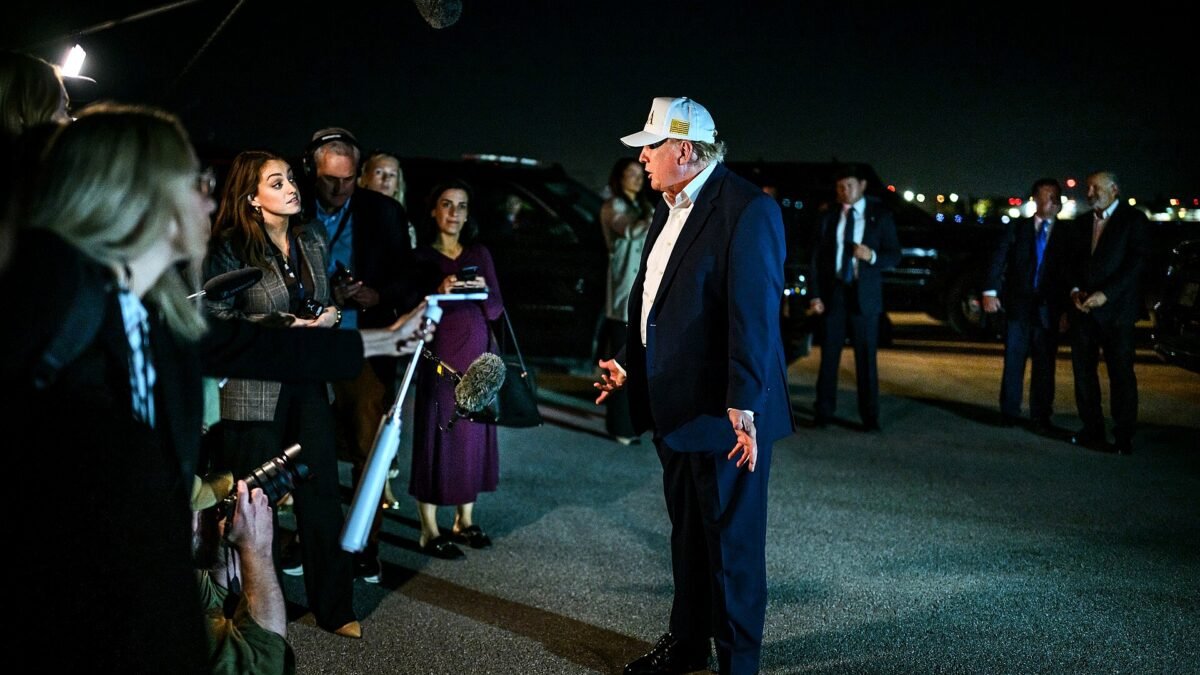
President Donald Trump has said he is inclined to order renewed military strikes on Iran after the new year if the two countries fail to reach a deal, in his sharpest warning yet that patience with the negotiations is running out.
Speaking by telephone to Fox News on Sunday, Mr Trump dismissed the talks with Tehran as empty and mocked Iran’s negotiators, according to reports of the interview. “They talk all the time, all they do is talk,” he said, describing the Iranian negotiators as “professional tap dancers”.
“They’re more aggressive now than before the election,” the president added, referring to the midterm elections on 3 November, in which Democrats won control of both chambers of Congress. The remarks, reported by Fox News and the Daily Mail, set a rough timetable on a war that has already lasted nearly nine months: if there is no agreement by the end of the year, American strikes could resume in January.
Mr Trump has not announced a final decision. But the tone of Sunday’s interview was markedly harder than his language only three days earlier. Flying back from the Shenzhen summit on Thursday, he told Israeli television that he was “not rushing to make any decisions on Iran”. By Sunday, the message had changed: he said he was inclined to escalate, and he predicted a continuation of the tit-for-tat strikes that have defined the past week.
The warning lands at a moment of unusual pressure from several directions at once. In Israel, Prime Minister Benjamin Netanyahu is pressing Mr Trump to strike “as soon as possible”, according to Israeli television reports citing an unnamed source. In Tehran, officials insist the door to diplomacy is still open, but they also insist that Iran’s red lines have not moved. In Washington, Congress is heading towards a funding deadline on 11 December, and the Democrats who take control of both chambers on 3 January are openly debating whether to use that moment to cut off money for the war. And in the Gulf, the past week has brought American strikes on an Iranian missile site, Iranian retaliation against American bases, an attack on a civilian plant in Bahrain and fresh attacks on shipping near the Strait of Hormuz.
What Trump said
The interview was wide-ranging, and its most quoted passages were its bluntest. Mr Trump said he was prepared to order new strikes soon after the new year and accused Tehran of negotiating in bad faith. He also turned to the crowds protesting in several Iranian cities and urged them to “keep protesting”, according to Conservative Daily News, which reported the interview in full.
Asked about signals from Iranian state media that Tehran might try to test the American naval blockade of Iran’s ports, which has been in place since 11 April, Mr Trump replied: “I hope they do; they’ll all be at the bottom of the sea like the rest of the navy,” the Jerusalem Post reported.
He also said this week that he was taking seriously the possibility that Iran could be planning an attack on Washington using a so-called “dirty bomb”, a conventional explosive designed to disperse radioactive material, according to the Daily Mail’s account of his remarks.
After the interview, Mr Trump took to Truth Social to claim that he had successfully predicted Iran would become more aggressive if the Democrats won the midterms. “Iran has launched more drones and missiles in the last week than at any time for over a year. Don’t worry, they’ve all been knocked down, and done no damage,” he wrote. “Iranian leaders consider the Democrats weak, ineffective, and Country destroying, but I won’t let that happen!”
The president’s own vice-president, JD Vance, has admitted that the Iran war was to blame for heavy Republican losses in the midterms, according to the Daily Mail’s report. That admission gives Sunday’s interview a second audience: it was addressed not only to Tehran, but to voters at home who have watched the war drag on and have begun to ask what it is costing.
A shift in tone in three days
The contrast between Thursday and Sunday matters, because it captures how quickly the mood in Washington has moved. On Thursday, Mr Trump said he was “not rushing to make any decisions on Iran” and would “see what happens after the beginning of the year”. On Sunday, the same end-of-year marker had become a deadline: strikes were now something he was “inclined” to order if no deal was reached.
Nothing in the public record explains the shift in a single sentence. But the week behind it was the most violent in months. On Tuesday, American forces struck a missile launch site on Qeshm Island in the Strait of Hormuz, which the United States said was “in response to IRGC aggression” in the region. On Wednesday, Iran retaliated by launching missiles and drones at American bases in the region, which were intercepted by Gulf nations allied with the United States. On Saturday, Iran’s Revolutionary Guards said they had fired missiles and drones at American military positions in Bahrain, home of the US Navy’s Fifth Fleet, while Bahrain said the attack had set a civilian industrial plant on fire.
Iranian state media also released a video on Saturday of what it called an underground Revolutionary Guards “missile city”, showing the Guards’ commander-in-chief, Ahmad Vahidi, and its aerospace commander, Majid Mousavi, touring a facility in which missiles lined the walls of lengthy corridors. Mousavi said in the video that there would be “no hesitation” in confronting threats against Iran and claimed that the country’s capabilities had “increased in the period between the two wars”.
American and Israeli strikes earlier in the war damaged Iran’s missile production facilities, but United States intelligence has estimated that Iran still possesses between 1,500 and 2,500 missiles, the Wall Street Journal reported. American officials said those figures were a low-confidence assessment but affirmed that Iran continues to possess a formidable stockpile if all-out war resumes.
Netanyahu presses for speed
Mr Netanyahu has been the most persistent voice urging speed. Israeli television reported, citing an unnamed source, that the Israeli prime minister wants Mr Trump to strike “as soon as possible”. The same reports said that Israel’s military intelligence had warned Mr Netanyahu that a strike could open “multiple fronts” — a reference to the risk that renewed fighting could spread to Lebanon, Syria and Gaza, where Iranian-backed groups remain active.
Mr Netanyahu repeated his own warning on Sunday that Iran or its proxies could attack ahead of elections on Tuesday to disrupt the vote, citing intelligence. “The IDF is ready both to defend and to strike,” he said in a video recorded during a visit to an anti-ballistic missile battery, adding: “You will suffer disproportionate blows far greater than you can imagine.”
The Israeli leader’s urgency is easy to understand and hard to square with the American timetable. Israel faces elections on Tuesday, and Mr Netanyahu has built his campaign in part around the argument that only continued pressure on Iran can keep Israel safe. A strike before the vote would be politically useful to him; a strike after the new year, on Mr Trump’s timetable, would come after the ballots are counted. That difference in timing is one of the quiet tensions running through the alliance, and it helps explain why the Israeli press has been reporting the prime minister’s private lobbying so prominently.
Iran’s answer: still talking, still unmoved
Tehran’s public answer to Mr Trump’s warning has been to insist that diplomacy has not failed, while refusing to move on the issues that matter most. Foreign Minister Abbas Araghchi told the state-owned Iran newspaper that messages continued to be exchanged between Iran and Washington through mediators, and that Tehran was seeking “an agreement that would ensure there was no further war”. He also said Iran wanted guarantees that Washington was serious about negotiations before proceeding further, and that Iran had discussed with mediators the form and nature of confidence-building measures.
The foreign ministry’s spokesperson, Esmail Baghaei, said Tehran had not closed the window of diplomacy and that messages were still being passed to the United States via intermediaries, although negotiations over the war had appeared to stall for weeks. He said the United States appeared to persist in unilateral demands, and that Mr Trump and American officials repeatedly used the phrase “complete surrender”, which, Mr Baghaei said, no Iranian accepts.
Iran’s red lines, as Mr Araghchi described them, include keeping its highly enriched uranium inside the country. The International Atomic Energy Agency estimated that Iran had 440.9 kilograms of uranium enriched to 60 percent when Israel and the United States attacked Iranian nuclear facilities in June 2025. Mr Araghchi has said there is “no solution” unless Washington fulfils its earlier commitments, and that as long as Iran’s demands are not met, discussion of the Strait of Hormuz and its opening is pointless.
At the same time, a spokesman for Iran’s parliament said on Monday that “the US only understands the language of force”, a reminder that the hardline current in Tehran regards negotiation itself with suspicion. The two messages — the foreign minister’s talk of guarantees and the parliament’s talk of force — are not contradictory so much as they are two faces of the same position: Iran will talk, but it will not surrender, and it will not give up the uranium stockpile that is its principal bargaining chip.
Mr Trump, for his part, said on Friday: “They want to make a deal, but they don’t want to make a deal that’s acceptable to me.” That single sentence captures the deadlock. Both sides say they want an agreement. Neither side will accept the other’s terms. And the clock, which Mr Trump has now wound forward to the new year, is ticking in public.
The diplomacy track: Qatar, Oman and a Monday meeting
While the threats have grown louder, the quiet work of mediation has continued. Qatar and Oman have served as intermediaries between the United States and Iran, and Qatari and Omani officials met Iranian diplomats last week. On Monday, at 2pm Washington time, Secretary of State Marco Rubio was due to meet Sheikh Mohammed bin Abdulrahman Al Thani, Qatar’s prime minister and foreign minister, whose government carries messages between the two sides.
Egypt’s foreign minister said on Sunday that a compromise was still possible. That is the most optimistic official assessment to have emerged in days, and it is worth weighing against the harder evidence: talks have stalled for weeks, the American side has spoken openly of a January deadline, and the Iranian side has spoken openly of force.
The mediation effort matters because it is the only channel that has produced results in this war. The ceasefire in Gaza, which took effect in October 2025, was brokered through the same intermediaries. The question now is whether the same machinery can be turned to a much larger conflict, one in which the stakes include the Strait of Hormuz, the global oil trade and the security of every Gulf state that hosts American forces.
The week that led here
To understand why Mr Trump’s warning carries weight, it helps to retrace the week that preceded it. The war itself began on 28 February, when the United States and Israel attacked Iran, prompting Tehran to strike Israel and Gulf states hosting American military bases. Since then, the conflict has settled into a pattern of strikes and counter-strikes, punctuated by negotiations that never quite produce a deal.
Last Tuesday’s American strike on the Qeshm Island missile site was described by Washington as a response to Revolutionary Guards aggression in the region. Iran’s retaliation on Wednesday — missiles and drones fired at American bases — was intercepted by Gulf allies, and no damage was reported by the United States. But the exchange did not end there. On Saturday, the Revolutionary Guards said they had fired missiles and drones at American military positions in Bahrain, claiming that “two radars belonging to the US Army’s Patriot air defence systems” had been struck at the Al-Riffa and Awali bases. The reported strikes and any damage have not been independently verified, according to Iran International.
Bahrain’s account was different. The kingdom’s Interior Ministry said on X that “a civilian industrial facility was targeted, causing a fire at the site”. On Sunday, the ministry said two people had been hurt: a Bahraini citizen in stable condition and a Pakistani resident in critical condition, according to The National. Residents told Agence France-Presse that they had seen smoke rising over Sitra Island. Bahrain’s Foreign Ministry rejected Iran’s justification and said the kingdom “reserves its inherent right to take all necessary measures to safeguard its sovereignty”. Saudi Arabia, Kuwait and Qatar condemned the attack on Sunday, according to ABC News.
The same day, a British maritime agency reported that two tankers had been struck by unidentified projectiles near Khasab, Oman, with no casualties, according to Al Jazeera. The incident was the latest in a series of attacks on shipping in and around the Strait of Hormuz, through which a large share of the world’s seaborne oil passes. The head of United States Central Command, Admiral Brad Cooper, was flying over the strait on Sunday and asserting that more than 3,000 commercial vessels had transited the waterway with American military support over the last six months, according to the Associated Press.
Meanwhile, Yemen’s Houthi rebels continued to fire drones and missiles towards Saudi Arabia. Saudi military spokesman Major General Turki al-Malki said air defences had intercepted and destroyed a ballistic missile and a drone fired towards Riyadh. Saudi authorities said debris from the interception of two ballistic missiles in Khamis Mushait and Ahad Rafida governorates had wounded two people, a Saudi citizen and a resident from an unspecified Asian country, and had damaged three buildings and seven vehicles. The Houthis later claimed attacks that included the King Khalid air base in Khamis Mushait, calling them a response to “Saudi aggression” against the rebel-held capital, Sanaa. The Associated Press said it could not independently verify the claims.
Two American aircraft carrier strike groups are operating in the Arabian Sea, the Jerusalem Post reported. The war has cost 48.3 billion dollars so far, not counting damage to bases, a Pentagon official said last week, according to Conservative Daily News.
Congress and the money
Mr Trump’s timeline collides with a fight in Congress that may matter as much as anything Tehran does. Federal funding runs out on 11 December, and Democrats who take control of both chambers on 3 January are debating whether to use that deadline to cut off money for the war.
Senator-elect Abdul El-Sayed, a Democrat from Michigan, was asked on NBC’s “Meet the Press” whether he would back a shutdown to defund the war. “It wouldn’t be Democrats shutting down the government,” he said. “It would be Donald Trump choosing his war over a functional government.” Mr El-Sayed said Congress “does not have a responsibility to fund an illegal, unjustified war”, but he did not say directly whether he would vote for a shutdown.
House Speaker-designate Hakeem Jeffries, a Democrat from New York, told CBS’s “Face the Nation” that Democrats plan “very early on in the new Congress” to “end this reckless and costly war of choice in Iran”, which he blamed for higher petrol, food and diesel prices. House Democrats remain divided over whether to risk a lame-duck shutdown now or wait until they hold the majority next year, according to The Hill.
The Senate has already had its say once. On 20 November, it rejected a bid to end the Iran war in a 51-48 vote, handing Mr Trump a symbolic victory after the midterm rebuke. That vote showed that the president still commands a majority for the war in the Senate as it stands today. But the Senate that voted on 20 November is not the Senate that will sit on 3 January, and the House that takes office in January will be led by a Speaker who has promised to end the war “very early on”.
For military families and anyone watching prices at the pump, the two deadlines now line up: a funding fight in mid-December, and a possible decision on new strikes in the same weeks that the new Congress takes power. Mr Trump has given himself until the new year. Congress may not give him that long.
The wider region: Gaza, Yemen and the detainees
The Iran crisis is not the only pressure on the region. In Gaza, Israeli strikes killed seven people on Sunday, according to Palestinian hospital officials. Two strikes in Gaza City killed four people, two brothers were killed in the southern city of Khan Younis, and one person was killed in the central town of Deir al-Balah. The deaths were confirmed by officials from Shifa, Hamad, Nasser and Al-Aqsa hospitals, as well as an American field hospital. The Israeli military did not immediately comment.
A ceasefire that took effect in October 2025 has largely halted major fighting in Gaza, but near-daily Israeli strikes have continued. More than 1,500 Palestinians have been killed since the truce began, according to the territory’s Health Ministry, which is part of the Hamas-run government. It does not distinguish between civilians and militants, but says women and children make up nearly half of those killed.
There was one small sign of movement. The International Committee of the Red Cross has begun receiving lists again of Palestinian detainees from the occupied West Bank and Gaza, after the Israeli Supreme Court ordered the government to resume sharing them. The government had suspended both practices since the Hamas-led attacks of 7 October 2023 and the start of the war in Gaza. ICRC spokesperson Gilad Grossman said Israel had not yet allowed prison visits to begin again, but “we hope that we will resume in the near future”. Around 9,000 Palestinians are still imprisoned or detained under harsh conditions, according to the Associated Press.
In Yemen, Pope Leo XIV urged an end to the fighting and warned of worsening conditions for more than one million residents of Taiz, besieged by Houthi rebels. “The population is suffering from a lack of food, water and medical care,” the pope wrote on social media. Families have begun rationing water, and a shortage of groceries has sent prices soaring in the country’s third-largest city.
Libya’s rival governments, meanwhile, rejected comments by Mr Trump in which he added the nation to a list of countries he described as “terror-infested”. Prime Minister Abdulhamid Dbeibah said he rejected “any affront” to his country or its people, “who have made great sacrifices in the fight against terrorism”. Libya’s second government, the self-styled Libyan National Army, called for the authorities to lodge a protest against Mr Trump’s comments.
Analysis: a deadline with two audiences
Mr Trump’s warning is best understood as a message with two audiences and two purposes. The first audience is Tehran. The president is telling Iran’s leaders that the negotiation they have been conducting for weeks — the one he now calls “tap dancing” — has a hard end, and that the end is the new year. The second audience is at home: the voters who punished his party in the midterms, the Democrats who will control Congress in January, and the allies in the Gulf who have borne the brunt of Iranian fire and have been urging a negotiated settlement.
The deadline is not a decision, and it is important to be precise about that. Mr Trump said he was “inclined” to order strikes, not that he had ordered them. He said “after the new year”, not on a date. He said “if” the talks fail, not “when”. Every word leaves room to step back. That is how deadlines work when they are issued by a president who has repeatedly used them as leverage: they are meant to concentrate minds, not to commit the person who sets them.
But deadlines also have a way of acquiring a life of their own. Once a president has said publicly that strikes are likely after the new year, every day that passes without a deal becomes evidence that the deadline is approaching, and every incident — a tanker struck, a drone intercepted, a radar claimed destroyed — becomes a reason to act sooner. The risk is not that Mr Trump has decided to strike. The risk is that the calendar, the politics and the incidents will decide for him.
Consider the calendar. The Israeli election is on Tuesday. The funding deadline is 11 December. The new Congress takes office on 3 January. The new year begins the day before the Democrats take power. If Mr Trump waits until January, he will be ordering strikes in the same week that a new House Speaker has promised to end the war. If he strikes in December, he will be doing so while Congress is fighting over whether to fund the government at all. There is no clean window. Every date on the calendar is crowded.
Consider the politics. The midterm result changed the war’s domestic standing. Mr Vance’s admission that the war cost Republicans the election is a remarkable concession from a vice-president, and it tells us that the administration knows the war is unpopular. Mr Trump’s response has been to double down: to argue that Iran has grown bolder since the election, and that only force will answer it. That is a coherent argument, but it is also a gamble. If strikes resume in January and the war escalates, the same voters who punished the party in November will be watching again, and the Democrats who take power in January will have a ready-made case that the president chose war over the negotiation he himself said was still under way.
Consider the incidents. The pattern of the past week — an American strike on Qeshm, an Iranian reply against American bases, an attack on a civilian plant in Bahrain, two tankers struck near Oman, Houthi missiles over Riyadh — is a pattern of escalation by small steps. None of these incidents, taken alone, would justify a new campaign. Taken together, they create a momentum of their own. The danger is that a single incident — a tanker sunk, a base hit hard, a civilian death toll that cannot be ignored — will force a decision before the deadline arrives.
There is also the question of what a deal would even look like. Mr Araghchi has said Iran wants guarantees that Washington is serious, and that its red lines include keeping its enriched uranium in the country. Mr Trump has said Iran wants a deal, but not one that is acceptable to him. The gap between those positions is the gap between a deal and a war. Closing it would require one side to give ground on the issue that matters most to it: for Iran, the uranium stockpile; for the United States, the demand that Iran’s programme be constrained in a way that can be verified. Neither side has shown any sign of moving, and the mediators — Qatar, Oman and Egypt — have been reduced to carrying messages between two governments that no longer trust each other.
What is genuinely new about Sunday’s interview is not the threat itself. Mr Trump has threatened Iran before, and he has set deadlines before. What is new is the combination: a named timetable, a public dismissal of the negotiation, a prime minister pressing for speed, a Congress about to change hands, and a region in which the shooting has not stopped for a week. Each of those elements on its own would be manageable. Together, they narrow the space for the one outcome that nobody has ruled out but nobody has achieved: a deal.
The most honest reading of the situation is that the war is now being fought on three fronts at once: in the Gulf, where the strikes and counter-strikes continue; in the negotiating room, where the mediators carry messages between governments that will not speak directly; and in Washington, where the president and the incoming Congress are heading towards a confrontation over whether the war should be funded at all. Mr Trump’s warning touches all three. It tells Tehran that time is short. It tells the mediators that their work has a deadline. And it tells Congress that the president intends to act with or without its blessing.
Whether that warning produces a deal or a war will depend on what happens in the next five weeks. The Rubio meeting with Qatar’s prime minister on Monday is the first test. The Israeli election on Tuesday is the second. The funding fight in December is the third. And the new year itself, when it arrives, will be the moment of truth: either the talks will have produced something, or the president will have to decide whether the inclination he expressed on Sunday becomes an order.
What to watch next
The first thing to watch is Monday’s meeting in Washington between Secretary of State Marco Rubio and Qatar’s prime minister, Sheikh Mohammed bin Abdulrahman Al Thani. Qatar carries messages between Washington and Tehran, and the meeting is the most direct channel available to either side. Any sign that the meeting produced movement — a new proposal, a new date for talks, a new statement from either capital — would be the first evidence that the deadline is working as leverage rather than as a countdown.
The second is the Israeli election on Tuesday. Mr Netanyahu has warned that Iran or its proxies could attack to disrupt the vote, and he has pressed Mr Trump to strike soon. A victory for Mr Netanyahu would strengthen the hand of those in Israel who want speed; a defeat would weaken it, and would remove one of the loudest voices urging the president on.
The third is the American naval blockade, in place since 11 April. Iranian state media have said that Iranian vessels might try to run it, and Mr Trump has said he hopes they do. A convoy of Iranian tankers has been reported gathering near Kharg Island. If those vessels sail, the American response will be the first real test of the new year deadline — and the first chance for an incident to force a decision before the deadline arrives.
The fourth is the funding deadline on 11 December. If Congress fails to fund the government, the war will become part of a shutdown fight, and the politics of the war will be fought in Washington rather than in the Gulf. If Congress funds the government without restricting the war, Mr Trump will have a freer hand in January.
And the fifth is the simplest: whether the talks produce anything at all. The mediators have been carrying messages for weeks. The foreign ministers have spoken of guarantees and red lines. The presidents and prime ministers have spoken of force. What has not happened, in all that time, is an agreement. Until one appears, the deadline Mr Trump set on Sunday will hang over the region, and every strike, every interception and every claim of a radar destroyed will be read as a sign of what January may bring.
Sources
- Daily Mail via DailyFoxNews — Trump prepares for renewed strikes on Iran as he slams their negotiating as ‘tap dancing’
- Associated Press — Iran says messages are still being passed to the US amid war concerns, and other Mideast news
- MENA Today — Araqchi seeks diplomacy, Trump rejects Iran’s conditions
- Silent Dossier — Will the US Strike Iran Again? Trump’s New Year Deadline
- Conservative Daily News — Trump Says Iran Strikes Could Resume After New Year if Talks Fail

About the Author — Abdul Mannan
Related Articles

Iran Flogs Singer Parastoo Ahmadi 74 Times Over Hijab-Free Concert
Iranian singer Parastoo Ahmadi and four members of her concert team were each lashed 74 times in Qom…
Attacks on Shipping in the Strait of Hormuz Hit Highest Level Since Iran War Began
Attacks on shipping in the Strait of Hormuz have reached their highest level since the Iran war began,…
Iran Readies 14-Tanker Convoy to Break the US Naval Blockade in a High-Stakes Gulf Gamble
More than 14 loaded Iranian tankers are staged at Kharg Island in a planned convoy to break the…