
Pakistan’s First Astronaut Muhammad Zeeshan Ali to Fly to China’s Tiangong Space Station on Shenzhou-24

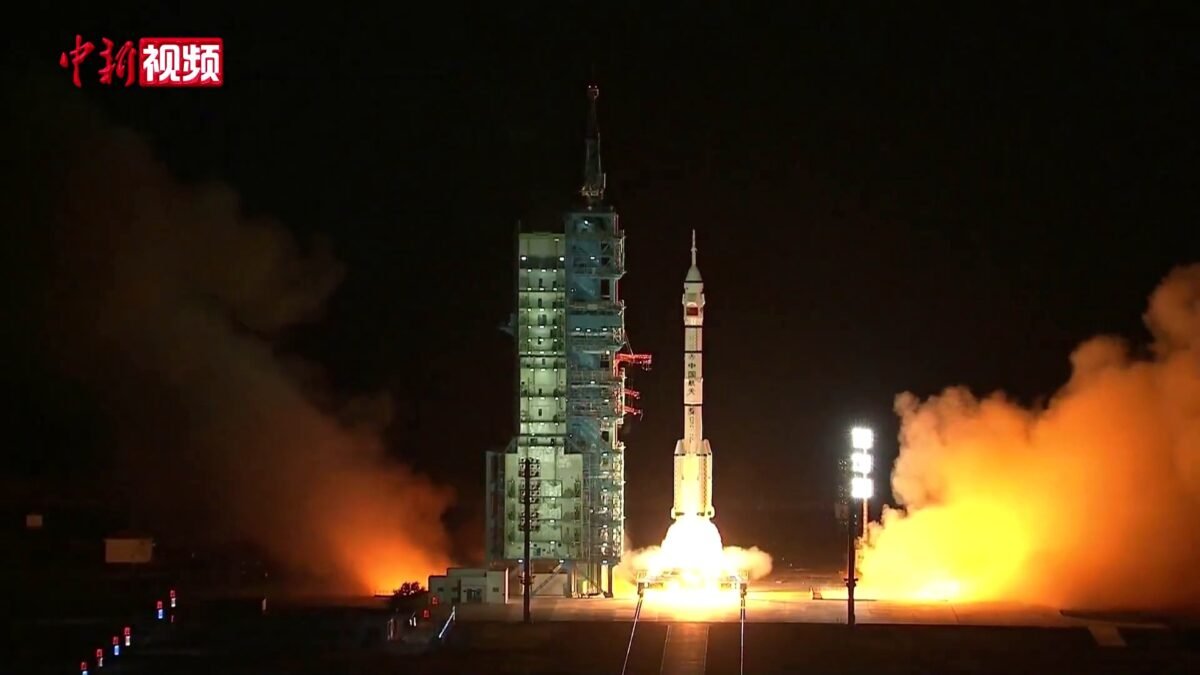
Pakistan is about to send its first citizen into space. Wing Commander Muhammad Zeeshan Ali, a Pakistan Air Force pilot turned astronaut, will lift off aboard China’s Shenzhou-24 spacecraft on Wednesday morning, becoming the first Pakistani to travel beyond Earth’s atmosphere and the first foreign astronaut ever to visit China’s Tiangong space station, according to the China Manned Space Agency.
The Shenzhou-24 spacecraft is scheduled to launch at 8:18 a.m. Beijing time — 5:18 a.m. in Pakistan — on Wednesday, 25 November, atop a Long March-2F rocket from the Jiuquan Satellite Launch Center in north-western China, the agency announced at a pre-launch media briefing on Tuesday. The crew was formally unveiled at the same briefing, ending months of anticipation over who would take the historic seat.
Ali will fly as a payload specialist alongside two Chinese astronauts: mission commander Tang Hongbo, 51, and flight engineer Wu Yi, 39. Tang has flown to Tiangong twice before, on Shenzhou-12 and Shenzhou-17, and is set to become the first astronaut to visit the station three times, according to the China Manned Space Agency. Wu, a member of China’s third batch of astronauts, will be making his first spaceflight.
The mission marks the first joint crewed spaceflight involving Chinese and foreign astronauts in the history of China’s human spaceflight programme, and it will make Tiangong the first Chinese space station to host a foreign astronaut. For Pakistan, a country whose space programme dates back more than six decades but which has never before put a citizen in orbit, the flight is a national milestone.
Ali is scheduled to spend about a week aboard the station before returning to Earth aboard the Shenzhou-23 spacecraft, according to Pakistan’s Space and Upper Atmosphere Research Commission (Suparco). He will come home with two members of the outgoing Shenzhou-23 crew, while the third, commander Zhu Yangzhu, will remain aboard Tiangong to complete China’s first year-long spaceflight, the agency said.
The Crew and the Mission
The three-person crew was announced by Zhang Jingbo, a senior engineer and spokesman for the China Manned Space Agency, at a news conference on Tuesday morning at the Jiuquan spaceport. Zhang said the crew was in good condition, launch preparations were complete, and the space station complex was operating normally.
After the Shenzhou-24 spacecraft enters its preset orbital position, it will switch on its rapid autonomous rendezvous and docking mode and take about three and a half hours to approach and connect with the front port of the Tianhe core module, Zhang said, according to China Daily. Several days of handover work will follow, after which the new crew will take over the station from the Shenzhou-23 crew, which has been in orbit for six months.
Tang and his crewmates will be responsible for maintaining routine operations aboard the station, carrying out repairs and regular inspections to keep it safe, reliable and efficient, advancing scientific research and applications, and taking part in science communication, education and public welfare activities, Zhang said.
The launch is the 41st flight mission of China’s crewed space programme, according to Reuters. China’s Shenzhou missions have sent trios of Chinese astronauts to Tiangong for six-month stays since 2021, and to date 27 Chinese astronauts from 11 crews have visited the station, according to China Daily. Shenzhou-24 will complete an in-orbit rotation with the Shenzhou-23 crew, the agency said.
The spacecraft and its Long March-2F carrier rocket were transferred to the launch area on 17 November, and the final full-system launch rehearsal was completed successfully on 21 November, according to details shared at the briefing. Propellant loading was scheduled to begin at the launch tower later on Tuesday, with other pre-launch preparations proceeding in an orderly manner.
A Week of Science in Orbit
While his stay aboard Tiangong will be short, Ali’s schedule is built around science. The Pakistani payload specialist will undertake a short-duration mission primarily conducting scientific experiments under Pakistan-China cooperation in space research, according to The News.
His responsibilities will include participating in routine crew activities, installing experimental samples and research equipment, and carrying out scheduled experiments aboard the orbiting laboratory. “While in orbit, in addition to taking part in the crew’s routine work, he will primarily be responsible for China-Pakistan joint space science experiments, focusing on installing experiment samples and units and conducting in-orbit tests as scheduled,” Zhang said.
The scientific work will build on four Pakistani biotechnology experiments selected by Chinese institutions from more than 300 proposals submitted to Suparco by universities across the country. The experiments focus on research relevant to food security and climate change, according to details previously shared by Suparco officials with Reuters. State broadcaster CCTV reported that Ali would carry out four scientific projects in the fields of biotechnology and materials, including an in-orbit experiment on photosynthetic microorganisms.
The choice of experiments is deliberate. For a country where agriculture employs a large share of the workforce and where climate change is already reshaping rainfall, heat and crop yields, research conducted in microgravity on plant biology and materials could feed back into practical problems at home — from hardier seeds to a better understanding of how living systems behave under stress. The experiments are small in scale, but they give Pakistani universities a direct stake in orbital research for the first time.
How Ali Was Chosen
The mission is the culmination of a cooperation agreement signed in February 2025 between the China Manned Space Agency and Suparco on selecting and training Pakistani astronauts for participation in Chinese space station missions, formally launching the selection process.
Following three rounds of screening and assessment, Ali and fellow pilot Khurram Dawood were selected as reserve astronaut candidates, and both completed their training in China. Ali has now been confirmed for the historic flight, while Dawood will serve as his backup. The two arrived in Beijing in April for intensive training at the Astronaut Center of China.
To prepare for the joint mission, Chinese authorities strengthened Ali’s specialist training in spacecraft and space station operations, scientific experiment procedures and emergency response. The crew also underwent joint exercises focusing on operational coordination, procedural handovers and handling technical problems.
Language training was another key part of the preparation, with Ali receiving instruction in Chinese commands and technical terminology to ensure accurate communication and execution of procedures. The Astronaut Center of China also prepared Chinese-English operating manuals and halal space food for the Pakistani astronaut, taking into account his language and dietary requirements. These arrangements were highlighted during the final full-system launch rehearsal completed at Jiuquan on 21 November, according to Chinese space programme reports.
Ali’s participation is part of bilateral cooperation under Beijing’s Belt and Road Initiative, according to Reuters. The flight extends a partnership that has already covered satellites and space technology into human spaceflight — a step neither country had taken together before.
A First for Pakistan — and for Tiangong
Pakistan’s space programme is one of the oldest in the developing world. Suparco was founded in 1961, and the country launched its first satellite, Badr-1, in 1990 with Chinese help. In recent years the partnership has deepened: Pakistan’s first lunar CubeSat, ICUBE-Q, flew to the Moon aboard China’s Chang’e-6 mission in May 2024 and sent back photographs of the lunar surface. But no Pakistani had ever travelled to space — until now.
The highest altitude previously reached by a Pakistani was about 87.4 kilometres, achieved by female polar adventurer and artist Namira Salim during a 55-minute suborbital flight arranged by the commercial space company Virgin Galactic in the United States on 6 October 2023, according to China Daily. The Karman line, at an altitude of 100 kilometres above sea level, is widely recognised as the boundary between Earth’s atmosphere and outer space, and the threshold for orbital flight. Ali’s journey will take him far beyond it, to an orbiting station travelling at roughly 400 kilometres above the Earth.
For China, the flight is also a first. Tiangong, completed in its current form in late 2022, has until now hosted only Chinese astronauts. Opening it to a foreign crew member signals Beijing’s ambition to present its station as an international platform, at a time when the International Space Station is ageing and its future beyond the end of the decade is uncertain. China has said the station is open to astronauts from other countries, and Pakistan is the first to take up the offer.
The launch comes amid an accelerating race to the Moon with the United States, which alleges that Beijing plans to colonise and mine lunar territory and resources — claims Beijing has strongly rejected, according to Reuters. In that contest, a successful joint crewed flight with a partner country is a visible demonstration of China’s space capabilities and of the reach of its partnerships.
Analysis — Why It Matters
The headline is the history: the first Pakistani in space, the first foreign visitor to Tiangong. But the significance of Shenzhou-24 runs deeper than a single flight, and it cuts in several directions at once — for Pakistan, for China, and for the way spaceflight is becoming a tool of diplomacy.
For Pakistan, the mission is first and foremost a matter of national pride, and pride of this kind is not trivial. A country that has spent much of the past few years consumed by political turmoil, economic strain and security challenges will watch one of its own leave the planet on Wednesday morning. Moments like this one have a way of cutting through division: the astronaut’s seat was won on merit through a competitive selection process, and his flight belongs to the whole country rather than to any party or institution. In a year when Pakistan’s public conversation has been dominated by court cases, coalition rows and price rises, a Pakistani flag in orbit is a reminder that the country’s ambitions are not confined to its troubles.
There is also a practical dimension that should not be overlooked. The four experiments Ali will run were chosen from more than 300 proposals submitted by Pakistani universities. That number alone says something important: there is a deep bench of researchers in Pakistan eager to work on space science, and until now they have had no route to orbit. A single short mission will not transform Pakistani science, but it creates a precedent and a pipeline. If the experiments return useful data, more will follow. If the mission succeeds, the argument for investing in space research — and for sending a second Pakistani astronaut — becomes much easier to make. The selection process itself, run jointly with China, has already built institutional knowledge inside Suparco about how astronauts are chosen, trained and supported.
For China, the value of the mission is diplomatic as much as technical. Tiangong was built while China was excluded from the International Space Station, and Beijing has long presented its station as open to the world. Until now that openness was a promise; with Ali aboard, it becomes a fact. Pakistan is a close and reliable partner, which makes it a natural first guest, but the signal is aimed well beyond Islamabad. Other countries watching — particularly in the developing world, where China has been courting partners for its space programme — will note that a seat on Tiangong is genuinely available, and that the price of admission is partnership rather than the vast budgets of the traditional space powers.
That is also where the wider strategic picture comes in. Space is increasingly where great-power competition plays out in public, and crewed flight is its most visible stage. The United States is pressing ahead with its Artemis programme to return astronauts to the Moon, while China has set out its own lunar ambitions. A joint flight with Pakistan does not change the balance of that race, but it shows that China is building a coalition around its programme, just as the United States has built one around Artemis. The Reuters report’s note of American allegations about lunar colonisation — and Beijing’s rejection of them — is a reminder that every launch now carries a political charge.
None of this should obscure the human core of the story. Ali is a serving air force officer who trained for months in a foreign language, in a foreign country, for a mission lasting about a week, knowing that his backup was ready to take his place. His crewmates are a veteran on his third visit to the station and a first-time flyer. Together they will spend their days keeping a complex machine running in a hostile environment, and their nights circling a planet that, from 400 kilometres up, shows no borders at all. That is the image that will stay with people in Pakistan long after the technical details fade.
There are risks, as with any spaceflight, and they are worth stating plainly. Crewed launches are among the most demanding operations humans undertake, and the Long March-2F, reliable as its record is, carries three lives on every flight. The return journey, aboard a different spacecraft from the one that carried Ali up, adds a layer of complexity that the mission planners will have rehearsed carefully. A successful docking, a productive week of experiments and a safe return are the measures by which this mission will ultimately be judged — not the ceremony of the announcement.
There is also a question the mission raises for Pakistan’s own priorities. Spaceflight is expensive, and Pakistan’s economy remains under severe strain. The cost of this flight is borne largely through the partnership with China, but the country will still need to decide how much of its own scarce resources to devote to space science in the years ahead. The honest answer is that the sums involved in a programme like this are small beside the budgets of defence or debt servicing, and the returns — in trained people, in research capacity, in international standing — are real. But it is a debate worth having openly, rather than settling by default.
What to Watch Next
The immediate focus is the launch itself, at 5:18 a.m. Pakistan time on Wednesday. Docking with Tiangong should follow about three and a half hours later, with the crew entering the station after checks are complete. The first images of Ali aboard the station — and any message he sends home — will be watched closely in Pakistan, where the flight is expected to dominate the morning’s news.
Over the following week, attention will turn to the experiments. Suparco and the Chinese institutions that selected the four projects will be looking for clean data from the biotechnology and materials work, including the photosynthetic microorganism study. Results may take months to analyse and publish, but the early signals — whether the experiments ran as planned — should emerge during the mission.
The return journey is the next milestone. Ali will come home aboard Shenzhou-23 with two of its crew, while Zhu Yangzhu stays on for China’s first year-long mission — itself a significant test of long-duration spaceflight. The handover between the two crews, and the safe landing of the returning spacecraft, will close the loop on a mission that has been in preparation since the February 2025 agreement.
Beyond that, the question is what comes next. If Shenzhou-24 succeeds, Pakistan will have a trained astronaut corps of two — Ali and his backup, Khurram Dawood — and a proven route to orbit through its partnership with China. Whether a second flight follows, and how soon, will depend on decisions in both Islamabad and Beijing. For now, the country has something it has never had before: a citizen in space, and a week in which to watch him work.
Sources
Reuters — China to launch Shenzhou-24 spaceship with first foreign astronaut
China Daily — China unveils Shenzhou XXIV crew for space station mission

About the Author — Abdul Mannan
Related Articles
Shehbaz Sharif to Make First Official Visit to Russia on 30 November for Putin Talks on Energy, Trade and Defence
Prime Minister Shehbaz Sharif will make his first official visit to Russia from 30 November for talks with…
Pakistan Minister Dodges Indus Waters Questions in New Delhi: ‘You Have Not Invited Me to Discuss It’
Pakistan's climate change minister Musadik Malik declined to discuss the Indus Waters Treaty or terrorism during his New…
Pakistan’s Slow Internet to Last Until 6 December as Repairs Continue on Faulty SMW5 Undersea Cable
Transworld Associates says repairs to the faulty SEA-ME-WE 5 submarine cable should finish by 6 December, with slower…