
Houthis Say They Struck Saudi Arabia’s Largest Refinery at Ras Tanura as Satellite Images Show Smoke

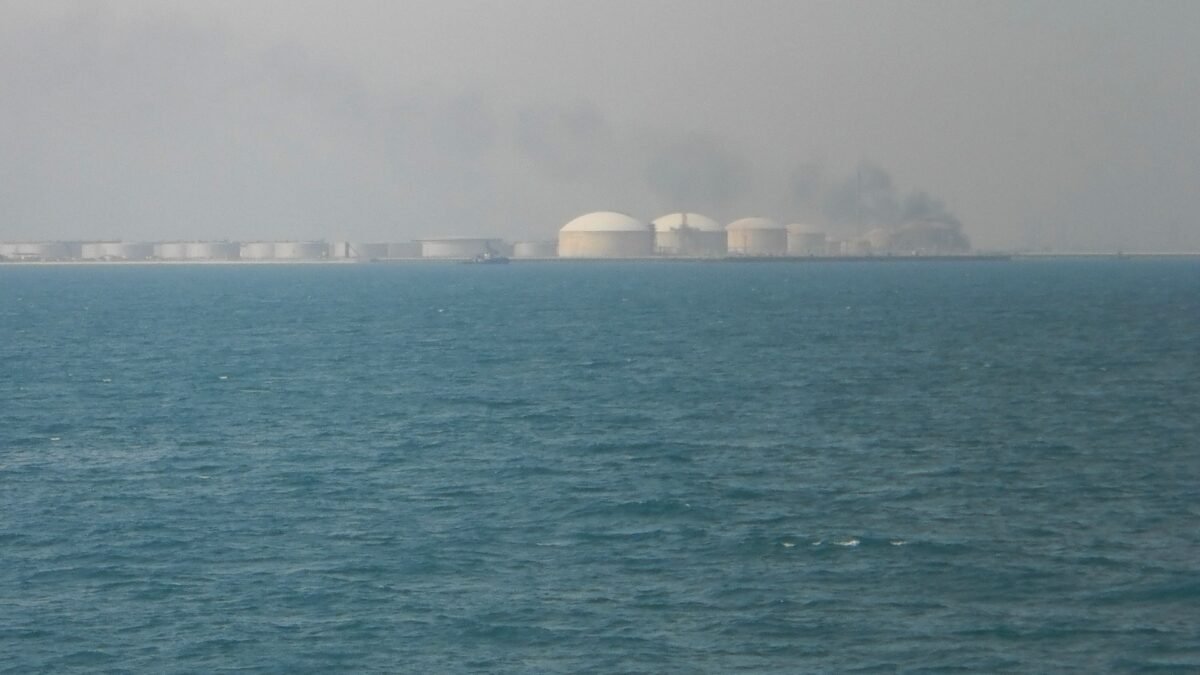
Yemen’s Houthis said on Wednesday that they had attacked Saudi Arabia’s Ras Tanura oil refinery, the kingdom’s largest, and Riyadh’s financial district, in the most serious escalation yet of a conflict that has spread from Yemen’s ports to the heart of the world’s biggest oil exporter. Satellite imagery reviewed by Reuters showed thick black smoke hanging over the refinery complex, while the Saudi-led coalition said its air defences had intercepted four drones over Ras Tanura and stopped short of confirming that the plant itself had been hit.
The claim, announced by Houthi military spokesman Yahya Saree, marks a sharp widening of a campaign that has already struck a tower in Riyadh’s financial district twice in less than a week, forced the evacuation of Yemen’s main commercial port, and sent oil traders weighing the risk of disruption against a market still expecting a surplus. According to Reuters, Saree said the attack on the refinery had caused fires, and that the group had struck the financial district in three phases.
Ras Tanura is not a marginal target. According to Reuters, the refinery can process 550,000 barrels of crude a day and sits inside a complex on Saudi Arabia’s Gulf coast that also serves as a major export terminal for Saudi crude. Any sustained damage there would matter far beyond Yemen’s war, touching global oil supplies, shipping through the Gulf, and the revenues of the world’s largest crude exporter. Saudi Arabia has not confirmed a direct hit on the refinery, and there is no independently verified evidence of extensive damage or a major interruption to operations. That gap, between a bold claim and an unconfirmed outcome, is now the central fact of the story, and it is one both sides are exploiting.
What the Houthis claimed
According to Reuters, Saree said on Wednesday that Houthi forces had attacked the Ras Tanura refinery and Riyadh’s financial district. He said the refinery attack caused fires and described the financial-district operation as taking place in three phases. The claim was the latest in a series of statements from the Houthi military spokesman, who has become the public face of the group’s long-range strike campaign against Saudi Arabia.
The group also claimed a wider set of strikes, according to reports of Saree’s statement, including the Rabigh refinery on the Red Sea coast, an Aramco facility at the Abqaiq oil field, King Fahd International Airport in Dammam and King Khalid International Airport in Riyadh, as well as an attack on the East-West pipeline that carries Saudi crude from the Gulf to the Red Sea. Saudi Arabia has not confirmed any of those claims, and none of them has been independently verified. They should be read as claims, not as established facts, and this article treats them that way.
It was also not immediately clear whether Saree’s claim of a three-phase attack on the financial district referred to the strike on Tuesday that hit the Public Investment Fund tower, to additional attempts, or to both. The ambiguity matters, because the Houthis have in the past described a single incident in expansive terms, and because the Saudi account of events on the ground differs in important respects from the Houthi version.
What Saudi Arabia has confirmed, and what it has not
According to Reuters, the Saudi-led coalition said earlier on Wednesday that air defences had intercepted and destroyed four drones in Ras Tanura in Saudi Arabia’s Eastern Province. The coalition did not say the refinery there had been struck. That is a significant distinction. An interception is a defensive success; a strike on the refinery would be a failure of that defence, and the coalition has not conceded one.
Saudi civil defence, meanwhile, said 11 people were wounded on Tuesday in a strike on a tower in Riyadh’s financial district, according to Reuters. It was the second strike on the same tower in less than a week. The first, on 19 November, damaged the building but caused no injuries. The tower is home to the Public Investment Fund, Saudi Arabia’s sovereign wealth fund, and sits in the King Abdullah Financial District, the centre of the kingdom’s business and public administration.
According to The Maritime Executive, all 11 people injured in Tuesday’s strike were foreign nationals. The same publication reported that the strike was the third successful Houthi attack on the financial district and the second hit on the PIF Tower. The distinction between a claim and a confirmed hit runs through the whole story: the Houthis claim more than the Saudis confirm, and the Saudis confirm interceptions while saying little about damage.
That pattern is familiar from earlier rounds of this war. Saudi Arabia has often been slow to acknowledge damage to sensitive energy infrastructure, while the Houthis have often claimed more than they achieved. The truth in this case will probably emerge, as it has before, from satellite imagery, shipping data and the oil market, rather than from either side’s statements.
The evidence from space
The strongest independent evidence so far comes from above. According to Reuters, NASA satellite imagery it reviewed showed large swathes of thick black smoke around the refinery, covering an area spanning around 600 square kilometres. Smoke on that scale is consistent with a large fire at or near the complex, though it does not by itself prove that the refinery’s processing units were hit, or that operations were interrupted.
According to The Maritime Executive, satellite imaging showed a smoke plume above the complex, and bystander footage appearing to originate from an offshore vessel showed a large fire and a single column of smoke rising from shore. NASA FIRMS infrared sensing data, the publication reported, confirmed large, brightly burning heat sources near the Ras Tanura refinery complex. FIRMS, the Fire Information for Resource Management System, detects thermal anomalies from space, and its data is widely used to track fires and explosions in conflict zones.
None of this amounts to confirmation that the refinery was struck. A fire near a refinery is not the same as a fire inside it, and smoke can come from a storage tank, a flare stack or a nearby facility. But the combination of a Houthi claim, a coalition admission of drones over the site, and satellite evidence of fire in the area makes it reasonable to say that something burned at or near Ras Tanura on Wednesday morning. What exactly burned, and how badly, remains unconfirmed.
A night of strikes in both directions
The Ras Tanura claim did not come out of nowhere. It was the latest move in an exchange that has escalated almost daily for more than a week. According to The Maritime Executive, the exchange began on Tuesday when Houthi drone forces hit the PIF office tower in downtown Riyadh, injuring 11 people. Overnight on Tuesday, Saudi Arabia retaliated with a large-scale attack on the port of Hodeidah, the largest commercial seaport in Yemen and a key logistics hub for the Houthis. Damage and casualty assessments from that strike have not yet been released.
The sequence matters because it shows how quickly the two sides are now trading blows. Earlier on Wednesday, the Saudi-led coalition’s Joint Forces Command had ordered civilians to evacuate Hodeidah port for their safety, posting a satellite map with a marked red zone. The Houthis answered by threatening Jeddah port and all Saudi ports along the Red Sea coast, urging workers to evacuate and shipping companies to move their vessels out. The coalition then said it had targeted operational capabilities at Hodeidah and destroyed targets in Saada and Amran.
According to The Maritime Executive, Saudi military officials ordered the port of Hodeidah evacuated in advance of the strike to reduce casualties, and Houthi leaders responded by ordering the evacuation of Saudi Red Sea ports and threatening counterstrikes. The Houthi response, the publication reported, may not have been long in coming: in the early hours of Wednesday morning, Saudi forces reported a drone strike at Ras Tanura.
This is the second middle-east escalation in a week to follow the same pattern. On 20 November, the coalition issued its first evacuation order for Hodeidah and struck the port in what an Al Jazeera correspondent described as the heaviest attacks since the conflict began. The Houthis answered with their first threat against Jeddah and a declaration that Saudi airspace was unsafe, except over Mecca and Medina. A second wave followed on 21 November. The fighting has intensified since September, when the Houthis advanced towards the Bab el-Mandeb strait, the narrow waterway at the mouth of the Red Sea through which a large share of world trade passes.
On Tuesday, United States embassies across the region warned Americans of an increased Houthi threat to Saudi airports and critical infrastructure. The warning, issued before the Ras Tanura claim, suggests that Washington had already assessed the risk as rising. It also underlines how far the conflict has moved from Yemen’s borders: the targets now include the capital of Saudi Arabia, its largest refinery, its main Red Sea port and its airports.
Oil markets react, but the glut story holds for now
Oil traders took the news in their stride, at least at first. According to Reuters, Brent crude futures declined 44 cents, or 0.5 per cent, to 90.96 dollars a barrel at 1035 GMT on Wednesday, while United States West Texas Intermediate crude slipped 62 cents, or 0.8 per cent, to 81.43 dollars a barrel. Both benchmarks had gained more than 2 per cent on Tuesday, when the first reports of the attacks reached the market.
Later in the day, Brent recovered. According to FinanceFeeds, Brent for January delivery traded at 92.41 dollars a barrel at 1305 GMT on Wednesday, up 1.1 per cent from Tuesday’s settle of 91.40 dollars, in a range of 89.50 to 92.73 dollars. The benchmark had bounced about 3.4 per cent in two sessions from Monday’s settle of 89.37 dollars, but it remained about 21 per cent below its 30 October close of 117.64 dollars. The market, in other words, is treating the attacks as a risk to watch rather than a supply shock that has already happened.
That caution reflects the balance of the market. A build-up in crude inventories is weighing on prices, and traders are focused on the prospect of supply exceeding demand. According to Reuters, United States crude stocks rose by 126,000 barrels in the week ended 20 November, according to market sources citing data from the American Petroleum Institute, against an average expectation of a 1.5 million barrel build among analysts polled by Reuters. The International Energy Agency has predicted that the market will swing to a surplus this quarter, and crude exports from the Gulf have surged in recent months.
Analysts quoted by Reuters were divided on how long the calm would last. Tsuyoshi Ueno, a senior economist at NLI Research Institute, said the attacks near the Strait of Hormuz and the exchanges between Saudi Arabia and the Houthis “have raised uncertainty” over whether the recent fall in prices can last. Tamas Varga of PVM said investors were “preoccupied” with supply exceeding demand and pointed to rising crude inventories. Zhenqiang Seto of LSEG said uncertainty about the OPEC+ meeting on 29 November, at which ministers will decide 2027 output policy, was another reason prices were soft, “especially with the UAE no longer restricted by OPEC+ policies and Iraq seeking higher oil output capacity”.
The OPEC+ meeting on 29 November now carries more weight than it did a week ago. If the attacks escalate, the group’s decisions about output will be read not just as market management but as a signal about how the Gulf’s producers see the security of their own exports. And the market’s underlying vulnerability should not be underestimated: according to ANZ Group Holdings, global oil inventories remain extremely low despite the improving supply outlook, which “leaves the market heavily exposed to further upside rallies”.
The wider escalation: mines in the Strait of Hormuz
The Ras Tanura attack is only one part of a wider pattern of disruption across the Gulf. According to Moneyweb, Iran claims that six tankers have hit mines in the Strait of Hormuz since Tuesday, according to local media reports. The United Kingdom Maritime Trade Operations centre said three vessels had been struck by unidentified projectiles in the strait on Monday, and on Tuesday Iran’s Revolutionary Guards said a container ship was targeted and stopped while sailing an “unauthorised” route near the strait.
The Strait of Hormuz is the world’s most important oil chokepoint, carrying roughly a fifth of global petroleum liquids. A mine campaign there, if sustained, would be a far more serious threat to world oil supplies than a single refinery attack, because it would threaten the shipping on which every Gulf exporter depends. Brent has tumbled this month after President Donald Trump held off on renewed strikes on Iran following the United States midterm elections, and as Gulf exports surged. But the mine reports and the Saudi-Houthi exchanges have put a floor under that fall, at least for now.
This site has covered the Hormuz mine campaign as it developed, including Iran’s claim in late October that four tankers had hit mines, and the explosion of three more tankers in the strait earlier this month. The latest claim of six tankers since Tuesday, if confirmed, would represent a sharp acceleration. It has not been independently verified, and it should be treated with the same caution as the Houthi claims about Ras Tanura. But the direction of travel is clear: the waters around the Gulf are becoming more dangerous, and the costs of that danger are being priced into oil, insurance and shipping.
Why Ras Tanura matters
Ras Tanura is not just a refinery. It is the oldest and most important oil complex in Saudi Arabia, and one of the largest in the world. The refinery there can process 550,000 barrels a day, according to Reuters, and the complex includes a terminal that loads crude onto tankers for export. It has been targeted before, both during the current conflict with the Houthis and during the broader war with Iran, and it has been attacked early in the war in Yemen as well. Its location on the Gulf coast, close to the shipping lanes through the Strait of Hormuz, makes it both strategically vital and exposed.
The attack also matters because of what it says about the Houthis’ capabilities. A strike on a target in Saudi Arabia’s Eastern Province, hundreds of kilometres from Yemen, requires long-range drones or missiles, accurate targeting and the ability to penetrate Saudi air defences. The coalition says it intercepted four drones over Ras Tanura, which is itself a measure of the scale of the attempt. The Houthis have been building these capabilities for years, with support from Iran, and their reach has grown steadily: from border towns, to Riyadh, to the holy cities, and now to the kingdom’s most important oil complex.
The choice of target is also a message. Ras Tanura is the symbol of Saudi Arabia’s oil wealth and of the kingdom’s role in the world economy. Hitting it, or even claiming to have hit it, is a way for the Houthis to show that they can reach the assets that matter most to Riyadh, and to force the kingdom to spend more on defence and to think harder about the costs of the war in Yemen. It is also a message to the wider world: that the Gulf’s oil infrastructure is not safe, and that the conflict in Yemen has consequences far beyond its borders.
The financial district is a different kind of message. The King Abdullah Financial District is the showcase of Crown Prince Mohammed bin Salman’s plan to diversify the Saudi economy away from oil, and the PIF Tower is its most prominent building. Striking it twice in a week, and injuring 11 people, is an attack on the kingdom’s economic ambitions as well as its security. The fact that all 11 injured were foreign nationals, according to The Maritime Executive, adds a further dimension: it raises questions about the safety of the expatriate workers on whom the Saudi economy depends.
Analysis: a war that keeps widening
The attack on Ras Tanura should be understood as part of a pattern, not as an isolated incident. The war in Yemen began in 2014, when the Houthis seized the capital, Sanaa. Saudi Arabia intervened in March 2015 at the head of a coalition, aiming to restore the internationally recognised government. The war has since become one of the world’s worst humanitarian crises, with Hodeidah, the port through which about 70 per cent of Yemen’s commercial imports arrive, according to the United Nations, serving as the main gateway for food, fuel and aid to the north of the country.
For most of that war, the fighting was confined to Yemen. That has changed. The Houthis have progressively extended their reach, first to Saudi border towns, then to Riyadh, then to the Red Sea shipping lanes, and now to the Gulf coast. Each step has been met with Saudi retaliation, and each retaliation has been met with a further Houthi escalation. The cycle is familiar from other conflicts in the region: neither side can afford to be seen to back down, and each round of strikes raises the stakes for the next.
What is different about the current round is its breadth. In the space of a few days, the conflict has touched the Strait of Hormuz, the Red Sea, Riyadh, Ras Tanura and Hodeidah. It has involved Iran, through the mine campaign and its support for the Houthis, and the United States, through its warnings to its citizens and its diplomacy over Iran. It has moved oil prices, even if only modestly, and it has forced the world’s attention back to a war that many had assumed was frozen.
The timing is also significant. The attacks come as the United States weighs its next steps towards Iran, as OPEC+ prepares to decide output policy for 2027, and as the Gulf’s producers try to navigate a market that is moving towards surplus. The Houthis, and their backers in Tehran, have every reason to remind the world that the Gulf’s oil infrastructure is vulnerable, and that the costs of confrontation could be high. The message is aimed as much at Washington as at Riyadh.
There is also a domestic dimension in Saudi Arabia. The kingdom has spent billions of dollars on air defences, much of it on American systems, and the repeated penetration of those defences by Houthi drones and missiles raises questions about their effectiveness. The coalition’s statement that it intercepted four drones over Ras Tanura is intended to reassure, but it also concedes that the drones reached the site. If the refinery was in fact hit, the questions will become harder.
For the Houthis, the calculation is different. The group has little to lose from escalation and much to gain. Each successful strike demonstrates its capabilities, embarrasses its enemy and strengthens its hand in any future negotiation. The group’s claims, whether or not they are fully accurate, are amplified by the media and the markets, and they contribute to a perception of power that is itself a form of power. The risk for the Houthis is that escalation brings a heavier Saudi response, as the strikes on Hodeidah suggest. But the group has survived a decade of war, and it has shown little appetite for restraint.
The most dangerous aspect of the current escalation is its potential to spread. The mine campaign in the Strait of Hormuz, the attacks on Saudi oil infrastructure and the strikes on Hodeidah are all part of a single conflict system that now spans the Gulf, the Red Sea and Yemen. A miscalculation in any one of these theatres could trigger a wider war, involving Iran and the United States, with consequences for the global economy that would dwarf the current market reaction. That is why the events of Wednesday matter, even if the immediate damage turns out to be limited.
What to watch next
Several questions will determine how this story develops. The first is whether Saudi Arabia confirms or denies a direct hit on the Ras Tanura refinery, and whether Aramco, the state oil company, reports any interruption to operations. A statement from Aramco, or from the Saudi energy ministry, would carry more weight than either the Houthi claim or the coalition’s account of interceptions, and it is likely to be the next authoritative word on the matter.
The second is whether the Houthis attempt further strikes, and whether Saudi Arabia responds with a heavier campaign against Houthi targets in Yemen. The strikes on Hodeidah, Saada and Amran suggest that Riyadh is already escalating its response. If the Houthis strike again, the cycle could intensify quickly.
The third is the oil market. Brent has so far treated the attacks as a risk rather than a shock, but that could change if there is evidence of sustained damage to Ras Tanura or of a wider disruption to Gulf exports. The OPEC+ meeting on 29 November will be watched closely for any sign that the group’s members are factoring security risks into their output decisions.
The fourth is the Strait of Hormuz. The claim that six tankers have hit mines since Tuesday, if confirmed, would mark a significant escalation in the campaign against shipping, and it would raise the stakes for every country that depends on Gulf oil. Independent confirmation from shipping companies, insurers or maritime authorities will be essential.
Finally, there is the question of diplomacy. The war in Yemen has no military solution, and the current escalation is a reminder of that. The Stockholm Agreement of 2018 and the truce of 2022 both showed that restraint is possible, but both have frayed. Whether the current round of strikes leads to a new round of talks, or to a wider war, will depend on decisions taken in Riyadh, Sanaa, Tehran and Washington in the coming days.
Sources
- Reuters — Yemen’s Houthis say they attacked Saudi oil refinery and Riyadh financial district
- The Maritime Executive — Riyadh, Hodeidah and Ras Tanura Hit in Saudi-Houthi Exchange of Fire
- Reuters via Euronext — Oil edges down as supply glut prospect offsets Middle East disruption fears
- Moneyweb — Oil declines as rising supply offsets escalating Hormuz attacks
- FinanceFeeds — Brent Crude Price $92.41: Houthis Claim Ras Tanura Strike

About the Author — Abdul Mannan
Related Articles
Houthis Threaten to Strike Jeddah and All Saudi Red Sea Ports After Coalition Orders Hodeidah Evacuated
Yemen's Houthis have threatened to strike Jeddah and every other Saudi Red Sea port if the Saudi-led coalition…
Israel Kills Hamas Internal Security Chief Naeem Abu Nahel in Gaza Drone Strike
Israel killed Hamas internal security chief Naeem Abu Nahel in a drone strike in western Gaza City on…

US Sanctions 30 Targets in Iran’s Shadow Banking Network in Fresh Blow to Tehran’s War Economy
The US Treasury has sanctioned 22 entities and eight individuals tied to Iran's shadow banking networks, as Washington…