
Hubble Maps an ‘Ocean of Stars’ in the Milky Way’s Heart to Help Roman Weigh Distant Worlds

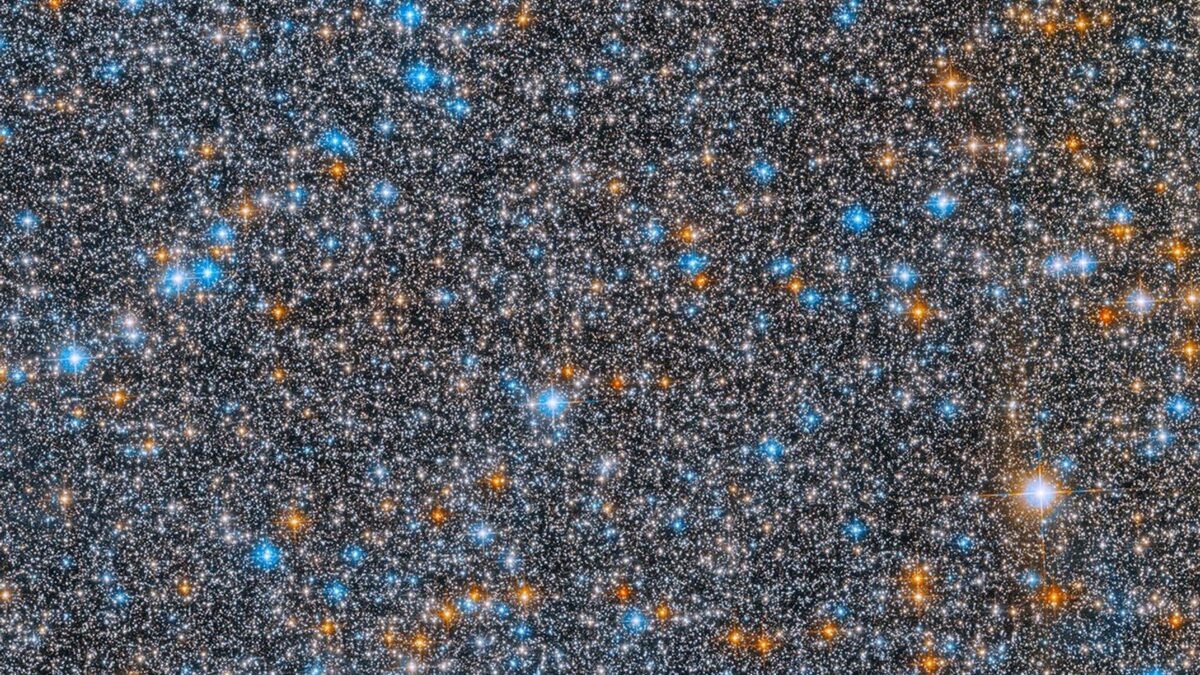
NASA has released three new images from the Hubble Space Telescope showing the Milky Way’s galactic bulge as a dense ocean of stars, the first public samples of a survey that will catalogue about 25 million stars and give the Nancy Grace Roman Space Telescope the reference map it needs to weigh the distant worlds it is about to discover. The images, published on 25 November 2026, look toward the crowded heart of our own galaxy, where stars are packed so tightly that separate points of blue, white and orange light cover nearly every pixel of the frame.
According to NASA, the pictures are far more than a portrait of a beautiful patch of sky. They are the opening instalment of a deliberate piece of groundwork: Hubble is photographing, star by star, the exact fields Roman will stare at when its planet hunt begins in the spring of 2027. When Roman records a star suddenly brightening, astronomers will be able to reach back into Hubble’s catalogue and identify precisely which star was involved, turning a fleeting flicker of light into a measured mass for a planet no telescope could ever see directly.
The galactic bulge is the dense, roughly spherical swarm of stars that surrounds the centre of the Milky Way’s disc. According to NASA, it holds nearly a quarter of the galaxy’s entire stellar mass, and its relative closeness lets astronomers examine it in far greater detail than the bulges of other galaxies, where crowded stars blur into a single glow. That density is exactly what makes it both a treasure and a challenge: millions of stars crowd into a small patch of sky, and behind them, in even greater numbers, lie the stars Roman will watch for the tell-tale brightening of gravitational microlensing.
The new images come from Hubble observing programme 17776, titled “A Precursor Survey of the Roman Galactic Bulge Time Domain Fields” and led by Sean Terry, an assistant research scientist at the University of Maryland and NASA’s Goddard Space Flight Center. The survey, which began in the spring of 2025, covers 354 fields in 177 visits, because Hubble’s Advanced Camera for Surveys and its Wide Field Camera 3 observe two neighbouring fields in each visit. Together the fields span about 1.1 square degrees of sky, and the team expects the finished catalogue to hold about 25 million stars. NASA’s earlier release on the same survey, published in May 2026, put the figure at 20 to 30 million point sources.
Hubble observed the bulge in two filters, known as F606W and F814W, at the red end of the visible spectrum and into the near-infrared. According to NASA, the wavelengths were chosen deliberately to overlap with Roman’s sensitivity, so that Hubble’s measurements of each star can be compared directly with the data Roman will collect in the same fields. The bluer of Hubble’s two bands also reaches beyond Roman’s primary filters, adding colour information Roman’s infrared detectors cannot easily capture on their own.
Why Roman Needs Hubble’s Help
Roman’s planet census will rely overwhelmingly on gravitational microlensing, a phenomenon in which the gravity of a foreground star briefly magnifies the light of a more distant background star. If the foreground star has a planet, the planet adds a short extra blip to the brightening, and the shape of that blip reveals the ratio between the planet’s mass and its host star’s mass, along with the geometry of the system. It is one of the few techniques capable of finding planets far from their stars, including planets drifting alone through space with no star at all.
But a light curve alone cannot say how heavy anything is. The duration of a microlensing event depends on three quantities tangled together: the mass of the lensing star, its distance from Earth, and how fast it moves across the sky. Many combinations of those three produce the same brightening, so the same mass ratio could describe a light planet around a dim dwarf star or a heavier planet around a larger one, and nothing in the flicker itself distinguishes between them. That ambiguity, known as the microlensing degeneracy, is the central problem Hubble’s survey exists to solve.
The fix, according to NASA, is to measure the lens star’s own light. If astronomers can identify the lens star in an image taken before or after the event and measure its brightness, a standard relationship between a star’s brightness and its mass converts that measurement into a host-star mass, and the mass ratio from the light curve then becomes a direct planet mass. As Terry explained in NASA’s May 2026 release: “Instead of estimating a mass ratio of a planet that’s orbiting a star, we can say that we’re confident it’s a Saturn-mass planet orbiting a star that’s 0.8 solar masses, for example. So with the help of precursor imaging from Hubble you can hope to get direct measurements of the masses as opposed to indirect mass ratios.”
Timing is the key to the whole enterprise. When a telescope watches a lensing event unfold, it can be difficult to tell which of two overlapping stars the light belongs to. If astronomers have already identified each star separately before the event, the puzzle becomes far easier. “The main goal of these observations is to be able to identify objects that participate in lensing events during the Roman survey, catching them before they undergo the lensing event,” said Jay Anderson of the Space Telescope Science Institute in Baltimore, a co-author of the survey paper. “When, in a couple of years, an event happens during Roman’s long stare at the field, we can go back and say, ‘This was a red star, this was a blue star, and the event happened when the red star went in front of the blue star.'”
An early demonstration of the method, described in a preprint analysing a real microlensing event called KMT-2019-BLG-0253, shows how powerful the approach can be. Applying Hubble imaging taken after the event, researchers derived a host star of about 0.65 solar masses at a distance of roughly 2.64 kiloparsecs, or about 8,600 light-years, and a planet of roughly 7 to 9 Earth masses, depending on which of two orbital solutions is correct. The Hubble imaging halved the number of solutions that still fitted the light curve. Because the work is a preprint and has not yet completed peer review, those values should be treated as provisional, but they illustrate the scale of the improvement Hubble’s baseline can deliver.
The Roman Telescope: A Planet Census Begins in Spring 2027
Roman itself is already in space. The telescope launched on 30 August 2026 at 7:26 a.m. Eastern Time aboard a Falcon Heavy rocket from Launch Complex 39A at Kennedy Space Center in Florida, and it is now travelling the roughly million-mile journey to its observing station, followed by about three months of commissioning. According to NASA, its first images are expected by early 2027, and its observations of the galactic bulge are set to begin in the spring of 2027.
Roman’s flagship campaign in the bulge, the Galactic Bulge Time-Domain Survey, will watch a patch of sky covering approximately 1.7 square degrees, an area roughly the size of eight and a half full moons, taking a snapshot about every 12 minutes across six observing seasons of 72 days each. Its Wide Field Instrument captures roughly 100 times the sky area of Hubble’s infrared camera in a single exposure, which is what makes a census of this scale possible at all. According to NASA, Roman may measure some 200 to 300 million point sources by the end of the survey, producing, in Terry’s words, “essentially, some of the deepest images ever taken of any part of the sky.”
The survey is optimised for microlensing, and the predicted yields are large. The survey paper cited in recent reporting predicts more than 30,000 microlensing events and more than 1,400 bound exoplanets over five years of Roman’s exoplanet survey. NASA has said the method is sensitive to a regime of planet masses and orbital distances that complements the Kepler and TESS missions, which found most of their planets close to their stars, and that Roman’s survey aims to detect more than a thousand wide-orbit planets. Roman’s mission requirement is to measure masses and distances within 20 per cent for 40 per cent of the hosts it detects, and simulations suggest more than 40 per cent would meet that standard using Roman’s own measurements of lens brightness and motion, with Hubble’s catalogue as a complement that sharpens the result further.
The partnership between the two telescopes is a study in complementary strengths. Hubble sees in ultraviolet, visible and near-infrared light, while Roman collects data mainly in near-infrared light and some visible light. Hubble’s sharp resolution separates individual stars in the crowded bulge and records their brightness, ages, composition and motion over time. Roman’s enormous field of view and rapid cadence then watch those same stars continuously for the brief brightenings that betray a planet. Neither telescope could do the job alone: Hubble cannot stare at the whole bulge for months on end, and Roman cannot resolve the crowded starfield finely enough, on its own, to identify every lens with confidence.
Rogue Planets, Black Holes and the Dark Census
Exoplanets are only part of what the survey will find. Many planetary systems evolve much like our solar system did, beginning with the collapse of a cloud of gas, the growth of a star and the formation of surrounding planets. But in some systems, gravitational encounters fling a planet out of the system where it formed, leaving it to drift alone through the galaxy. According to NASA, hundreds of these “rogue planets” will be detected by Roman’s Galactic Bulge Time-Domain Survey, along with previously unseen isolated neutron stars and even black holes with masses similar to our Sun.
These dark objects are among the most tantalising targets of the whole enterprise. A lone black hole or neutron star emits no light of its own, so the only way to find one is to watch it bend the light of a background star as it passes in front of it. The same microlensing signal that reveals a planet can therefore reveal a stellar corpse, and Hubble’s baseline catalogue is what lets astronomers tell the difference between a faint star, a planet and something that emits no light at all. As Anderson put it: “The great thing about microlensing is that we’ll be able to do a complete census of objects as small as Mars that are moving between us and these fields in the bulge, no matter what it is.”
The bulge also offers a laboratory for the history of the galaxy itself. By measuring the brightness and colour of thousands of individual bulge stars, astronomers can trace star-formation histories and chemical enrichment across the oldest central populations of the Milky Way. The new Hubble data will also help map the dust that veils the region: the survey can identify areas of extinction, dense pockets of dust and gas that absorb or scatter light, allowing researchers to chart where stars can be seen clearly and where they cannot. At the lowest galactic latitudes, dust absorbs more than 20 magnitudes of visible light, meaning only about one visible photon in a hundred million survives the journey to Hubble. Roman’s infrared detectors see through that dust far more easily, which is another reason the two telescopes are needed together.
The scale of the undertaking becomes clear when it is set against what came before. Hubble’s earlier Sagittarius Window Eclipsing Extrasolar Planet Search, known as SWEEPS, stared at a single bulge field for seven days in 2006, examined roughly 180,000 stars and reported 16 candidate planets. A catalogue of 25 million stars is about 139 times larger. The new survey is also larger than the two earlier surveys, each covering around half a square degree, whose data were combined into Hubble’s largest mosaic, that of the neighbouring Andromeda galaxy, which took more than a decade to assemble.
Hubble’s Long Goodbye, Written in Starlight
There is a poignant undertone to this release. The catalogue is being built by a telescope with a finite lifespan, and the survey paper’s authors write that there is “no guarantee that it will remain operational for another decade.” Hubble has been operating for more than three and a half decades since its launch in 1990, and it has been working in a reduced-gyroscope mode since June 2024, after NASA moved it to one-gyro operations and returned it to science on 14 June 2024. The mode places limits on the telescope’s field of regard, tracking speed and scheduling flexibility, and early visits in the bulge survey were affected by failures to acquire guide stars, a problem the survey team links generally to the reduced-gyroscope mode.
On 29 October 2026, NASA issued a request for information asking industry about boosting Hubble’s orbit, servicing the telescope or a controlled re-entry, with responses due on 30 November. Hubble’s orbit is predicted to decay to the point of re-entry in 2033 to 2034, which means NASA expects any servicing or reboost mission would need to fly by 2032. The notice is an industry-capability query, not the announcement of a funded mission, but it underlines that the telescope which has defined space astronomy for a generation is now being planned for in its final chapter.
That makes the bulge survey doubly valuable. It is not only a gift to Roman; it is also an addition to Hubble’s continuing legacy of high-precision observations of the galactic bulge, a record that began with the WFC3 Galactic Bulge Treasury Program and continues today. The data from the survey are available in the Mikulski Archive for Space Telescopes, where any astronomer in the world can use them, and the catalogue itself will keep growing in value as Roman’s observations accumulate over the coming years. Long after Hubble falls silent, its measurements of these 25 million stars will still be the baseline against which Roman’s discoveries are read.
Analysis: Why It Matters
A census, not a collection of curiosities
The most important thing about this story is not any single image, beautiful as the new pictures are. It is the shift from discovery to demography. For thirty years, exoplanet science has largely been a hunt for individual worlds: a planet here, a system there, each one a headline. Roman’s bulge survey, with Hubble’s catalogue beneath it, is designed to do something different, which is to count. A census of thousands of planets, measured with real masses rather than ratios, will show how common different kinds of planets are, where they form, how often they are thrown out of their systems, and how the architecture of planetary systems changes between the crowded galactic centre and the quieter suburbs where our Sun lives. That statistical picture is what turns a catalogue of curiosities into a theory of how planets are made, and it is the reason the Hubble groundwork matters as much as the Roman observations themselves.
The value of looking before you leap
There is a quieter lesson in the way this mission has been planned. The Hubble survey began in the spring of 2025, more than a year before Roman’s launch and two years before its bulge observations start. Astronomers did not wait for Roman to arrive and then wonder how to interpret what it saw; they spent years building the reference data first, accepting that the unglamorous work of cataloguing 25 million stars would determine whether the glamorous discoveries that follow could be trusted. It is a model of how big science should be sequenced, and it stands in contrast to the all-too-common pattern of launching first and improvising later. The patience is paying off already: the preprint analysis of a single past event shows Hubble imaging cutting the possible answers in half before Roman has taken a single science image.
What the dark census could reveal
The rogue planets and lone black holes deserve particular attention, because they are the objects no other method can find in large numbers. A planet with no star cannot be found by watching a star wobble or dim; a black hole with no companion cannot be found by watching anything orbit it. Microlensing is almost the only way to see them, and a survey that finds hundreds of rogue planets will answer a question that has been open since the first such worlds were identified: are they rare accidents of violent planetary systems, or are they as common as stars themselves? If they are common, then the galaxy is full of frozen, starless worlds, and our picture of where planets live, and where life might conceivably exist, will need to expand far beyond the warm zones around stars. Similarly, a census of isolated stellar-mass black holes would test our understanding of how massive stars die, and how many of their remnants wander the galaxy unseen.
A handover between generations
Finally, this story is a handover. Hubble, launched in 1990, is handing its sharpest asset, its resolution, to Roman, a telescope that sees a hundred times more sky at once but cannot match Hubble’s ability to separate crowded stars. The arrangement is a reminder that new instruments rarely replace old ones outright; more often, they make the old ones more valuable, because the new questions they raise can only be answered with the old data. Hubble’s bulge catalogue will still be doing science in the 2030s, quite possibly after the telescope itself has gone. That is a fitting legacy for an observatory that has spent 35 years rewriting astronomy, and a measure of how much of Roman’s success will rest on work done by a telescope launched before many of Roman’s own scientists were born.
What to watch next
The immediate milestones are close. Roman’s first images are expected by early 2027, and its bulge observations begin in the spring, when the first microlensing events of the new era will start to appear in its data. Watch for the release of the full Hubble catalogue of roughly 25 million stars, for the first Roman microlensing detections and their Hubble-assisted mass measurements, and for NASA’s decision on Hubble’s future after the 30 November deadline for responses to its request for information. Each of those moments will show whether the careful groundwork laid in the bulge is delivering the planet census it promises, and whether the telescope that made it possible gets a reprieve or a dignified end.
Sources
- NASA Science — “NASA’s Hubble Views Ocean of Stars in Groundwork for Roman” (25 November 2026)
- NASA Science — “Hubble Survey Sets Up Roman’s Future Look Near Milky Way’s Center” (11 May 2026)
- Tech Times — “NASA Publishes Hubble Galactic Bulge Images: Planned Star Catalog Helps Roman Weigh Planets” (25 November 2026)
- TML News — “Hubble Bulge Survey Builds Star Catalog For Roman” (25 November 2026)
- The Fair Report — “Hubble maps stars in the Milky Way’s bulge for Roman’s planet search” (25 November 2026)

About the Author — Abdul Mannan
Related Articles
Light-Powered ‘BrainBots’ Deliver Five Times More Cancer Drug Across the Blood–Brain Barrier in Mice
Caltech researchers have built light-activated nanorobots that carried about five times more chemotherapy drug across the blood–brain barrier…

Microsoft Declares ‘Code Red’ After 24-Hour Outage Exposed Failures Across Outlook and Teams
Microsoft has declared its most severe internal alarm, a Code Red, after a 24-hour outage knocked out Outlook,…

Pakistan’s First Astronaut Docks at China’s Tiangong Station as Shenzhou-24 Completes Historic Flight
Wing Commander Muhammad Zeeshan Ali became the first Pakistani in orbit and the first foreign astronaut aboard China's…