
Zelensky: Putin “Can’t Be a Friend” — Ukraine’s Warning to the West

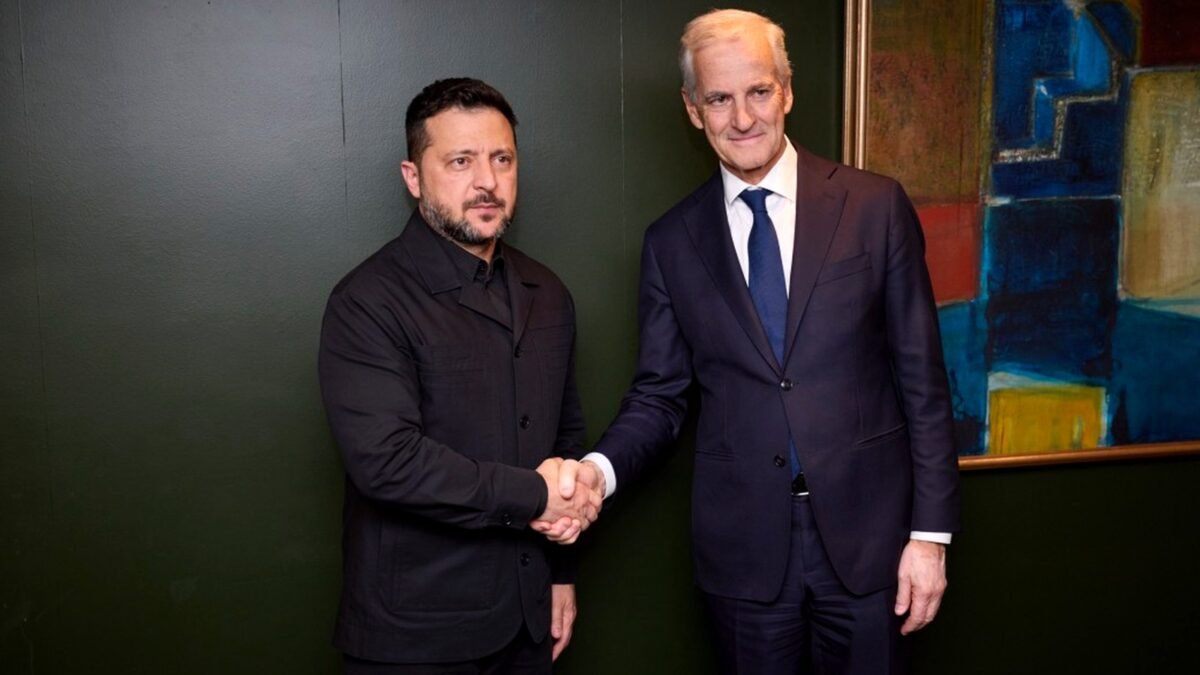
What do you call it when the most powerful man on earth embraces the man who bombs your cities, and calls him “my friend”? I ask you this plainly, because on Friday, 27 November 2026, the president of a nation at war looked into a camera in Kyiv and asked the same question — and his answer should haunt every capital in the free world.
“He’s an aggressor, and a killer… He can’t be a friend. Just cannot be.” Those were the words of Volodymyr Zelensky, speaking in English to the BBC’s Sarah Rainsford at his office in central Kyiv. He was talking about Donald Trump’s public embrace of Vladimir Putin — a photograph the American president himself posted, showing the two men hugging, captioned “my friend”. Zelensky called it strange. Then he reached for the comparison that history forces upon us all: it was, he said, like claiming friendship with Adolf Hitler during the Second World War.
I have read that sentence three times since this morning, and each time it lands heavier. Because this is not the language of a man picking a quarrel. This is the language of a man who has watched his country bleed for nearly five years, who has buried children killed by ballistic missiles in their beds, and who now finds his most powerful ally publicly embracing the man who ordered those missiles fired. If you cannot hear the moral shock in that sentence, I ask you to read it again — slowly.
The Deficit That Is Measured in Lives
At the heart of Zelensky’s anger sits a number that is not a number at all. Ukraine’s air defenders, he told the BBC, can now destroy about seventy per cent of Russia’s fastest drones — a figure that is improving. But against ballistic missiles, the fastest and deadliest weapons in Russia’s arsenal, his country faces what he called a “very, very big” deficit of interceptors. The Patriot systems that can shoot those missiles down are arriving too slowly, and Zelensky blames Washington directly.
“It’s a pity they made a focus on Middle East and they help them more… It’s a pity. We have huge questions with this,” he said. And then the sentence that should be carved above the door of every foreign ministry in the West: “The deficit of these missiles — that is people’s lives.”
Pause on that. We speak of missile deficits as though we were discussing a warehouse shortfall, a gap in a spreadsheet, a line item in a defence budget. Zelensky will not let us. Every interceptor that does not arrive is a missile that is not stopped. Every missile that is not stopped is a building that falls, a hospital that burns, a family that does not wake up. The United Nations counts 6.3 million internally displaced people in Ukraine, and the BBC reports that civilian deaths are running at an all-time high as Russia’s strikes grow more frequent and winter closes in. These are not statistics. They are the arithmetic of abandonment.
Munich Never Left Us
History is a mirror, and I have held this mirror up before. In September 1938, the leaders of Britain and France flew to Munich and handed a dictator a piece of another country, and returned home waving a piece of paper and promising “peace for our time”. Within a year, Europe was at war. The lesson of Munich was supposed to be carved into the conscience of the West forever: you do not buy peace by embracing the aggressor. You do not flatter the man who redraws borders by force and call it diplomacy.
And yet here we are, in November 2026, watching the same play performed with new actors. The American president’s two envoys, Jared Kushner and Steve Witkoff, have been shuttling to Moscow, meeting Putin directly, trying to broker an end to the war. The latest round of talks, held in Abu Dhabi earlier this month, made no obvious progress. “The more we know, the more problems,” Zelensky said of those negotiations. Moscow, by its own public statements, appears to have returned to its original hardline demands. And still the envoys press on — men who, the BBC observed, often seem more in tune with Moscow’s position than with Kyiv’s.
Now ask yourself the question Zelensky asked: when the mediator embraces one side and calls him “my friend”, what is left of mediation? When the strongest nation on earth signals to the aggressor that his friendship is valued, what incentive does the aggressor have to stop? The history books are merciless on this point. Appeasement has never once purchased peace. It has only ever purchased time — time the aggressor uses to reload.
The Gaze That Wandered
Zelensky’s second charge cuts deeper still, because it is about attention — the most precious currency in statecraft. The United States, he says, has turned its gaze toward the Middle East, where war has widened across the Gulf and the Red Sea, and Ukraine has slipped from the centre of Washington’s vision to its edge. The interceptors promised to Kyiv, he suggests, are being held back or diverted while the Middle East burns.
I understand the arithmetic of empires. A great power has many fires to fight, and the Middle East has always burned hottest. But I ask you, the reader, to consider what it means when a nation’s survival depends on another nation’s attention span. Ukraine did not choose to be the test case of whether the West still believes in its own principles. It was chosen by the man who invaded it. And every time Washington’s gaze wanders, Moscow reads the wandering as permission.
This is the old story of the world, retold in modern dress. The great powers have always had somewhere else to look. In 1938 it was the Sudetenland, a faraway place of which, as Chamberlain said, we knew little. In 2026 it is a country whose cities are bombed nightly while the cameras point elsewhere. The excuse changes. The abandonment does not.
The Ping-Pong of Machines
There was a moment in the interview that revealed something almost absurd about modern war. Zelensky confirmed that Starlink, the satellite communications system, and its military version Starshield, remain restricted in occupied areas of Ukraine. Ukrainian drone units have told the BBC that their interceptor drones can no longer catch up with Russia’s Shahed drones, which then fly deeper into the country unhindered. Whose decision was that? the BBC asked.
“Technically SpaceX, politically — I don’t know, I really don’t know,” Zelensky replied. “It’s like… ping pong. We are asking one side, they say it’s the other.”
Read that again and feel the humiliation in it. A president at war, begging for a signal — not a weapon, not money, but a signal — and being bounced between a corporation and a government like a ball in a parlour game. We have built a world where the tools of war are owned by private companies and the decisions about them are nobody’s responsibility. This is not strategy. This is abdication, dressed up as complexity.
Kyiv Will Not Fall Quietly
And yet, for all the frustration, Zelensky did not sound like a man surrendering. Talks are expected to resume in December, though it remains unclear whether European negotiators will be at the table, despite the American envoys’ announcement that they would. The Kremlin appears to be resisting Europe’s presence — which tells you everything about what Moscow fears. Europe at the table means Europe’s interests at the table, and Moscow would rather negotiate with a Washington that embraces it than with a Europe that remembers its history.
Zelensky vowed that Ukraine would defend its capital by every means. “Without a capital, there is no country,” he told the BBC. That is the sentence of a man who understands what is at stake — not territory, not pride, but existence itself. And it is the sentence that should shame every comfortable observer who treats this war as a distant quarrel between strangers.
I write this column from a country that knows what it means to be small in the shadow of great powers. We know the feeling of being a footnote in someone else’s grand strategy. We know what it is to watch the world look elsewhere while your people pay the price. That is why Zelensky’s words reach me not as foreign news, but as a warning written for all of us: when the powerful begin to call the aggressor a friend, the next victim is already being chosen.
So I leave you with the question with which I began, and I ask you to carry it with you beyond this page. What do you call it when the most powerful man on earth embraces the man who bombs your cities? Zelensky has given us his answer: you call it strange. You call it wrong. And you refuse, whatever the cost, to call it peace. Because peace was never made by embracing the killer. Peace is made by stopping him — and the stopping begins with the honesty to name him for what he is.
Sources & References
- BBC News — “Zelensky tells BBC US too focused on Middle East and not pushing Russia hard enough” (Sarah Rainsford, 27 November 2026), via EuropeSays
- The Business Standard — “Zelensky criticises US for prioritising Middle East over Ukraine, urges tougher stance on Russia” (27 November 2026)
- Nexus Europa — “US envoys meet Putin in Moscow following joint Western talks on Ukraine” (27 November 2026)
- Artesh — World News Brief, 27 November 2026 (UN figure: 6.3 million internally displaced persons in Ukraine)
- Wikimedia Commons — Featured photo: Volodymyr Zelenskyy visits Norway, September 2026 (Vinnytsia Oblast State Administration, CC BY 4.0)
Photo credit: Vinnytsia Oblast State Administration / Wikimedia Commons (CC BY 4.0).

About the Author — Abdul Mannan
Related Articles

Myanmar’s Min Aung Hlaing Rejects Parts of World Court’s Genocide Ruling, Calling It ‘Inappropriate’
Myanmar's leader Min Aung Hlaing has said his country will not comply with parts of the International Court…
Pablo Hernández de Cos Chosen as Next ECB President as Europe Faces High Inflation and French Debt Strain
Eurozone leaders have chosen Spain's Pablo Hernández de Cos to succeed Christine Lagarde as president of the European…
EU Leaders Wrestle Over €1.58 Trillion Budget and €45 Billion Ukraine Loan as Kremlin Warns Funding Threatens Peace Talks
EU leaders opened two days of talks in Brussels on a €1.58 trillion seven-year budget and a €45…