
BepiColombo Reaches Mercury Despite Software Glitch That Cut Its Orbit Burn Short

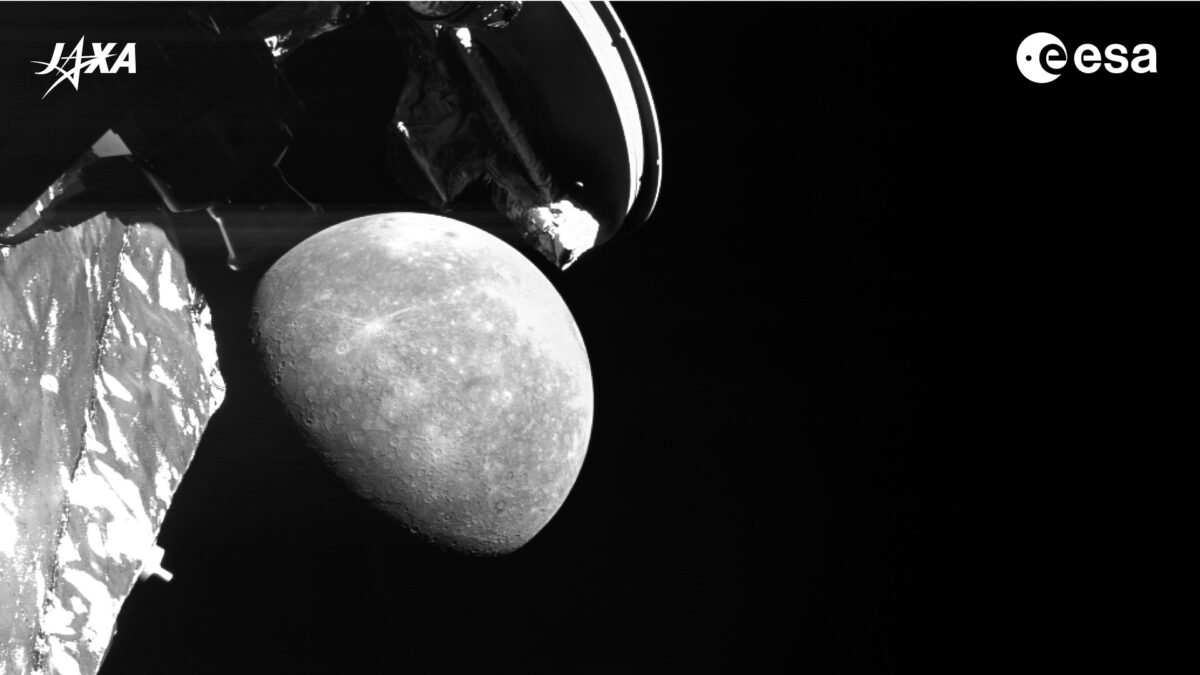
A software glitch came within minutes of ruining one of the most ambitious planetary missions ever flown, after the European Space Agency’s BepiColombo spacecraft reached Mercury last week with its main thruster burn cut short and its flight team unsure for hours whether it had arrived at all. The spacecraft is now safe in orbit around the solar system’s smallest planet, according to the agency, but it is circling Mercury on a wider loop than planned and its engineers face a compressed and more demanding run-up to the next critical manoeuvre.
BepiColombo, a joint mission of the European Space Agency (ESA) and the Japan Aerospace Exploration Agency (JAXA), fired its four axial thrusters on 21 November to slow down enough to be captured by Mercury’s gravity after an eight-year journey from Earth. The burn was planned to last 37 minutes. It ended after just 28, achieving only about 77 per cent of the planned change in speed, and the spacecraft dropped into safe mode, a protective state in which it shuts down all non-essential activity. It took the mission control team at ESA’s European Space Operations Centre in Darmstadt, Germany, around four hours of analysis before it could confirm that the partial burn had nevertheless put BepiColombo into orbit around Mercury.
The spacecraft was supposed to settle into an orbit that looped around Mercury once every 58 hours. Instead it entered a 75-hour orbit, reaching about 10,000 kilometres higher above the planet than intended at its farthest point. ESA acknowledged at a news conference in London on Friday 27 November that the wider orbit leaves less margin for further problems, although the spacecraft is operating as expected. The agency said the mission remains on track for the separation of its two science orbiters on 9 December, and for the start of science operations in April 2027.
The glitch has been traced to a software issue involving the spacecraft’s attitude guidance and thruster control, according to ESA. CNN reported that it resulted from an unlikely timing mismatch between the guidance software and the thruster controls, which triggered an abnormally strong command that interrupted the planned burn. ESA later calculated that there had been a one-in-six chance of the glitch occurring. The scenario had been among a range of simulated problems the team had considered, but it had not been used in training runs before the orbit insertion attempt.
“We’re using BepiColombo’s software in flight for the first time,” Ignacio Tanco, ESA’s head of inner solar system mission operations, told CNN. “Since we separated from MTM in September, we are basically flying a new spacecraft.” The MTM, or Mercury Transfer Module, provided propulsion during the long cruise to Mercury and was jettisoned in early September, leaving the two science orbiters to fly on their own for the first time.
A tense night in Darmstadt
The drama of the arrival unfolded in silence. At 16:51 UTC on 21 November, BepiColombo reoriented itself for the manoeuvre, and as planned, contact with Earth was lost while the spacecraft turned its antenna away from the planet and pointed its thrusters in the right direction. The mission control team in Darmstadt waited for the spacecraft to carry out the sequence of commands that had been sent to it in advance.
At 18:24 UTC, as BepiColombo passed just 635 kilometres above Mercury’s surface, its four chemical thrusters began firing as planned. The burn was supposed to last 37 minutes, slowing the spacecraft enough to secure its orbit. But the signal from the spacecraft returned earlier than expected, and the room knew at once that something had gone wrong.
“The first hint that things were not going according to plan was the fact that we received the signal earlier than expected – that meant something was not right,” Tanco said, according to CNN. “That was like flipping a switch, really. You could see the entire room change immediately to contingency mode – we needed to figure out what was happening.”
When contact was re-established through ESA’s Estrack New Norcia deep-space antenna in Australia, telemetry showed that the manoeuvre had been autonomously interrupted and the spacecraft had entered safe mode. “Upon finding Bepi in safe mode, it was like flipping a switch. Everybody was focused in understanding what had happened,” Tanco said in ESA’s account of the night.
There was one immediate and frightening question, as Tanco put it to CNN: “The spacecraft was clearly safe, but the maneuver had not completed. Were we in orbit around Mercury, or had we just flown by?” If the probe had failed to slow down enough, it would have overshot its target and continued along its orbit around the Sun. Mission control would still have had a chance to recover the spacecraft and try the orbit insertion again, Tanco said, but at a great cost. The amount of fuel spent returning to Mercury would have made it difficult to achieve an orbit good enough to gather scientific data. “We absolutely didn’t want to end up in that scenario,” he added.
The answer came after hours of work. The mission control team immediately began analysing the spacecraft and trajectory data, and their analysis showed that the burn had ended prematurely, achieving around 77 per cent of the total planned velocity change. The next step was to determine what this meant for the orbit BepiColombo had actually secured. Reacquiring the signal confirmed the spacecraft was there, but not exactly which orbit it had captured. After detailed data analysis, a clear answer came in around 01:00 local time through the voice loop from the flight dynamics team. “We confirm Mercury orbit capture!” announced ESA’s BepiColombo flight dynamics manager, Frank Budnik.
“In the end, we were rather lucky, because it could have gone much worse,” Tanco said, according to CNN. “We still managed to pretty much hit all the orbital parameters.”
Why the orbit is wider – and what happens next
Mercury orbit insertion is not a single-burn milestone. The thruster burn on 21 November was one of many in the months to come, each one gradually modifying BepiColombo’s orbit around the rocky planet. The approach is deliberate: by firing in short bursts at the closest point of each orbit, the spacecraft repeatedly takes advantage of a “sweet spot” where braking is most efficient, minimising what engineers call gravity losses and making the most of the propellant on board. A single hours-long burn would carry the spacecraft well beyond this optimum point, making the manoeuvre less efficient. The sequence is also adaptive: after each burn, the flight dynamics team determines the orbit achieved and then designs the next manoeuvre around the spacecraft’s actual trajectory.
That flexibility is what saved the mission from the consequences of the glitch. According to ESA, the orbit insertion sequence had been designed from the start to be flexible and robust to unexpected events. With a 75-hour orbit rather than the originally planned 58-hour orbit, the remaining sequence has already been adapted to the new trajectory, with no additional burns required. ESA said these changes do not affect the separation of the two orbiters on 9 December, or the Mercury Planetary Orbiter’s ability to reach its planned science orbit around Mercury.
But there is, as Tanco put it, a price to pay. The spacecraft still has a significant hurdle ahead: its two orbiters – ESA’s Mercury Planetary Orbiter (MPO) and JAXA’s Mercury Magnetospheric Orbiter, known as Mio – will need to separate from each other to begin their respective science missions. That manoeuvre is planned for 9 December in Germany, which is 10 December in Japan. The recent issues have made it more complicated and forced engineers to make some changes, according to CNN.
The separation will be preceded by several trajectory adjustments, which were originally planned, but the available time to perform these adjustments has decreased after the spacecraft’s bumpy arrival. Some of those manoeuvres will have to be longer, Tanco said, and they will need to take place at a different time than expected, because of the different orbital period.
Once the two orbiters separate, the team will once again have to fly a reconfigured spacecraft. “Dynamically, the spacecraft is going to be different. There are significant question marks there,” Tanco said. “I’m not nervous – I know that the team can deal with pretty much anything that the spacecraft throws at it, but I’m hoping that it’s not as bad as it could be, because some of the scenarios are really tough. We could be facing a tough Christmas and New Year’s. I’m kind of hoping for the easier version of it.”
After separation, Mio’s protective sunshield, known as MOSIF, will remain attached to the Mercury Planetary Orbiter until it is ejected on 16 December. Further thruster burns will then guide the orbiter towards its final orbit by March 2027, bringing scientists closer to the moment they have waited years for: the start of science operations on 6 April 2027. The mission is planned to operate until 2029.
ESA said the arrival also delivered a first: entering orbit around another planet using “weak stability capture”, a technique that involves arriving at lower speeds than is typical for planetary missions and that had previously only been used by some spacecraft travelling to Earth’s Moon. “With this weak gravity capture, BepiColombo would remain captured for several orbits, but only temporarily,” Budnik explained. “This is why Mercury orbit insertion is essential.” The thruster burn turns that temporary capture into a lasting orbit that ultimately brings the spacecraft towards its final science orbit.
Eight years, nine flybys and one earlier setback
BepiColombo is named for Giuseppe “Bepi” Colombo, the Italian engineer and mathematician who studied Mercury’s peculiar rotation and proposed the trajectories that enabled NASA’s first flybys of the planet in 1974. The mission launched on an Ariane 5 rocket from Europe’s Spaceport near Kourou in French Guiana in October 2018. Since then it has travelled more than 10 billion kilometres, using solar electric propulsion and nine planetary flybys – of Earth, Venus and Mercury itself – to reshape its trajectory and slow down enough to be captured by the smallest planet in the solar system.
The journey has already tested the mission once before. In April 2024, an electrical issue affecting the spacecraft’s electric propulsion system forced engineers to rethink its route, delaying its arrival at Mercury by almost a year. The original plan had the spacecraft arriving in December 2025; the revised trajectory pushed that to November 2026. The start of the scientific part of the mission, currently planned for April 2027, was already a long time coming when the spacecraft finally reached its destination.
The mission’s final flybys gave scientists a preview of what awaits. On 4 September 2024, BepiColombo completed its fourth gravity-assist flyby, passing about 165 kilometres above Mercury’s surface and capturing images of some of the planet’s largest impact craters. Two more flybys followed, in December 2024 and on 8 January 2025, the sixth Mercury flyby, during which the spacecraft snapped images of the planet’s cratered landscape.
BepiColombo is only the third mission to visit Mercury, and the first from Europe. Two previous missions, both from NASA, studied the planet: Mariner 10, launched in 1973, which flew past Mercury three times, and MESSENGER, which launched in 2004 and became the first spacecraft to enter orbit around Mercury in 2011, operating until 2015. BepiColombo is the first mission to send two orbiters to Mercury at once, and the first to attempt the weak stability capture technique around another planet.
Why Mercury still matters
Mercury is the least explored planet in the inner solar system, and it poses some of the most stubborn puzzles in planetary science. It is a small world with a density similar to Earth’s, a huge iron core that takes up most of its interior, and an active magnetic field – something the Moon, Venus and Mars do not have. Scientists still do not fully understand why Mercury is so small yet so dense, why it has a magnetic field at all, or how it formed so close to the Sun. The planet’s surface temperatures can reach about 430 degrees Celsius during the day, and the Sun’s immense gravitational pull makes exploring it particularly difficult.
BepiColombo carries an extensive suite of instruments designed to answer those questions. ESA’s Mercury Planetary Orbiter will use 11 instruments to survey the planet’s surface and internal composition, while JAXA’s Mio will use five instruments to study Mercury’s magnetosphere. Some of those instruments had already started taking data and being calibrated before the spacecraft reached Mercury. The Mercury Imaging X-ray Spectrometer, for example, imaged the Crab Nebula to help scientists measure how sharply it will be able to distinguish features on Mercury’s surface.
The mission’s design gives it an advantage over its predecessor. MESSENGER flew in an elongated orbit that gave it much better coverage of Mercury’s northern hemisphere. BepiColombo’s two spacecraft, carrying different scientific instruments, will offer comparable coverage of both the northern and southern hemispheres. “There are a host of characteristics and processes that MESSENGER was able to describe well in the north, but for which we are looking to BepiColombo to provide corresponding information for the southern hemisphere,” Sean Solomon, MESSENGER’s principal investigator and an adjunct senior research scientist at Columbia University, told CNN.
“There are many fundamental questions that were raised by previous exploration that can be now addressed with the extensive suite of instruments on BepiColombo,” said James W. Head, a professor of earth, environmental and planetary sciences at Brown University who was MESSENGER’s co-investigator. Among the questions the mission could help answer, he said, is why Mercury is so small and yet has a density similar to that of Earth, as well as a huge core, and why it has an active magnetic field while the Moon, Venus and Mars do not.
“Our almost 600-strong science team will be delighted to see BepiColombo pass this key milestone and begin revealing more about Mercury, from its interior and surface to the space around it,” said Geraint Jones, ESA’s lead project scientist for BepiColombo.
Analysis: the glitch is the story, not a footnote
It is tempting to file the BepiColombo glitch as a footnote to a successful arrival. The spacecraft is in orbit, the science phase is still on schedule, and no extra burns are needed. But that reading misses what the incident reveals about where the real risk in deep-space exploration now sits. The hardware worked. The thrusters fired. The spacecraft survived eight years in space and a journey of 10 billion kilometres. What nearly undid the mission was a line of timing in software that had never been flown in this configuration before – a one-in-six chance that the team had simulated as a possibility but never actually rehearsed.
That is the paradox of modern spaceflight. Spacecraft have become so capable, and their missions so long, that the greatest dangers are no longer the violent moments of launch or the obvious hazards of heat and radiation. They are the quiet, untested corners of code that only get exercised once, at the worst possible moment, millions of kilometres from any engineer who could fix them. BepiColombo’s software had flown for eight years in one configuration; the moment it had to fly in another, after the transfer module separated in September, a timing mismatch between guidance and thruster control produced a command strong enough to shut the burn down. Tanco’s remark that the team is “basically flying a new spacecraft” is not a throwaway line. It is an honest admission that the spacecraft which arrived at Mercury was, in operational terms, a different machine from the one that left Earth.
The second lesson is about the value of designing for failure rather than merely hoping to avoid it. ESA’s account stresses that the orbit insertion sequence was built from the start to be flexible and robust to unexpected events, and that the recovery needed no additional burns. That is not luck. It is the result of a design philosophy that assumes the plan will break and builds in the room to adapt. The contrast with the nightmare scenario Tanco described – losing the spacecraft without a clear cause, which would prevent any learning – is instructive. A mission that can diagnose its own failure, as BepiColombo did within hours, is a mission that can survive it. The four hours of uncertainty in Darmstadt were agonising, but they were also the system working as designed: the spacecraft protected itself, the ground team read the telemetry, and the flight dynamics team rebuilt the plan around the orbit the spacecraft had actually achieved.
There is also a wider significance that goes beyond this one mission. The same pattern – software behaving in ways that were foreseen in theory but never exercised in practice – recurs across spaceflight, aviation and autonomous systems on Earth. The difference in deep space is the cost of being wrong: a signal takes about 20 minutes to make a round trip between Mercury and Earth, so engineers cannot intervene in real time. They must plan ahead, and when the plan breaks, they must work with whatever the spacecraft has already done. BepiColombo’s escape from disaster was narrow – 77 per cent of the planned velocity change, a wider orbit, less margin – but it was an escape, and it was made possible by a spacecraft that was allowed to protect itself and a team that was prepared to improvise.
The third point is about what the glitch costs, because the price is real even if the mission survives. The wider orbit means less margin for further problems, and the run-up to the 9 December separation is now compressed, with longer manoeuvres that must happen at different times than planned. Separation itself is the next moment of maximum risk: two spacecraft that have flown joined together for eight years must part and fly on their own, and once they do, the team will be flying yet another reconfigured spacecraft. Tanco’s hope for “the easier version” of a tough Christmas is not false modesty. It is a professional’s recognition that the hardest part of the mission may still lie ahead, and that the glitch has consumed some of the slack the team was counting on.
Yet there is a reason for measured optimism. The mission has already absorbed one major setback – the 2024 propulsion problem that delayed arrival by almost a year – and adapted. It has now absorbed a second, in the most critical minutes of its flight, and adapted again. That record suggests a team and a spacecraft that are resilient rather than merely lucky. The science at stake justifies the effort: a planet whose oversized core and magnetic field challenge our understanding of how planets form close to their stars, and whose southern hemisphere has never been mapped the way BepiColombo will map it. If the mission succeeds, it could rewrite, or at least significantly improve, scientists’ understanding of how planets form so close to their stars, shedding light on the evolution of Earth and the rest of the solar system.
What to watch now is straightforward. First, the trajectory adjustments in the days before 9 December, and whether the compressed schedule holds. Second, the separation itself, and whether the two orbiters part cleanly after eight years joined together. Third, the ejection of Mio’s sunshield on 16 December, and the burns that will guide the Mercury Planetary Orbiter towards its final orbit by March 2027. And finally, 6 April 2027, when science operations begin and the eight-year journey starts to pay off in data. Tanco’s own summary of the scientific enterprise applies here as well: “The thing with science is you never know what the next question is going to be. You just ask a question, get an answer, and it’s never a satisfactory answer because it raises more questions.” BepiColombo’s arrival, glitch and all, is the beginning of that process, not the end of it.
Sources
- European Space Agency – BepiColombo safely in Mercury orbit despite unexpected challenge (23 November 2026)
- CNN – Software glitch disrupts spacecraft’s long-awaited arrival at Mercury (27 November 2026)
- Physics World – ESA’s BepiColombo mission reaches Mercury despite software glitch (24 November 2026, updated 27 November 2026)
- JAXA Institute of Space and Astronautical Science – The ESA-JAXA BepiColombo mission reaches Mercury
- Wikimedia Commons – BepiColombo hugs Mercury (ESA/BepiColombo/MTM, CC BY-SA 3.0 IGO)

About the Author — Abdul Mannan
Related Articles
MIT Scientists Turn a Toxic Cancer Drug Into a Promising Antibiotic by Delivering It With Its Own Antidote
MIT researchers paired the toxic cancer drug calicheamicin with a built-in antidote, curing bacterial pneumonia in mice without…

Hubble Maps an ‘Ocean of Stars’ in the Milky Way’s Heart to Help Roman Weigh Distant Worlds
NASA has released new Hubble images of the Milky Way's crowded galactic bulge, the first samples of a…

Light-Powered ‘BrainBots’ Deliver Five Times More Cancer Drug Across the Blood–Brain Barrier in Mice
Caltech researchers have built light-activated nanorobots that carried about five times more chemotherapy drug across the blood–brain barrier…