
Asian Chip Stocks Crash as KOSPI Trips Circuit Breaker and Nikkei Tumbles on AI Financing Fears

A Brutal Morning in Seoul
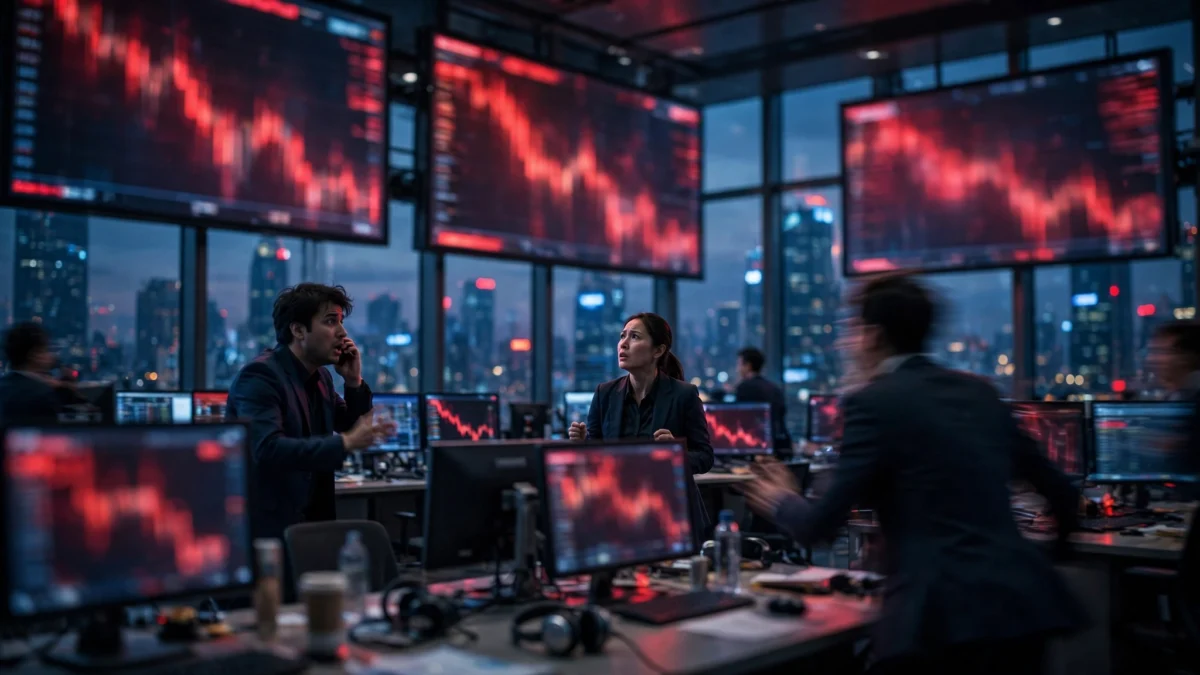
Asia’s stock markets endured one of their worst days in years on Thursday as a deepening technology selloff swept across the region, with South Korea’s benchmark index plunging so far that trading was halted to slow the rout. The KOSPI tumbled around 8% during the session, triggering circuit breakers on both the KOSPI and the smaller KOSDAQ boards — the first time both exchanges were frozen on the same day since late July, according to the AP.
The sell-side trading curb kicked in shortly after the opening bell, suspending program sell orders as the selling intensified, and by the afternoon a full circuit breaker halted all KOSPI trading for 20 minutes when the index’s losses exceeded 8%, according to AJU Press. The index closed down roughly 8% at 5,527.12, one outlet reported — a staggering fall for a single session that wiped out trillions of won in market value and capped a month-long slide that has now erased more than 16% from the index.
The damage radiated outward. Japan’s Nikkei 225 tumbled close to 5% to around 64,340, Taiwan’s Taiex shed more than 3%, Hong Kong’s Hang Seng dropped over 1%, and Shanghai’s Composite eased about 2%. Only Australia’s ASX 200 escaped with a flat reading. US equity futures pointed to more pain ahead when Wall Street reopened.
Chip Giants Bear the Brunt
The carnage was concentrated exactly where the artificial intelligence boom had been hottest: semiconductors. Samsung Electronics, the world’s biggest memory-chip maker, plunged roughly 9.5% to 210,000 won after touching an intraday low of 204,500 won, according to AJU Press. SK Hynix, its rival in memory chips, sank around 11% to 1,262,000 won. Together, the two companies account for nearly half of the KOSPI’s market capitalization, so their collapse virtually guaranteed the index would follow.
The pain spread down the supply chain. Samsung Electro-Mechanics cratered more than 15%, while SK Square — SK Hynix’s largest shareholder — dropped over 10%, according to AJU Press. In Tokyo, OpenAI investor SoftBank Group lost 9.4%, chip-equipment maker Tokyo Electron fell 7.3%, memory producer Kioxia Holdings dropped 11.2%, and testing-equipment giant Advantest plunged nearly 14%, one outlet reported. Murata Manufacturing shed 10%.
Foreign investors fled: they sold a net 2.9 trillion won (about $2.04 billion) on Korea’s main board during the session, according to one outlet. The Korean won weakened 0.8% against the dollar.
Not everything fell. A handful of defensive names bucked the tide: Samsung Biologics gained 5.5%, Celltrion advanced 1.3%, and Hana Financial Group rose 0.7%, according to AJU Press. Pharmaceutical shares climbed 2.7% and food and beverage stocks gained about 2%. But these were islands of green in a sea of red — electrical and electronics shares dropped 10.1% as a sector, and medical and precision-equipment stocks fell 8.9%.
What Set It Off: Hot Inflation, Cold Feet on AI Money
Two forces converged to produce Thursday’s rout. The first was Wednesday’s hotter-than-expected US inflation report. The Labor Department said consumer prices rose 3.7% year-on-year in September, up from 3.4% in August and above economists’ forecasts, according to Reuters. Core inflation, which strips out food and energy, ran at 2.6% — also above expectations. Gasoline prices jumped 9.1% in a single month.
The numbers revived the prospect of another Federal Reserve interest-rate increase this month, with traders lifting the odds of an October hike to around 41% from roughly 20% before the data, according to Reuters. That repricing hit AI-linked stocks hardest because they depend on cheap, abundant financing: higher borrowing costs make the multi-hundred-billion-dollar data-center buildout more expensive and harder to justify. The Philadelphia Semiconductor Index fell 4.3% on Wednesday, its sixth straight daily decline, according to AJU Press. The Russell 2000 index of small-cap stocks slid into correction territory, more than 10% below its recent highs, according to the Wall Street Journal.
The second force was a growing fear that the AI investment wave itself is running on fragile financing. The day before the Asian rout, shares of CoreWeave — the AI cloud provider at the center of Wall Street’s “AI bond” anxiety — plunged 15% in New York and shed another 5.9% after hours, according to Morningstar. Research firm Gartner warned of a widening gap between projected infrastructure investment and the revenue needed to justify it. Bond yields on longer-term US Treasuries jumped on inflation worries before sinking again, and the dollar index rose to its highest level in more than a year, according to the Wall Street Journal. Gold futures lost 1.6% to $4,084.80 an ounce, while Brent crude rose to about $106 a barrel.
Lorraine Tan, director of equity research for Asia at Morningstar, told the AP that heavily technology-weighted markets such as Korea and Taiwan face a specific risk: any threat to perceived AI spending growth can quickly translate into slower demand expectations for chips and equipment — a mismatch, she said, between the market’s growth expectations for the tech sector and what may actually eventuate.
The TSMC Paradox
In a striking twist, the day’s loudest victim was not a laggard but one of the AI boom’s strongest performers. Taiwan Semiconductor Manufacturing Co. reported better-than-expected profit for the latest quarter on Thursday, and the company said AI demand remains “very strong,” according to the AP. Yet TSMC’s shares fell more than 2% anyway.
That disconnect is the day’s most telling detail. When even the best results in the industry cannot lift the stock, the market is no longer pricing the chips — it is pricing the money behind them. Investors appear less worried about whether anyone will want AI computing and more worried about how anyone will pay for it if borrowing costs keep rising.
Not Everyone Fell: Europe’s Defensives and India’s Rotation
Europe offered a counterpoint. After the Kospi slumped nearly 8% in Seoul and the Nikkei fell 5% in Tokyo, the major European indexes traded mixed to higher, according to MarketWatch. Being left behind the AI trade proved fortuitous: while tech names including Infineon slumped, well-received results from companies including Ericsson and Pernod-Ricard, plus a preference for defensive offerings such as food and beverage stocks, kept the continent afloat. London’s FTSE 100 climbed 0.4%, Paris’s CAC 40 rose 0.5%, and Frankfurt’s DAX slipped 0.1%. Sterling picked up on the dollar after the UK economy registered surprising monthly growth.
India moved the other way from its Asian peers entirely. The Sensex rose about 1.1% to above 73,600 and the Nifty reclaimed 22,800, powered by TCS, Infosys and Tech Mahindra — the very IT services companies investors had been dumping for most of the year, according to one outlet. The rupee firmed to 94.86 per dollar. One way to read that split: countries whose indices are packed with memory makers and chip-equipment suppliers are taking the hit, while India, which barely owns that trade, is being treated as a place to hide.
Analysis: Why It Matters
Thursday’s rout matters less for the money it destroyed in a single day — markets do that routinely — and more for what it revealed about the fragile wiring underneath the AI boom. For two years, investors have argued about whether artificial intelligence demand is real. This week’s selloff suggests the argument has moved on: demand is real, but financing is the choke point. TSMC’s paradox is the proof. When the world’s most important chipmaker reports a strong quarter and declares AI demand “very strong,” and its shares fall anyway, the market is telling you that customers were never the question. The question is the capital stack.
That explains why a US inflation print could detonate Seoul and Tokyo but leave Paris calm. A hotter CPI number does not change how many chips anyone needs. What it changes is the cost of money — and the AI trade is, at its core, a trade on cheap, plentiful money. Neoclouds and hyperscalers are borrowing tens of billions of dollars to build data centers whose revenues arrive years later. When the two-year Treasury yield climbs toward 5% and traders start pricing another Fed hike, the present value of that future revenue shrinks, and the debt used to fund it gets more expensive at the same time. It is a double squeeze, and it hits the most leveraged, most AI-exposed balance sheets first.
The geography of the selloff maps almost perfectly onto the geography of AI exposure. Korea and Taiwan — the world’s memory and logic-chip heartland — fell hardest because their indices are the purest expression of the AI hardware trade. Japan followed because SoftBank has become the country’s AI proxy. Europe barely blinked because it was never really in the trade. And India rallied because rotation is the market’s other signature move this week: money leaving AI hardware is looking for somewhere to hide, and India’s domestic-demand story fits the bill.
None of this resolves the underlying question. The optimists still have the strongest fact on their side: the world’s largest chipmaker says AI demand remains very strong. The pessimists have the strongest logic: if the buildout needs to be financed at 5%-plus interest rates, the math only works if the revenue eventually arrives at a scale nobody can guarantee today. Gartner’s warning about the gap between projected infrastructure investment and the revenue needed to justify it is the institutional version of that doubt. Thursday’s selling was the market trying to price both views at once — and failing, loudly.
The historical frame is worth keeping in mind. Sell-side curbs and circuit breakers exist precisely because panic feeds on itself; the Korea Exchange halted trading for 20 minutes to break the cascade. But mechanical halts treat the symptom, not the cause. The cause is a market that had priced perfection — a June record above 9,000 on the Kospi, built on AI euphoria — and is now repricing for a world where money is no longer nearly free. The KOSPI has fallen more than 16% in a month. That is not a correction in a single stock. That is a regime shift in what investors are willing to pay for the future.
What to Watch Next
- The Fed’s October 27–28 meeting: Whether the central bank actually delivers the rate increase traders are now pricing will set the tone for every AI-financing deal on Wall Street. The next batch of US economic data arrives first.
- Whether the rout spreads to the US open: Nasdaq 100 futures were already lower. A third consecutive day of losses in American semiconductors would confirm this is a global repricing, not an Asian blip.
- More chip earnings: TSMC beat and fell. If the rest of the sector’s results are met the same way, the “fundamentals don’t matter” reading gains force.
- Korean official response: Foreign investors sold 2.9 trillion won in a single session. Watch for market-stabilization signals from Seoul and whether the won’s slide forces the central bank’s hand.
- The financing deals themselves: The AI buildout’s mega-deals — including Nvidia’s chip-backed financing program — now have to be priced against a 5%-plus rate environment. Any delay or repricing there will echo back into chip stocks.
Sources
- Associated Press — A tech sell-off drags Asian stocks lower as markets in South Korea and Japan sink
- AJU Press — KOSPI plunges over 7% as chip rout triggers trading halts
- Euronews (via IndexBox) — Asian Stocks Tumble: Kospi Drops 7.7%, Nikkei Falls 4.8% on Tech Sell-Off
- MarketWatch — As Asian stocks slump, European markets trade mixed to higher as defensive stocks gain
- Morningstar/Alliance News — London market open: Europe largely higher but AI worry lingers
- AsiaDaily — Asia Daily: South Korean Stocks Plunge 8% as Trading Halts Hit
- Wall Street Journal — U.S. Stocks Fall on Hot Inflation Report, AI Sell-Off
- Reuters (via livemint) — Stocks fall, dollar rallies as US inflation tops forecasts

About the Author — Abdul Mannan
Related Articles

CoreWeave Crashes 16% as “AI Bond Blues” Grip Wall Street; Traders Pile Into “Bubble Puts”
CoreWeave plunged about 16 percent on Wednesday as its bonds sank into distressed territory, dragging AI infrastructure stocks…

Hot September Inflation Puts Fed Rate Hike Back on the Table as Markets Tumble
U.S. consumer prices rose 3.7% in September as gasoline surged, with core inflation topping forecasts — reviving bets…
ASML Posts Record €11.7 Billion Quarter as AI Chip Demand Outruns Supply Through 2028
ASML reported record third-quarter sales of €11.7 billion and warned its planned supply for 2027 and 2028 will…