
ASML Posts Record €11.7 Billion Quarter as AI Chip Demand Outruns Supply Through 2028

A record quarter at the choke point of the AI boom
The company that sells the machines that make the world’s most advanced chips has just posted the biggest quarter in its history — and told investors that even its best-laid production plans will not be enough. ASML, the Dutch maker of lithography systems, reported record third-quarter total net sales of €11.7 billion, according to the company’s own results announcement published on Wednesday, October 14, 2026. Net income reached €5.0 billion, and the gross margin came in at 57.5 percent.
The numbers mark a sharp step up from the previous quarter. In the second quarter of 2026, ASML recorded total net sales of €9.3 billion, net income of €2.9 billion and a gross margin of 54.0 percent, according to the same announcement. The third quarter therefore delivered roughly a quarter more in sales and about 70 percent more in profit within the space of three months. Basic earnings per share rose to €12.95, up from €7.59 in the second quarter, according to ASML.
The year-on-year comparison is starker still. Third-quarter sales of €11.7 billion compared with €7.5 billion in the same period last year, according to Agence France-Presse. The result landed toward the high end of the company’s own guidance: in July, ASML had guided third-quarter net sales of between €11.0 billion and €12.0 billion with a gross margin between 55 and 57 percent, according to Unite.AI. Sales finished near the top of that range, while the margin beat it.
On the profit line, the outcome was comfortably ahead of what analysts had pencilled in. Analysts tracked by Visible Alpha had expected earnings per share of €10.87, according to Investopedia, against the €12.95 actually delivered. On sales, the picture was closer: Visible Alpha’s revenue consensus stood at €11.71 billion, essentially where the quarter landed, while a separate LSEG consensus cited by alfw.ai had pointed to €11.85 billion. In other words, the quarter was roughly in line with expectations on revenue and clearly ahead on profit — though, as discussed below, part of the profit jump came from an investment revaluation rather than from selling more machines alone.
Investors greeted the numbers warmly at first. ASML shares rose more than 2 percent at the opening bell on the Amsterdam stock market, according to AFP. That early gain built on an already powerful run: the shares had rallied about 56 percent this year before the results, according to CNBC. Options traders had braced for a sharp move either way, with pricing implying a swing of up to 4.6 percent in either direction by the end of the week, according to Investopedia.
What actually sold
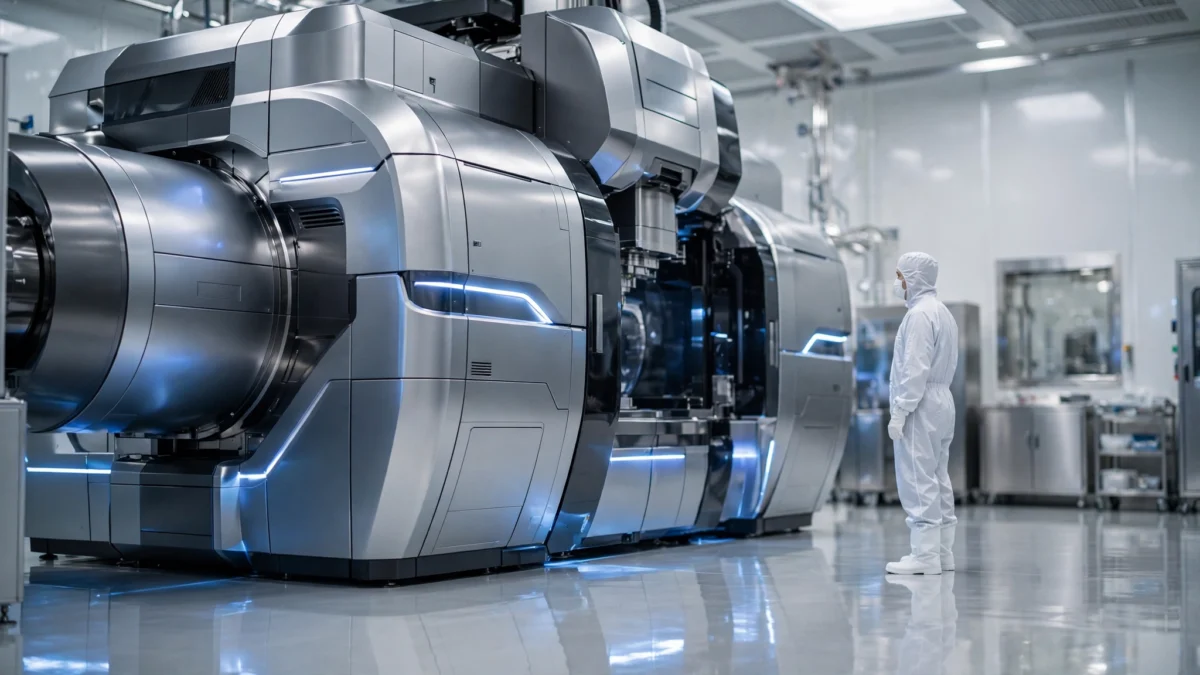
ASML’s business has two engines, and both ran hard in the quarter. The company sold 113 new lithography systems and 8 used systems, up from 86 new systems in the second quarter, according to its results announcement. These machines — each a feat of precision engineering the size of a small bus — are what chipmakers use to print the patterns of integrated circuits onto silicon wafers. Without them, the most advanced chips cannot be made at all.
The second engine is the service and upgrade business. Installed Base Management sales — the company’s term for net service and field-option sales — reached €3.3 billion, above guidance, according to ASML. Chief Financial Officer Roger Dassen said in the company’s results video that this figure came in about €400 million above what had been guided, driven by customer demand for productivity upgrades on machines already installed, according to Unite.AI. That upgrade demand was a major reason the gross margin rose above guidance to 57.5 percent.
Cash piled up too. Cash and cash equivalents plus short-term investments stood at €12.7 billion at the end of the quarter, up from €7.6 billion at the end of the second quarter, according to ASML. The company also returned money to shareholders: it bought back around €4.1 billion worth of shares in the quarter under its 2026–2028 buyback programme, and declared an interim dividend of €1.88 per ordinary share, payable on November 4, 2026, according to the announcement.
The headline that matters more than the numbers
Strong quarters come and go. The sentence in ASML’s announcement that will shape the next two years concerns supply, not sales. Chief Executive Officer Christophe Fouquet said customers continue to raise their short- and medium-term equipment demand forecasts, driven primarily by their views on the size and duration of artificial-intelligence-related investments, according to the company. Some customers, he said, are already expressing interest in placing orders for 2029 and even 2030.
That visibility has produced an unusual admission from a company whose entire business is expanding production. With order-book momentum increasing quarter on quarter this year, ASML now expects that its supply as currently planned for both 2027 and 2028 will not fully meet customer demand, according to the announcement. The company said it is investigating ways to increase capacity for 2028 beyond the 30 percent increase it had previously communicated, while continuing to expand the wafer capacity available to customers through productivity upgrades to machines already in use.
This is a significant shift in framing. Earlier in the year, ASML had said it planned to increase 2026 low-numerical-aperture EUV and DUV immersion capacity by 30 percent in 2027, and was investigating a further 30 percent increase for both in 2028, according to a footnote in the same announcement. Now even that expanded footprint looks insufficient. The bottleneck has moved: the constraint on the AI build-out is no longer only the willingness of chipmakers to spend, but the physical ability of the one company that makes the most advanced lithography machines to build them fast enough.
The guidance: another step up
ASML paired the record quarter with a forceful outlook. For the fourth quarter of 2026, the company expects total net sales of between €14.2 billion and €15.2 billion, with a gross margin of around 57 percent, according to the announcement. The midpoint of that range would represent roughly another quarter of growth on top of the record just reported. Expected research and development costs are around €1.2 billion, with selling, general and administrative costs of around €0.4 billion.
For the full year, ASML now expects total net sales of between €44 billion and €45 billion, with a gross margin of around 56 percent, according to the company. Secondary reporting counted the upgrade as the third time the company has lifted its full-year range this year, according to alfw.ai. A company raising its forecast three times in one year is not guessing about demand; it is struggling to keep its public numbers in step with its order book.
One important caveat on the profit figure
The headline net income of €5.0 billion deserves a closer look before anyone concludes that machine-selling alone produced it. According to Dassen, speaking in the company’s results video, the quarter’s net income included €500 million from the revaluation of the first tranche ASML bought from Mistral AI, the French artificial-intelligence company, according to Unite.AI. The Financial Times also reported that the Mistral revaluation contributed to the quarter’s profit, according to alfw.ai.
That does not make the profit figure wrong — investment gains are real gains — but it does mean the operating story and the headline profit story are not identical. Strip out the half-billion-euro revaluation and the underlying equipment-and-services profit, while still very strong, is more modest than the headline suggests. Readers comparing this quarter with future quarters should keep that in mind: investment revaluations can flatter one quarter and vanish the next, while machine sales and service revenue are the durable core.
The technology at stake: High NA EUV
Behind the financials sits a technology transition that will shape who can build the next generation of chips. ASML is the only company in the world that produces extreme ultraviolet lithography machines, the tools used by companies such as TSMC to make the world’s most advanced semiconductors, according to CNBC. Its next-generation tool, High NA EUV, is widely seen by analysts as key to the company’s future growth, according to CNBC.
During the quarter, Samsung and TSMC — the world’s two biggest chipmakers — committed to using ASML’s High NA EUV machines, according to CNBC. That matters because the adoption of a new generation of lithography equipment is never automatic. Each new generation is more expensive and more complex than the last, and chipmakers commit only when they are convinced the economics of finer, denser patterns will pay. Two of the three largest logic chipmakers committing in the same quarter is a strong signal that High NA EUV has moved from experiment to production roadmap.
The stakes extend beyond any single company. The machines ASML builds determine, in practice, how quickly the whole industry can shrink transistors further and pack more computing power into each chip. When ASML says its supply will fall short of demand for two years, it is effectively saying the entire AI hardware build-out has a speed limit — and that the speed limit is set in Veldhoven, in the Netherlands.
China, export controls and the geopolitical shadow
No account of ASML is complete without China. The company has been caught in the crossfire of a technology dispute between the United States and China, and has previously warned that its Chinese sales would decline significantly this year, according to AFP. Washington is leading efforts to curb high-technology exports to China over fears they could be used to bolster the country’s military, according to AFP. Beijing has reacted furiously to the measures, describing them as “technological terrorism,” according to AFP.
For now, China remains a substantial but shrinking slice of ASML’s business. Dassen said China would represent around 20 percent of ASML’s business this year, in line with previous forecasts, according to AFP. The company has also denied reports of United States concerns that one of its advanced chipmaking machines was in China, potentially violating the restrictions, according to AFP. Meanwhile, China is reportedly in the early stages of producing its own EUV technology, according to AFP — a long-term effort that, if it ever succeeds, would strike at the heart of ASML’s monopoly.
The export-control regime is one of the clearest risks to the optimistic demand story. ASML’s own forward-looking statements flag restrictions on shipments of systems, including ordered systems, under export controls, along with trade-environment and national-security regulations, as factors that could cause actual results to differ from its outlook. In plain terms: some of the demand ASML counts may prove undeliverable if political decisions close off particular customers or destinations.
Context: a company reshaping itself mid-boom
The record quarter arrives in the middle of a corporate reshaping. In January, ASML announced an organisational shake-up expected to result in the loss of around 1,700 jobs in the Netherlands and the United States, mainly from leadership roles, according to AFP. The company employs more than 45,500 people on a full-time-equivalent basis, according to its own announcement — a figure that underlines how much of ASML’s value lies in specialised engineering talent that cannot be hired overnight.
That talent constraint is part of why the supply warning matters. Expanding production of the world’s most complex machines is not like adding a shift at an ordinary factory. It requires precision optics, ultra-clean assembly, and a supplier network of hundreds of specialised firms. When ASML says it is investigating ways to lift 2028 capacity beyond a previously planned 30 percent increase, it is describing an industrial effort that will test its suppliers, its workforce and its own factory floor in equal measure.
Analysis: Why It Matters
ASML’s quarter is best read not as a company earnings story but as a reading on the whole artificial-intelligence economy. Here is the chain of logic. Every AI model, from the chatbots answering questions to the systems designing drugs, runs on chips. The most advanced of those chips can only be made with ASML’s machines. So when ASML reports record sales and says it cannot build enough machines for the next two years, it is telling us that the AI build-out is demand-led, supply-constrained, and nowhere near its peak.
First, the demand signal is unusually clean. Chipmakers do not order lithography machines on a whim. Each system costs an enormous sum, takes months to install and calibrate, and commits its buyer to a production roadmap years into the future. When customers raise their forecasts and start asking about orders for 2029 and 2030, they are revealing what they genuinely believe about the durability of AI spending. That is a stronger signal than any survey of executive sentiment, because it is backed by capital commitments.
Second, the supply warning reframes the AI debate. Much of the public argument about artificial intelligence has centred on whether the spending is a bubble: too much money chasing too little revenue. ASML’s numbers suggest a different framing for the hardware layer at least. A bubble is characterised by supply racing ahead of demand and prices collapsing. What ASML describes is the opposite — demand racing ahead of supply, with the bottleneck supplier unable to keep up. That does not prove every AI investment will pay off. It does suggest the hardware layer of the boom is built on real orders, not speculation.
Third, scarcity creates its own economics. When the bottleneck supplier cannot meet demand, pricing power shifts to that supplier, waiting lists lengthen, and customers compete for allocation. For ASML, that is a favourable position: it supports margins, deepens customer dependence, and makes the order book more resilient. For chipmakers, it means production plans must be negotiated years in advance, and smaller players without allocation may find themselves squeezed. For the rest of us, it means the pace at which AI capability spreads is governed less by software breakthroughs than by the delivery schedule of a few hundred machines a year.
Fourth, the High NA EUV commitments from Samsung and TSMC show the technology ladder still has rungs. There has been a persistent worry that chipmaking is approaching physical limits that will slow progress and flatten the industry’s economics. The move to High NA EUV is the industry’s answer: a new generation of tools that keeps shrinking features and raising performance. That both companies committed in the same quarter suggests the leading edge is advancing, not stalling — and that ASML’s monopoly position extends into the next generation rather than expiring with the current one.
Fifth, the China question remains the great unknown. A fifth of ASML’s business still comes from China, yet the political direction of travel points toward tighter restrictions, not looser ones. The tension is structural: ASML is a commercial company that would like to sell to every willing buyer, operating inside a geopolitical system that treats its most advanced products as strategic assets. The company’s record quarter was achieved despite that tension, not in the absence of it. If restrictions tighten further, ASML would lose revenue in the short term — but its non-China customers, already unable to get enough machines, would likely absorb much of the freed-up supply. The company’s monopoly cushions it in a way few other firms enjoy.
Finally, the Mistral revaluation is a useful reminder to read earnings carefully. A half-billion-euro investment gain is welcome, but it is not evidence about the machine business. The durable story in this quarter is the sales record, the margin beat, the raised guidance and the supply warning. The investment gain is a footnote that happens to be large. Serious readers should keep the two apart.
None of this means the AI boom is guaranteed to end well. Hardware suppliers can prosper for years while the ultimate applications disappoint; the railway booms of the nineteenth century enriched the companies that laid track long before the railways themselves turned reliably profitable. ASML’s quarter tells us the track is being laid at a record pace. It tells us nothing about whether the trains will be full. What it does tell us is that, for now, the people building the infrastructure believe the traffic is coming — and they are putting billions of euros behind that belief.
What to Watch Next
- Fourth-quarter delivery: ASML guided fourth-quarter sales of €14.2 billion to €15.2 billion. Hitting the top of that range would require another large step up in shipments. Any shortfall would raise questions about whether the constraint is demand, production, or installation capacity.
- The 2028 capacity decision: Watch for concrete plans — factory expansions, supplier commitments, hiring — that show how ASML intends to lift 2028 capacity beyond the previously communicated 30 percent increase. Vague intentions will not close a two-year supply gap.
- High NA EUV execution: Commitments from Samsung and TSMC are the starting gun, not the finish line. The pace at which High NA systems ship, qualify in fabs, and enter volume production will determine ASML’s growth profile for years.
- Export controls and China: Any tightening of restrictions, any reported violation, or any sign of progress in China’s own EUV efforts could move the stock and reshape the demand picture. China’s share of around 20 percent of business this year is the number to track.
- The wider market backdrop: With United States bank earnings continuing and American inflation data due later on Wednesday, the appetite for risk assets — and for richly valued technology suppliers — could shift quickly. ASML’s investor call on Wednesday afternoon will be the first chance to hear management pressed on all of the above.
Sources
- ASML — ASML reports €11.7 billion total net sales and €5.0 billion net income in Q3 2026 (official results announcement)
- AFP — AI boom drives record sales at Dutch tech giant ASML
- CNBC — ASML says it’s getting order interest through 2030 as profit smashes expectations
- Investopedia — Here’s How Much ASML Stock Is Expected to Move After Earnings
- Unite.AI — ASML Warns 2027–2028 Chip Tool Output Will Fall Short of AI Demand

About the Author — Abdul Mannan
Related Articles
Bank Earnings Season Opens Today as JPMorgan, Goldman Sachs, Citigroup and Wells Fargo Face a 5% Yield Test
Wall Street's biggest banks report third-quarter results on Tuesday amid generational-high Treasury yields — the first test of…

Asian Markets Slide as Chip Sell-Off, Rising Oil and Earnings Anxiety Trigger Risk-Off Tuesday
Asian equities fell sharply on Tuesday as a chip sell-off, rising oil prices and a packed week of…

Bull Market Turns Four as Wall Street Opens a High-Stakes Week of Bank Earnings, CPI and Oil Jitters
The S&P 500 bull market turned four on Monday, nearly 120 per cent above its October 2022 low,…