
Pakistan’s Parliament Backs Emergency and Governor’s Rule in Khyber Pakhtunkhwa With 214-56 Joint-Sitting Vote

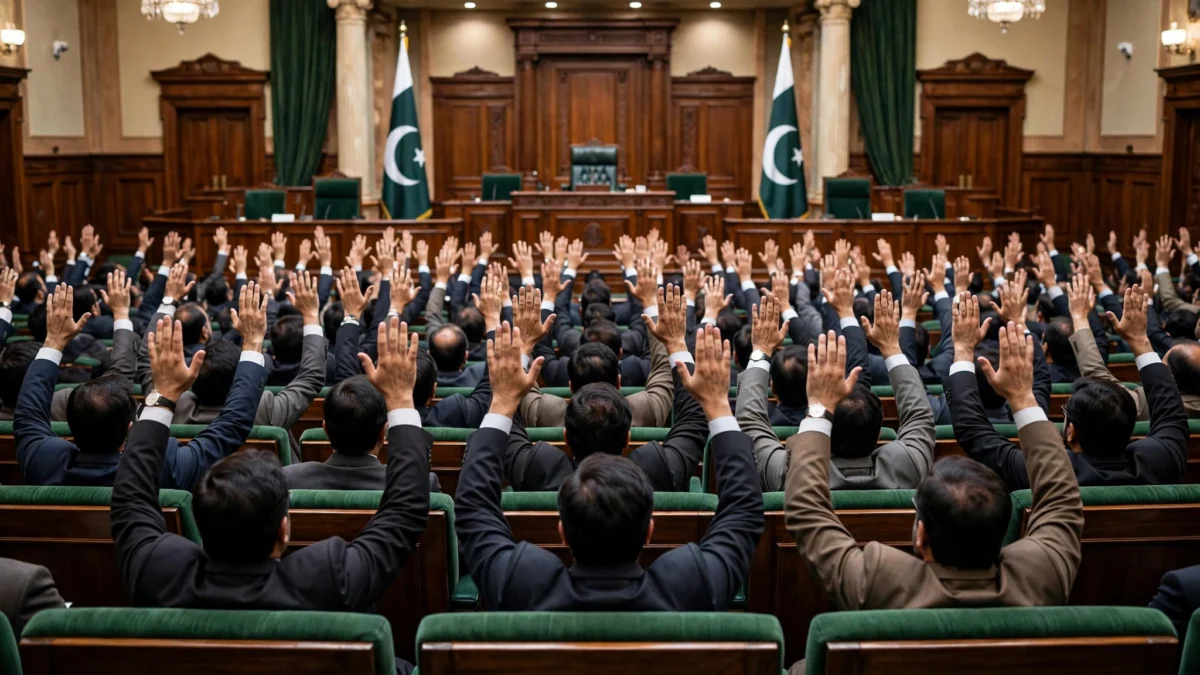
ISLAMABAD — A joint sitting of Pakistan’s Parliament on Thursday formally endorsed the emergency and governor’s rule imposed in Khyber Pakhtunkhwa, approving the government’s two resolutions by 214 votes to 56, according to WENewsEnglish and Dunya News. The vote gives full parliamentary sanction to the October 11 federal takeover of the northwestern province, locking in Islamabad’s direct control of the province for the next two months.
The session, chaired by National Assembly Speaker Sardar Ayaz Sadiq, considered two separate resolutions moved by Federal Minister for Parliamentary Affairs Tariq Fazal Chaudhry — one under Article 232 of the Constitution approving the presidential proclamation of emergency, and another under Article 234 endorsing governor’s rule, according to WENewsEnglish. When opposition lawmakers began protesting as the voting started, the speaker ordered a full count, Dunya News reported, and the final tally came out at 214 in favour and 56 against.
Before the substantive votes, Chaudhry moved a procedural motion under Rule 32 of the Parliament (Joint Sitting) Rules 1973, seeking suspension of the usual notice periods so that the resolutions required by clause 7 of Article 232 and clause 3 of Article 234 could be taken up the same day, WENews reported citing the National Assembly’s own posts on X. The house adopted the motion, clearing the path for the vote.
Speaking during the joint sitting, Law Minister Azam Nazeer Tarar said a special mechanism had been established to run the province’s affairs during the period of emergency and governor’s rule, according to WENewsEnglish. He said the government was prepared to respond to questions raised by opposition members, and emphasised what he called the constitutional basis for the extraordinary measures. Tarar has repeatedly cited what he describes as the provincial government’s disengagement from the fight against terrorism; during Wednesday’s National Assembly debate he said 3,787 terrorist incidents had been recorded in Khyber Pakhtunkhwa over the past year. On Thursday he also criticised PTI leaders for failing to attend the funerals of people killed in terrorist attacks, WENews reported.
In a parallel move, Speaker Sadiq once again invited Pakistan Tehreek-e-Insaf to hold talks in the National Assembly, Dunya News reported. Production orders were also issued for PTI lawmakers Sanaullah Mastikhel and Dawar Kundi, clearing the way for their attendance in Parliament despite their detention.
Why the Joint Sitting Was the Decisive Step
Thursday’s approval was not merely symbolic. Under Pakistan’s constitutional framework, the separate resolutions adopted by the National Assembly and the Senate on Wednesday satisfied only the first deadline: because President Asif Ali Zardari proclaimed the emergency on October 11 without a resolution from the Khyber Pakhtunkhwa assembly, the second proviso to Article 232(1) required both houses of Parliament to approve it separately within ten days, according to the constitutional explainer published by ZarkNews. Wednesday’s votes met that requirement.
But a second step remained for both measures. Under Article 232(7), the emergency proclamation must also be laid before a joint sitting of Parliament and lapses after two months unless the joint sitting approves it. Governor’s rule under Article 234 follows the same joint-sitting route: it ceases to operate after two months unless approved there, and may then be extended in steps of up to two months at a time, to a maximum of six months in total, according to ZarkNews.
With Thursday’s 214-56 vote, both measures now carry the joint sitting’s approval. The emergency is secured for two months and the governor’s rule can now run through its full constitutional runway — extensions of two months at a time, up to six months in total — subject to further joint-sitting votes before each deadline.
The Interior Ministry has separately issued an order under Article 245 of the Constitution authorising the deployment of Pakistan Army troops in aid of civil power in the province for the duration of the emergency, ZarkNews reported.
How the Province Is Being Run
The elected provincial government ceased to function when the emergency was proclaimed. Governor Faisal Karim Kundi, a PPP nominee, now heads the administration with an 11-member advisory council. Parliament has assumed the legislative powers of the provincial assembly, and the chief minister and cabinet — led by PTI’s Sohail Afridi — have ceased to hold office. Afridi has been detained since the crackdown that followed the emergency proclamation, and PTI spokesperson Zulfikar Bukhari condemned what he called the arrest of “the only mandated Chief Minister” in a post on X, according to IANS.
The federal government has framed the intervention as a response to a security emergency. Officials have argued that the provincial administration repeatedly declined to take ownership of counterterrorism efforts and that two days of talks before the October 11 proclamation failed to produce assurances. The opposition disputes that framing entirely, arguing that the timing — the PTI was preparing a long march from Khyber Pakhtunkhwa to Islamabad to demand the release of its jailed founder, Imran Khan — exposes the security rationale as a pretext for removing a hostile provincial government.
PTI’s Two-Front Resistance
PTI has chosen to fight the measures on two fronts: in the courts and, potentially, in the street. Party chairman Barrister Gohar Ali Khan filed a petition in the Peshawar High Court on Wednesday challenging the emergency and governor’s rule and seeking the withdrawal of both measures and the restoration of the elected provincial government, The Standard reported. The petition, filed through lawyer Ali Zaman, argues that invoking terrorism as the basis for curtailing the powers of an elected provincial government amounts to discriminatory treatment, and that political differences cannot be the basis for stripping a provincial administration of its powers.
Gohar’s petition draws two pointed comparisons. It notes that governor’s rule has not been imposed in Balochistan despite its security situation, and it recalls that no such measures were taken against the Khyber Pakhtunkhwa government between 2007 and 2015 — years when the province faced intense militancy — arguing that the current action is therefore discriminatory. The petition further maintains that the imposition of governor’s rule must meet the constitutional requirements and procedure laid down in Article 234, and contends that the PTI, which it says holds a two-thirds majority in the province following the 2024 general elections, had not planned any illegal activities during its long march to Islamabad, according to The Standard. An earlier petition challenging both measures was filed on Monday, ZarkNews reported; no hearing date or interim order has been announced for either.
The opposition’s rhetoric outside the courtroom has been sharper still. The International Human Rights Foundation condemned the emergency and governor’s rule in a statement on Tuesday, describing the move as a “military-backed power grab” and demanding the restoration of democratic rights and the release of detained political leaders, according to ZarkNews. Bukhari, writing on X, called the move a “coup disguised as emergency,” according to IANS.
Street-level tensions remain volatile. On Tuesday, a protest against governor’s rule in the Bara Bazaar area turned violent, with demonstrators torching a NADRA office and, according to police, holding 15 personnel hostage, while police responded with tear gas and live rounds. Reuters reported five injured and 50 detained; PTI claims of casualties could not be independently verified, the Express Tribune reported, according to IANS.
The Speaker’s Opening — Carrot and Stick
Thursday’s session carried a mixed signal from the treasury benches. Speaker Sadiq’s invitation to PTI to hold talks in the National Assembly — echoed earlier by PPP chairman Bilawal Bhutto-Zardari, who has combined his criticism of the PTI with a renewed dialogue offer — suggests the government wants the confrontation channelled through Parliament rather than the streets or the courts. The production orders for Mastikhel and Kundi point in the same direction: the treasury appears to want PTI voices inside the chamber for the next round of debate, a notable shift from the posture of exclusion that preceded the emergency.
Whether PTI accepts is another matter. Opposition parties boycotted much of Wednesday’s proceedings in protest, and the party’s current posture is defined by its court petitions and its detained leadership. The 56 votes against the resolutions on Thursday show the opposition still commands a bloc inside the house — small against the government’s 214, but capable of using every procedural and rhetorical tool available.
Analysis: Why It Matters
First, the arithmetic of permanence. A 214-56 vote is not a close call; it is a parliamentary landslide that converts an executive decision into legislative fact. With the joint sitting’s imprimatur, the federal takeover is now constitutionally locked for two months, with a clear path to six. That means Islamabad will govern Khyber Pakhtunkhwa — a province where the government’s own figures cite 3,787 terrorism incidents in a year — through the winter, in a province whose elected government and most of whose elected representatives opposed the arrangement.
Second, the legitimacy question has simply moved venues. The government’s case rests on a security record; the opposition’s rests on a calendar. Gohar’s petition makes the strongest version of the latter argument: why Khyber Pakhtunkhwa and not Balochistan, why now and not during 2007-2015, why days before a planned long march? The federal government’s answer — “deliberate disengagement” from counterterrorism — is a claim about intent, not a measurable fact, which is precisely why the Peshawar High Court petitions matter. A courtroom tests evidence; a parliament tests numbers. The government won the numbers test on Thursday. The evidence test is still to come.
Third, the Speaker’s invitation and the production orders reveal a government that understands the limits of rule by decree. Detaining PTI lawmakers while inviting their party to talks looks contradictory, but it is also pragmatic: a government running a province under emergency benefits from having the opposition inside the tent for the next votes — including the future joint-sitting approvals needed to extend governor’s rule. The 56 “no” votes on Thursday are, paradoxically, evidence that the parliamentary channel still functions.
Fourth, the two-month clock changes the tempo of everything. Security operations under Article 245, the advisory council’s governance, the PHC petitions, PTI’s street strategy — all now run against hard constitutional deadlines. If the government cannot show measurable results in counterterrorism by the time the next joint-sitting vote is needed, the opposition’s “pretext” argument gains force. If it can, the emergency acquires the one thing it currently lacks: a retroactive justification.
Fifth, precedent. Pakistan has imposed governor’s rule in provinces five times since 1975, and none of those episodes ended with the underlying political or security problem resolved — they ended with political settlements, judicial reversals, or fresh elections. The 12-district wartime governance model and the Article 245 deployment are new layers on an old template. Whether Khyber Pakhtunkhwa follows the template or breaks it will be decided not in this vote, but in what Islamabad does with the power the vote has just handed it.
What to Watch Next
- The Peshawar High Court petitions. No hearing date or interim order has been announced for Gohar’s Wednesday petition or the earlier Monday petition. An interim stay would upend everything Thursday’s vote settled.
- The next joint-sitting deadline. Governor’s rule must return to the joint sitting before two months expire if the government wants to extend it. December’s vote will be the first real test of whether the security situation has improved.
- The Article 245 deployment. The army’s aid-to-civil-power role is now formally authorised. Whether it produces measurable counterterrorism gains — or new grievances in the 12 designated districts — will define the public verdict.
- The talks invitation. Speaker Sadiq’s offer of dialogue and the production orders for detained PTI lawmakers create an opening. Does PTI step into Parliament, or keep fighting in court and on the street?
- The detained leadership. With production orders issued, the detained lawmakers may appear in Parliament and speak. Their statements — and the status of the detained former chief minister — will shape the opposition’s next move.
Sources
- WENewsEnglish — Pakistan’s Parliament Approves Emergency, Governor’s Rule in KP
- Dunya News via Shafaqna Pakistan — Joint Parliamentary Session Approves Emergency in Khyber Pakhtunkhwa by Majority
- NewsPulse — Parliament Ratifies Emergency, Governor’s Rule in KP by Majority Vote
- ZarkNews — Pakistan’s Parliament Endorses Emergency and Governor’s Rule in Khyber Pakhtunkhwa
- The Standard — PTI Challenges Emergency, Governor’s Rule in Khyber-Pakhtunkhwa
- IANS — Pakistan Faces Political, Security and Economic Pressures That Could Spill Over
- Express News — KP Emergency Approved! Parliament’s Joint Session Passes Resolution

About the Author — Abdul Mannan
Related Articles
At Least 27 Children and a Teacher Killed in Peshawar School Roof Collapse
The roof of a private school in Peshawar collapsed while classes were in session on Thursday, killing at…
Pakistan’s Parliament Holds Joint Session to Ratify Governor’s Rule in Khyber Pakhtunkhwa
Pakistan's Parliament convened a joint sitting on Thursday to formally ratify the emergency and governor's rule in Khyber…
National Assembly Backs Emergency and Governor’s Rule in Khyber Pakhtunkhwa as PTI Protests and Court Challenge Continue
Pakistan's National Assembly has passed a resolution endorsing the federal government's emergency and governor's rule in Khyber Pakhtunkhwa,…