
Pakistan’s Parliament Holds Joint Session to Ratify Governor’s Rule in Khyber Pakhtunkhwa

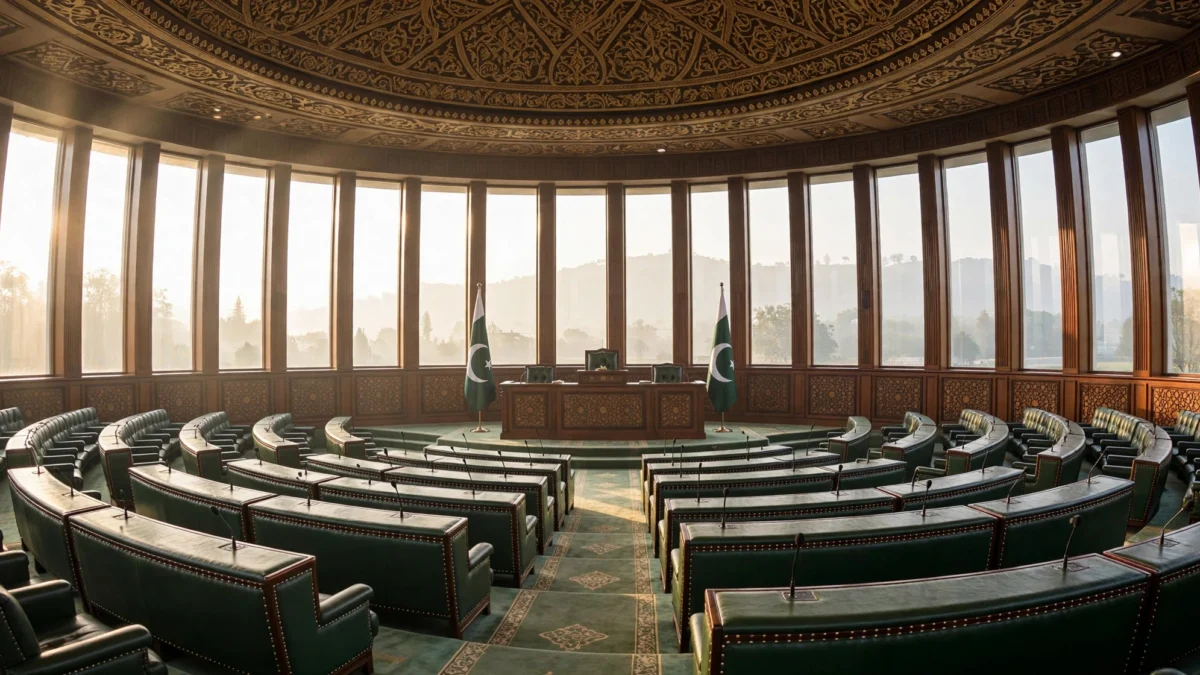
The Joint Sitting Convenes
ISLAMABAD — Pakistan’s Parliament met in a joint sitting on Thursday, summoned by President Asif Ali Zardari, to formally consider and ratify the emergency and governor’s rule imposed in Khyber Pakhtunkhwa — the final constitutional step in the federal government’s October 11 takeover of the province, according to multiple Pakistani media reports.
The president summoned the joint sitting of the Majlis-e-Shoora (Parliament) for Thursday morning under clause (1) of Article 54 of the Constitution, with the National Assembly Secretariat issuing the notification, according to WENewsEnglish and reporting by 24NewsHD carried by Ghanamma. The primary agenda item is the formal consideration and ratification of the governor’s rule and the October 11 emergency proclamation in Khyber Pakhtunkhwa.
Under Pakistan’s constitutional framework, both measures must survive the joint sitting. Because the president proclaimed the emergency without a resolution from the Khyber Pakhtunkhwa assembly, the second proviso to Article 232(1) required both houses of Parliament to approve it separately within ten days — by October 21 — a deadline met in Wednesday’s separate votes. But a further hurdle remains: under Article 232(7), the proclamation must also be laid before a joint sitting of Parliament, and it lapses after two months unless the joint sitting approves it, according to a constitutional explainer published by The Business Standard. Governor’s rule under Article 234 follows the same joint-sitting route: it expires after two months unless approved there, and may then be extended in increments of up to two months at a time, to a maximum of six months in total.
Wednesday’s Separate Votes
On Wednesday, both houses of Parliament adopted separate resolutions approving the emergency proclamation, endorsing the executive action taken on October 11. In the National Assembly, the resolution was moved by Minister for Parliamentary Affairs Tariq Fazal Chaudhry and adopted by majority vote after a debate that, according to SAMAA TV, ran for four hours, with opposition members protesting and chanting slogans against the move. The Senate mirrored the approval the same day, according to Reuters, WENewsEnglish and other outlets.
Law Minister Azam Nazeer Tarar, opening the debate in the lower house, told lawmakers that presenting the emergency proclamation before Parliament and obtaining its approval was a constitutional requirement, arguing the step had been necessitated by internal disturbances in the province and what he called the provincial government’s lack of seriousness in dealing with terrorism. Defence Minister Khawaja Muhammad Asif said there had been no choice but to impose the emergency, reaffirming what he described as the government’s firm resolve to combat terrorism with full force, according to the same reports.
The government says the cabinet, chaired by Prime Minister Shehbaz Sharif, recommended the measures on October 11, citing what officials described as the provincial administration’s “deliberate disengagement” from the fight against terrorism. Tarar told the House that 3,787 terrorist incidents had been recorded in Khyber Pakhtunkhwa over the past year — a figure the government has used as the statistical backbone of its case. He also said the Khyber Pakhtunkhwa governor had written to both the president and the prime minister about the province’s situation.
Bilawal Bhutto-Zardari, whose Pakistan Peoples Party is a coalition partner of Sharif’s government, defended the move as constitutional and said the PTI had committed a “political suicide attack” on its own interests; he also renewed an offer of dialogue, saying he would personally ask the prime minister to lift the emergency if conditions allowed. Opposition lawmakers, including PTI chairman Barrister Gohar Ali Khan, called the move an assault on provincial autonomy and democracy, while opposition figure Mahmood Khan Achakzai warned about damage to the federal structure.
Who Governs Khyber Pakhtunkhwa Now
Under the federal arrangement, Governor Faisal Karim Kundi of the Pakistan Peoples Party has assumed the functions of the provincial government, assisted by an 11-member advisory council. The chief minister, cabinet ministers, advisers and advocate general ceased to hold office, and Parliament has assumed the legislative powers of the provincial assembly, where the PTI held a majority.
The Interior Ministry, through an order under Article 245 of the Constitution, has authorized the deployment of Pakistan Army troops in aid of civil power for the duration of the emergency, according to reports by The Business Standard and other outlets. A separate federal order has established a secretariat for 12 “designated districts,” mostly in the former tribal areas along the Afghan border, headed by an additional chief secretary whose orders carry the same legal effect as those of the provincial government. In those districts, the constitutional provision requiring the separation of the judiciary from the executive “shall not apply,” according to the order. Interior Minister Mohsin Naqvi has said no province has been divided and that the districts are war-hit areas needing more funding and focus.
On Monday, a meeting of the Regional Development Secretariat was held in Peshawar, presided over by Naqvi and attended by the Corps Commander Peshawar, the additional chief secretary and other senior civil and military officials, according to Kashmir English. The meeting decided to immediately release funds for peace and development in the 12 districts — including Bannu, Lakki Marwat, Tank and Dera Ismail Khan — and to review the law and order situation, development needs and public grievances there.
The Pushback: Courts, Rights Groups and the PTI
Imran Khan’s Pakistan Tehreek-e-Insaf has rejected the federal government’s justification, describing the emergency as a pretext for a political takeover of Khan’s main stronghold and a move to stop his supporters from marching on Islamabad, according to Reuters. The party has challenged the measures in court: PTI chairman Gohar Ali Khan filed a petition in the Peshawar High Court on Wednesday asking the court to declare the October 11 proclamation unconstitutional, following an earlier petition filed on Monday, according to ZarkNews, citing local reporting. No hearing date or interim order had been reported as of Thursday.
The International Human Rights Foundation condemned the emergency and governor’s rule in a statement on Tuesday, describing the move as a “military-backed power grab” and demanding the restoration of democratic rights, the IANS news agency reported. The foundation said former provincial chief minister Sohail Afridi was among those detained and called for the emergency order to be rolled back and detained political leaders released. Reuters has separately reported the arrest of Khan’s three sisters and hundreds of supporters, including party leaders, ahead of a planned march to Islamabad demanding his release and medical treatment.
Separately, the Federal Constitutional Court is scheduled to hear a petition by Sher Afzal Marwat challenging Sohail Afridi’s appointment as chief minister on Thursday — the hearing date was announced on October 8, according to ZarkNews. Street-level tensions flared earlier in the week: Reuters reported that police fired tear gas and live rounds at Khan’s supporters in the province on Tuesday, with five people injured and 50 detained, and disputed accounts of a fire at a NADRA centre in Bara.
The crisis sits against the backdrop of Khan’s own detention. The 74-year-old former prime minister has been in prison since 2023 on corruption and other charges, which he denies as politically motivated. His family and party say his health is worsening — loss of vision in one eye, fluctuating blood pressure and the psychological fallout of solitary confinement — and have demanded urgent medical intervention, according to Reuters.
Analysis: Why It Matters
Thursday’s joint sitting is the moment when a controversial executive decision either becomes settled constitutional fact or stays legally fragile. That distinction matters more than the parliamentary theatre around it.
First, consider what the joint sitting actually does. Wednesday’s separate votes satisfied the first constitutional checkpoint; without Thursday’s approval, both the emergency and the governor’s rule die by their own clock — two months, then gone. The government’s decision to move this fast — joint sitting within four days of the proclamation, when the Constitution allows up to thirty for the emergency — signals that Islamabad wants the legal lock-in done before the courts, the streets, or the narrative can complicate it. A PTI challenge in the Peshawar High Court carries less weight once the full Parliament has signed off.
Second, the numbers are doing political work on both sides. The government’s figure — 3,787 terrorist incidents in a year — is a genuine security statistic, but it is also a rhetorical shield: it converts a political decision (seizing a rival’s provincial government) into an administrative one (responding to a security emergency). The PTI’s counter is not that the violence is invented, but that the federal government starved the province of funding and equipment and then punished it for the consequences — a claim that, notably, cannot be tested without the transparent accounting neither side has offered.
Third, this is the fifth time since 1975 that a Pakistani province has been placed under emergency, and all previous episodes were reversed within months through court or political intervention. That history cuts both ways: it normalizes the federal toolkit, and it guarantees nothing about permanence. The constitutional design — separate votes, then a joint sitting, then two-month increments capped at six — is meant to keep the exception exceptional. Whether that design still disciplines a government with a comfortable parliamentary majority is the real test of this week.
Fourth, the geography of the arrangement deserves attention. The 12 designated districts along the Afghan border get their own secretariat, their own chief secretary, and — most strikingly — the suspension of the judiciary-executive separation. That is a wartime administrative model transplanted onto civilian governance, and it will outlast the immediate crisis even if the broader emergency is lifted. The development-funds meeting chaired by the interior minister, with the corps commander in the room, tells you who the real stakeholders of that model are.
Finally, the PTI’s dilemma is sharpening. Every option — court challenge, parliamentary protest, street march — now operates inside a framework the federal government designed and Parliament blessed. Khan’s party says it lost nothing politically; the analysts quoted by Reuters say it lost on both counts, surrendering both its government and its leaders. Thursday’s sitting will not settle that argument. But it will decide the arena in which it continues — a courtroom, a parliament, or a street — and that is a decision worth the full country’s attention.
What to Watch Next
- The joint-sitting vote. The numbers and whether the resolution passes by majority — the government’s majority makes approval likely, but the margin and the opposition’s conduct will set the tone.
- The Peshawar High Court. Whether a hearing date or an interim order emerges on the PTI’s petitions challenging the October 11 proclamation.
- The Federal Constitutional Court. The Thursday hearing on Sher Afzal Marwat’s petition challenging Sohail Afridi’s appointment as chief minister.
- The long march. Whether the PTI calls off or proceeds with the planned march to Islamabad to demand Khan’s release and medical treatment.
- The two-month clock. Any move toward extension of governor’s rule under Article 234, and how the security situation evolves in the 12 designated districts.
Sources
- Reuters: Jailed Imran Khan’s woes compound after Pakistan suspends his provincial government
- Reuters: Pakistan police fire tear gas, rounds at Imran Khan backers, party says
- The Business Standard: What does Pakistan’s governor’s rule in Khyber Pakhtunkhwa mean?
- The Business Standard: Pakistan imposes emergency, governor’s rule in Khyber Pakhtunkhwa
- WENewsEnglish: Pakistan President summons Parliament’s joint sitting for Thursday
- ZarkNews: Pakistan’s Parliament endorses emergency and governor’s rule in Khyber Pakhtunkhwa
- IANS: ‘Military-backed power grab’: Pakistan govt condemned for Khyber Pakhtunkhwa emergency rule

About the Author — Abdul Mannan
Related Articles
National Assembly Backs Emergency and Governor’s Rule in Khyber Pakhtunkhwa as PTI Protests and Court Challenge Continue
Pakistan's National Assembly has passed a resolution endorsing the federal government's emergency and governor's rule in Khyber Pakhtunkhwa,…
Pakistan Confirms Detention of Ousted KP Chief Minister Sohail Afridi and Cabinet Members in “Preventive Custody”
Pakistan's Interior Ministry has confirmed that ousted Khyber Pakhtunkhwa chief minister Sohail Afridi and several cabinet members were…
Governor Kundi Chairs First Advisory Council Meeting in Peshawar, Makes Security and Anti-Corruption Top Priorities
A day after President Asif Ali Zardari imposed an emergency and governor's rule in Khyber Pakhtunkhwa, Governor Faisal…