
Five Killed as Houthi Missiles Strike Yemen’s Presidential Palace in Aden

Five Killed as Houthi Missiles Strike Yemen’s Presidential Palace in Aden
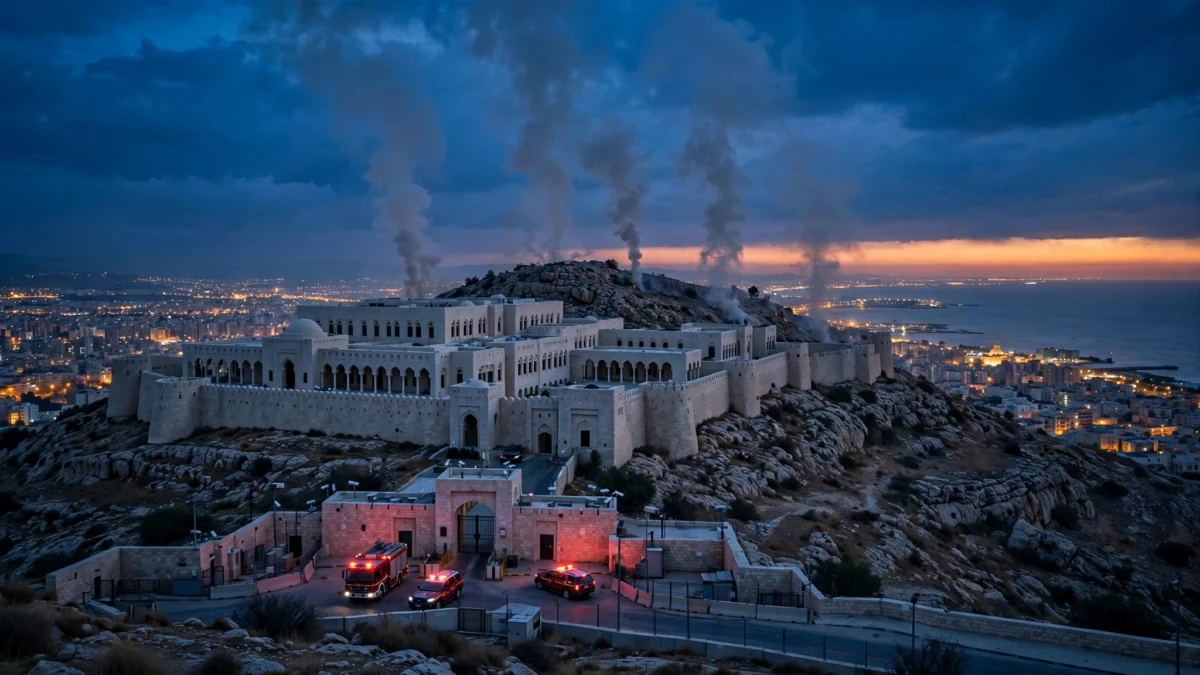
Missiles fired by Yemen’s Iran-aligned Houthi rebels struck the presidential Al-Maashiq Palace complex in the southern port city of Aden on Thursday, killing five people and wounding sixteen others, according to Yemen’s health ministry — the highest-profile attack on the seat of the country’s internationally recognized government since the civil war flared back to life this summer.
Yemen’s health minister, Qasim Mohammed Buhaibeh, said the dead and wounded included security personnel and civilian employees working at the government complex, which serves as the headquarters of Yemen’s Saudi-backed government and a key workplace for senior officials including the prime minister, according to Reuters. Yemen’s cabinet said the attack involved both missiles and drones.
Yemen’s information minister, Moammar al-Eryani, said Prime Minister Shaya Al-Zindani and members of the government were safe following the strike. A government minister, speaking on condition of anonymity because they were not authorized to brief the press, told Agence France-Presse that the prime minister had been present at the time of the attack but was not harmed in any way, according to reports citing AP and AFP. Witnesses told Reuters they heard loud booms near the palace.
The strike was the first in the current phase of the conflict on Al-Maashiq Palace — the de facto capital’s seat of power — and landed on the same day the Saudi-led military coalition detailed dozens of Houthi attacks on airports, ports, and oil facilities inside Saudi Arabia in recent weeks, underlining how rapidly the Yemen war has escalated into a wider regional confrontation.
The Houthi claim — and what remains unverified
The Houthis quickly claimed responsibility. The group’s military spokesperson, Yahya Saree, said its fighters had bombed what he described as the Saudi military operations headquarters inside the palace compound, framing it as part of the group’s declared policy of targeting, in his words, “Saudi reinforcements wherever they were located,” according to Reuters. The Houthi-run Saba news agency said the headquarters was run by Saudi officers and that there were weapons depots at the complex.
Reuters said it could not independently verify those claims. Yemen’s government, for its part, described the target as the official headquarters of the government itself — a competing framing that matters, because the two descriptions point at different messages. If the Houthis hit a Saudi command node, the strike was a battlefield blow against the coalition. If they hit the presidential palace as such, it was an attack on the government of Yemen itself — a symbolic decapitation attempt aimed at the very center of the Saudi-backed state’s authority in Aden.
The truth may be both at once: the compound is the government’s official headquarters, and Saudi officers and weapons are embedded there, as the Houthis claim. But the distinction will shape how Riyadh, Washington, and the region respond in the coming days.
Coalition details a campaign against Saudi infrastructure
Hours before the palace strike was fully understood, the Saudi-led coalition held a briefing detailing the scale of the Houthi campaign against Saudi civilian infrastructure. Coalition spokesperson Turki al-Maliki told reporters that the Houthis had launched 20 attacks on King Khalid International Airport in Riyadh this month alone, killing 17 people and wounding 333 others, according to Reuters. He said attacks on Abha airport in southwestern Saudi Arabia, near the Yemeni border, had killed three people and wounded 28.
Al-Maliki said the Houthis had acquired advanced military technology with the help of “regional actors,” including ballistic missiles, drones, and explosive-laden fast boats. Iran has provided weapons, money, and training to the Houthis, although Tehran has officially denied arming them in violation of a UN arms embargo, Reuters noted. The coalition said it had destroyed 127 weapons storage facilities and launch platforms in Yemen’s mountainous areas, and called on the Houthis to immediately halt operations targeting civilians and civilian infrastructure.
The governing council of the UN’s International Civil Aviation Organization condemned the recent attacks on civilian airports, aircraft, and aviation infrastructure in Saudi Arabia — a rare, high-level rebuke of attacks on civilian air travel, and a marker of how far the campaign has crossed beyond the battlefield.
Shortly after the coalition briefing, the Houthi military spokesperson renewed a warning to airlines that Saudi airspace and airports were unsafe, pointedly excluding the airspace over the holy cities of Mecca and Medina. Saudi Arabia’s civil defence authority issued early-warning alerts throughout Thursday over potential threats in the cities of Najran and Jizan, as well as the wider Najran and Jazan regions, before later saying the danger had passed. The coalition said it had intercepted and destroyed a drone in the southwestern Saudi Arabian city of Khamis Mushait, and another launched toward the country’s southern region, according to Reuters.
From stalemate to a new war
War broke out in Yemen in 2014, when the Houthis seized the capital Sanaa and drove the government south. Aden became the internationally recognized government’s de facto capital. A Saudi-led military intervention the following year led to a bloody stalemate, which a 2022 truce froze in place. That truce held until this year.
The renewed conflict is a new theatre in the wider regional war that began with US and Israeli strikes on Iran in February, according to Reuters. In that earlier phase of the Yemen conflict, Houthi fighters and allied forces briefly seized Al-Maashiq Palace itself during a battle for Aden, before withdrawing — a history that makes Thursday’s strike a reminder of a long-standing Houthi goal: not just harassing the government, but physically taking the seat of its power.
The truce collapsed around the middle of the year. Since then, Houthi forces have seized territory along the Red Sea coast, including the port town of Mocha, tightening their grip on one of the world’s most important shipping arteries. In recent days, Houthi rebels encircled Taiz, Yemen’s third-largest city, prompting the UN’s World Food Programme to warn of a looming humanitarian catastrophe. Government forces responded with a campaign — dubbed operation “Yemen’s Dawn” — to recapture areas controlled by the Houthis, and last week recovered ground near the Bab el-Mandeb Strait.
The escalation has not stayed in Yemen. Houthi ballistic missiles and drones have hit key Saudi sites for weeks, including Riyadh’s airport and the Aramco headquarters in Dhahran. The coalition has answered with airstrikes on Sanaa’s fuel depot and other targets. President Donald Trump weighed in earlier this week on Truth Social, accusing the Houthis of behaving badly at Iran’s behest and hinting at direct US action — comments that arrived against the backdrop of an eight-month US-Iran war and Brent crude prices above $100 a barrel.
Analysis: Why It Matters
Striking the seat of government is a different category of escalation. Attacking Saudi airports and oil installations is economic and psychological warfare. Firing missiles at the Al-Maashiq Palace — while the prime minister may have been inside — is an attempt to shatter the credibility of the internationally recognized government itself. A government that cannot protect its own headquarters cannot credibly promise to protect its citizens, and the Houthis know it. The strike was designed as much for the cameras of Aden and Riyadh as for any tactical objective.
The battle over what was hit is itself the war. The Houthis insist they destroyed a Saudi military operations headquarters; the government insists they attacked the presidential palace. Each side needs its version to be true, because each version justifies what comes next. A strike on a military command node is a battlefield action within an active war. A strike on the government’s headquarters is an act of terror against a sovereign state — and would license a far harder response. Watch which framing the Saudis and their allies adopt, because it will signal what they intend to do.
Saudi Arabia’s economic vision is now directly under fire. The coalition spokesman’s numbers — 20 attacks on Riyadh’s main airport in a single month, with hundreds of civilian casualties — describe a campaign that is methodically turning the kingdom’s civilian infrastructure into a pressure point. Every closed airport, every cancelled flight, every worried traveller is a tax on the kingdom’s ambitions to become a global tourism and logistics hub. The Houthis, with Iranian backing, have found a lever that does not require invading a single square kilometre of Saudi soil: they can reach over the border and make normal life unreliable. That is the logic of “turning Saudi Arabia into a pressure point,” and it is working.
The regional war is collapsing into one conflict. Reuters frames the Yemen fighting as a new theatre in the wider regional war that began with US and Israeli strikes on Iran in February. The threads are now visibly connected: the Houthis strike Saudi airports with Iranian-supplied weapons; the coalition destroys Houthi launch sites in the mountains; Washington weighs direct intervention; and oil markets price in the risk of disruption at the Strait of Hormuz and Bab el-Mandeb simultaneously. Treating Yemen as a separate, self-contained civil war is no longer analytically honest. It is a front.
Diplomacy’s windows keep closing. The Taiz encirclement, the airport attacks, and now the palace strike each make a negotiated settlement harder, not easier. The 2022 truce was broken by incremental escalation that both sides misread; the same dynamic is now repeating at higher intensity. The UN’s warnings about Taiz describe a humanitarian catastrophe already forming; each new missile makes the political space for de-escalation smaller. The question is no longer whether this round escalates, but how fast — and whether any party still has both the incentive and the credibility to propose an exit.
What to Watch Next
- The Saudi response. Will the coalition limit itself to striking Houthi launch sites and weapons depots in the mountains, as it says it has been doing, or does hitting the presidential palace trigger a qualitatively harder retaliation — strikes on Sanaa’s command structure, or a widening of the bombing campaign?
- Civil aviation in the Gulf. The Houthi warning that Saudi airspace is unsafe — and the ICAO governing council’s condemnation — put international airlines and aviation insurers in a difficult position. Watch for flight suspensions, rerouted services, or travel advisories from major governments.
- Washington’s posture. President Trump’s earlier comments suggested direct US action against the Houthis was on the table. With an eight-month US-Iran war already underway, any US strike would fold Yemen into a live theatre — and risk Iranian counter-escalation.
- The ground war in Yemen. The government’s “Yemen’s Dawn” campaign and the Houthi encirclement of Taiz are moving in opposite directions. If the palace strike hardens Riyadh’s commitment to the offensive, the next weeks could see a major ground battle for Taiz — with catastrophic humanitarian consequences that aid agencies have already begun warning about.
- Oil and shipping. Brent is already above $100 a barrel on the Iran-war risk. A Houthi move against the Bab el-Mandeb Strait or a new attack on energy infrastructure would hit both oil prices and Red Sea shipping lanes — the global economic cost of a war that keeps refusing to stay local.
Sources
- Reuters — “Yemen’s Houthis hit palace in Aden, coalition details attacks on Saudi infrastructure” (via Devdiscourse)
- CNN — “Iran-aligned Houthis launch deadly attack on Yemeni presidential palace in escalating campaign against Saudi Arabia”
- The Guardian (via People Daily) — “Deadly explosions hit Yemen presidential palace as Houthis claim attack” (reporting AP and AFP accounts)
- Algemeiner — “Houthis Attack Presidential Palace Complex in Yemen’s Aden, PM Unharmed, Officials Say” (Reuters reporting)

About the Author — Abdul Mannan
Related Articles
Zelensky Ends Ukraine’s Energy-Strike Pause as Drones Set Fire to Russia’s Ryazan Refinery: “We’re Done”
Ukraine ended its three-day pause on striking Russian energy targets after Vladimir Zelenskyy told the Financial Times the…

Colombia Opens Embassy in Jerusalem, Restoring Israel Ties Broken Under Petro
Colombia inaugurated its embassy in Jerusalem on Wednesday, becoming the tenth country to locate its mission in the…

Ukraine Accuses SpaceX of Throttling Starlink for Its Drones as Musk Points to the White House
Kyiv says Starshield drone speeds were throttled without warning during Russia's barrage; Elon Musk blames the US military…