
Colombia Opens Embassy in Jerusalem, Restoring Israel Ties Broken Under Petro

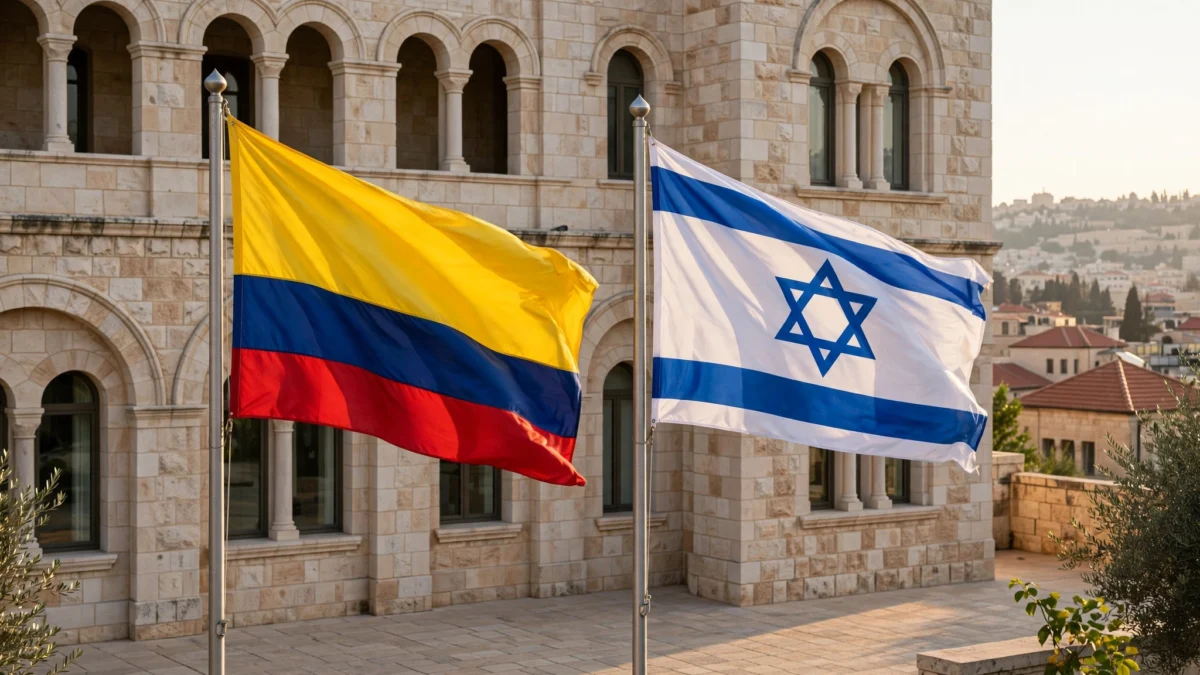
Colombia formally opened its embassy in Jerusalem on Wednesday, becoming the tenth country to place its diplomatic mission in the city and completing a sweeping restoration of relations with Israel that the new president, Abelardo de la Espriella, has pushed through in barely two months in office, according to Reuters.
The inauguration, attended by Israeli Foreign Minister Gideon Saar and his Colombian counterpart, Omar Bula Escobar, seals the end of a diplomatic rupture that began in May 2024, when the previous president, Gustavo Petro, broke relations with Israel over its military campaign in Gaza. One day before the ceremony, the two governments formally reinstated the free trade agreement that Petro had terminated, rebuilding the commercial pillar of a partnership that had been dismantled piece by piece, Reuters reported.
“In just two months, we have reversed most of the negative consequences of the Petro administration for Israel-Colombia relations and have even broken new ground,” Saar said at the ceremony, thanking de la Espriella for his determination to take bilateral relations “to an all-time high,” according to Reuters.
The move fulfills a campaign promise. According to Newsmax, de la Espriella told Saar well before his election: “If I am elected President, I will immediately move Colombia’s embassy to Jerusalem.” He kept that promise, and in doing so, Colombia joined a small club of countries — the United States, Guatemala, Honduras, Paraguay, Somaliland, Kosovo, Papua New Guinea, Fiji and Nauru — with embassies in Jerusalem rather than Tel Aviv, where the vast majority of diplomatic missions to Israel remain, Reuters and MENA Today reported.
A ceremony loaded with symbolism
The opening ceremony was choreographed to underline how completely the rupture has been repaired. Bula and Saar cut the ribbon together, unveiled an official plaque, and Saar affixed a mezuzah to the entrance of the building, the Algemeiner reported. Saar signed the embassy’s guest book, declaring, “This is an important date for the State of Israel. It is also an important date for the city of Jerusalem,” according to MENA Today.
Also present were Jerusalem Mayor Moshe Lion and Colombia’s ambassador to Israel, Tania Gilinski, whom the embassy’s relocation turns into one of the central figures of the restored relationship, MENA Today reported. The two foreign ministers held bilateral talks on Wednesday focused on political dialogue, security and defence cooperation, the strengthening of trade, and new opportunities for investment, according to the Algemeiner.
Saar framed the moment as part of a broader diplomatic momentum. “This is the 10th embassy to open in Jerusalem. When I took office less than two years ago, there were only five,” he said, describing it as “an important milestone and a major diplomatic achievement,” the Algemeiner reported. Gilinski called the day “the beginning of a golden age in relations between our two countries,” according to MENA Today, while Bula said the opening was a “concrete step towards restoring diplomatic relations between our two countries, relations that should never have been broken,” and described Israel as a strategic partner, the Algemeiner reported.
How deep the break had been
To understand the scale of the reversal, one must recall how far the relationship had fallen. In May 2024, Petro — Colombia’s first leftist president — announced that Colombia would sever diplomatic ties with Israel, accusing its government of committing genocide in Gaza, an allegation Israel rejects, according to IANS. He closed Colombia’s embassy in Tel Aviv, recalled its ambassador, halted coal exports to Israel, and repeatedly launched fierce personal attacks on Prime Minister Benjamin Netanyahu, Reuters reported.
Israel reacted angrily, describing the move as antisemitic and a reward for Hamas militants, according to Reuters. The confrontation did not end with the initial rupture. In October 2025, after Israel intercepted a Gaza-bound flotilla and detained two Colombian nationals aboard, Petro expelled Israel’s remaining diplomats from Colombia and terminated the free trade agreement between the two countries, IANS reported. By the time de la Espriella took office, the bilateral relationship was essentially frozen — no ambassadors, no trade pact, no embassy, and a long trail of public hostility.
The reversal began quickly after de la Espriella’s victory. According to Newsmax, Saar travelled to Colombia in August and met privately with the president-elect in Barranquilla on August 6, one day before his inauguration in Cali. In a meeting that lasted nearly three hours, the two leaders discussed expanding diplomatic, economic and security cooperation, including restoring ambassadors, removing visa requirements and resuming Colombian coal exports to Israel. On July 15, the two countries had reached an agreement to restore full diplomatic and economic relations, which took effect after the new president took office, IANS reported.
A new president with a different doctrine
De la Espriella, 48, a lawyer and businessman who had never previously held elected office, represents a sharp ideological break from his predecessor. According to Newsmax, the political outsider campaigned on restoring security, confronting criminal organisations and rebuilding Colombia’s international partnerships — and his election marked a decisive rejection of Petro’s leftist foreign policy posture.
The new president is widely described as a political ally of Donald Trump, who moved the United States embassy to Jerusalem in 2018, MENA Today reported. That affinity is not incidental: locating an embassy in Jerusalem remains a statement that aligns a country with Washington’s position on the city’s status, and de la Espriella’s swift move suggests his foreign policy will tilt firmly toward the United States and its allies.
The trade dimension matters as much as the symbolism. Reinstating the free trade agreement, terminated by Petro, reopens a channel for Colombian exports and Israeli investment that the previous government had deliberately closed. According to the Algemeiner, Wednesday’s ministerial talks explicitly put trade expansion and new investment opportunities on the agenda — signalling that the restoration is intended to be economic as well as diplomatic.
Why Jerusalem remains so contested
Almost every country with diplomatic relations with Israel keeps its embassy in Tel Aviv. Israel regards Jerusalem as its capital, while Palestinians seek East Jerusalem as the capital of a future independent state, making the city’s status one of the most contentious issues in the Israeli-Palestinian conflict, Reuters noted. The United Nations does not recognise Israel’s annexation of East Jerusalem, captured in the 1967 war, according to MENA Today.
Each new embassy in Jerusalem is therefore a diplomatic data point with political weight. For Israel’s government, every addition erodes the international consensus that embassy location should wait for a final-status agreement. Saar’s claim that the number of Jerusalem embassies has doubled during his less-than-two years in office underscores how actively the Israeli foreign ministry has pursued this goal. According to IANS, Saar said just last week that the Democratic Republic of Congo would soon move its embassy to Jerusalem as well.
Colombia’s move arrives at a moment when Israel’s European relationships are strained rather than strengthening. According to IANS, Israel last month ordered the closure of the British Consulate in East Jerusalem in retaliation for sweeping British sanctions imposed on goods originating from Israeli settlements — a sharp contrast with the golden-age language deployed in Jerusalem on Wednesday. For Israel, Latin American gains have become the counterweight to European losses, and Colombia is by far the largest diplomatic prize in that strategy.
Analysis: Why It Matters
Diplomatic reversals of this completeness are rare, and this one deserves to be read at several levels at once.
First, it is a test case in how quickly ideology-driven foreign policy can be unwound. Petro’s break with Israel was among the most confrontational foreign policy acts by any Latin American government in decades — not merely a downgraded relationship but a severed one, with trade cut, ambassadors recalled and accusations of genocide levelled. Two months into de la Espriella’s presidency, essentially every element of that rupture has been reversed: the embassy is reopened and moved, the trade pact is reinstated, ambassadors are being restored, and coalition-style cooperation talks are underway. The speed demonstrates something important about Petro’s legacy — that much of it was personal rather than institutional. There was no Colombian deep state holding the rupture in place; it was the work of one president, and one president has been enough to erase it. That should temper any reading of Petro’s tenure as a structural reorientation of Colombian foreign policy. It was, in the end, a four-year detour.
Second, the embassy’s location matters more than the restoration itself. Reopening relations could have meant returning to Tel Aviv, where Colombia’s embassy stood before Petro closed it. Choosing Jerusalem instead was a deliberate escalation of the gesture — a signal that de la Espriella is not merely undoing Petro’s damage but staking a position beyond even the pre-Petro status quo. It places Colombia, a country of more than 50 million people and a significant Latin American economy, squarely in the Jerusalem-embassy camp at a moment when that camp is still tiny. For Palestinians and their supporters, the symbolism will be read as a further international erosion of the two-state framework; for Israel’s government, it is proof that its long campaign to normalise Jerusalem’s status is working, capital by capital.
Third, this is a regional story disguised as a bilateral one. The Algemeiner’s reporting that Saar discussed security and defence cooperation, and Newsmax’s note that resuming Colombian coal exports was on the table in August, point to the substantive spine beneath the ceremony. Israel’s courtship of Latin America has been accelerating — Paraguay, Guatemala, Honduras and others already made the Jerusalem move — and Colombia, with its security challenges and resource exports, is the biggest economy Israel has pulled into this alignment. The pattern suggests a deliberate strategy: as relations with several European capitals cool over the Gaza war and settlement policy, Israel is building a counter-coalition in Latin America and parts of Africa, offering security and technology partnerships in exchange for diplomatic positioning on Jerusalem. The DRC announcement Saar teased last week fits the same pattern.
Fourth, the Trump connection runs through the whole story. De la Espriella’s alignment with Washington, his pre-election promise on the embassy move, and the broader context of a US administration that itself lifted Russian diesel sanctions and is rethinking its foreign policy posture all point to a Western Hemisphere that is being quietly re-sorted along new ideological lines. Colombia under Petro was one of the loudest critics of both Israel and the United States in the region; Colombia under de la Espriella is positioning itself as a partner of both. That swing — from the region’s most confrontational voice to one of its most accommodating — will have ripple effects across Latin American diplomacy, from the Pacific Alliance to the Organization of American States.
Finally, the episode is a reminder that diplomatic capital is perishable in both directions. Israel spent months in 2024 and 2025 denouncing Petro in the strongest terms, calling his moves antisemitic and a reward for terrorism. The speed with which it has now embraced his successor — “a golden age,” in Gilinski’s words — shows how pragmatic Jerusalem can be when interests align. The language of moral condemnation deployed against Petro has been shelved without a backward glance. That pragmatism is entirely normal in diplomacy, but it is worth noting precisely because the rhetoric was so heated. Words deployed as absolute principles in one administration become disposable instruments in the next.
What to Watch Next
- The DRC embassy move: Saar said last week that the Democratic Republic of Congo would soon move its embassy to Jerusalem. If it happens quickly, it will confirm that the Jerusalem-embassy campaign is accelerating and that Israel’s foreign ministry is working through a pipeline of commitments. If it stalls, it may suggest that Colombia was an exceptional case — driven by a new president eager to prove his credentials — rather than a trend.
- Trade flows under the restored pact: The reinstated free trade agreement will take months to show results, but the first indicators to watch are Colombian coal exports to Israel — halted by Petro, discussed by Saar in August — and Israeli technology and security investment into Colombia. These will show whether the “golden age” is commercial or merely ceremonial.
- Palestinian and regional reactions: Each Jerusalem embassy opening draws condemnation from the Palestinian Authority and often from Arab and Muslim-majority states. The strength of that reaction — and whether it carries practical consequences such as diplomatic pressure on Colombia — will signal how much room remains for Israel to expand the Jerusalem-embassy club without cost.
- De la Espriella’s broader realignment: The embassy move is the most visible element of a larger foreign policy reset that includes restoring ambassadors, removing visa requirements and rebuilding partnerships. Colombia’s votes in multilateral forums, its posture on US policy in the region and its approach to the Venezuela question will reveal how far the realignment goes.
- European contrast: Watch for whether Israel’s Latin American gains begin to affect its European disputes — particularly the UK consulate closure row — or whether the two tracks simply run in parallel: deepening estrangement in Europe, deepening partnership in Latin America. The long-term question is whether Israel can sustain a foreign policy that trades old alliances for new ones without becoming strategically isolated in the regions closest to it.
Sources
- Reuters — “Colombia opens embassy in Jerusalem, restores free trade deal with Israel”
- Newsmax — “Colombia Opens Embassy in Jerusalem; FM Sa’ar Hails New Era”
- Algemeiner — “Colombia Opens Embassy in Jerusalem, Restores Free Trade Deal With Israel”
- asiaPost (IANS) — “Colombia opens Embassy in Jerusalem”

About the Author — Abdul Mannan
Related Articles

Ukraine Accuses SpaceX of Throttling Starlink for Its Drones as Musk Points to the White House
Kyiv says Starshield drone speeds were throttled without warning during Russia's barrage; Elon Musk blames the US military…

Trump Says ‘Massive’ Oil, Gas and Mineral Exploration Is Set to Begin in Greenland; Nuuk Pushes Back
President Trump claimed 'massive' oil, gas and mineral exploration is set to begin in 'our new and beautiful…

Kremlin Rejects Zelenskyy’s 60-Day Ceasefire for Ukraine Elections, Offers Halt Only on Election Day
Moscow has rejected Volodymyr Zelenskyy's offer to hold wartime elections during a 60-day ceasefire, insisting on a lasting…