
Second Woman Testifies Against Russell Brand at London Rape Trial, Describing ‘Wild-Eyed Maniac’ Encounter

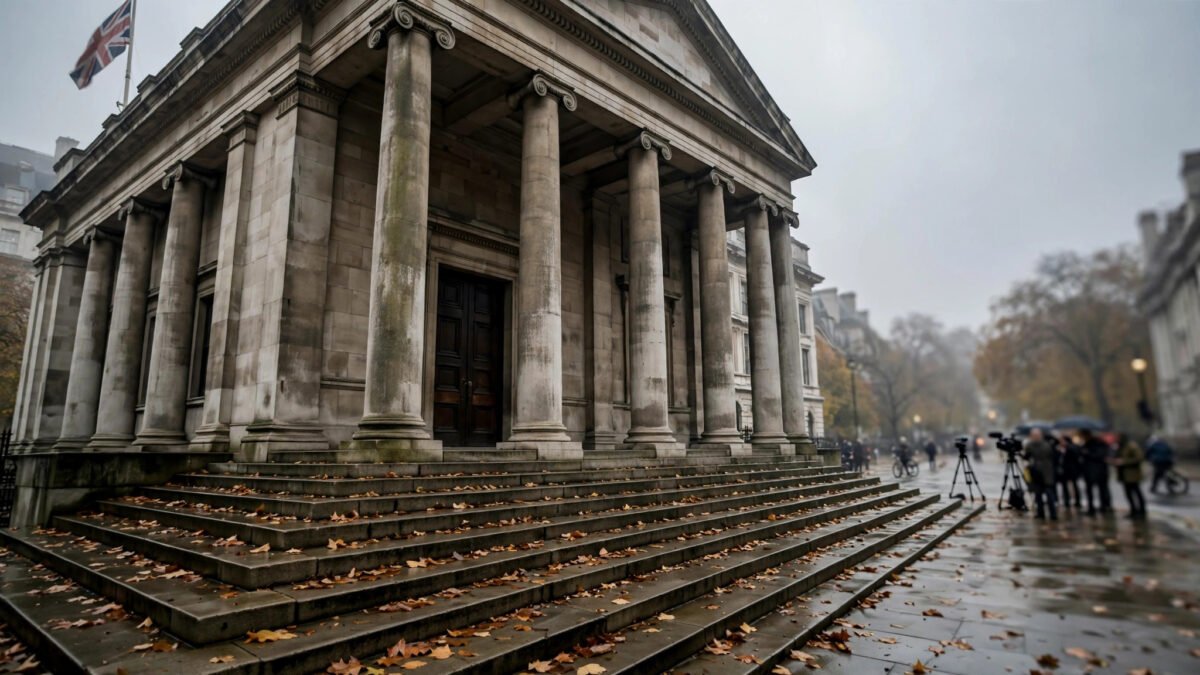
The second complainant in Russell Brand’s sex-offences trial told a London court on Friday that the actor and comedian turned into a “wild-eyed maniac” when he tried to drag her into a toilet cubicle at her workplace in 2001, as the trial of one of Britain’s most prominent celebrity defendants moved into its first full week of evidence at Southwark Crown Court.
Brand, 51, is on trial accused of three counts of rape, three counts of sexual assault and one count of indecent assault against six women, covering alleged offences between 1999 and 2009. The former broadcaster and film actor denies all the charges, and has told police he never engaged in non-consensual sexual activity.
The woman told the jury that she had exchanged friendly “banter” with Brand about the T-shirt he was wearing — one reading “I am Spartacus” — and had offered to show him where the bathrooms were at MTV Europe, where she worked at the time. But she said his demeanour changed abruptly once she accompanied him, according to Reuters.
“He grabbed me by the arm and started to pull me and said ‘come on, come in with me’,” she told the court. “He started to plead almost, ‘go on, go on, come in’.”
She said she wrenched her arm free despite Brand gripping it hard. “I said to him ‘what are you doing, are you mad, let me go’,” she testified. She said the entire incident lasted about 20 seconds, and that when he realised she would not go with him, he went into the toilets alone.
The woman told the court she did not report what happened to her employer at the time, saying it would have been her word against his. She only went to the police after seeing a 2023 television documentary about Brand’s alleged behaviour, she said.
Brand’s defence lawyer characterised the alleged incident as “short-lived”, according to Reuters’ account of Friday’s proceedings.
The testimony is the second account of alleged non-consensual sexual conduct to be heard by the jury since the trial opened earlier this week. On Thursday, the first complainant told the court that Brand had turned “monster-like” during an alleged rape at a conference in 1999, and had afterwards acted as though nothing had happened, according to press reports from the proceedings.
Statements from two friends of that first complainant were also read to the court on Friday by prosecutor Suki Dhadda, detailing when each of them was told about the alleged rape. One, a journalist, said she received a telephone call “out of the blue” from the woman in 2023 after Brand had been publicly accused of sexual misconduct in a television documentary and newspaper articles, according to The Times. She told the court the woman said she had been raped by Brand. The second friend said she learned of the allegation in a WhatsApp message in December 2024.
The prosecution’s case, opened earlier in the week by Riel Karmy-Jones KC, has described Brand as “ruthless” and a “sexual predator” — a characterisation the defence disputes. Karmy-Jones told the jury that “the circumstances of the offending were as wide and as varied as the defendant’s career,” and described his desire for sexual contact as “indiscriminate and voracious,” according to reports of the opening statement. Brand’s lawyers are expected to argue that consensual sexual encounters have been “reimagined” in recent years as misconduct.
The defence case has also pointed to the passage of time between the alleged offences and the complaints. The allegations span the years when Brand was one of the most recognisable entertainers in Britain — a presenter on Big Brother spin-off programmes and MTV, a film actor, and later a prominent media commentator with a large online following.
Brand arrived at court on Friday morning with his wife, Laura Gallacher. Speaking to waiting journalists, he said: “Obviously it’s an extraordinary and stressful situation but it is also an exploration of truth and justice and as I’ve said before I pray for everybody involved.”
The trial is expected to continue through the coming weeks, with the remaining complainants and further defence witnesses still to be heard.
Background: How the Case Reached Court
The prosecution follows a joint investigation published in September 2023 by Channel 4’s Dispatches programme, The Times and The Sunday Times, in which multiple women accused Brand of sexual offences including rape and sexual assault. Brand denied the allegations at the time and issued a video statement maintaining that his relationships had been consensual.
Detectives from the Metropolitan Police began a criminal investigation shortly afterwards. In April 2025, the Crown Prosecution Service authorised charges against Brand of one count of rape, one count of indecent assault, one count of oral rape and two counts of sexual assault relating to four women; in May 2025 he pleaded not guilty to all charges. The case now before the court covers seven counts against six women.
Brand had moved to the United States in the years before the investigation became public, building a large online audience with commentary on politics and culture. His prosecution has nevertheless become one of the most closely watched criminal trials in Britain this year, drawing sustained national media coverage and live reporting from the courtroom.
Analysis: Why It Matters
The Russell Brand trial is not simply the prosecution of one celebrity; it has become a stress test for how the British criminal justice system handles sexual-offence allegations against powerful public figures — and for how a decade-old public reckoning with celebrity misconduct holds up under the highest burden of proof known to law.
First, the case crystallises the evidentiary problem that has long shadowed sexual-offence prosecutions in Britain. Several of the complainants, including the woman who testified on Friday, did not report their allegations at the time. Their reasons — that it would be “her word against his,” that Brand’s celebrity made her fear she would not be believed — are precisely the dynamics that campaigners say have historically kept such complaints from ever reaching court. Prosecutors will be asking the jury to treat delayed disclosure not as a mark against credibility but as a predictable product of the power imbalance itself. The defence, conversely, will invite the jury to weigh the difficulty of testing memories and defending oneself against events from more than two decades ago. How the jury resolves that tension will be studied by lawyers on both sides of every similar case that follows.
Second, the trial marks a significant moment in the long aftermath of the post-2017 reckoning with sexual misconduct. Unlike many high-profile cases that ended in settlements, retractions, or abandoned investigations, this one has survived a Metropolitan Police investigation and Crown Prosecution Service charging review to reach a jury. Whatever the verdict, the fact that it got this far — on evidence spanning a decade and beginning a quarter of a century ago — signals that British prosecutors are prepared to bring historic sexual-offence cases against defendants of enormous public profile. That is likely to influence the calculus of both potential complainants deciding whether to come forward and institutions deciding how to handle internal complaints.
Third, the proceedings illustrate how the media environment has transformed since the alleged offences. Brand’s defence argument — that consensual encounters have been “reimagined” in recent years — is an explicit appeal to the idea that cultural change has rewritten the meaning of past conduct. Prosecutors will counter that consent is a factual question for the jury in each case, not a cultural mood. The tension between those two positions runs through almost every public debate about historic allegations, and this trial puts it in its starkest legal form.
Fourth, there is the question of Brand’s public afterlife. Whatever the outcome, the trial’s daily coverage is being consumed by an audience far beyond Britain’s news consumers — Brand retains a large international following for his online commentary. An acquittal would be seized upon by his supporters as vindication; a conviction would rank among the most consequential celebrity convictions of recent years. Both outcomes carry political and cultural reverberations well outside the courtroom.
Finally, the testimony heard so far underscores something the evidence itself keeps returning to: the role of status. The second complainant’s account — a junior employee at MTV Europe, a brief friendly exchange about a T-shirt, a sudden change of demeanour — is, if the jury accepts it, a story about how celebrity status can create a momentary bubble in which ordinary workplace boundaries are hard to assert. That theme, of status as its own form of pressure, is the through-line of the prosecution’s case and will likely remain so through the defence’s turn.
What to Watch Next
- The remaining complainants’ evidence. Four more complainants are expected to give evidence in the coming days and weeks, including the accounts of rape and sexual assault described in the prosecution’s opening. Their testimony will determine the shape of the case the defence must answer.
- The defence’s turn. Brand’s lawyers have signalled an argument that consensual encounters have been retrospectively “reimagined.” Watch how they handle the second complainant’s account in particular — an incident measured in seconds, with no allegation of completed sexual contact, may be used to argue that the charges overstate brief, ambiguous encounters.
- Corroboration evidence. The prosecution has begun reading statements from friends to whom complainants disclosed the allegations years later. The jury’s view of that contemporaneous-disclosure evidence could be decisive where the cases turn on credibility alone.
- The trial’s length and the verdict. With seven counts across six complainants and evidence spanning a decade, the trial is expected to run for several more weeks. Any verdict will be reported instantly and analysed for its wider significance for historic sexual-offence prosecutions.
- Civil and reputational consequences. Regardless of the criminal outcome, the case’s profile means the parties’ legal and public battles are unlikely to end with the jury’s verdict.
Sources
- Reuters: “‘Wild-eyed’ comedian Russell Brand tried to drag me into toilets, woman tells UK court” (16 October 2026)
- The Times: “Russell Brand trial latest: comedian acted like ‘wild-eyed maniac’, accuser says” (16 October 2026)
- PA (via The Oldham Times): “‘Egotistical’ Russell Brand preoccupied by sex, former flatmate tells trial” (16 October 2026)

About the Author — Abdul Mannan
Related Articles

Healey Poised to Tax Britain’s Banks in 28 October Budget, Guardian Reports
Chancellor John Healey is poised to raise taxes on Britain's banks in his 28 October budget to shore…

19 Injured as Minibus and Freight Train Collide at Channel Tunnel Terminal in France
At least 19 people were injured on Thursday evening when a minibus carrying lorry drivers collided with a…

Ex-DUP Leader Jeffrey Donaldson Jailed for 15 Years Over Child Sex Offences
Former DUP leader Jeffrey Donaldson was jailed for 15 years at Newry Crown Court on Thursday after being…