
19 Injured as Minibus and Freight Train Collide at Channel Tunnel Terminal in France

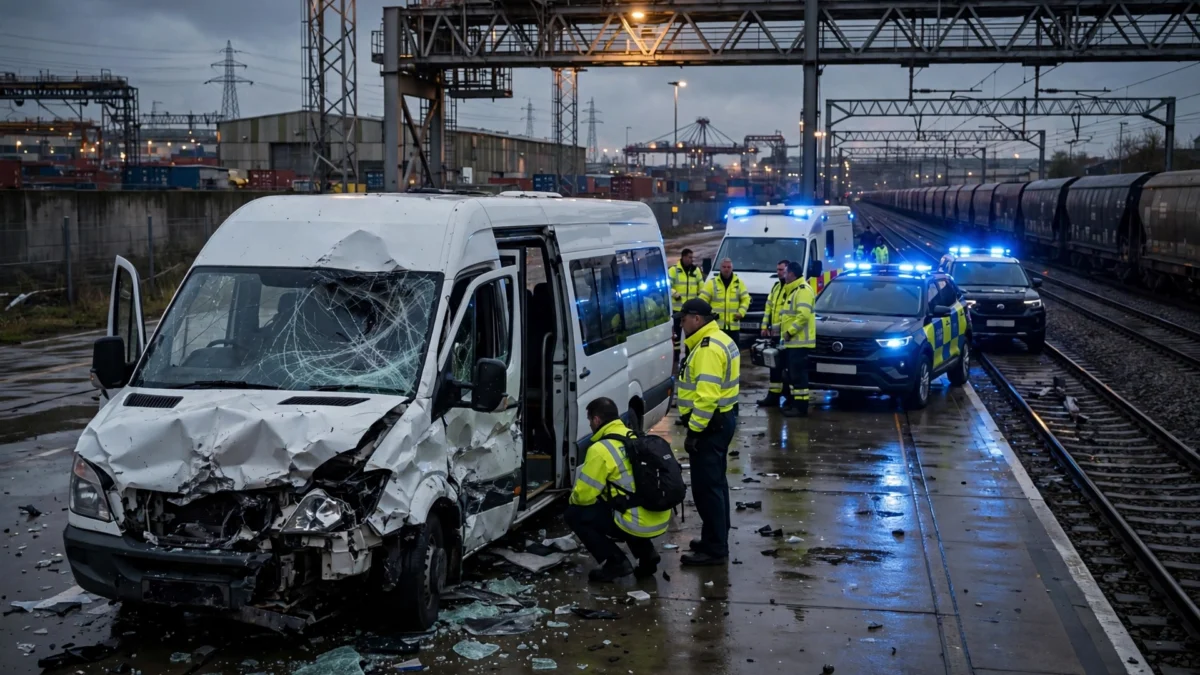
At least 19 people were injured on Thursday evening when a minibus carrying lorry drivers collided with a freight train at the Eurotunnel loading platform in Coquelles, northern France, according to French authorities.
The accident happened at around 7.30pm local time at the terminal near Calais where vehicles are boarded onto Le Shuttle trains for the crossing under the English Channel to England, the Pas-de-Calais prefecture said.
The minibus was transporting 18 heavy-goods-vehicle drivers plus its own driver — all 19 of them hurt — who had been preparing to board a Le Shuttle service, the prefecture said. No fatalities were reported, and the prefecture said none of the injuries were life-threatening, although French media reported that five of the injured were initially in a critical condition.
The nationalities of those hurt have not been disclosed by the French authorities.
What happened at the terminal
The exact sequence of events remains unclear, and early accounts differ. The Times reported that according to some accounts the minibus tipped over onto its side on the track near the boarding platform at the Eurotunnel entrance and was struck by the train, while other reports said the minibus hit the side of the train. A later Reuters report, citing the prefecture, said the minibus crashed into a train that was about to leave.
The prefect of the Pas-de-Calais region said in a statement: “An accident involving a minibus transporting heavy goods vehicle drivers who were about to board a Le Shuttle shuttle occurred this evening, at the loading platform of the Eurotunnel site.” The prefecture added: “At this stage, there are no fatalities, and no one’s life is considered to be in danger.”
A photograph published by the local news outlet La Voix du Nord showed a badly damaged minibus on the platform, with police officers and staff in high-visibility jackets at the scene and injured people receiving treatment, according to The Oldham Times.
Emergency response
The emergency response was large and immediate. The prefecture said significant resources were deployed by Eurotunnel and then placed under the authority of the prefect of the Pas-de-Calais department.
Ambulances, fire services and police raced to the Coquelles terminal, and a helicopter equipped with a mobile intensive care unit was dispatched, according to The Times and Reuters. The Sun reported that around 100 Eurotunnel staff were involved in the response.
A press briefing by the sub-prefect of the Calais district, Agathe Cury, was scheduled for around 10.15pm local time, according to Sky News, with some French outlets putting the time at 10.30pm.
Transport disruption across the Channel
Eurotunnel’s Le Shuttle service and freight train services through the Channel Tunnel were suspended after the incident, according to The Times, disrupting one of Europe’s busiest freight arteries in both directions.
Eurostar, the passenger service linking London to Paris and other continental destinations, said it was not directly affected. In a status update, Eurostar said: “An incident occurred several kilometres away from the Channel Tunnel. This incident does not involve or impact Eurostar trains running from and to London. All of Eurostar trains will run as expected.”
The last two Eurostar trains scheduled to depart from Paris Gare du Nord and London St Pancras on Thursday night were cancelled, but Eurostar said this was due to planned engineering works and not the collision, according to The Times. Some French media outlets initially reported that Eurostar traffic had been suspended, underscoring how quickly conflicting information spread in the first hours after the crash.
Why the Channel Tunnel matters
The Channel Tunnel, opened in 1994, runs 50.45 kilometres between Folkestone in Kent and Coquelles near Calais, and remains the only fixed link between Britain and continental Europe. Eurotunnel’s Le Shuttle service carries passenger vehicles and, crucially, more than a million trucks a year through the tunnel, making it a load-bearing artery of UK-EU trade.
Any sustained interruption to freight services quickly cascades: lorries bound for Dover’s ferries or the tunnel stack up on both sides of the Channel, perishable goods are delayed, and just-in-time supply chains absorb the shock within hours. That is why even a collision confined to a loading platform — rather than inside the tunnel itself — carries economic weight well beyond the immediate casualties.
A second French rail scare in a week
The crash comes days after a separate and more serious rail accident in Normandy that has already put French transport authorities on edge. A regional train carrying 186 passengers from Rouen to Caen derailed on Friday evening near Cléon, in the Seine-Maritime department, injuring 44 people, according to the Associated Press.
Police told AP that a piece of rail had been found on the track, and French authorities were investigating whether sabotage caused the derailment. The Rouen prosecutor’s office described the rail segment as the primary hypothesis for the cause, the train’s event recorder was seized, and the driver tested negative for drugs and alcohol, according to reports.
There is no indication that Thursday’s Channel Tunnel incident is connected to the Normandy derailment, and no authority has suggested sabotage at Coquelles. But the timing guarantees that French investigators and the public will view the two events in the same frame — and will demand answers quickly about how a road vehicle ended up in the path of a train inside a secure terminal.
Analysis: Why It Matters
The most striking feature of Thursday’s crash is where it happened. This was not a level crossing in open countryside, the classic setting for train-versus-vehicle collisions, but a loading platform inside one of the most tightly managed transport terminals in Europe. Boarding areas at Eurotunnel are choreographed environments: vehicles queue, are marshalled onto shuttle trains, and rail movements happen on strict timetables. A minibus ending up on or against the tracks in that setting points to a breakdown in the choreography — human error, a mechanical failure, a misunderstood signal, or some combination of the three. Investigators will reconstruct the minutes before the collision with the terminal’s CCTV and operational logs, and the findings will matter far beyond this one evening, because the same boarding choreography is repeated thousands of times a day at Coquelles and Folkestone.
The casualty picture also carries a lesson about the fog of breaking news. Within the first hours, French media were reporting five people in critical condition; the prefecture later downgraded the assessment to no life-threatening injuries and no fatalities. Both statements can be true at different moments — initial triage classifications often change — but the swing illustrates why casualty numbers in fast-moving incidents should always be treated as provisional and attributed, never stated as settled fact. The families of the injured drivers, many of them professional hauliers far from home, deserve that discipline most of all.
Then there is the freight dimension. Le Shuttle is not a marginal service; it is the workhorse of UK-EU goods movement. Suspending freight trains in both directions, even briefly, ripples into logistics planning on both sides of the Channel. Thursday evening’s suspension will have forced hauliers into overnight recalculations — diverting to ferry ports, rebooking, absorbing delays — at a moment when cross-Channel freight already operates with thin margins for disruption. The economic cost of the accident will be measured not just in damaged vehicles but in the hours and days of rescheduled freight.
The Eurostar confusion is a smaller but telling subplot. Initial French media reports suggested passenger services had been suspended, while Eurostar itself insisted its trains were unaffected and running as expected. In a cross-border incident, passengers in two countries are watching two different news ecosystems; the gap between them is where rumour thrives. Eurostar’s quick, specific statement — distinguishing the terminal platform from the tunnel itself, and the collision from the planned engineering cancellations — was a model of how operators should communicate in a crisis. Other operators would do well to copy it.
Finally, the Normandy parallel cannot be ignored, even though no link has been established. France is investigating a possible act of rail sabotage that injured 44 people; days later, a vehicle-train collision shuts a strategic international terminal. The two events are almost certainly unrelated — one is a suspected criminal act on open track, the other an accident inside a controlled facility — but they will be processed together by a public already primed to worry about infrastructure security. French authorities will need to be transparent and fast with the Coquelles findings precisely because the Normandy investigation has raised the temperature. In an information vacuum, speculation fills the gap; the scheduled briefing by the Calais sub-prefect was the right call, and its contents will set the tone for everything that follows.
What to Watch Next
- The sub-prefect’s briefing: The press conference by Agathe Cury, the sub-prefect of the Calais district, should establish the official account of how the minibus came to be on the tracks and confirm the condition of the injured.
- The investigation: French authorities will need to determine whether the collision resulted from driver error, a vehicle fault, a signalling or marshalling failure, or a combination — and whether anyone faces criminal liability.
- Service resumption: How quickly Le Shuttle and freight services return to normal will determine the scale of the logistics disruption for UK-EU hauliers.
- The injured: Updated medical assessments and the release of the drivers’ nationalities, which French authorities have so far withheld.
- A terminal safety review: Whether Eurotunnel orders a review of vehicle movements around its loading platforms — and whether regulators on both sides of the Channel demand one.
Sources
- Reuters: “Nineteen injured after train and coach collide in northern France” (Oct 15, 2026)
- The Times: “Channel Tunnel crash: at least 19 hurt as train and bus collide” (Oct 15, 2026)
- The Oldham Times: “Nineteen people injured in Eurotunnel accident near Calais” (Oct 15, 2026)
- Sky News: “19 injured after Channel Tunnel collision between bus and train on French side” (Oct 15, 2026)

About the Author — Abdul Mannan
Related Articles
Ex-DUP Leader Jeffrey Donaldson Jailed for 15 Years Over Child Sex Offences
Former DUP leader Jeffrey Donaldson was jailed for 15 years at Newry Crown Court on Thursday after being…

Ofwat Proposes £240 Million Water Bill Rebate as Thames and Yorkshire Face Biggest Penalties
Ofwat has proposed returning £240 million to customers by 2030 after water companies missed environmental and service targets…
Prosecution Calls Russell Brand a “Ruthless Sexual Predator” as Rape Trial Opens at Southwark Crown Court
Prosecutors opened their case against Russell Brand at Southwark Crown Court on Wednesday, telling jurors the comedian and…