
Shehbaz Sharif Says Federal Government Was ‘Compelled’ to Impose Governor’s Rule in Khyber Pakhtunkhwa

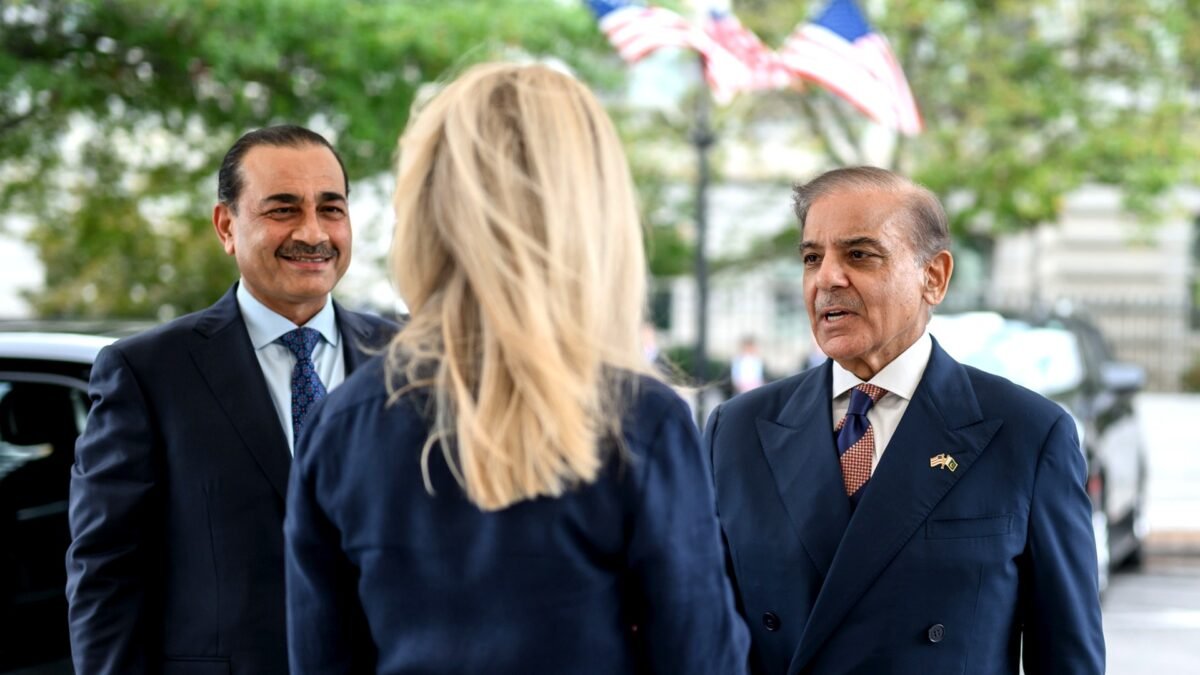
ISLAMABAD: Prime Minister Shehbaz Sharif said on Saturday that his federal government had been “compelled” to impose emergency measures and Governor’s Rule in Khyber Pakhtunkhwa (KP), blaming the opposition-run province’s alleged refusal to cooperate in the fight against terrorism, according to reports published on October 18.
The prime minister made the remarks while speaking to the media in Gujranwala, where he had visited the residence of Rashid Bashir Virk to offer condolences on the death of his father, former parliamentarian Mahmood Bashir Virk, Sabah News reported.
Defending the October 11 decision that suspended the elected Pakistan Tehreek-e-Insaf (PTI) provincial government, Shehbaz said the Centre had made a final, exhaustive attempt at dialogue before resorting to what he called an unpalatable necessity. According to Dawn, as cited by the ANI wire service, the prime minister said a joint delegation comprising representatives of the federal government and the Pakistan Peoples Party (PPP) had held “day and night” negotiations with the PTI over 48 hours “with the intention to settle matters from every aspect”.
“They had talks with them (PTI) day and night, for 48 hours, and sat with the intention to settle matters from every aspect,” the prime minister was quoted as saying by Dawn. He added that a draft agreement had been prepared under which the PTI was to withdraw its call for a long march on the federal capital, but the effort collapsed at the final stage.
Shehbaz recalled the late PML-N lawmaker Mahmood Bashir Virk’s services before turning to the KP crisis, which he described as a “last attempt” — referring to rounds of negotiations between the opposition and the joint delegation of the PPP and the federal government, Sabah News reported. The second round of those talks, held on October 3, lasted several hours but ended without a breakthrough.
Meetings with Afridi and Gandapur
The prime minister said he had personally held several meetings with Sohail Afridi, the PTI chief minister whose role became non-functional after Governor’s Rule was imposed, as well as with Afridi’s predecessor, Ali Amin Gandapur. According to Dawn, Shehbaz told the media he had assured the KP chief minister of Islamabad’s full backing, saying he would make administrative, resource and operational decisions in direct consultation with him.
The promise of consultation, however, sat uneasily alongside the suspension of the elected government itself. Afridi, along with several other PTI figures including Junaid Akbar, was detained in the days following the October 11 decree, according to PTI spokesperson Zulfiqar Bukhari, who publicly condemned the arrests on X and described the intervention as a “coup disguised as emergency”.
Shehbaz also reached back into political history to justify the intervention, invoking what he called the PTI’s “very horrific” past. According to Dawn, he recalled the party’s 2014 sit-ins at Islamabad’s D-Chowk during the tenure of his brother, former prime minister Nawaz Sharif, and last year’s protest that he said had jammed the entire country — an apparent reference to the PTI’s November 2024 long march, which ended in violent clashes with security forces in Islamabad.
What happened on October 11
The emergency and Governor’s Rule were imposed on October 11 after a federal cabinet meeting chaired by the prime minister. President Asif Ali Zardari approved the proclamation under Articles 232 and 234 of the Constitution of Pakistan on the cabinet’s recommendation, transferring executive authority in the province to Governor Faisal Karim Kundi, according to multiple reports.
The Centre cited a deteriorating security situation and what it described as the provincial government’s “deliberate disengagement” from the fight against terrorism. Parliament endorsed the emergency decisions this week amid opposition protests, Sabah News reported. An advisory council of largely non-political figures has been set up under the governor to run the province’s affairs, with the prime minister expressing the hope that it would improve living conditions and safety in KP, The Standard Pakistan reported.
Speaking to the PML-N parliamentary party on October 13, Shehbaz had earlier described the situation as a “now or never” stage. He said the decision followed two and a half hours of consultations with coalition allies, arguing the government could not remain a silent spectator to the opposition’s plans for a long march, agitational politics and an armed sit-in, The News reported. He alleged that the PTI’s negotiating team had arrived with instructions to sabotage the dialogue to repeat the May 9, 2023 unrest “or even go beyond that”, after talks had nearly reached an agreement.
PTI rejects the move, approaches court
The PTI has rejected the intervention as unconstitutional and politically motivated, arguing that it crushes the democratic mandate of the one province the party governs. Party chairman Gohar Ali Khan said weakening provincial autonomy would not establish peace, while Bukhari warned of “further instability and collateral damage”. The party has filed a legal challenge in the Peshawar High Court seeking restoration of its elected government, AbbTakk and other outlets reported.
The joint opposition has separately demanded the immediate withdrawal of the emergency, The Standard Pakistan reported. Internationally, the International Human Rights Foundation condemned the emergency on October 13 as a “military-backed power grab” and demanded the restoration of democratic rights in the province, according to a report carried by IANS. The foundation’s statement also referred to the detention of the former chief minister and to restrictions on the internet in the province.
Interior Minister Mohsin Naqvi, addressing the Senate this week, maintained that the emergency and Governor’s Rule did not violate the Constitution. Responding to the Senate opposition leader, he urged him to identify the specific constitutional provision allegedly breached, The Standard Pakistan reported.
The Imran Khan factor
At the centre of the standoff stands Imran Khan, the jailed PTI founder, who has been held in Rawalpindi’s Adiala Jail for about three years. A report published by the Bangladeshi daily Porthom Alo and cited by IANS noted that on August 18, the Supreme Court of Pakistan had ordered the government to transfer Khan to Al-Shifa Hospital in Islamabad within two days; the report alleged that instead of implementing the order, the government took him on a tour of the Pakistan Institute of Medical Sciences (PIMS) and returned him to Adiala.
It was Afridi’s announcement of a long march toward Islamabad to press for Khan’s release that set the confrontation in motion. According to the Porthom Alo report cited by IANS, Afridi had said the PTI would call off the march only if Khan himself asked for it — a condition the federal government would not accept. Holding Afridi responsible for the breakdown, the Centre moved to impose Governor’s Rule.
Adding to the government’s show of support, Nawaz Sharif on October 17 backed the emergency, saying action against the PTI should have come even earlier. He said the PML-N remained committed to Pakistan’s stability, development and prosperity, and that the federal and provincial governments were working to improve living standards, AbbTakk reported.
Analysis: Why It Matters
The imposition of Governor’s Rule in Khyber Pakhtunkhwa is the most consequential federal-provincial rupture in Pakistan since the 18th Amendment of 2010 devolved power to the provinces. The constitutional provision exists precisely for moments when a provincial government cannot be carried on — but invoking it against the elected government of a province ruled by the country’s largest opposition party converts a legal instrument into a political lightning rod. How the Peshawar High Court treats the PTI’s challenge will therefore set a precedent far beyond this single province.
The prime minister’s language on Saturday is telling. “Compelled” is the vocabulary of a government that wants to present coercion as necessity rather than choice. By framing 48 hours of talks, a second October 3 round, and a ready draft agreement as proof of good faith, Shehbaz is building a public record of exhaustiveness: we tried everything, and only then did we act. The PTI’s account is the mirror image: a government that negotiated in bad faith while preparing the paperwork for a takeover, then arrested the chief minister it claims it was consulting. The two narratives cannot both be true, and the gap between them is where the political battle will now be fought.
Equally significant is the counter-terrorism justification. Khyber Pakhtunkhwa genuinely sits on the front line of Pakistan’s security crisis, and the federal government alleges the PTI administration deliberately disengaged from the fight. But emergencies declared in the name of security have a long history in Pakistan of outliving their stated purpose, and critics — from the PTI to the International Human Rights Foundation — argue the timing reveals the real motive: the long march, not the militants. The measure of the government’s case will be whether the counter-terrorism cooperation it says was missing now materialises under the governor’s administration, and whether it can point to concrete security outcomes rather than political quiet.
There is also a structural paradox at the heart of the crisis. Imran Khan, imprisoned for three years, remains the axis around which Pakistani politics turns. The PTI’s demand — his release, or at minimum his transfer to a hospital ordered by the Supreme Court — is the engine of the confrontation; the government’s refusal to meet it is the fuel. A government that jails its principal rival, declines to implement a court order concerning him, and then suspends democracy in his party’s province to stop a march demanding his freedom has constructed a situation in which every move deepens the grievance it claims to be managing. Reports of detained leaders and internet restrictions, if confirmed, only harden that cycle.
Finally, the episode exposes how brittle the federal bargain has become. The 18th Amendment was meant to make provincial autonomy irreversible; Governor’s Rule, parliamentary endorsement amid protests, and an advisory council of unelected figures running a province of 40 million people pull in the opposite direction. An IANS report this week, citing India Narrative, warned that Pakistan faces intertwined political, security and economic pressures that could spill over — a reminder that the KP crisis does not exist in isolation. The federal government is betting that decisive action restores order; the risk is that it teaches every future federal government the same lesson.
What to Watch Next
- The Peshawar High Court challenge: The PTI’s petition against the emergency and Governor’s Rule is now the decisive legal front. A stay or a full hearing could force the federal government’s hand; dismissal would entrench the new order.
- The long march question: Afridi’s condition — that only Imran Khan can call off the march — makes the protest a live threat as long as Khan remains in Adiala. Watch whether the PTI escalates street action under Governor’s Rule.
- The advisory council’s record: The unelected council under Governor Kundi must now govern. Its composition, its handling of security operations, and whether it delivers the development the prime minister promised will be the government’s empirical test.
- Detentions and dialogue: Whether detained PTI leaders are released or charged, and whether any back-channel contact survives the collapse of the October 3 talks, will determine whether this crisis has a political exit.
- Parliamentary and international reaction: With the joint opposition demanding withdrawal and rights bodies condemning the move, sustained pressure — domestic and foreign — could reshape the cost-benefit calculus for Islamabad.
Sources
- ANI via LatestLY: “Pakistan PM Claims Govt ‘Compelled’ to Impose Emergency Rule in Khyber Pakhtunkhwa Amid Political Fallout”
- Sabah News: “Federal government ‘compelled’ to impose emergency measures and Governor’s Rule in KP: PM Shehbaz”
- The News: “KP was at a ‘now-or-never’ stage: PM”
- The Standard Pakistan: “Joint Opposition Demands Immediate Withdrawal of Emergency in KP”
- AbbTakk: “Nawaz Sharif backs KP emergency, says action against PTI should have come earlier”

About the Author — Abdul Mannan
Related Articles
CPJ Urges Pakistan to Scrap PEMRA Ban on Live TV Coverage of Terror Attacks and ‘Unpleasant’ Incidents
The Committee to Protect Journalists has urged Pakistan to withdraw a PEMRA directive barring TV channels from live…
Pakistan Stands ‘Shoulder to Shoulder’ With Saudi Arabia as Houthi Strikes Test Makkah Defence Pact
Prime Minister Shehbaz Sharif has pledged Pakistan's full backing for Saudi Arabia under the Makkah Joint Defence Agreement…
Peshawar High Court Sets October 20 Hearing as Battle Over KP Emergency, Governor’s Rule Moves From Parliament to the Courts
The Peshawar High Court has fixed October 20 to hear petitions challenging the federal emergency and governor's rule…