
Siemens and Nvidia Unveil AI-Driven Factory Automation at Erlangen, Target Up to 80% Automation

The announcement
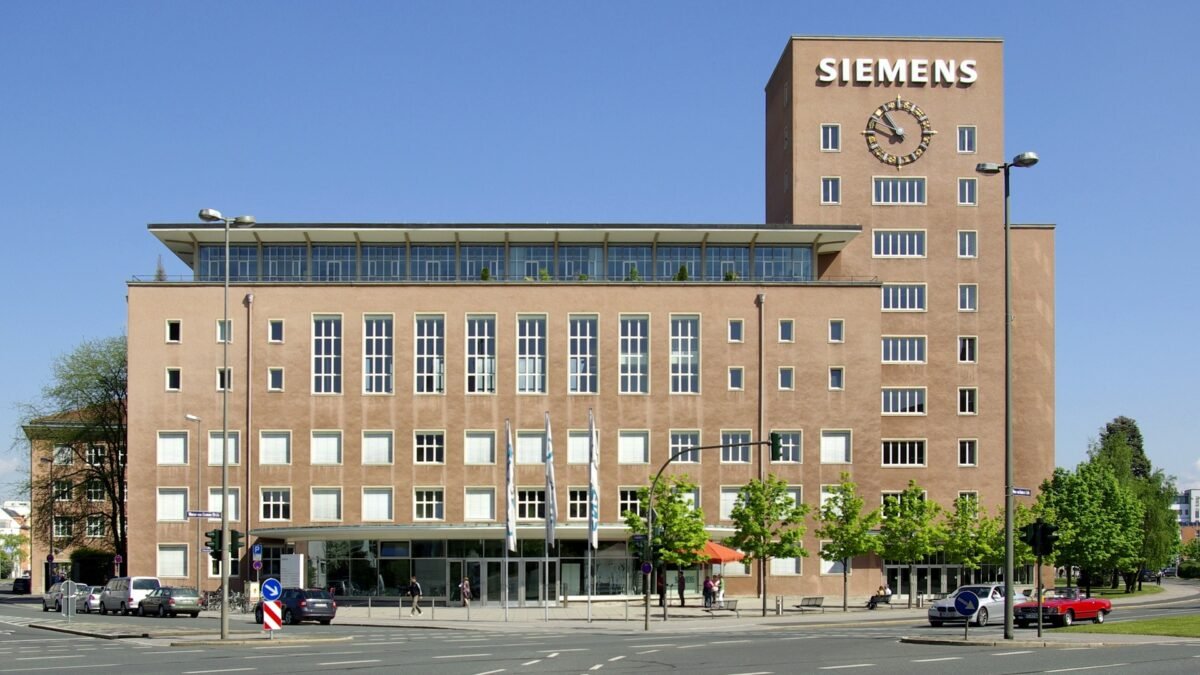
Siemens wants to take the artificial intelligence boom out of the data centre and onto the factory floor — and it is offering its own electronics plant in Erlangen, Germany, as the proof. Speaking at the plant on Monday, Siemens executive board member Cedrik Neike said AI could lift the level of automation in factory manufacturing to between 70 and 80 per cent, up from 30 to 40 per cent today, according to Reuters.
Neike argued that manufacturers now need annual productivity gains of 7 to 9 per cent simply to stay competitive, and that AI-driven automation could help keep manufacturing work in high-wage economies such as Germany rather than driving it elsewhere, Reuters reported. It was an unusually blunt framing of the stakes: automate with AI, or watch production migrate to cheaper labour markets.
Alongside the targets, Siemens unveiled new AI solutions developed with the American chipmaker Nvidia at the Erlangen site, according to Dow Jones Newswires. The tools combine AI with virtual replicas — digital twins — of factory systems to accelerate production ramp-up and improve planning. Siemens said the applications are currently unique in the manufacturing industry, according to the company’s own timeline of the partnership.
What the technology actually does
The centrepiece is what the two companies call “physical AI”: using digital twins and AI models to simulate and optimise factory operations before any change is made on the production floor, according to Reuters. In practice, that means a manufacturing line can be tested and refined entirely in software — and only then built or reconfigured in the real world.
Siemens attached striking numbers to the approach. A fully virtual production ramp-up cuts the engineering effort needed for new printed circuit board assemblies by up to 85 per cent and reduces time-to-market by up to 40 per cent, Dow Jones Newswires reported. Separately, AI agent-based production planning — software agents that adapt schedules to shortages and demand changes — can cut planning costs by up to 20 per cent, according to the same report.
“The historic opportunity for Germany and Europe lies in bringing artificial intelligence out of the data centers and into the factories — and applying it on an industrial scale,” Neike said, according to Dow Jones Newswires. Siemens said further applications of the technology are planned in the coming months.
The €500 million Erlangen bet
Siemens is backing the rhetoric with concrete spending. The company plans to invest €500 million — about $561 million — to expand the Erlangen electronics site by 2030, turning it into a showcase for AI-powered manufacturing, according to Reuters. The Erlangen electronics factory, known inside Siemens as GWE, specialises in frequency converters, switchgear systems and power electronics, and already serves as one of the company’s flagship digital-enterprise sites, according to Siemens.
The investment is part of a much larger German commitment. In June 2023 Siemens announced a €2 billion global investment plan, including €1 billion for Germany — with €500 million earmarked for the expansion and modernisation of the Erlangen factory, a project then expected to lift production capacity by 60 per cent by 2029. The site has a pedigree: the Erlangen electronics manufacturing plant was named “Factory of the Year” in 2006 in one of industry’s most prestigious benchmarking competitions.
Erlangen itself has become the geographic centre of Siemens’ future. In July 2026 the company completed its Siemens Campus Erlangen — the largest transformation project in its recent history — after investing around €1 billion since 2014. About 16,000 people from the greater Nuremberg metropolitan region now work there, according to Siemens.
A partnership nine months in the making
Monday’s unveiling is the first major public milestone of a partnership dramatically expanded at the CES technology show in Las Vegas in January 2026. There, Siemens and Nvidia announced they would build an “Industrial AI operating system” spanning the entire industrial value chain — from design and engineering to manufacturing, operations and supply chains — and, as Siemens put it at the time, the world’s first fully AI-powered manufacturing sites.
Under the arrangement, Nvidia provides AI infrastructure, simulation libraries, models, frameworks and blueprints, while Siemens commits hundreds of industrial AI experts alongside its hardware and software portfolio, according to Siemens’ January press release. “Together, we are building the Industrial AI operating system – redefining how the physical world is designed, built, and run,” Siemens chief executive Roland Busch said at the time.
Nvidia’s founder and chief executive Jensen Huang framed it as the next industrial revolution: “Generative AI and accelerated computing have ignited a new industrial revolution, transforming digital twins from passive simulations into the active intelligence of the physical world,” he said, according to the same release. Since January, the two companies have been co-developing and testing the applications in live production at the Erlangen plant, Siemens said on Monday — meaning the tools unveiled this week have already been running on a real factory floor, not just in a laboratory.
The collaboration has been widening on several fronts this year. In July, Siemens announced self-verifying agentic AI workflows for semiconductor and circuit-board design built with Nvidia; earlier this month, the two companies announced advances in GPU-accelerated computational lithography for next-generation AI chips, according to Siemens.
Analysis: Why It Matters
1. “Physical AI” leaves the slide deck
For two years, “physical AI” has been one of the tech industry’s favourite phrases — a convenient label for everything from humanoid robots to self-driving cars. What makes Monday’s announcement different is its specificity: named applications, deployed in live production, with quantified claims attached. Siemens is effectively daring the industry to judge physical AI not by keynote demos but by engineering hours saved and weeks shaved off production ramp-ups. If the 85 per cent and 40 per cent figures survive contact with independent customers, this will be remembered as the moment the concept grew up. If they do not, it will be remembered as a very expensive marketing exercise.
2. The high-wage economy wager
Neike’s most politically loaded claim was not a number but an argument: that AI-driven automation can preserve manufacturing in high-cost countries like Germany. Europe’s industrial model has been under siege — from energy costs, from Chinese competition, from the gravitational pull of American subsidies. Siemens is proposing a third way between deindustrialisation and protectionism: automate so aggressively that the labour-cost gap stops mattering. It is a compelling narrative, and one Berlin clearly wants to hear. But it carries an obvious tension: the same automation that “preserves” manufacturing jobs will transform or eliminate many of the jobs currently done by humans on those floors. Siemens’ 70-to-80 per cent automation target is, by definition, a story about machines doing work people used to do.
3. Read the fine print on the percentages
Every percentage in Monday’s announcement deserves a careful read. The 85 per cent engineering-effort reduction applies to new printed circuit board assemblies taken through a fully virtual ramp-up; the 20 per cent planning-cost saving applies to AI agent-based production planning. These are company claims about specific applications, not independently audited results across a whole factory — let alone across the thousands of factories Siemens equips. Vendor benchmarks have a long history of looking heroic in pilot deployments and ordinary at scale, because pilots get the best engineers, the cleanest data and the most attention. The honest test will be what Siemens’ customers report a year from now, on their own lines, with their own messy data.
4. Nvidia’s land grab beyond the data centre
For Nvidia, Erlangen is about much more than one German factory. The chipmaker already dominates AI training in the data centre; the next contested territory is the physical world — factories, warehouses, robots — where the software stack is still up for grabs. Siemens matters enormously as a channel: it is one of the world’s largest industrial automation companies, with an installed base that reaches into nearly every manufacturing sector. If Nvidia’s simulation libraries and AI frameworks become the default way factories are designed and run, the company captures a toll booth on the entire industrial economy. Monday’s announcement, and the investment summit running in Berlin this week, suggest Nvidia is pursuing that position with the active blessing of the German state.
5. The politics are the point
It is no accident that Siemens chose to unveil factory-automation targets in the language of European industrial sovereignty, in the same week that Nvidia, the German government and German business leaders are meeting in Berlin — with a partnership to promote AI in German industry expected to be announced, according to Dow Jones Newswires. Industrial AI has become industrial policy. For Germany, the question is whether a Siemens-Nvidia stack can do for factory AI what the country’s carmakers and machine-tool builders once did for mechanical engineering: set a global standard that others must license, buy into, or work around. The €500 million Erlangen expansion is the down payment on that ambition.
What to Watch Next
- The Berlin summit outcome. An investment summit between Nvidia, the German government and German business leaders is under way in Berlin, with a partnership to promote AI in German industry expected, according to Dow Jones Newswires. Its shape — funding, participants, commitments — will show how seriously Berlin is backing the Siemens-Nvidia stack.
- The “coming months” pipeline. Siemens said further applications of the AI-driven manufacturing technology are planned in the coming months. Watch for customer names: the first external deployments will be the real test of the 85/40/20 per cent claims.
- Erlangen expansion milestones. The €500 million site expansion runs to 2030. Groundbreakings, hiring announcements and capacity figures will indicate whether the showcase factory is on schedule.
- Independent verification. Siemens’ efficiency figures are company claims. Third-party case studies — from customers, auditors or industry analysts — will determine whether virtual ramp-ups deliver in ordinary factories, not just flagship ones.
- The competitive response. Siemens’ rivals in industrial automation will not stand still. Expect competing “physical AI” announcements — and competing definitions of what the term even means — in the months ahead.
Sources
- Reuters: “Siemens targets up to 80% factory automation with AI, board member says” (19 October 2026; reporting by Alexander Huebner, writing by Cian Muenster)
- Dow Jones Newswires: “Siemens and Nvidia Develop AI-Driven Factory Automation Technology” (19 October 2026; by Michael Hennessey)
- Siemens: Siemens and NVIDIA strategic partnership timeline (official; 19 October 2026 milestone entry)
- Siemens press release: “Siemens and NVIDIA expand partnership to build the Industrial AI Operating System” (6 January 2026, CES Las Vegas)
- Siemens: Erlangen Electronics Factory (GWE) site profile (official)

About the Author — Abdul Mannan
Related Articles
RIKEN Scientists Achieve 99.99% Fidelity Controlling Silicon Qubits in Parallel
RIKEN researchers have shown silicon spin qubits can be driven in parallel without losing accuracy, clearing a key…
Intel Promises 700 TOPS for Humanoid Robots With Razor Lake-AX Chip Due in 2028
Intel SVP Cho Min-sung confirmed at a Seoul conference that the Razor Lake-AX processor will launch in 2028…
Google’s Willow Chip Cuts Magic-State Errors 40-Fold in Quantum Computing Breakthrough
Google demonstrated magic state cultivation on its Willow quantum chip, cutting errors about 40-fold with record 99.99% fidelity…