
RIKEN Scientists Achieve 99.99% Fidelity Controlling Silicon Qubits in Parallel

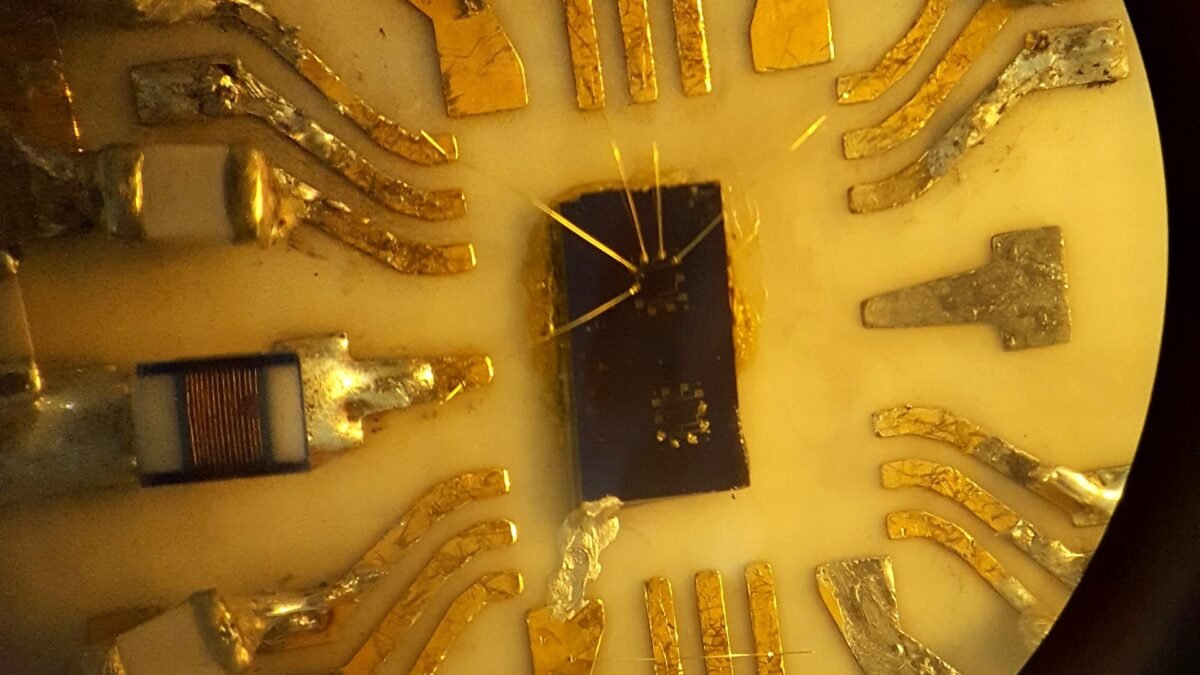
Researchers in Japan have solved one of the stubbornest control problems in silicon-based quantum computing, showing that several qubits can be driven at the same time without sacrificing the precision each achieves alone. The result, published in Nature Physics, keeps gate fidelities above 99.99 per cent while up to three qubits operate in parallel — a milestone the team says brings larger silicon quantum processors within reach.
The work comes from the RIKEN Center for Emergent Matter Science and its collaborators, who ran a five-qubit silicon array through a single shared microwave line. When the qubits were operated individually, each achieved single-qubit gate fidelities comfortably above 99.99 per cent, with the best approaching 99.999 per cent. With up to three qubits driven at once, fidelities stayed above the 99.99 per cent mark. Even with all five operating simultaneously, fidelity held at approximately 99.9 per cent — a level that sits close to what fault-tolerant quantum computing schemes demand in practice.
“This shows that high-fidelity control can be maintained even when several qubits are operated at the same time and represents an important step toward scaling up silicon-based quantum processors,” said Leon Camenzind, a research scientist at RIKEN and co-first author who supervised the experiments, according to Phys.org.
A wiring problem hiding in plain sight
Silicon spin qubits are among the most promising candidates for practical quantum computers for a simple reason: they are tiny, and they can in principle be manufactured using the same industrial semiconductor processes that produce ordinary computer chips. Each qubit is essentially the spin of a single electron trapped in a quantum dot within a silicon substrate. Microwave signals manipulate those spins to carry out quantum operations.
The catch is that a quantum computer is useless if its qubits must take turns. Real computation requires many operations to run simultaneously, before fragile quantum information decays. And silicon spin qubits have historically suffered a painful version of that transition: qubits that behave beautifully in isolation tend to lose accuracy the moment several are driven at once.
That parallel-control penalty is more than a laboratory curiosity. It is a structural obstacle to scale. A processor that needs a dedicated control line for every qubit — the obvious way to avoid interference — quickly becomes unbuildable as qubit counts climb into the thousands. The number of control lines is one of the main barriers to scaling silicon quantum hardware, a constraint that even industrial efforts such as Intel’s 12-qubit “Tunnel Falls” silicon research chip, released in 2023, have had to confront.
Catching the culprit: the AC Stark shift
The RIKEN team began by hunting down the dominant source of the parallel-operation errors, and found it in a familiar quantum-mechanical effect: the AC Stark shift. When microwave control signals are applied to qubits through a shared control line, neighbouring qubits are exposed to off-resonant fields that subtly shift their effective energy levels. That shifts the phase of their quantum states, making each operation slightly less precise. When several qubits are driven at once, these phase shifts interfere with the intended control of each qubit, and the errors accumulate.
The team’s response was a scalable calibration protocol built around pairwise phase corrections. Rather than demanding an entirely separate calibration procedure for every possible combination of qubits — an approach that would itself explode in complexity — the method uses calibrations between pairs of qubits to compensate for the unwanted phase shifts.
“Rather than requiring an entirely separate calibration procedure for every possible combination of qubits, our method uses calibrations between pairs of qubits to compensate for the unwanted phase shifts,” said Yi-Hsien Wu, the paper’s first author, who carried out the experiments as part of his doctoral research, according to Phys.org.
The researchers paired the protocol with an optimised device design and carefully shaped microwave control pulses to minimise the impact of the shift.
What the experiment actually showed
The headline numbers are strikingly strong. Single-qubit gate fidelities — a measure of how accurately each quantum operation is performed — stayed well above 99.99 per cent on each of the five qubits when tested alone. With the new calibration protocol active, the team maintained that level while operating up to three qubits simultaneously. With all five driven in parallel, fidelities settled at around 99.9 per cent.
That 99.9 per cent figure matters because it is the threshold often cited as the entry requirement for error-correction schemes such as the surface code, in which a large number of imperfect physical qubits are stitched together into more reliable logical qubits. A platform that cannot keep its parallel operations near that threshold cannot even begin the fault-tolerant era; one that can has cleared a genuine hurdle.
The remaining degradation, the team found, comes from a different effect than the one they fixed: drive-induced decoherence, a loss of quantum coherence caused by the stronger microwave power needed to operate several qubits at once. Camenzind described it as a limitation rather than a dead end, telling Phys.org that “further improvements to device design could help mitigate this source of error.”
It is worth noting what the study does not claim. The results concern single-qubit operations; two-qubit gates, which are both harder and essential for universal computation, were not the focus of the work.
Analysis: Why It Matters
Quantum computing has had a loud October. Earlier this month, Google Quantum AI reported its first hardware demonstration of magic state cultivation on the 105-qubit Willow processor, cutting errors by roughly 40-fold and producing T-states at a record 99.99 per cent logical fidelity. That result attacked the resource cost of fault-tolerant computation — the software-and-codes side of the ledger. The RIKEN result attacks the other side: the physical wiring and control overhead that has long made silicon processors difficult to grow.
The two advances are complementary in a way that is worth pausing over. Google’s superconducting qubits are large, fast, and extremely demanding — they must be cooled to near absolute zero and come with extensive wiring. Silicon spin qubits are small, comparatively slow, and in principle compatible with the trillion-dollar semiconductor manufacturing base. The field does not yet know which platform will reach practical fault tolerance first, and honest assessments change month to month. What the RIKEN work does is remove one of the most frequently cited objections to the silicon path: that its qubits cannot be controlled accurately at scale.
The pairwise calibration insight is arguably the most elegant part of the story. The naive fix for parallel-operation errors — calibrating every combination of qubits — is computationally hopeless: for a thousand-qubit chip, the number of combinations is astronomical. A protocol that scales from pairwise calibrations is the kind of idea that actually survives contact with a large processor. It is a small, mathematical piece of good news, but those are the kind that compound.
None of this should be read as the end of the road. The decoherence that appears when all five qubits are driven — caused by the raw physics of pumping more microwave power into the chip — is a reminder that every fix in quantum hardware reveals the next layer of problems. And single-qubit gates are the easy part; the field’s real test remains entangling two-qubit operations at comparable fidelities, followed by demonstrations at tens and hundreds of qubits rather than five. But five qubits run in parallel at above 99.99 per cent fidelity would have read as fantasy not long ago, and the physics behind the improvement is well understood, which makes it more likely to transfer to other groups’ hardware.
The broader stakes are the usual ones for quantum milestones: the ability to do reliable parallel control on manufacturable silicon is one more small tick on the long checklist between today’s experimental machines and the error-corrected processors that could one day crack encryption, simulate new drugs, or optimise logistics at scales no classical machine can touch. None of those applications is imminent. But the trend line of this particular fortnight — Google on the codes side, RIKEN on the control side — points in the same direction, and that is unusual enough to notice.
What to Watch Next
- Replication at larger qubit counts: whether the pairwise calibration protocol holds its accuracy on arrays of dozens of qubits, not just five.
- Two-qubit gates: whether the team can extend the AC Stark-shift mitigation to entangling operations, the harder and more important milestone.
- Device redesigns: whether hardware tweaks can suppress the drive-induced decoherence that limits all-five-qubit operation, as Camenzind suggested.
- Industrial uptake: whether silicon quantum efforts at Intel and other chipmakers adopt shared-control-line architectures informed by this result.
- Seigo Tarucha’s Moonshot programme: what the next steps are for the JST Moonshot Goal 6 project, whose stated long-term aim is a fault-tolerant quantum computer built on silicon spin qubits.
Sources
- Yi-Hsien Wu, Leon C. Camenzind et al., “Simultaneous high-fidelity single-qubit gates in a spin qubit array”, Nature Physics (2026) — DOI: 10.1038/s41567-026-03466-2
- Phys.org, “Silicon qubits surpass 99.99% gate fidelity while operating three at once” (October 2026)
- Scienmag, “Silicon Spin Qubits Hit Fault-Tolerance Threshold While Running in Parallel” (October 2026)
- Nanowerk, “Silicon qubits achieve 99.9% fidelity during simultaneous operation” (October 2026)

About the Author — Abdul Mannan
Related Articles
Intel Promises 700 TOPS for Humanoid Robots With Razor Lake-AX Chip Due in 2028
Intel SVP Cho Min-sung confirmed at a Seoul conference that the Razor Lake-AX processor will launch in 2028…
Google’s Willow Chip Cuts Magic-State Errors 40-Fold in Quantum Computing Breakthrough
Google demonstrated magic state cultivation on its Willow quantum chip, cutting errors about 40-fold with record 99.99% fidelity…
Apple’s First Foldable iPhone Duo Sells Out Within Hours as Preorders Open at $1,999
Apple's first foldable iPhone, the $1,999 iPhone Duo, opened preorders on October 16 and sold out within hours,…