
Georgian Court Begins Hearings on Bid to Ban Five Main Opposition Parties

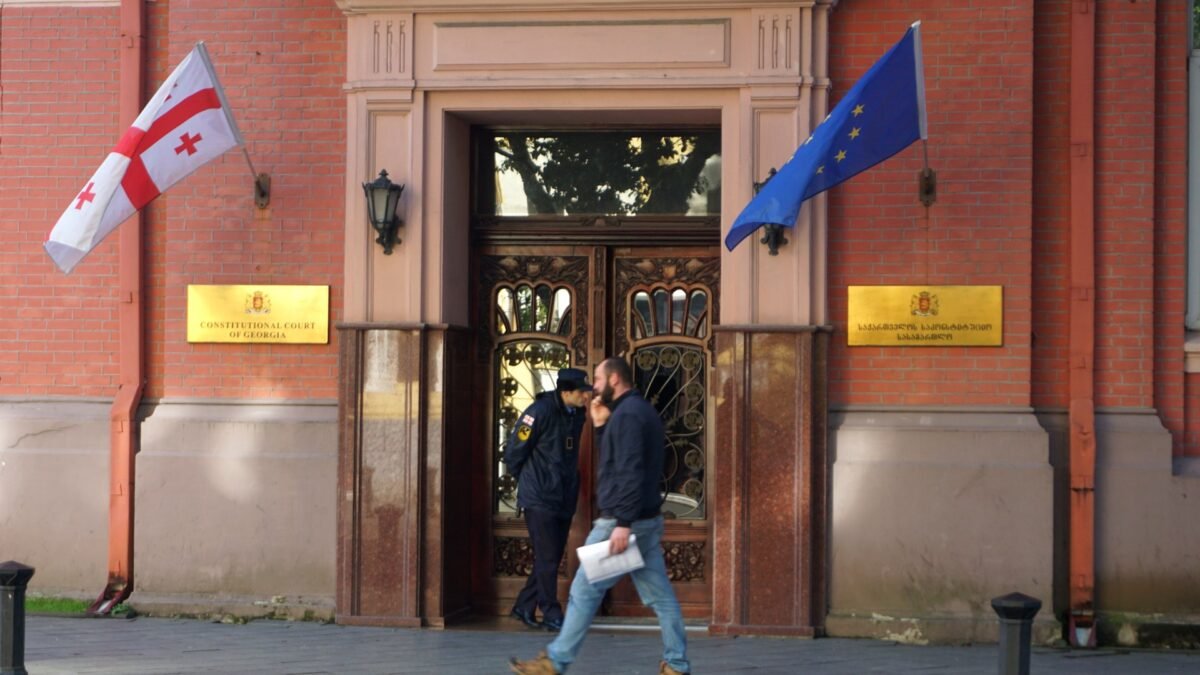
Georgia’s Constitutional Court began three days of hearings on Wednesday in the coastal city of Batumi on a lawsuit filed by the ruling Georgian Dream party seeking outright bans on the country’s five main opposition parties, in a case that civil society groups say presages the beginning of one-party rule in the South Caucasus country, according to Reuters.
The court’s seven-judge plenum will meet on October 21, 22 and 23 to review the suit, first filed by 88 Georgian Dream lawmakers about a year ago. The court announced on October 13 that it had accepted the case for consideration on the merits, according to Civil Georgia. Any ruling will be final and cannot be appealed inside Georgia; the court must deliver its decision by June 2027.
Georgian Dream, in power since 2012, is seeking to outlaw the parties on the grounds that they pose “a real threat to the constitutional order”. The five targeted forces are the United National Movement (UNM), the Coalition for Change (Ahali), Lelo/Strong Georgia, the Federalists, and Gakharia’s For Georgia, according to Civil Georgia’s live coverage of the proceedings.
The party’s submission argues that the five groups have, since 2016, continuously denied the legitimacy of Georgia’s authorities and the ruling party, and that their activities are unconstitutional under Article 23 of the Constitution because they have attempted, and still aim, to overthrow Georgia’s constitutional order or change it by force, according to AnewZ’s analysis of the court filing. As evidence, the lawsuit cites the parties’ refusal to recognise elected bodies, their boycott of elections, protest events it links to them, an alleged storming of the Georgian parliament building in June 2019, and what it describes as six attempts between 2019 and 2025 to overthrow or violently change the constitutional order. The United National Movement has denied the 2019 allegation.
Georgian Dream says it is protecting the country from opposition figures who it claims are trying to seize power and foment a catastrophic war with Russia, which fought and won a short war with Georgia in 2008, according to Reuters.
Representatives of four of the five targeted parties — the UNM, Coalition for Change, Lelo/Strong Georgia, and For Georgia — were in the Batumi courtroom on Wednesday to plead their cases, according to Civil Georgia. The Federalists said they would “mock” the proceedings from outside rather than legitimise them, even as they planned to stay in Batumi as part of the party’s campaign. The hearings were scheduled to start at 12pm local time and were livestreamed on the court’s YouTube channel, with the Georgian Public Broadcaster the only media organisation authorised to film inside.
The case’s roots stretch back to Georgian Dream’s victory in the 2024 parliamentary election, which the opposition says was rigged. Four of the five targeted parties collectively gained 784,820 votes — 37.79 per cent — in that vote, according to AnewZ, and all four crossed the five per cent threshold for entering parliament. They refused to take their seats, citing electoral fraud. For Georgia later reversed its position and took up its 12 seats in October 2025. If the lawsuit succeeds, every opposition party that crossed the five per cent threshold in 2024 could effectively disappear from Georgian politics.
“The ruling is about depriving a large part of Georgian society of genuine political choice and fundamentally changing the nature of the country’s political system,” Giorgi Butikashvili, the foreign secretary of the Ahali–Coalition for Change, told Reuters. Rights groups and the European Union, which Georgia is formally seeking to join, have condemned the move.
Council of Europe Secretary General Alain Berset issued a statement ahead of the hearings calling on Georgian authorities to “uphold political pluralism”, warning that the proceedings take place “against a backdrop of growing restrictions on civil society, independent media and freedom of peaceful assembly” and that “taken together, these developments risk undermining the checks and balances essential to democratic governance in Georgia”, according to Civil Georgia. The European Parliament adopted a resolution against Georgian Dream’s efforts to ban the opposition parties on October 8.
The lawsuit marks the culmination of a sustained government campaign against its critics since the disputed 2024 vote, according to Reuters. That campaign has included funding restrictions on media and civil society organisations, criminal proceedings against opposition leaders, and a series of laws restricting political activities for broader groups, according to Civil Georgia.
Once among the most democratic and pro-Western of the successor states to emerge from the Soviet Union, Georgia has turned increasingly authoritarian and deepened ties with Moscow since Russia’s full-scale invasion of Ukraine in 2022, according to Reuters.
Analysis: Why It Matters
The mathematics of erasure
The most striking number in this case is not a legal one. Four of the five parties Georgian Dream wants banned together won 784,820 votes — nearly 38 per cent of the national vote — in 2024. A ban would not trim the opposition at the margins; it would surgically remove the organisations that represent well over a third of voters. When the party that won the most recent election asks the court to dissolve every organisation that crossed the parliamentary threshold behind it, the question before the court is not really about individual parties’ conduct. It is about whether organised political opposition remains legal in Georgia at all.
A court under strain
The procedural history of the case deserves as much attention as its legal arguments. Georgian Dream first filed the suit last year, then resubmitted it several times — each resubmission resetting the court’s maximum nine-month review clock while new parties were added to the target list. Two judges have quit the court since the ruling party announced its intention to outlaw opponents through it, and three new judges were appointed over the past year. Another judge, Manana Kobakhidze, resigned after the court refused her request to recuse herself from the case. None of this proves how the seven-judge plenum will rule, but it is the kind of attrition that makes civil society groups read the hearings as a staged formality rather than a genuine test of evidence.
The 2024 election is the hinge
Everything in this case turns on the disputed 2024 parliamentary vote. Georgian Dream treats the opposition’s refusal to recognise the result as proof of an anti-constitutional posture — boycotts and protest are presented as evidence of a plot to overthrow the order. The opposition treats that same refusal as the only honest response to a rigged election. This is the trap at the heart of the Article 23 argument: once a government defines non-recognition of its legitimacy as unconstitutional, opposition becomes self-incriminating. The crime, in effect, is disagreement.
The “second front” framing
Georgian Dream’s stated justification — that it is protecting Georgia from opposition figures seeking to provoke a war with Russia — trades on a genuine national trauma. The 2008 war is the defining catastrophe of modern Georgian statehood, and the fear of a second one is real. But the argument also performs a useful political function: it recasts a domestic power struggle as a question of national survival, where dissent can be framed as treason and the government as the only barrier between the country and catastrophe. It is a framing that has accompanied democratic erosion in many places, and its use here should be examined with the same scepticism.
What Europe can actually do
The irony of the timing is hard to miss: Georgia is formally pursuing European Union membership while its government asks a court to dissolve the opposition and its broadcasters livestream only through a state-authorised channel. Brussels has condemned the move — the European Parliament’s resolution and the Council of Europe’s statements are on the record — but condemnation has been a diminishing currency in Tbilisi. The question now is whether the EU’s leverage over Georgia’s accession process, and its funding, can be made to bite before a final ruling arrives in June 2027. If the ban proceeds, the EU will face an unavoidable decision about what it means to keep a one-party state on a membership track.
What to Watch Next
- Days two and three of the hearings (Oct 22–23): whether the plenum pushes for additional evidence, sets further hearing dates, or moves toward closing arguments — each signal will sharpen the read on how quickly the court intends to rule.
- Protests in Batumi and Tbilisi: whether opposition supporters and civil society groups mobilise around the courthouse and in the capital, and how security forces respond.
- The Federalists’ outside campaign: the party’s decision to “mock” the proceedings rather than attend them is a calculated bet that delegitimising the process matters more than defending the case — watch whether other parties echo that posture.
- European reaction this week: statements are expected from EU capitals and Brussels institutions; watch for any move beyond rhetoric toward the accession process or funding.
- The road to June 2027: the court’s deadline is the real political calendar. Watch for further judicial personnel changes, new resubmissions, and whether Georgian Dream widens the target list again before the ruling lands.
Sources
- Reuters: Georgian court begins hearing lawsuit seeking ban on major opposition parties
- Civil Georgia: Backgrounder — Constitutional Court Starts Hearing Opposition Party Ban Case
- Civil Georgia: Live Updates — Constitutional Court Hears Opposition Ban Case
- Civil Georgia: Council of Europe Secretary General Calls to ‘Uphold Political Pluralism’ in Georgia
- AnewZ: Why is Georgian Dream trying to ban the opposition?

About the Author — Abdul Mannan
Related Articles

Russia Frees Detained American Teacher Stephen Hubbard as Witkoff Holds Ukraine Talks with Putin
Russia freed 74-year-old American teacher Stephen Hubbard after four years in Russian custody, with Vladimir Putin announcing the…

Indonesia Erupts in Protest as Wildfire Haze Chokes Southeast Asia
Nationwide student protests erupt on President Prabowo's second anniversary as wildfires and toxic haze choke Southeast Asia in…

Witkoff to Meet Putin in St Petersburg With Updated Peace Proposal After ‘Constructive’ Oslo Talks
US envoy Steve Witkoff will meet Vladimir Putin in St Petersburg on Wednesday with an updated peace proposal,…