
Hundreds of Thousands March Across France for a Second Weekend as Evening Clashes Flare in Paris

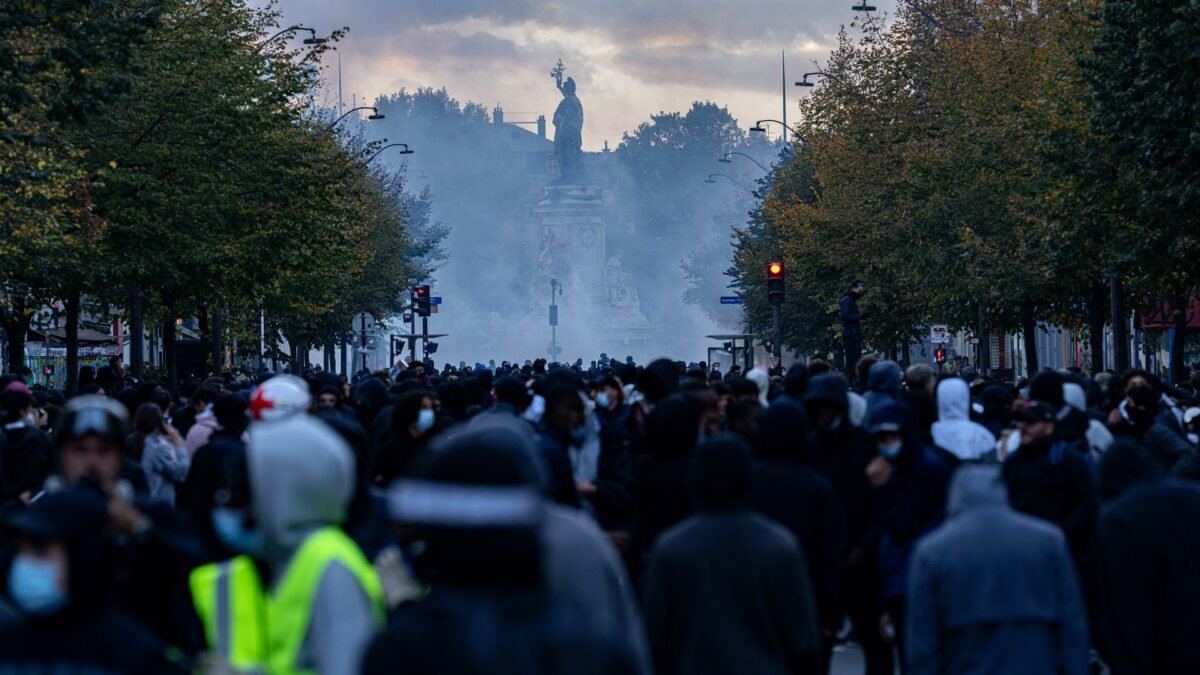
Hundreds of thousands of people marched across France on Saturday, 24 October, for a second consecutive weekend of protests over the cost of living and the state of the country’s schools, in a largely peaceful day of action that ended with clashes in Paris, Marseille and several other cities despite one of the biggest security operations in recent French history.
According to the Interior Ministry, about 410,000 people took part in demonstrations nationwide, including around 110,000 in Paris. Trade unions put the true turnout far higher, claiming about 800,000 protesters across the country and 250,000 in the capital, according to the Wall Street Journal. The gap between the two counts is now a familiar feature of French protest politics, but on one point the figures agree: the Paris march matched last weekend’s turnout, even after a week in which the government had promised to prevent any repeat of the rioting and looting of 17 October.
For most of the day, that promise appeared to hold. Marches in Paris and other major cities passed off peacefully, with protesters waving union flags and handmade placards denouncing rising prices and growing inequality. As night fell, however, the atmosphere deteriorated sharply in the capital. Riot police fired tear gas and used water cannon to disperse a group of around 500 hooded youths who hurled stones at officers, according to a security official cited by Reuters. In Marseille, France’s second city, youths dragged large metal sheets across a street, set fire to rubbish bins and threw rocks and bottles at riot police, with confrontations continuing after sunset. Clashes also flared in Lyon, Bordeaux and Grenoble, while police fired volleys of tear gas at demonstrators in Clermont-Ferrand, Lille, Nantes and Nice.
Interior Minister Laurent Nuñez said about 135 people had been arrested nationwide by early afternoon, many following pre-emptive searches that he said had uncovered fireworks, ball bearings and other items that could be used as weapons. By Saturday evening, the Wall Street Journal reported, around 1,000 people had been detained across the country, a figure Nuñez said he expected to rise considerably. Even so, the violence was far less intense than a week earlier, when looters and vandals went on the rampage in a number of French cities.
A huge security operation — and a row over the route
Authorities deployed some 70,000 police officers and gendarmes on Saturday, about 10,000 more than a week earlier, backed by helicopters, armoured vehicles and water cannon, after conceding that they had underestimated the scale of the unrest on 17 October. Prime Minister Sébastien Lecornu had earlier said troops would reinforce the police. In Paris, officers carried out 635 security checks, seizing items including a knife, an angle grinder and protective equipment, according to reporting of the day’s events.
The operation also reshaped the geography of protest. In Paris, the police prefecture changed the approved march route at short notice, moving it from the traditional Bastille to Nation route to a march from Porte d’Italie to Porte de Vincennes along the Boulevards des Maréchaux, authorised between 1pm and 7pm. Organisers rejected the change, with the Paris CGT union calling the new route impossible to secure and the student federation Fage describing it as an unacceptable last-minute reversal. The coalition announced an urgent request to the Paris administrative court on Saturday morning and said it would march to Bastille as planned.
Demonstrations in the city centres of Montpellier, Rouen, Nice and Lyon were banned outright, while marches planned in Marseille and Lyon were prohibited or placed under strict conditions, with local curfews imposed in some places. In Lyon, police used tear gas to disperse about 150 people gathered in an area where demonstrations had been barred. Night-time curfews for unaccompanied minors, first introduced in Lille, Denain, Douai and Wattignies, were extended until Monday morning and expanded to Marly and Valenciennes.
The disruption reached deep into everyday life in the capital. At least 24 Paris metro stations were closed on police orders, the Louvre and the Musée d’Orsay shut for the day, and Art Basel Paris cancelled its weekend programme at the Grand Palais. Shops in central Paris and Lyon were boarded up. In Orléans, where Marine Le Pen’s far-right National Rally was holding a party congress to launch its presidential campaign, the local prefecture put the crowd of counter-demonstrators at 11,000. The first authorised march there passed off peacefully.
How a school protest became a national movement
The movement now filling French streets did not begin as a single campaign. It began in September at high schools in the working-class suburbs north and east of Paris, where students joined striking teachers protesting against unfilled teaching posts, overcrowded classes and dilapidated buildings. The first flashpoint was the Lycée Saint-Exupéry in Créteil, outside Paris, and within two weeks the protest was national. By early October, the education ministry said at least 400 of France’s roughly 3,700 high schools were closed, with up to 500 fully or partly shut on 5 October.
Public middle and high schools lost 15.4 million teaching hours in the 2024-25 school year because absent teachers were not replaced, according to Education Ministry figures cited in reporting of the protests — amounting to 7.5 per cent of scheduled teaching time. Student organisations have demanded more teachers, smaller classes, repaired buildings, 250,000 more university places and an overhaul of Parcoursup, the national university admissions platform that many students say leaves them stressed and uncertain about their futures.
Alongside the schools revolt, a second grievance gathered force: the cost of living. Petrol prices hit a record of about 2.12 euros a litre in early September, with diesel close to 2.37 euros, as energy markets were disrupted by the war involving the United States, Israel and Iran and by disruption in the Strait of Hormuz. On 7 October, Prime Minister Lecornu announced the release of 10 million barrels from France’s strategic diesel reserves. But for many protesters, the gesture did not touch the deeper squeeze: according to national statistics cited in reporting, the economy shrank by 0.2 per cent in the first quarter of the year and was flat in the second, household purchasing power adjusted for household size fell by 0.6 per cent in the second quarter, and unemployment reached 8.3 per cent, its highest since 2020.
The two movements converged on 17 October, when students, trade unions and former “yellow vest” activists marched together. The Interior Ministry counted about 550,000 people that day, including 110,000 in Paris, while unions claimed far more. Daytime marches were largely peaceful, but the evening turned violent in several cities, with looting, arson and attacks on public buildings. More than 1,800 people were detained and hundreds of police officers, gendarmes and firefighters were injured, according to contemporaneous reporting. One protester died in Paris after suffering a cardiac arrest, and the burning of the historic town hall in Limoges became a symbol of the night’s destruction for many observers.
What the government has offered — and why protesters say it is not enough
On Friday, the day before Saturday’s marches, President Emmanuel Macron met student representatives and promised more teachers and a deep overhaul of the Parcoursup admissions system. Student representatives welcomed the meeting but called for further mobilisation until the government presents concrete measures, and Saturday’s turnout suggests that, for now, promises have not been enough to clear the streets.
Mr Macron has blamed what he calls “ultra-left” groups wanting to bring down the republic for the worst of last weekend’s violence. Interior Minister Nuñez has accused far-left activists and criminal gangs of seeking to foment violence, telling reporters on Saturday: “We have to be ultra, ultra responsive.” Protest organisers reject that framing. They accuse the government of ignoring widespread public anger and of attacking the right to protest itself, pointing to the bans on demonstrations in several city centres and to restrictions on marches not led by unions.
Hard-left leader Jean-Luc Mélenchon, who joined the Paris rally, hailed what he called a magnificent display of collective discipline and self-restraint, and predicted the protests would continue until Mr Macron, whose mandate expires next year, addressed what he described as France’s social malaise. Many demonstrators have also accused the government of overreacting, noting that soldiers were dispatched to patrol the Champs-Élysées. “We shed tears for shops, not for the people who are being impoverished all year round,” Clara Lebbadi, a 22-year-old arts student, told Reuters.
The political calendar adds pressure on all sides. The National Rally used its congress in Orléans to launch its campaign for presidential elections due in about six months, and thousands marched against both Ms Le Pen and Mr Macron. A shooting west of Paris on Friday, in which a gunman suspected of acting out of Islamophobic hatred killed one person and wounded four others, including a 12-year-old girl, heightened tensions further, according to Reuters. Organisers from the yellow-vest movement have already called for another day of rallies on 31 October to defend the right to demonstrate.
Analysis: Why It Matters
A movement with no single leader — and no single demand
The most important thing to understand about this autumn in France is that there is no one movement to negotiate with. What began as a dispute about teacher shortages in a handful of suburban schools has fused with a trade-union campaign over wages and pensions and with the revived yellow-vest anger over fuel prices and the cost of living. That fusion is the movement’s strength: it brings teenagers, teachers, railway workers, farmers and pensioners onto the same streets, and it makes the protests very hard for the government to dismiss as the grievance of one group. It is also the movement’s weakness. A government can, in principle, promise more teachers or tinker with an admissions website; it cannot, with a single announcement, fix fuel prices, rebuild school estates, raise real wages and restore faith in public services all at once. The breadth of the demands is precisely why Saturday’s marches are likely to be followed by more.
The battle over numbers is a battle over legitimacy
Every French protest produces two turnouts: the ministry’s and the unions’. Saturday was no exception, with 410,000 against roughly 800,000 nationwide. Readers should treat both figures with the same scepticism, because both are produced by interested parties and neither can be independently verified on the day. What matters more than the exact total is the direction of travel. The Paris march held at last weekend’s level despite a much heavier police presence, route changes, station closures and bans in several cities. A movement that can reproduce its turnout under those conditions has not been deterred; it has been, if anything, hardened. The government’s claim to have kept order is real — Saturday was calmer than 17 October — but order is not the same as resolution.
Policing worked on its own terms, at a political cost
Judged narrowly, the security operation succeeded. There was no repeat of the large-scale looting of the previous Saturday, and the damage in Marseille, where a jewellery shop and a Carrefour supermarket were damaged or looted according to the Wall Street Journal, was far more limited than a week earlier. But the methods used to achieve that calm — banned city-centre marches, a last-minute route change, pre-emptive searches, curfews for minors — feed directly into the protesters’ second grievance: that the state answers dissent with control rather than with concessions. When organisers can plausibly say that the right to demonstrate itself is under pressure, the government hands them a cause that unites students, unions and civil-liberties campaigners who might otherwise disagree about economics. The risk for the authorities is that each heavily policed Saturday makes the next one easier to mobilise, not harder.
Macron’s narrowing room
President Macron is term-limited and cannot run again, he leads a minority government with no parliamentary majority, and his 2027 budget carries about 43 billion euros of fresh savings with the civil-service pay index frozen, according to reporting of the finance bill. That combination leaves him very little fiscal room to buy his way out of a cost-of-living protest, and very little political room to be seen to surrender to the street. Concessions on schools, welcome as they are to students, do not touch fuel prices or household budgets; concessions on fuel would collide with the budget arithmetic. Meanwhile the National Rally is already campaigning for the presidency from Orléans, eager to present itself as the alternative to both the government and the street. The president’s problem is therefore not one bad Saturday but a structural one: the things protesters want cost money the budget does not have, and the things the budget demands are among the things protesters are marching against.
What to Watch Next
- 31 October: Yellow-vest organisers have called another day of rallies to defend the right to demonstrate. Turnout and the policing response will show whether Saturday’s calmer pattern holds or whether the movement escalates again.
- Concrete education measures: Students have said protests will continue until the government presents specific actions on teachers, class sizes and Parcoursup, not just promises. The timing and scale of any package will be the first real test of Friday’s meeting.
- The 2027 budget debate: With about 43 billion euros of savings planned and no parliamentary majority, the government’s budget fight in the coming weeks will run in parallel with the street protests — and each will be used as an argument in the other.
- Arrests and court cases: According to the justice minister, cited in reporting, about 2,700 people had been arrested across France since the movement began, as of 22 October. How many face fast-track convictions, and how the courts treat pre-emptive arrests, will shape the debate about the right to protest.
- The security weekend ahead: The Paris Saint-Germain against Lyon football match was moved from Sunday to Monday on police orders, while the NFL’s Pittsburgh Steelers against New Orleans Saints game at the Stade de France and the Ballon d’Or ceremony in London both fall in the same crowded window — a reminder of how much of French public life now has to be scheduled around the risk of unrest.
For now, France has had two Saturdays of mass protest, one violent and one mostly peaceful, and neither has produced a settlement. The schools are still short of teachers, fuel is still expensive, the budget still demands savings, and the streets still fill. Until one of those facts changes, the next Saturday is already being planned.
Sources
- Wall Street Journal — Hundreds of Thousands Protest Across France as Clashes Erupt in Paris
- Reuters — Sporadic violence flares as hundreds of thousands protest in France (syndicated report)
- Reuters — Violence flares in Paris after massive, largely peaceful protests across France (updated report)
- Reuters — French league moves PSG-Lyon clash as Paris braces for fresh protests

About the Author — Abdul Mannan
Related Articles
Trump Says US Warships Could Stop Off Cuba on the Way Back From Iran as Rubio Urges Cubans to Work With the CIA
President Donald Trump has revived the prospect of US military pressure on Cuba, telling a Florida rally that…
US Cuts Staff at Four Middle East Embassies as Intelligence Chief Warns Iran Plots Against Americans Reach ‘Advanced Stages’
Washington is thinning its diplomatic footprint across the Middle East after U.S. intelligence warned that Iranian plotting against…
France Deploys 70,000 Police as Half a Million Protesters Take to the Streets
France has deployed some 70,000 police officers and banned or restricted protests in major cities ahead of a…