
Riyadh Airport Reopens After Two-Week Houthi Shutdown as Rebels Warn It Will ‘Never Be Safe’

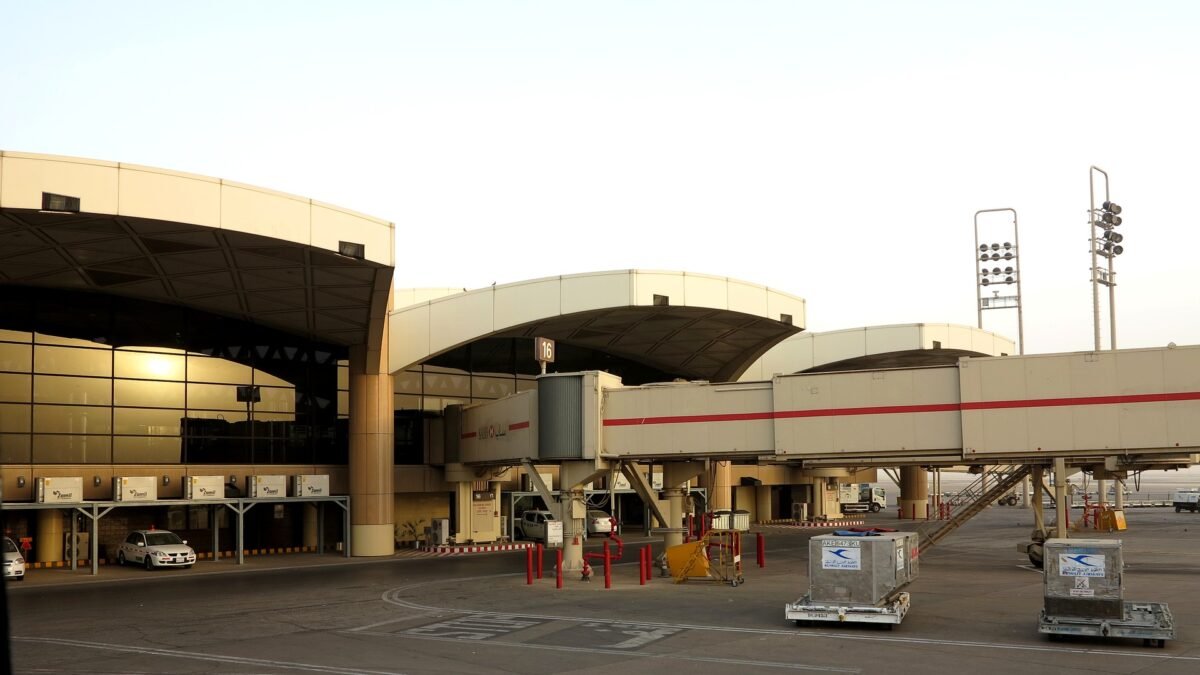
Riyadh’s King Khalid International Airport resumed flights on Sunday after a two-week closure, reopening a hub that had become one of the most exposed civilian targets in the Gulf — only for Yemen’s Houthis to warn within hours that it would “never be safe”.
The airport announced late on Saturday that Terminal 1 would handle domestic flights and Terminal 2 would serve international flights operated by national carriers from Sunday, according to a passenger notice posted on X. By early on Sunday, flight-tracking data showed a plane departing Riyadh for the Saudi city of Jeddah, according to Agence France-Presse, the first visible sign that the capital’s main gateway was working again.
The reopening did not last long as a moment of normality. Houthi military spokesman Yahya Saree renewed the group’s warning against using the airport, calling it a “military target” and telling airlines, airport staff and travellers to stay away, according to Reuters. “The Saudi regime shall bear the consequences of any operations at the airport,” he said, adding that the group’s operations against the airport would continue.
The Saudi-led coalition fighting the Houthis said early on Sunday that it had shot down two drones in the Riyadh area, according to AFP. The interception was a reminder, delivered on the very morning of the reopening, that the threat the closure was meant to escape has not gone away.
A weekend of claims and interceptions
The reopening followed a sharp exchange over the weekend. The Houthis claimed on Saturday that their forces had carried out seven missile and drone operations against targets inside Saudi Arabia, according to reports of Saree’s statement. The claimed targets included King Khalid International Airport in Riyadh, King Fahd International Airport in Dammam, Najran Airport, an airbase at Khamis Mushait, Saudi Aramco facilities at Yanbu, the Rabigh refinery and the East-West oil pipeline. The group described the operations as retaliation for what it said were repeated Saudi airstrikes on Yemen.
Those impact claims have not been independently confirmed, and Saudi authorities have not confirmed that all of the reported targets were hit. What the coalition did confirm was interceptions: a ballistic missile fired towards Riyadh was destroyed, and drones were shot down over the Riyadh region, according to coalition statements reported over the weekend. The gap between the two accounts — sweeping claims on one side, confirmed interceptions on the other — is itself part of the contest, since both sides are fighting over whether the kingdom’s airspace can be considered safe.
The stakes of that argument were set on 10 October, when an attack on King Khalid airport, claimed by the Houthis, killed 13 people and wounded more than 300 others, according to Reuters. It was the deadliest attack inside the kingdom in more than a decade. Operations were halted the same day, and the suspension was extended two days later. For two weeks, one of the busiest airports in the Middle East — a hub for pilgrims, business travellers and cargo — sat largely silent while missiles and drones continued to fly.
Airlines keep their distance
The airlines, notably, are not following the airport’s lead. Air India and Air India Express announced on Saturday that flights to and from Riyadh and Dammam would remain suspended until 7 November, while services to Jeddah would stay suspended until 31 October, according to the airlines’ joint advisory. IndiGo said its flights to Jeddah, Dammam and Madinah would remain cancelled until 31 October, and Akasa Air extended its Riyadh suspension until 30 November and Jeddah until 10 November, according to reports of the carriers’ advisories.
The split between an airport reopening and airlines staying away tells its own story. An airport authority can declare its terminals open; an airline must answer to insurers, crews and passengers, and it must be able to explain its decision if something goes wrong. The Indian consulate in Jeddah said it was running round-the-clock control rooms in Jeddah and Makkah to help Indian nationals, particularly Umrah pilgrims caught by the cancellations, according to ANI. Pilgrimage traffic is one of the quiet casualties of the disruption: thousands of travellers whose journeys depend on Gulf hubs now face rebooking, refunds or long overland detours.
How a Yemeni war reached Riyadh’s runways
The airport attacks are the newest front in a Yemeni conflict that has spilled far beyond Yemen’s borders. Saudi Arabia, along with Yemen’s internationally recognised government, which it backs, has faced a wave of Houthi attacks in recent weeks after a years-long truce broke down in the summer, according to AFP. The Houthis have been firing ballistic missiles and drones at Saudi airports, ports and oil installations, turning the kingdom into a pressure point in the wider war, according to Reuters.
Saudi Arabia has recently stepped up its military involvement in Yemen, launching strikes against the Houthis and backing a government counteroffensive after the Houthis seized strategic territory along the Red Sea coast last month, according to Reuters. The counteroffensive, dubbed Operation Dawn of Yemen by Yemeni government supporters, aims to reclaim ground lost in that advance. The fighting has shifted the focus of the wider United States-Iran confrontation, according to AFP, and deepened a humanitarian disaster in Yemen, one of the world’s poorest countries.
That wider context matters because the airport is not an isolated target. The Houthis’ campaign against Saudi infrastructure — airports, refineries, pipelines — is designed to impose costs on Riyadh for its role in Yemen and, by extension, to signal to Washington that its regional allies are reachable. The Saudi-led coalition’s interceptions, in turn, are designed to show that the shield holds. Both claims can be true at once: most incoming weapons can be shot down, and a single weapon getting through can still kill 13 people and close an airport for a fortnight.
Analysis: Why It Matters
A reopening designed to be seen
Reopening an airport is never just a transport decision in wartime; it is a statement. By designating terminals and publishing a timetable, Riyadh is telling its own citizens, its neighbours and the markets that the capital absorbs blows and carries on. The choice of a phased reopening — domestic flights in one terminal, national-carrier international services in another — is deliberately cautious, a way to restore movement without pretending that the risk has vanished. But a statement only works if the audience believes it, and the Houthis’ warning was timed to deny Riyadh exactly that belief, arriving within hours of the announcement.
The airport as a weapon
There is a reason airports have become the Houthis’ preferred target, and it is not only the physical damage a missile can do. An airport concentrates everything a modern state wants to protect — civilians, commerce, prestige and connectivity — into a single, unmissable place. Closing one imposes costs far beyond the terminal: stranded pilgrims, cancelled cargo, nervous insurers and headlines around the world. The 10 October attack demonstrated that logic brutally. Even the threat of a repeat, credibly maintained, forces governments to spend heavily on air defence and forces travellers to think twice. In that sense the Houthis do not need to hit the airport again to keep profiting from the last hit; the warning itself does much of the work.
The airlines are voting with their schedules
The most honest verdict on Sunday’s reopening may come not from governments but from airline timetables. Carriers with no political stake in the argument are keeping Riyadh, Dammam and Jeddah off their schedules for days or weeks, and extending those suspensions even as the airport reopens. That caution reflects a cold calculation: the cost of a cancelled route is bounded, while the cost of a tragedy is not. It also creates a two-speed recovery, in which Saudi national carriers resume first while foreign airlines wait — a pattern that, if it persists, could quietly reshape Gulf aviation, pushing traffic towards hubs perceived as safer and leaving Riyadh to rebuild confidence one uneventful week at a time.
Saudi Arabia’s widening war
The airport episode also exposes how far Saudi Arabia’s Yemen entanglement has widened. A kingdom that once fought the Houthis largely through Yemeni proxies and air power is now defending its own capital’s airport, backing a ground counteroffensive and absorbing strikes on its energy infrastructure. Each step deeper into the war raises the domestic political stakes: a government that cannot keep its main airport open looks vulnerable, while a government that escalates risks a longer and bloodier conflict. Riyadh’s balancing act — hitting Houthi positions hard enough to deter, while reopening airports fast enough to project normality — is becoming harder with every exchange.
A new normal, with sharp limits
What is emerging in the Gulf looks less like a return to peacetime and more like a brittle new normal: airports that open and close, airlines that suspend and resume, warnings that are renewed as routinely as timetables. Such an arrangement can hold for a while, but it is inherently unstable. It depends on interceptions working almost every time, on no single strike repeating the toll of 10 October, and on travellers and insurers tolerating a level of risk they would once have considered unacceptable. The moment any of those conditions fails, the cycle resets — another closure, another warning, another round of cancellations.
What to Watch Next
- Whether flights actually operate from King Khalid airport through the coming week, and whether foreign carriers follow the national carriers back or extend their suspensions further.
- Whether the Saudi-led coalition reports further interceptions over Riyadh or other cities, and whether any Houthi weapon is confirmed to have struck its target.
- How the Saudi-backed government counteroffensive in Yemen develops, and whether it recovers any of the Red Sea coast territory seized last month.
- Whether the Houthis carry out a further attack on a Saudi airport or energy site, or keep the pressure at the level of warnings and claims.
- Whether the wider United States-Iran confrontation produces any diplomatic opening, or whether the Gulf’s airport war becomes a permanent feature of the conflict.
Sources
- Reuters — Yemen’s Houthis renew warning against using Riyadh airport
- AFP via The Business Standard — Riyadh airport resumes flights following Houthi attacks
- The Hindu BusinessLine — Air India and AI Express cancel Riyadh, Dammam flights till Nov 7
- ANI via Desi Talk — Riyadh airport announces resumption of operations at T1, T2 following closure after Houthi attacks

About the Author — Abdul Mannan
Related Articles

Houthis Say They Struck Saudi Oil Sites and Airports as Missiles Hit Aden
Yemen's Houthis said they attacked Saudi oil facilities and airports on Saturday, while Yemen's government said missiles also…
US Strike on Iran ‘Absolutely’ Possible This Weekend, Says Trump Envoy Tom Barrack
US Ambassador to Turkey Tom Barrack has said American strikes on Iran could come as soon as this…
Israel Strikes Iran’s Nuclear Sites, Iran Hits US Base in Saudi Arabia as Rubio Promises War Will End ‘in Weeks’
Israel strikes Iran's nuclear sites including Bushehr and Arak while Iran hits a US airbase in Saudi Arabia,…