
Grand Jury Declines to Indict Cassidy Hutchinson Over January 6 Testimony in Setback for Justice Department

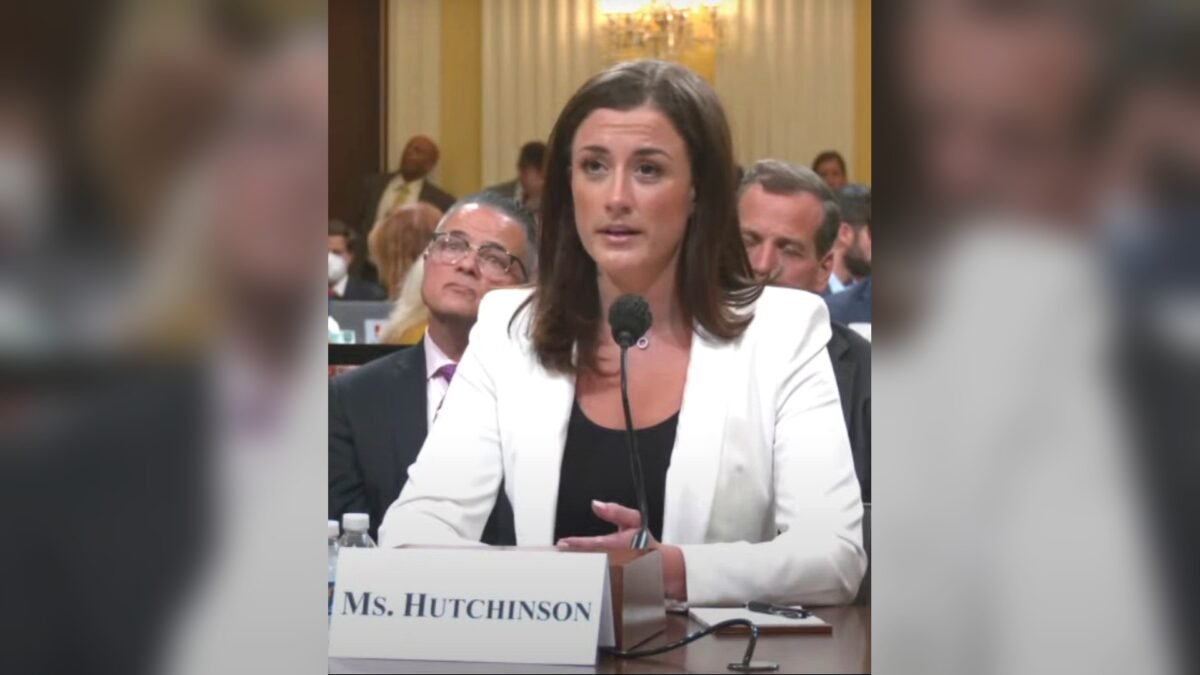
A federal grand jury in Washington declined on Tuesday, 27 October 2026, to indict Cassidy Hutchinson, the former White House aide whose televised testimony to the House committee investigating the January 6, 2021, attack on the United States Capitol became one of the most contested accounts of that day, according to Reuters, CNN and other outlets reporting the decision from sources familiar with the matter.
The Justice Department had been investigating whether Hutchinson gave false testimony to the congressional panel, according to Reuters. Hutchinson has maintained that her testimony was truthful, Reuters reported. The grand jury’s refusal means that prosecutors did not secure the indictment they sought at this stage. It is not a court finding that every statement Hutchinson made was true, and it does not, on the reporting available, prevent prosecutors from presenting the matter again. Those limits matter, because much of the public argument since Tuesday has treated a charging decision as if it were a verdict on the underlying events. It was not. It was a decision by ordinary citizens, meeting in secret, about whether the evidence presented to them met the comparatively low threshold for a criminal charge. On the accounts published so far, they concluded that it did not.
The outcome became public in an unusual way. A Justice Department lawyer told a magistrate judge during a court hearing on an unrelated matter that a grand jury had returned a “non-concurrence”, according to CNN. The lawyer did not name the defendant in court, CNN reported. Two people familiar with the matter told CNN that the lawyer was referring to Hutchinson. Reuters, citing a source familiar with the matter, reported separately that the grand jury had declined to indict her. The Associated Press also confirmed the outcome through two people familiar with the matter, according to reporting carried by other outlets, and NBC News confirmed it with a senior United States official, according to reporting summarised in news coverage of the decision. The Washington Post first reported the outcome, according to CNN and other outlets. Neither the Justice Department nor Hutchinson’s lawyers immediately responded to requests for comment, according to CNN. USA Today reported that it had reached out to the White House and the Justice Department for comment and that Hutchinson could not immediately be reached.
What prosecutors asked the grand jury to charge, in precise terms, has not been publicly disclosed. ABC News reported, according to sources familiar with the matter, that prosecutors had sought charges concerning alleged false statements to Congress. Reuters described the investigation more broadly, as an inquiry into whether Hutchinson gave false testimony to the congressional panel. CNN reported that it could not be determined from the material available which parts of her testimony were under scrutiny. That gap is important. Without the proposed charge, the public cannot know whether prosecutors concentrated on one disputed anecdote, on a pattern of statements, or on something else entirely. Any account that claims to know the exact allegation the grand jury rejected goes beyond what the published reporting establishes, and this article does not make that claim.
The lawyer who disclosed the outcome in court was Neville Hedley, who introduced himself as acting senior litigation counsel in the Justice Department’s Civil Rights Division, according to reporting of The Washington Post’s account. He told United States Magistrate Judge Zia Faruqui that the grand jury had not concurred on a proposed indictment, according to that reporting. The hearing itself concerned another matter. The disclosure was brief, and the courtroom announcement did not identify Hutchinson by name. The identification came afterwards, from sources speaking to news organisations on condition of anonymity, as is common in reporting on grand jury proceedings, which are conducted in secret and whose participants are generally barred from discussing what happened inside the room.
How the case reached a grand jury
The investigation followed a criminal referral from Republican members of Congress. Representatives Barry Loudermilk of Georgia and Jim Jordan of Ohio referred Hutchinson to the Justice Department earlier in 2026, according to reporting of The Washington Post’s account and other coverage. They alleged that she had provided false testimony to the January 6 committee and asked the department to consider prosecution. A congressional referral is a recommendation. It does not itself establish that a crime was committed, and it does not oblige prosecutors to bring charges. Prosecutors must still decide whether the evidence supports a case and must still persuade a grand jury that there is probable cause to believe a crime occurred.
The case was handled by the Justice Department’s Civil Rights Division, according to NBC News and reporting of The Washington Post’s account. The division is led by Assistant Attorney General Harmeet Dhillon, a Trump appointee, according to NBC News reporting summarised in coverage of the decision. The Washington Post described the assignment as unusual for a false-statements investigation, according to summaries of its reporting, because the Civil Rights Division ordinarily enforces federal civil rights and anti-discrimination law, while matters involving alleged perjury or false statements to Congress are more typically handled as criminal matters by the United States Attorney’s office in Washington. The Justice Department has not, in the reporting available, publicly explained the specific legal theory it pursued or why the division led the presentation. That absence of explanation has become part of the story, because the choice of division is one of the few concrete facts about the investigation’s structure that has entered the public record.
Reporting on the investigation’s progress before Tuesday suggested disagreement inside the department. CNN reported, citing sources familiar with the matter, that the potential prosecution had become a point of controversy between lawmakers and Justice Department employees, and that some inside the department believed there was not enough evidence to bring a viable criminal case. That reporting is attributed, and it cannot by itself prove what individual prosecutors thought. It does, however, indicate that the grand jury’s refusal was not the first sign of doubt about the case. It followed weeks in which the investigation itself had been publicly reported: the New York Post reported earlier in October 2026 that a panel had been convened to hear evidence and witness testimony related to Hutchinson’s appearance before the committee on 28 June 2022.
Republican Senator Bill Cassidy of Louisiana, who is not related to Hutchinson, called the matter an act of “lawfare” directed by the president, according to CNN. His use of that word matters because it came from within the president’s own party, and because it framed the investigation as a political exercise rather than a routine charging decision. Lawmakers across the political divide had also called on the department to abandon the investigation, according to CNN. Supporters of the investigation, by contrast, have argued for years that congressional testimony must be truthful and that potential violations deserve scrutiny regardless of political affiliation. That argument was reflected in the referral itself and in the long-running Republican challenge to Hutchinson’s credibility. The grand jury’s decision does not resolve that political disagreement. It resolves only the narrower question of whether this presentation produced an indictment.
The testimony at the centre of the dispute
Hutchinson served as a special assistant and aide to Mark Meadows, who was White House chief of staff during President Donald Trump’s first term, according to CNN and USA Today. She was, in USA Today’s description, a top-level former Trump staffer who was in the room with Trump and Meadows during critical moments leading up to and during the Capitol attack. Her role gave her a close view of White House deliberations, and it also meant that much of what she later described to Congress came from what she heard in meetings, from conversations with senior officials, and from accounts relayed to her by others. That mixture of direct observation and secondhand reporting has shaped every dispute about her evidence since.
On 28 June 2022, Hutchinson testified on live television before the House select committee investigating the January 6 attack. She was 25 at the time, according to reporting of The Washington Post’s account. About 13 million people watched the hearing, according to Nielsen figures cited in that reporting. She described, among other things, Trump being told that supporters at his rally near the White House had been stopped at security checkpoints because some were carrying weapons, including guns and knives. According to CNN’s account of her testimony, she said she heard Trump say words to the effect of not caring that supporters had weapons, because they were not there to hurt him, and urging that the magnetometers, the security screening devices, be taken away so that his people could enter. USA Today, summarising her earlier testimony, reported that she testified that the president knew there was an armed mob at his rally and directed that mob towards the Capitol. The precise wording matters in a false-statements inquiry, which is why paraphrase, however careful, cannot substitute for a transcript. What can fairly be said is that her account presented Trump as aware of a risk of violence and as determined, nevertheless, to press ahead with a march to the Capitol.
The most widely disputed part of her testimony concerned what happened after Trump’s speech. Hutchinson told the committee that she had been told by Tony Ornato, then White House deputy chief of staff for operations, that Trump had become angry when he was told he would not be taken to the Capitol, and had reached for the steering wheel of his presidential vehicle and lunged at a Secret Service agent, according to CNN and USA Today. She acknowledged that she had not witnessed that episode herself. She was recounting what she said Ornato had described to her. Ornato and others disputed the account, according to CNN. The driver of the vehicle later told House investigators, in a transcribed interview made public in March 2024, that the president had insisted on being taken to the Capitol but had never grabbed the steering wheel or lunged into the front seat, according to the New York Post’s account of that interview. Trump also disputed Hutchinson’s testimony in the hours after the hearing, according to NPR reporting from June 2022, calling the steering-wheel account false.
Other parts of her testimony have also been contested, and some have been corroborated in part by other evidence. She described Trump throwing a porcelain plate against a wall after learning that his former Attorney General, Bill Barr, had said there was no widespread fraud in the 2020 election, according to USA Today’s summary of her testimony. She said she had been told, four days before January 6, by Rudy Giuliani, Trump’s personal lawyer, that January 6 was going to be a great day, and that the remark left her worried, according to USA Today. She described Meadows being warned about the possibility of violence and Trump being reluctant, in her account, to urge supporters to stand down as the attack unfolded. Former special counsel Jack Smith, who investigated the January 6 attack, told members of Congress in a closed-door interview earlier in 2026 that Hutchinson was not a powerful witness in his investigation, in part because many of her stories were secondhand, according to CNN. That assessment, attributed to Smith, is distinct from a finding that she lied. Secondhand evidence can be accurate, and it can also be mistaken. The difficulty for prosecutors in a false-statements case is not simply showing that an account was disputed. It is showing that the witness knowingly made a false statement about a material matter. A witness who accurately reports what she was told, even if what she was told turns out to be wrong, presents a different legal problem from a witness who invents an account.
Hutchinson has consistently maintained that her testimony was truthful, according to Reuters. She has not, in the reporting available, retracted any part of it. Trump has called her a “scam artist” who lied under oath and has suggested she should be prosecuted, according to NBC News reporting summarised in coverage. In 2022, he asked publicly what the Justice Department was going to do about her testimony, according to that reporting. Those statements are part of the political record. They are not evidence in a criminal case, and the grand jury’s task was not to decide whether the president’s characterisation was fair. Its task was to decide whether prosecutors had shown probable cause that a crime had been committed.
The wider pattern prosecutors faced
Grand juries rarely refuse to indict. Prosecutors need only persuade a majority of grand jurors that there is probable cause to believe a crime was committed, according to CNN. The defence is not present in the grand jury room, and the threshold is far lower than the proof beyond reasonable doubt required at trial. The Washington Post described refusals as exceedingly rare, according to summaries of its reporting. That rarity is why Tuesday’s outcome attracted so much attention. It is also why the outcome should not be overstated. A grand jury hears only what prosecutors choose to present, it does not hear cross-examination, and its members do not publish reasons. A refusal can reflect doubts about the evidence, doubts about the legal theory, doubts about a witness’s credibility, or a combination of factors that outsiders cannot reconstruct from a one-word outcome.
CNN reported that grand juries have declined to bring charges in several cases since Trump took office for his second term, including a single charge against former FBI Director James Comey and full indictments against New York Attorney General Letitia James and six lawmakers who urged service members to disobey illegal orders. That pattern, as reported by CNN, places the Hutchinson decision in a sequence rather than treating it as an isolated event. Each of those cases involved a person whom Trump or his allies had portrayed as a political adversary, and each involved a presentation that did not produce the indictment prosecutors sought, at least in the form presented. The cases differ in their facts, their charges and their procedural histories, and they should not be collapsed into a single narrative. What they share, on CNN’s reporting, is the institutional fact that grand jurors in Washington, presented with politically sensitive cases, have on several occasions declined to approve what was asked of them.
The broader context is the January 6 investigation itself. After weeks of Trump’s false claims that he had won the 2020 election, his supporters stormed the Capitol on 6 January 2021 in an unsuccessful attempt to prevent Congress from certifying the election result, according to Reuters. Trump pardoned nearly everyone criminally charged in connection with the Capitol attack on his first day back in office for a second term in January 2025, according to Reuters. Former special counsel Jack Smith and his team secured an indictment in 2023 accusing Trump of plotting to overturn his defeat in the 2020 election, according to Reuters. Smith dropped that case and another after Trump won the 2024 election, citing a Justice Department policy against prosecuting a sitting president, Reuters reported. The House select committee that heard Hutchinson’s testimony has since been disbanded, and its work has been the subject of sustained political dispute. The criminal investigation of Hutchinson therefore arrived years after the events it concerned, and it concerned not the attack itself but the truthfulness of testimony about it. That distance in time, and that shift in subject, shaped the legal and political questions the grand jury was asked to consider.
Analysis: Why It Matters
1. A charging decision is not a verdict on the testimony
The most important discipline in covering this story is also the easiest to abandon. A grand jury’s refusal to indict does not establish that Hutchinson’s account of January 6 was accurate in every detail. Nor does it establish that any particular disputed anecdote, including the steering-wheel account, happened as she described it. The grand jury was not asked to rule on the historical record. It was asked whether prosecutors had shown probable cause that Hutchinson knowingly lied to Congress. A “no bill”, the term NBC News used for the outcome, means the panel rejected the effort to indict her on the presentation made. It does not publish findings of fact, and it does not resolve the conflicting accounts of Ornato, the driver, Trump and Hutchinson. Anyone who claims Tuesday’s decision proves the steering-wheel episode, or disproves it, is claiming more than the public record supports. The decision matters precisely because it is narrow. It closes, for now, a criminal case. It leaves the historical argument where it was: contested, documented in part, and dependent on evidence that was never tested in a courtroom.
2. The messenger became the case
Hutchinson’s testimony was always going to be attacked. She was a young aide testifying against the president she had served, in a hearing watched by millions, about conduct that went to the heart of the case against him. What is distinctive about the criminal investigation is that it turned the witness into the defendant, or at least into the proposed defendant, and did so on the basis of a congressional referral from two of the president’s closest allies in the House. That sequence raises a question that goes beyond Hutchinson herself: when does scrutiny of a witness become a deterrent to future witnesses? Prosecutors are entitled, and sometimes obliged, to investigate false testimony. Congress depends on truthful evidence, and a witness who lies under oath undermines that function. But the choice of vehicle matters. Assigning the case to the Civil Rights Division, whose ordinary work is the enforcement of civil rights law, invited the inference, fair or not, that the investigation was driven by political purpose rather than by the ordinary allocation of criminal work. The Justice Department has not publicly answered that inference in the reporting available. Until it does, the institutional question will outlive the charging decision, because future witnesses will weigh not only whether they told the truth but whether telling an unwelcome truth could expose them to a criminal presentation years later.
3. Grand juries are a check prosecutors cannot assume away
There is a familiar saying in American law that a prosecutor could persuade a grand jury to indict almost anyone, because the standard is low, the proceeding is secret, and only the prosecution presents evidence. Tuesday’s outcome is a reminder that the saying is an exaggeration, and that grand jurors are citizens, not instruments. They can ask questions, they can doubt a presentation, and they can refuse. The pattern reported by CNN, in which several politically sensitive presentations have failed, suggests that this is not an accident of one panel. It may reflect the quality of the evidence, the difficulty of the legal theories, the composition of Washington grand juries, or a growing scepticism among jurors about cases that arrive with an obvious political charge. The reporting does not allow a firm choice among those explanations, and this article does not pretend otherwise. What can be said is that the grand jury, an institution designed in part to stand between the state and the citizen, performed that function here. For a Justice Department that has presented these cases as straightforward applications of the law, repeated refusals are a practical problem as well as a reputational one. Each refusal consumes time, exposes the limits of the evidence, and makes the next presentation harder, because prosecutors must decide whether to try again with the same material or to accept the panel’s answer.
4. The secondhand-evidence problem explains why this case was hard
False-statements prosecutions are difficult when the statement at issue is a report of what someone else said. Hutchinson was explicit, in the steering-wheel account, that she was relaying what Ornato had told her. To prove that she lied, prosecutors would ordinarily need to show not only that the underlying event did not happen as described, but that Hutchinson knew her statement was false when she made it. If she accurately reported what she had been told, even if the person who told her was mistaken or lying, the legal case against her is weak. If she misreported what she had been told, prosecutors would need evidence of that misreporting, which is likely to turn on the recollection of the very people whose accounts are already in dispute. Smith’s reported assessment that Hutchinson was not a powerful witness because much of her evidence was secondhand points to the same difficulty from the other side: secondhand evidence is often insufficient to carry a prosecution, whether the target is a president or a witness. The grand jury’s refusal may therefore reflect a straightforward evidential judgement rather than a political one. The public record does not disclose the evidence presented, so that remains an inference. But it is the inference most consistent with the structure of the case, and it counsels against reading the outcome as a referendum on the January 6 committee’s entire record.
5. What this settles, and what it leaves open, before the midterms
The decision arrives a week before midterm elections in which control of Congress is at stake, and in which the Justice Department’s handling of politically sensitive cases has itself become a campaign issue. For the administration, the refusal is an embarrassment, because it follows a pattern of failed presentations and because it concerns a witness the president has publicly accused of lying. For Hutchinson’s supporters, it is vindication of a kind, although a limited one. For voters, its significance is likely to be symbolic rather than electoral in any direct sense: few voters will change their view of January 6 because a grand jury declined to indict a witness. The more durable significance is institutional. A criminal investigation of a congressional witness, pursued years after the testimony, assigned to an unusual division, and rejected by a grand jury, will be cited in future arguments about the independence of the Justice Department, whatever the next administration. It will also be cited by those who argue that grand juries remain a meaningful check. Both citations will be selective. The fuller lesson is less convenient for either side: charging decisions turn on evidence and legal standards that are often invisible to the public, and a refusal to charge is neither an acquittal of the underlying conduct nor a condemnation of the investigation. It is a decision, made in secret, by citizens who heard more than the public has heard and who were not persuaded.
What to Watch Next
- Whether the Justice Department makes an on-the-record statement about the outcome, and whether it says anything about the proposed charges, the division that led the case, or its intentions. Silence would leave the attributed reporting as the only public account, and would allow competing political characterisations to fill the gap.
- Whether prosecutors present the matter to a grand jury again. NBC News reported that the refusal does not bar the department from attempting to charge Hutchinson again in the future. A fresh presentation would require new evidence or a different legal theory, and any such step would itself become a major story. The absence of a fresh presentation, over time, would indicate that the department has accepted the panel’s answer.
- Whether any filing, court record or official disclosure identifies the specific statements prosecutors scrutinised. Until that happens, the public cannot assess whether the case turned on the steering-wheel account, on another part of the testimony, or on a combination of statements, and speculation about the precise allegation should be treated as speculation.
- What Hutchinson, her lawyers, and the members of Congress who referred her say next. Hutchinson has maintained that her testimony was truthful, according to Reuters, but she and her lawyers did not immediately respond to requests for comment on Tuesday, according to CNN. Statements from Loudermilk, Jordan and Senator Cassidy would show whether the political argument about the investigation continues after the legal presentation has failed.
- How the parallel cases reported by CNN develop, including the proceedings involving Comey and James, and whether further grand jury decisions reinforce or break the pattern of refusals in politically sensitive presentations. Those cases involve different facts and different defendants, but they share the institutional question at the heart of the Hutchinson decision: whether grand jurors will approve charges that arrive with a visible political charge.
Sources
- Reuters: Grand jury declines to indict former White House aide Cassidy Hutchinson, source says
- CNN: Justice Department fails to indict former White House aide over her testimony about Trump and Jan. 6, sources say
- USA Today: Grand jury won’t indict former Trump aide Cassidy Hutchinson for riot testimony
- New York Post: Grand jury declines to indict ex-Trump White House aide Cassidy Hutchinson
- Washington Examiner: Grand jury declines to indict ex-Trump aide Cassidy Hutchinson over Jan. 6 testimony

About the Author — Abdul Mannan
Related Articles
Trump Heads to Texas to Bolster Paxton as Rubio Joins Him at Venezuelan Oil Tanker
President Donald Trump travelled to Texas on Tuesday to campaign for Ken Paxton in a tight Senate race,…
Justice Department Charges James Comey for Third Time Over Alleged 2016 Leak to The New York Times
The Justice Department has charged former FBI Director James Comey for a third time, over an alleged 2016…
Trump Rules Out Iran Strike ‘Today’ Even as US Forces Stand Ready to Act Within 96 Hours
US President Donald Trump said there would be no strike on Iran on Sunday, even as US officials…