
Polish President Turns Plane Around and Enters Constitutional Tribunal as Rival Judges Claim Control of Top Court

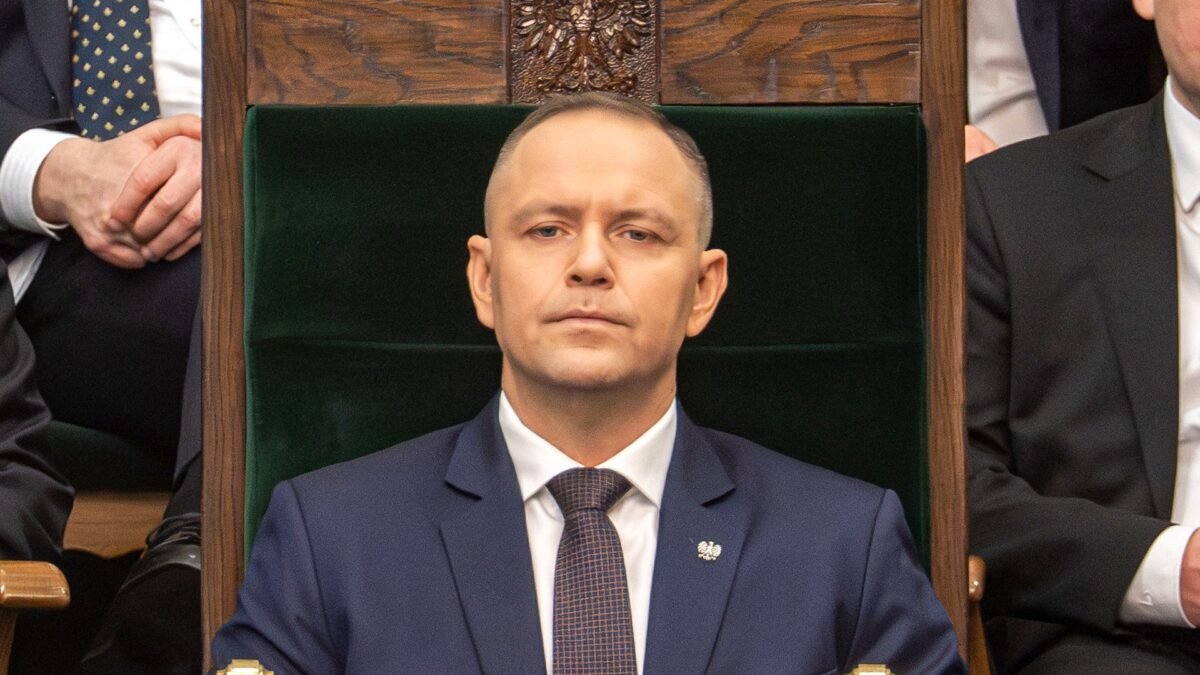
Polish President Turns Plane Around and Enters Constitutional Tribunal as Rival Judges Claim Control of Top Court
Poland woke on Saturday to a constitutional crisis that had stopped being a legal argument and become a physical contest over a single building in Warsaw. Overnight, President Karol Nawrocki cut short an official trip to Senegal, ordered his aircraft to turn back mid-flight, and pushed his way into the Constitutional Tribunal after rival judges announced the suspension of the court’s president and deputy — leaving the country’s highest court with two competing leaderships, riot police on its grounds, and a president demanding that government security forces leave.
According to Reuters, Mr Nawrocki turned his plane around on Friday after police entered the premises of the Constitutional Tribunal and its president was suspended. “At a moment like this, the President must be in Poland. I am cutting short my flight to Senegal. I am returning,” he wrote on X, according to Reuters and CNN.
The confrontation, which unfolded across Friday evening and the early hours of Saturday, is the sharpest escalation yet in a decade-long struggle over who controls Poland’s top court — a dispute that has already drawn in the European Union’s courts, paralysed the tribunal for months, and now pits the country’s president directly against its prime minister.
By Saturday morning, the tribunal had, in effect, two leaderships. One camp, led by Judge Anna Korwin-Piotrowska, says the court’s president, Bogdan Święczkowski, and his deputy, Bartłomiej Sochański, have been suspended for a month and that she is temporarily in charge. The other camp — the tribunal’s existing leadership — insists both men remain lawfully in office, says its website was seized, and has accused those behind the suspension of attempting a coup d’état.
Neither side has conceded. And with the president now convening urgent consultations with parliamentary parties, the crisis is set to dominate Polish politics in the days ahead.
How the night unfolded
The crisis broke on Friday evening, 30 October. At around 6 p.m. local time, a notice appeared on the Constitutional Tribunal’s website announcing that Mr Święczkowski and Mr Sochański had been suspended from their duties for one month, according to CNN and Reuters. Judge Korwin-Piotrowska, one of the judges elected by the current parliamentary majority, said she had issued the order and would temporarily lead the court.
Judge Korwin-Piotrowska told the state broadcaster TVP that she had acted because Mr Święczkowski was breaching the rules governing how the tribunal operates, and that she had no other choice, according to reports summarised by several outlets. She has also said, in a statement quoted by the Anadolu news agency, that a democratic state “cannot function without a constitutional court.”
The tribunal’s existing leadership rejected the move within hours. Its official account on X said the court’s website had been hacked, that both men remained in office, and that anyone taking part in the actions was committing a coup. The Polish news agency PAP reported that both men’s names had disappeared from the tribunal’s website before it went offline.
Police moved quickly. Warsaw police said officers were on the tribunal’s grounds between 5 p.m. and 6 p.m. after a notification from Judge Korwin-Piotrowska warning of possible threats to the life or health of the court’s judges and staff and a risk of public disorder, according to Polish media reports. Riot police were deployed around the building, and supporters of the opposition Law and Justice party (PiS) gathered outside to protest.
According to Reuters, police said officers entered the premises of the tribunal after incidents outside the court, including the throwing of dangerous objects at officers. CNN reported that police detained three people after some protesters breached the court’s fence and others threw objects at officers. The Guardian also reported three arrests, describing those detained as having tried to force their way through the heavy police presence.
Mr Nawrocki was already in the air when the news broke. He had been travelling to Senegal for the Summer Youth Olympic Games, according to the BBC, and reports said his aircraft turned back over Spain before landing in Warsaw. His chief of staff, Paweł Szefernaker, said the president would meet Zbigniew Kapiński, the first president of Poland’s Supreme Court, immediately after landing.
Shortly before 1 a.m. on Saturday, Mr Nawrocki arrived at the tribunal. Video footage showed him pushing past people in the doorway — among them Judge Korwin-Piotrowska and judges Krystian Markiewicz and Maciej Berek — as he tried to enter the building, according to multiple reports. He told them: “You are not judges of the Constitutional Tribunal.”
The president remained inside the building for several hours. The Guardian reported that he was still inside at 4 a.m. local time. Photographs posted by his spokesman after 2 a.m. showed Mr Nawrocki inside the tribunal with Mr Kapiński, his chief of staff Zbigniew Bogucki, the head of his security bureau Bartosz Grodecki, and Mr Sochański — the vice-president Judge Korwin-Piotrowska says is suspended.
According to PAP, Mr Nawrocki left the building before 5 a.m., after consultations with the Supreme Court president. Judge Maciej Taborowski told PAP that judges remained inside after the president’s departure.
At about 5 a.m., a presidential statement was read to demonstrators outside the court by Mr Szefernaker. “Tonight there was a violation of the constitutional order of the Republic of Poland and a forcible takeover of a constitutional body of the state,” the statement said. Mr Nawrocki called for the restoration of legal order and for “the coercive forces sent to the site by the government to leave the Tribunal premises.”
The statement added that Mr Kapiński “also does not recognize as legal the actions taken by persons usurping power in the Constitutional Tribunal.” Citing a threat to the internal security of Poland, Mr Nawrocki said he was convening urgent consultations with representatives of parliamentary forces “in order to stabilize the political situation and restore constitutional order.” He also said he had enabled Mr Sochański, whom he regards as the lawfully serving vice-president, to enter the building.
The prosecution move
Running alongside the standoff over the tribunal’s leadership is a criminal process against its two suspended leaders. Justice Minister Waldemar Żurek, who is also attorney general, told reporters he had asked for the immunity of Mr Święczkowski and Mr Sochański to be lifted so they could face criminal charges, according to the BBC and Al Jazeera.
Mr Żurek’s accusation is that the two judges failed in their duties by preventing other judges from working. According to Türkiye Today, he filed five applications to lift their immunity — four concerning Mr Święczkowski and one concerning Mr Sochański. Al Jazeera reported that over the past six months Mr Święczkowski had used his authority as head of the court to keep judges chosen by the current parliamentary majority from taking up their seats, a dispute that has effectively paralysed the court.
Mr Żurek also criticised Mr Nawrocki’s actions inside the tribunal and urged prosecutors to investigate the incident, according to reports. Maciej Berek, a legal adviser to the Tusk government whose own nomination to the tribunal the president had vetoed, posted footage claiming Mr Nawrocki had physically assaulted Judge Korwin-Piotrowska and other judges. That claim has not been independently verified, and the presidential side has said the occupants of the building obstructed the president’s entry and violated his inviolability. Video verified by multiple outlets shows the president pushing past people in the doorway; accounts of exactly what happened at the door differ depending on which side is telling the story.
The court’s spokeswoman, Weronika Ścibor, told the broadcaster Kanał Zero that seven people elected as tribunal judges this year had been escorted inside the building by officers of the State Protection Service, according to reports.
Two camps, two stories
Prime Minister Donald Tusk defended the suspension on Friday evening. “Restoring the rule of law is our obligation,” he wrote on X. “After years of lawlessness under PiS this is a difficult process, sometimes painful and it requires decisive action. There is no other way,” he said, according to CNN.
Mr Tusk, whose pro-European government came to power in December 2023 promising to restore the independence of the judiciary, has long argued that the tribunal was captured by the previous nationalist government. His government has refused to recognise the tribunal since taking office and has stopped publishing its decisions.
From the other side, the language was just as uncompromising. Former justice minister Zbigniew Ziobro called the suspension “a blatant, criminal attack on the constitutional order” and appealed for “resistance that will be loud, firm, solidary and fearless,” according to CNN. Jarosław Kaczyński, the leader of PiS, led protests outside the building and called the suspension a coup.
Lawyer Marcin Matczak, a long-time critic of the PiS-era judicial changes who has described Mr Święczkowski as the court’s worst president, told the BBC that the suspension had no legal basis and warned that images of armed police would damage the cause of the rule of law for years. His intervention matters because it shows the unease extends beyond the tribunal’s defenders: even critics of the old court question whether the government’s method was lawful.
That split — between those who see Friday’s events as the restoration of the rule of law and those who see them as its violation — is now the central fault line in Polish politics, and both sides are using the language of constitutional emergency.
A decade-long fight over one court
To understand why a dispute over judicial appointments produced riot police, a president turning his plane around and a head of state forcing his way into a court building, it is necessary to go back to 2015.
That year, a PiS-led government took office and moved quickly to appoint judges to the Constitutional Tribunal, the body that rules on whether laws comply with Poland’s constitution. Its 15 judges are elected by parliament for nine-year terms, and its rulings are binding on all state bodies. Control of its bench is therefore politically significant: it decides the fate of legislation.
Critics in Poland and the European Union accused PiS, which led the country between 2015 and 2023, of imposing political control over key judicial institutions, including the tribunal. The PiS reforms led the EU to impose fines on Poland, according to CNN, and the European Court of Human Rights and the Court of Justice of the European Union later found that three of the judges had been chosen improperly because they occupied positions already validly filled by the previous parliament.
In December 2025, the Court of Justice of the European Union ruled that the irregular appointments of three judges and the tribunal’s president undermined the court’s independence under EU law, according to the BBC. The Tusk government has used those rulings as grounds to stop publishing the tribunal’s decisions.
The immediate trigger for Friday’s crisis was the appointment of new judges. Parliament has elected new tribunal judges this year, and Mr Nawrocki — a PiS-backed conservative who narrowly won the presidency in 2025 — has refused to swear in several of them, questioning how they were selected or whether they were qualified. Reuters reported that earlier this year Mr Nawrocki refused to swear in three of six judges nominated by parliament, while Mr Święczkowski declined to allow judges elected by the current parliamentary majority to assume their duties. Reports differ on the precise numbers: the BBC said five judges elected since March had not been sworn in, while Al Jazeera said three of six nominated since his election.
Under the 2016 law on tribunal judges, newly elected judges take an oath before the president, and the tribunal itself ruled in 2015 that administering the oath is the president’s statutory duty. The judges Mr Nawrocki refused to swear in took their oaths instead at a ceremony in parliament. On 6 May, the European Court of Human Rights ordered the tribunal to accept four of those judges; Mr Święczkowski said Strasbourg had no such authority.
The Council of Europe’s advisory body on constitutional matters, the Venice Commission, said earlier this month that Mr Nawrocki should swear in the judges so they can sit on the bench, according to the BBC.
Mr Tusk’s efforts to overhaul the judiciary have repeatedly been blocked by presidential veto — first by Mr Nawrocki’s predecessor, Andrzej Duda, and now by Mr Nawrocki himself, according to CNN. That veto power is one reason the government has resorted to more direct methods, and one reason the confrontation has now spilled out of parliament and into the tribunal’s corridors.
Mr Nawrocki’s opponents note that he has himself been accused by the government of defying the law, with Justice Minister Żurek warning that the president’s refusal to swear in judges could bring him before the State Tribunal. His supporters reply that the president is the guarantor of constitutional continuity and that the judges behind Friday’s suspension were never lawfully appointed in the first place.
Analysis: Why It Matters
1. A court that cannot function cannot settle the argument
The most immediate consequence of Friday night is practical. The Constitutional Tribunal is the final arbiter of whether Polish laws comply with the constitution. With two rival leaderships, each denying the other’s legitimacy, and with the court’s president facing a bid to strip his immunity, the tribunal cannot credibly perform that role. Every future dispute over legislation — and Poland, like every democracy, produces a constant stream of them — will now be shadowed by the question of which tribunal, if any, has the authority to decide it. A constitutional court that cannot function is not merely a political embarrassment; it removes the referee from the political game at the very moment the game is at its most heated.
2. Both sides now claim the language of the rule of law
What makes this crisis so difficult to resolve is that both camps are using the same vocabulary. Mr Tusk says restoring the rule of law is his government’s obligation. Mr Nawrocki says the constitutional order has been violated and a constitutional body seized by force. The tribunal’s old leadership calls the suspension a coup d’état; the judges behind it say they acted to restore the rule of law. This is not a dispute in which one side openly rejects legality — it is a dispute in which each side accuses the other of lawlessness, and each can point to a court ruling, a legal opinion or a constitutional provision in its favour. When the language of the rule of law is claimed by both sides at once, the argument can no longer be settled by invoking the law; it has to be settled politically, and that is a much harder and more dangerous process.
3. The president has made himself a party to the dispute
Presidents are supposed to stand above the fray. By turning his plane around, entering the tribunal building in the middle of the night, telling judges to their faces that they are not judges, and then convening crisis consultations, Mr Nawrocki has placed himself at the centre of the confrontation. That may strengthen his standing with his supporters, who see a president defending the constitution in person, but it also means the presidency itself is now a party to the dispute rather than a potential mediator of it. If the consultations he has called fail, there is no higher domestic authority left to appeal to — short of the courts themselves, which are the subject of the dispute.
4. Brussels is watching, and the stakes are European
Poland’s judicial dispute has been a European issue since 2015, drawing fines from the EU and rulings from the European Court of Human Rights and the Court of Justice of the European Union. Friday’s events will be read in Brussels as a test of whether the Tusk government’s approach to restoring judicial independence is itself compatible with the rule of law. The images of riot police around a constitutional court — and of a president forcing his way past judges — will alarm European partners whatever their view of the underlying appointments dispute. The European Commission has spent years pressing Poland on judicial independence; it now faces the awkward question of what to say when the government it supported uses methods that its own critics describe as unlawful. How Brussels responds will shape not only Poland’s standing in the EU but also the credibility of the EU’s rule-of-law policy across the bloc.
5. The crisis points towards an early election — or a long stalemate
Poland’s next parliamentary elections are due in 2027, but some observers already see Friday’s events as a step towards an earlier vote as a way of resolving a deadlock that the institutions can no longer settle. The alternative is a long stalemate: a government that refuses to recognise the tribunal, a president who vetoes its reforms, and a court that cannot sit. That stalemate would leave Poland without a functioning constitutional arbiter for months or years, with each side governing around the other. The consultations Mr Nawrocki has convened are the first test of whether a political way out exists. If the parliamentary parties cannot agree on one, the crisis will either escalate further or settle into a frozen conflict — and a frozen conflict over the constitution is, in the end, a crisis that never quite ends.
What to Watch Next
- The president’s consultations: Mr Nawrocki has convened urgent talks with representatives of parliamentary forces, citing a threat to internal security. Whether the governing coalition attends, and what — if anything — the talks produce, will be the first signal of whether a political settlement is possible.
- Who actually controls the tribunal building: Judges remained inside the building after the president left before 5 a.m. Who gives orders there on Monday morning — Judge Korwin-Piotrowska or Mr Święczkowski — will show which leadership holds the institution in practice.
- The immunity proceedings: Justice Minister Żurek has asked for the immunity of Mr Święczkowski and Mr Sochański to be lifted so they can face criminal charges. The progress of those applications will determine whether the dispute moves from the political arena into the criminal courts.
- The investigation into the president’s entry: Mr Żurek has urged prosecutors to investigate Mr Nawrocki’s actions inside the tribunal, while the presidential side says those who obstructed his entry violated his inviolability. A criminal investigation of a sitting president would be an extraordinary escalation.
- Brussels’ response: The European Commission and the Council of Europe’s Venice Commission have both weighed in on the appointments dispute before. Their reaction to Friday’s events — and any new infringement proceedings or rulings — will shape how the crisis is understood beyond Poland’s borders.
Sources
- CNN — Polish president turns plane around to return home as court chief’s suspension sparks protest
- Reuters — Polish president turns back from Senegal trip as top court chief suspended
- Nawrocki says ‘forcible takeover’ of Poland’s Constitutional Tribunal, calls crisis talks
- Poland’s Government Moves to Prosecute Top Judges as Police Guard Court (BBC and Al Jazeera reporting)
- Interbellum News — Poland’s Constitutional Tribunal Faces Leadership Crisis

About the Author — Abdul Mannan
Related Articles

US and Russia Veto Each Other’s Western Sahara Plans as UN Mission MINURSO Loses Its Mandate
Russia vetoed a US plan to reshape the Western Sahara mission and Washington vetoed Moscow's rival text, leaving…
US Approves $2.1 Billion Sale of 500 Patriot Missiles to Ukraine — but Kyiv May Wait Years for Delivery
The US State Department has approved a possible $2.1 billion sale of 500 Patriot PAC-3 MSE interceptors to…

Tens of Thousands March Across Italy in Nationwide Strike Against Cost of Living and Military Spending
Tens of thousands of Italians marched in more than 40 cities on Friday in a nationwide general strike…