
ISRO’s GSLV-F18 Puts NVS-03 Navigation Satellite in Orbit, Restoring India’s NavIC to Four Satellites

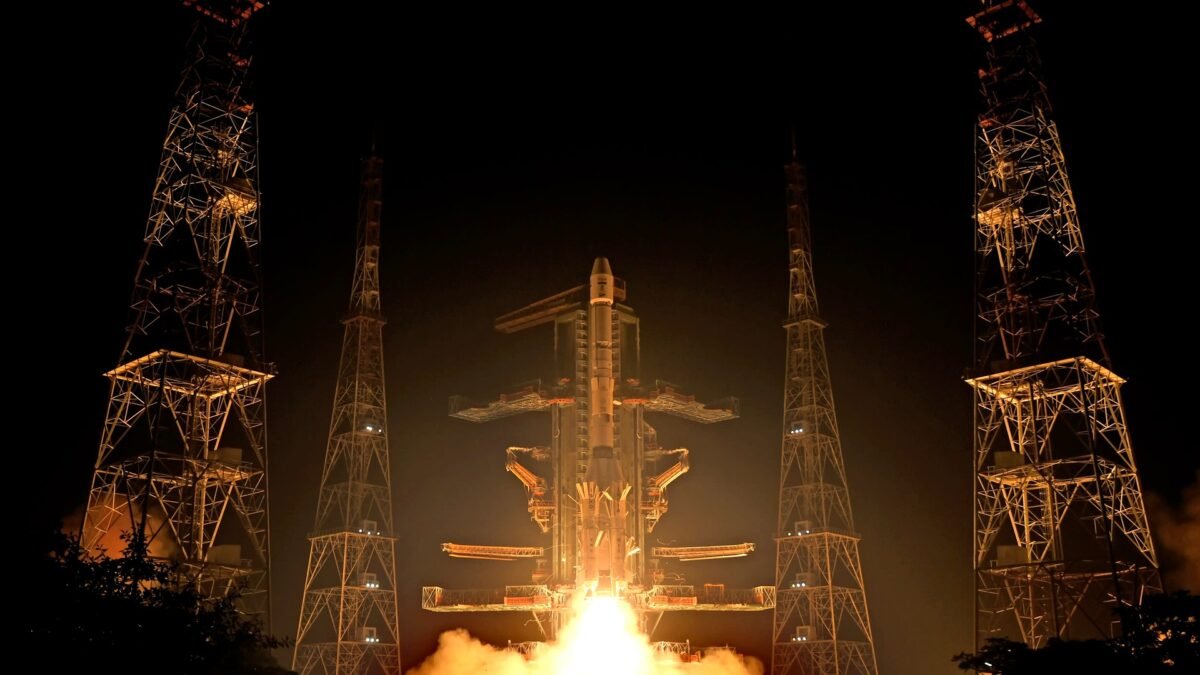
India’s space agency has put a new navigation satellite into orbit, restoring the country’s home-grown satellite navigation system to the minimum strength it needs to tell users where they are. The Indian Space Research Organisation (ISRO) said its GSLV-F18 rocket lifted off from the Satish Dhawan Space Centre at Sriharikota at 11:51 p.m. local time on Friday, 30 October, carrying the NVS-03 satellite, and placed it in its intended transfer orbit about eighteen minutes later.
“Mission Success! GSLV-F18 has successfully placed NVS-03 in the intended orbit,” ISRO announced on X at 12:23 a.m. on Saturday, about half an hour after liftoff, according to The Hindu BusinessLine. The satellite’s solar panels deployed shortly after it separated from the rocket, and ground stations established contact with it, according to FoneArena’s mission report. Over the next few days, NVS-03 will fire its own engine in a series of manoeuvres to climb from the elongated transfer orbit into its final circular orbit high above the equator.
The launch was the twentieth flight of the Geosynchronous Satellite Launch Vehicle (GSLV), the three-stage rocket that carries India’s heaviest satellites into high orbits, and it came just 56 days after the previous GSLV mission — the shortest gap between two GSLV launches in the rocket’s history, according to ISRO Chairman V. Narayanan. Speaking after the launch, Narayanan said the GSLV had now carried about 30 tonnes of spacecraft into orbit over its career, and he described the injection of NVS-03 as exceptionally precise. The rocket put the satellite into an orbit with a perigee, its closest point to Earth, of 170.3 kilometres and an apogee, its farthest point, of 38,080 kilometres, at an inclination of about 20.75 degrees — closely matching the planned figures, according to FoneArena.
Prime Minister Narendra Modi congratulated ISRO’s scientists and engineers on Saturday. “Congratulations to our scientists and engineers at ISRO on the successful launch of GSLV-F18 carrying NVS-03,” he wrote on X. “This mission marks an important step in strengthening NavIC, our indigenous satellite navigation system. Equipped with enhanced capabilities, NVS-03 will further our pursuit of self-reliance in critical technologies and support navigation services that benefit our people. The dedication and ingenuity of our space scientists continue to make our nation proud.”
NVS-03 is the third satellite in the second generation of India’s Navigation with Indian Constellation (NavIC) system, the country’s independent alternative to the American GPS. Built on ISRO’s I-2K satellite bus and weighing about 2,250 kilograms, it carries an indigenous rubidium atomic clock developed in India alongside procured space-grade clocks, and it adds a civilian L1 navigation signal to the L5 and S-band signals the system already broadcasts, according to FoneArena. The L1 band, at 1575.42 MHz, is the same frequency used by GPS and Europe’s Galileo system, which means ordinary consumer positioning chips can pick up NavIC signals more easily. The satellite is designed to provide position, navigation and timing services across India and a region extending about 1,500 kilometres beyond the country’s borders.
The mission mattered more than most routine launches because NavIC had slipped below the strength it needs to work at all. A satellite navigation system needs at least four satellites in view to fix a position in three dimensions plus time, and NavIC had been left with only three working satellites. The Indian government told Parliament on 29 July that the constellation could no longer provide a standalone positioning service, though its timing service continued to work, and it named the three satellites still broadcasting navigation signals: IRNSS-1B, IRNSS-1I and NVS-01, according to Orbinauts. The shortfall followed the failure of the atomic clock aboard IRNSS-1F on 13 March, just three days after that satellite completed its ten-year design life. Narayanan said after the launch that NVS-03 had restored the constellation to its minimum operational configuration of four satellites.
That restoration was not guaranteed. The previous satellite in the series, NVS-02, was launched on 29 January 2025 aboard GSLV-F15 — ISRO’s hundredth launch — and reached its transfer orbit without trouble, but it never climbed to its final orbit. An investigation by an ISRO Apex Committee found that the oxidiser could not flow to the satellite’s liquid apogee motor because the electrical signal that should have opened a pyro valve never reached it. The committee concluded that at least one contact had come apart in both the main and the backup electrical paths of a connector, so the engine could not fire even though the satellite carried redundant systems, according to The CSR Journal and India Strategic. NVS-02 remains stranded in its transfer orbit.
For NVS-03, ISRO took an unusual step to make sure the same failure could not happen again. Senior officials confirmed before the launch that the satellite’s pyro valves would be opened before liftoff — a departure from standard procedure and, according to The CSR Journal, a first in ISRO’s 51-year history of satellite launches. Pyro valves are single-use devices that open a sealed passage by pyrotechnic action and cannot be closed again, so opening them on the ground removed the need for the critical post-launch command that failed on NVS-02. The same corrective measures were applied to the CMS-03 communications satellite, launched on 2 November 2025, which reached its intended orbit, according to Orbinauts. The successful injection of NVS-03 suggests the fix has now worked on a navigation satellite as well, though the satellite still has to complete its orbit-raising manoeuvres before it can be declared fully operational — the same stage at which NVS-02 was lost.
A system born of a wartime lesson
NavIC’s origins lie in a lesson India learned during the Kargil conflict of 1999, when it found that access to the United States-controlled GPS could not be taken for granted in wartime. The government approved an indigenous regional navigation system in 2006, and ISRO launched the first satellite of the Indian Regional Navigation Satellite System (IRNSS) in July 2013. Seven first-generation satellites followed on Polar Satellite Launch Vehicle rockets between 2013 and 2018 — an eighth, IRNSS-1H, was lost in a failed launch in August 2017 — and the system was declared operational in 2018. It was renamed NavIC, short for Navigation with Indian Constellation, in 2016.
The first-generation satellites are now ageing, and some have already failed. IRNSS-1A, the first of the series, suffered failures of its imported atomic clocks, which pushed ISRO to develop a home-grown rubidium clock — the technology now flying on NVS-03. The second-generation NVS series, five satellites numbered NVS-01 to NVS-05, is meant to replace and reinforce the old constellation while adding the L1 signal and the indigenous clock. NVS-01, the first of the series, was launched aboard GSLV-F12 on 29 May 2023. NVS-04 and NVS-05 are in advanced stages of development, according to Mirror Now.
NavIC is a regional system by design, not a global one. Where GPS, Russia’s GLONASS, Europe’s Galileo and China’s BeiDou circle the whole planet, NavIC is built to serve India and the surrounding region, with an extended service area stretching from 30 degrees south to 50 degrees north and from 30 to 130 degrees east, according to Orbinauts. That narrower ambition is also its point: a system India controls outright, for both civilian use and strategic purposes. Narayanan described the constellation after the launch as a strategic asset giving India independent access to position, navigation and timing, and he noted civilian uses such as vehicle tracking and the government’s “one nation, one time” project, which aims to give the whole country a single synchronised time standard, according to The Hindu BusinessLine.
The rocket that carried it
GSLV-F18 is the latest flight of a rocket that has been central to India’s ambitions in high orbit. The vehicle stands about 50 metres tall, with a gross lift-off mass of roughly 420 tonnes, according to FoneArena. Its first stage is a solid-fuel core booster, the S139, carrying 138.2 tonnes of propellant, supplemented by four liquid strap-on boosters loaded with 170.6 tonnes of hypergolic propellant. The second stage is powered by the Vikas liquid engine, and the third is the indigenous CUS15 cryogenic upper stage, driven by the CE-7.5 engine burning super-cooled liquid oxygen and liquid hydrogen.
The cryogenic stage is the part of the story that took India longest to master. Cryogenic engines, which burn fuels stored at hundreds of degrees below zero, are the key to lifting heavy satellites into high orbits, and India spent years developing its own after being denied the technology from abroad. The GSLV’s record reflects that difficult history: of its twenty flights, fourteen have succeeded, four have failed and two have been partial failures, according to The Hindu BusinessLine. The 56-day turnaround between GSLV-F17, which launched the EOS-05 earth observation satellite on 4 September, and GSLV-F18 is the fastest the programme has ever managed, and Narayanan presented it as a sign of a launch operation that is becoming routine rather than exceptional.
By one count, GSLV-F18 was the 246th successful orbital launch in the world in 2026, the third from India and ISRO’s second of the year, according to The Space Road. The pace matters because ISRO’s manifest is crowded: alongside the NavIC replenishment, the agency is preparing the Gaganyaan human spaceflight programme, further lunar and planetary missions, and a growing commercial launch business.
Analysis: Why It Matters
1. Strategic autonomy is the point, not the payload
On its own, one navigation satellite is a modest event. What makes NVS-03 significant is what it restores: a system India owns outright. Every modern economy runs on satellite timing and positioning — power grids, banking networks, mobile phones, aircraft, missiles and farm equipment all depend on signals from space. A country that borrows those signals borrows them on someone else’s terms, and the terms can change. India learned that in 1999 and has spent two decades and billions of rupees making sure it never has to learn it again. NVS-03 does not make NavIC global, and it does not need to. It makes the system whole again inside the region India cares about, and that is the whole purpose of the programme. The Prime Minister’s emphasis on “self-reliance in critical technologies” was not decoration; it was the mission statement.
2. The fix that had to work
The most interesting decision in this mission was made on the ground, before the rocket ever left the pad. Opening a satellite’s pyro valves before launch is the kind of step engineers take only when the alternative has already bitten them, and NVS-02 had bitten hard. A connector contact came apart in both the main and the backup path — a failure of redundancy itself, the one thing a spacecraft is supposed to be able to rely on. ISRO’s response was pragmatic rather than elegant: remove the step that can fail instead of trying to make it fail-proof. It worked on CMS-03 last year and it has now worked on NVS-03, but the real test is still ahead. The satellite must climb to its final orbit over the coming days, and until it does, the lesson of NVS-02 — that reaching a transfer orbit and joining the service are two different things — will hang over the mission. A successful orbit-raising would close the book on one of the more embarrassing episodes in ISRO’s recent history; a failure would reopen it.
3. The L1 signal is a quiet revolution for users
Most people will never notice NVS-03, and that is the idea. The satellite’s new L1 signal broadcasts on the same frequency as GPS and Galileo, which means the positioning chips already inside ordinary smartphones can listen to NavIC without special hardware. Earlier NavIC signals, on the L5 and S bands, needed dedicated receivers, which is one reason the system has been slow to reach consumers despite being technically operational for years. If handset makers and app developers take up the L1 signal, NavIC could start appearing in the everyday lives of Indian users — in maps, in ride-hailing, in logistics and in the timing systems that keep banks and power grids in step — without anyone having to buy anything new. The “one nation, one time” project Narayanan mentioned points in the same direction: a single national time standard, kept by Indian satellites rather than borrowed from foreign ones.
4. A crowded sky, and a regional answer
NVS-03 arrives in a world where satellite navigation has become an arena of great-power competition. China’s BeiDou went global in 2020, Europe’s Galileo is complete, and GPS itself is being modernised. Each system is a statement that its owner does not intend to depend on anyone else for something as basic as knowing where things are. India’s answer is deliberately smaller — regional rather than global — but that modesty is also a kind of discipline. NavIC does not need to cover the oceans to serve India’s farmers, soldiers, pilots and power engineers. The question for the years ahead is whether that regional focus survives India’s growing ambitions: the country now talks of a global navigation system of its own, and the five-satellite NVS series is only the bridge to whatever comes next. For now, four working satellites are enough to restore the service. They are not enough to expand it.
5. The turnaround is the other story
It is easy to overlook the 56-day gap between the last two GSLV launches, but for a space programme it may be the most important number in this mission. Rockets are not supposed to be one-off feats; they are supposed to be a service, and a service is measured in cadence. ISRO has historically launched a handful of times a year. A two-month turnaround on its heaviest operational rocket — and the chairman’s evident pride in it — suggests an organisation trying to become a production line rather than a laboratory. That matters commercially as well as strategically: the global launch market rewards reliability and tempo, and India wants a share of it. If the GSLV can fly every two months, the NavIC replenishment, the Gaganyaan test flights and the commercial manifest all become easier to schedule. If it cannot, the 56 days will be remembered as a record, not a routine.
What to Watch Next
- Orbit-raising: NVS-03 must climb from its transfer orbit to its final geostationary slot over the coming days. ISRO’s announcements on the manoeuvres, and the satellite’s health checks afterwards, will determine whether the mission is a full success.
- Return to service: Once in its slot, the satellite must be tested and commissioned before NavIC can again offer standalone positioning. Watch for ISRO’s confirmation that the constellation is back to four working satellites and that positioning services have resumed.
- The L1 signal in phones: Whether handset makers enable NavIC’s L1 signal in devices sold in India will decide whether the system reaches ordinary users or remains a specialist and strategic tool.
- NVS-04 and NVS-05: Two more second-generation satellites are in development. Their launch dates will show whether the replenishment keeps pace with the ageing first-generation fleet.
- GSLV cadence: Whether ISRO can repeat a roughly two-month turnaround on its next GSLV flight will show whether the 56-day gap was a milestone on the way to routine operations or a one-off.
Sources
- Indian Space Research Organisation — GSLV-F18/NVS-03 mission gallery (primary source)
- The Hindu BusinessLine — ISRO successfully injects third NavIC satellite NVS-03 in GTO
- FoneArena — ISRO deploys GSLV-F18 with NVS-03 3rd Gen NavIC satellite
- NewKerala (IANS) — PM Modi congratulates ISRO scientists on successful GSLV-F18 launch carrying NVS-03
- The CSR Journal — ISRO’s NVS-03 launch strategy and the NVS-02 failure

About the Author — Abdul Mannan
Related Articles

Rubin Observatory Spots Possible Sixth Dwarf Planet Beyond Pluto in Largest Distant Find in 20 Years
Astronomers have found 2026 ED138, a large icy world orbiting beyond Pluto that could become the solar system's…

SLAC Team Confirms Altermagnetism, a Third Kind of Magnetism, in Manganese Telluride
Physicists led by SLAC have delivered conclusive experimental proof of altermagnetism, a third class of magnetism, by detecting…

Binance Says $6.3 Billion Breach Is the Largest Crypto Heist Ever as $3 Billion Is Frozen
Binance has put the impact of a security breach at about $6.3 billion, with about $3 billion frozen,…