
Rubin Observatory Spots Possible Sixth Dwarf Planet Beyond Pluto in Largest Distant Find in 20 Years

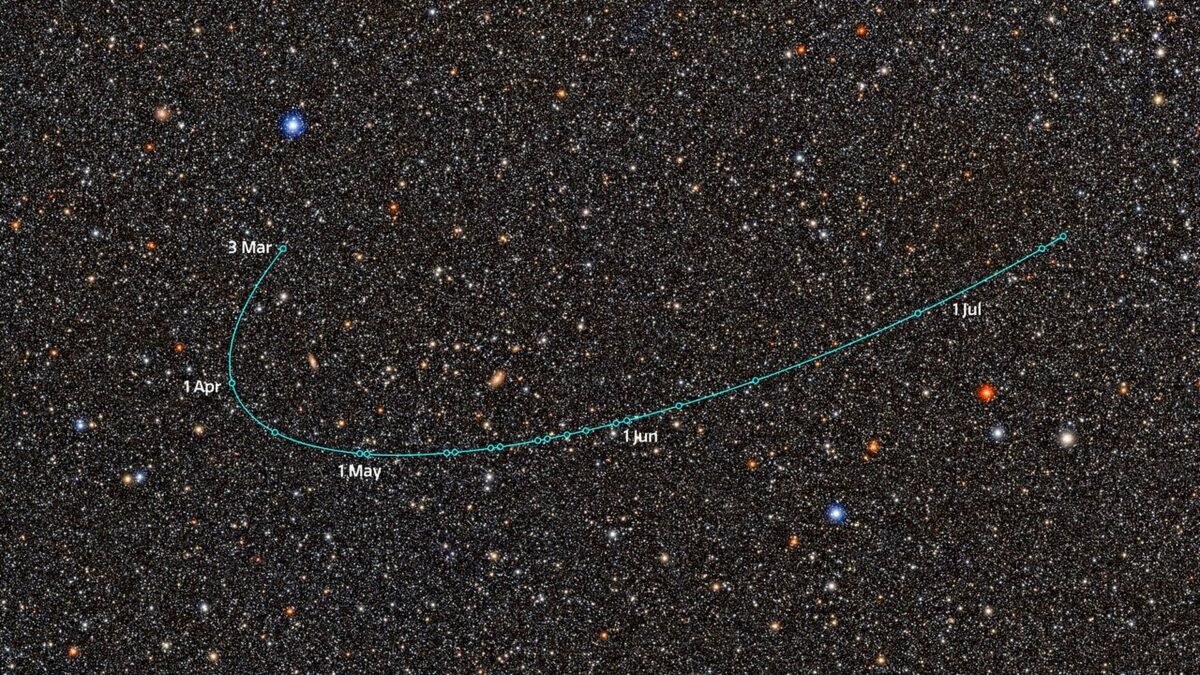
Astronomers have found a large, bright world orbiting the Sun far beyond Pluto, a discovery that could add a sixth member to the solar system’s small and exclusive family of dwarf planets. The object, provisionally named 2026 ED138, was spotted in data from the NSF–DOE Vera C. Rubin Observatory in Chile and announced by the International Astronomical Union’s Minor Planet Center on Tuesday 27 October 2026, according to the observatory.
The candidate world sits about 46 astronomical units from the Sun — 46 times the distance between the Earth and the Sun, and well beyond Pluto, whose average distance is about 40 astronomical units. Based on its brightness and distance, scientists estimate that it measures between 600 and 1,500 kilometres across, which would place it among the largest objects ever found in the outer solar system. If follow-up observations confirm its size and shape, it would join Pluto, Ceres, Eris, Haumea and Makemake as only the sixth dwarf planet formally recognised by the International Astronomical Union (IAU).
It is also, according to the University of Washington, the largest trans-Neptunian object found in about 20 years — and it was discovered before the observatory’s flagship ten-year survey had even properly begun. That timing is part of what makes the find so significant: the Rubin Observatory only switched on its 3,200-megapixel Legacy Survey of Space and Time (LSST) camera in June 2026, and the discovery was made in data gathered during the run-up to that survey.
A find so rare its discoverer first suspected a mistake
The discovery was made by Matthew Holman, a senior astrophysicist at the Center for Astrophysics at Harvard and Smithsonian and a member of the Rubin operations team, who works on the algorithms that search the observatory’s data for distant moving objects. On the evening of 13 October, Holman was running a search programme he had developed with colleague Kevin Napier through data Rubin had collected earlier in 2026. The code is designed to sift through billions of detections of moving objects, compare them, and identify the detections that belong to the same body.
What it returned was an object so bright, and so distant, that it was almost certainly unusually large. “My first reaction was one of excited disbelief,” Holman said, according to the Rubin Observatory. “Objects like this are very rare, so I immediately started checking whether I or the code had done something wrong.”
That instinct — to distrust a result precisely because it was exciting — is the discipline at the heart of observational astronomy, and it set off a rapid verification effort. Mario Jurić, a professor of astronomy at the University of Washington and Rubin’s solar system lead scientist, searched the observatory’s catalogues and images and found 20 more observations of the object, stretching back to 4 March 2026. In total, Rubin’s Simonyi Survey Telescope had observed ED138 thirty times on twenty nights between 4 March and 11 July 2026.
The team then looked further back still. Archival images taken by the Dark Energy Camera (DECam), mounted on the Víctor M. Blanco 4-metre Telescope at Cerro Tololo in Chile, and uncovered through the Asteroid Institute’s ADAM precovery service, showed the object as far back as 2016. National Geographic reported that it may also have been captured in images dating to 1954. Together, those records allowed the team to trace more than a decade of ED138’s orbit — enough to be certain it was a real, single object moving on a coherent path, and not an artefact of the data.
Once the checks were complete, the Minor Planet Center reviewed the work and formally announced the discovery in a Minor Planet Electronic Circular. Holman and Jurić presented the results at a press conference at the 58th annual meeting of the American Astronomical Society’s Division for Planetary Sciences in Spokane, Washington.
What the new world looks like — and why it stayed hidden
ED138 is a trans-Neptunian object, or TNO: a body that orbits the Sun at a greater distance than Neptune. More specifically, its orbit is tilted almost 25 degrees from the plane of the solar system, which classifies it as a “hot-classical” TNO — a body that was probably knocked out of its original orbit by gravitational encounters with Neptune long ago. Scientists suspect it formed billions of years ago much closer to the Sun, before Neptune’s gravity flung it outwards into the cold, dark region it now inhabits.
Its size is still uncertain, and that uncertainty is itself a story. The team estimates ED138 is between 600 and 1,500 kilometres across, based on its distance, its brightness and assumptions about how reflective its surface is. As The Register reported, if the lower figure proves correct, it would be the smallest dwarf planet yet observed. If the larger figure is right, it would be smaller than Pluto, Eris and Haumea, but larger than Makemake and Ceres. Either way, it would be a substantial world: at 1,500 kilometres, it would be wider than the distance from London to Rome.
Why did such a large object go undiscovered until now? The answer lies in where it was found. ED138 sits in a region of sky close to the plane of the Milky Way, a crowded field packed with millions of background stars. To most telescopes, the faint, slow-moving dot was lost among the glare of billions of stars. It took Rubin’s combination of a huge field of view, a giant camera and software capable of comparing billions of detections to pick it out of the crowd.
“Rubin Observatory’s regular and continuous monitoring of the entire Southern Hemisphere sky, combined with powerful algorithms that sift through millions to billions of points of light to identify those corresponding to small moving objects, enabled the team to spot ED138 within the crowded field,” the observatory said.
Why it is a candidate — and what confirmation requires
The word “candidate” matters. Under the IAU’s 2006 definition, a dwarf planet is an object in orbit around the Sun that is large enough for its own gravity to pull it into a nearly round shape, but has not cleared its orbit of other debris. The distinction between a dwarf planet and an ordinary trans-Neptunian object therefore turns on size and shape — and size is precisely what astronomers cannot yet pin down.
Icy bodies of ED138’s estimated size are expected to be round, which is why scientists are confident enough to call it a candidate. But confidence is not confirmation. Observations in the infrared are needed to measure its heat, and therefore its true size, more precisely. Only then can the IAU formally consider adding it to the list. “If confirmed as a dwarf planet, ED138 would join a very small family of worlds,” Holman said, according to the Rubin Observatory.
The process is deliberately slow, and deliberately conservative. The IAU currently recognises five dwarf planets: Ceres, in the main asteroid belt between Mars and Jupiter; and Pluto, Eris, Haumea and Makemake, all in the region beyond Neptune. Dozens of other objects are suspected of qualifying, but formal recognition requires evidence that an object is genuinely round — evidence that, for bodies billions of kilometres away, is extraordinarily hard to obtain.
A family with a complicated history
The dwarf planet category itself is barely twenty years old, and it was born in controversy. For most of the twentieth century, Pluto was counted as the solar system’s ninth planet. That changed in 2005, when astronomers discovered Eris, a world beyond Neptune that appeared to be roughly Pluto’s size. If Eris was a planet, then so, logically, were dozens of other icy bodies — and the tidy nine-planet solar system would dissolve into a crowd.
In 2006, the IAU resolved the question by redefining what a planet is. A planet, it decided, must orbit the Sun, be round under its own gravity, and have cleared its neighbourhood of other objects. Pluto and Eris met the first two tests but failed the third: they share their orbits with many other icy bodies in the Kuiper Belt, the donut-shaped ring of frozen debris beyond Neptune. Both were reclassified as dwarf planets, along with Ceres — which had itself been demoted from planet to asteroid in the nineteenth century — and later Haumea and Makemake.
The decision remains one of the most argued-over in modern astronomy. But whatever the merits of the 2006 vote, it gave astronomers a precise, testable framework — and ED138 is now the most significant test of that framework in two decades.
The Kuiper Belt, where ED138 lives, is more than a graveyard of icy leftovers. It is a fossil record of the solar system’s formation. Scientists study the size, composition and orbits of trans-Neptunian objects to understand how the solar system formed, how the giant planets migrated over time, and how smaller bodies were scattered during that evolution. Each new large object is another data point in that story — and a large object on a tilted, disturbed orbit is a particularly valuable one, because its orbit carries the fingerprints of the gravitational encounters that shaped it.
The telescope that found it
The Vera C. Rubin Observatory, perched on Cerro Pachón in Chile, is jointly funded by the United States National Science Foundation and the Department of Energy’s Office of Science, and operated by NSF NOIRLab and SLAC National Accelerator Laboratory. It is named after the astronomer Vera Rubin, whose work provided the first convincing evidence for dark matter.
Its instrument is the largest camera ever built: a 3,200-megapixel device that photographs the entire southern sky, again and again, for ten years, as part of the Legacy Survey of Space and Time. The result will be an ultra-wide, ultra-high-definition time-lapse record of the universe — a dataset so large that human eyes alone could never search it. That is why the software matters as much as the optics: Holman and Napier’s code exists to find the handful of moving dots among billions of detections.
“Rubin Observatory’s super power is the ability to clearly capture movement and change among a vast number of objects and phenomena that humans have never seen before,” said Edward Ajhar, the NSF’s programme director for Rubin, according to the observatory. “That power greatly extends our ability to reveal and understand new things about our Solar System, the Milky Way, and billions of other galaxies across the Universe.”
The scale of what Rubin can do was already clear before the main survey began. In April 2026, before the LSST formally started, the Rubin solar system team submitted observations of more than 11,000 new asteroids to the Minor Planet Center — including roughly 380 new trans-Neptunian objects. At the time, the team called that haul “the tip of the iceberg”. With ED138, that prediction is coming true.
“Rubin is giving us an unprecedented capacity to explore the sky through a combination of speed, depth, and precision,” Jurić said, according to the observatory. “And the discovery is just the beginning: once we identify a new object, we can search back months, and sometimes even decades, finding it in images where nobody knew to look. This ability to both discover and ‘precover’ objects is transforming how quickly and accurately we can determine their orbits and understand the distant Solar System.”
Analysis: Why It Matters
1. The outer solar system is still largely unmapped — and Rubin is about to change that
The most striking fact about ED138 is not its size, but the fact that it was missed for so long. This is a world up to 1,500 kilometres across, among the largest and brightest bodies in its region, and it sat undiscovered until 2026 — not because telescopes were too weak, but because nobody had systematically looked in the right way, in the right place. The Milky Way’s crowded star fields were, in effect, a blind spot in the sky, and ED138 was hiding in plain sight inside it.
That should change how we think about what remains to be found. If a world this big could hide for this long, the outer solar system is almost certainly holding more. Rubin’s ten-year survey will photograph the southern sky hundreds of times over, and every pass is another chance to catch something moving. ED138 is the first dwarf planet candidate of the Rubin era; the honest expectation, given the 11,000 asteroids and 380 trans-Neptunian objects already logged before the survey even began, is that it will not be the last. The map of our own cosmic backyard is about to be redrawn, and this discovery is the first new landmark on it.
2. Software is now as important as the telescope
Holman’s first reaction — checking whether he or the code had made a mistake — captures a quiet revolution in astronomy. The Rubin Observatory does not produce a handful of images for astronomers to pore over; it produces billions of detections, a firehose of data no human could ever read. The discovery of ED138 was made by an algorithm, not an eyeball at an eyepiece. The code compared billions of points of light, linked the ones that belonged to the same moving object, and flagged a result so rare that its author distrusted it.
This is the new shape of discovery. The telescope gathers the light; the software does the finding. And the verification, too, is increasingly computational: Jurić’s search through Rubin’s catalogues, and the Asteroid Institute’s precovery service trawling archival images back to 2016, are both exercises in data archaeology — finding an object in photographs taken years before anyone knew it existed. The lesson for science funding is blunt: a telescope without its software is an expensive camera. The billions spent on Rubin only pay off because of the code written by people like Holman and Napier, and the institutions that fund the next generation of observatories would do well to fund the algorithms with the same seriousness as the mirrors.
3. The “candidate” label is a strength, not a weakness
It is tempting to read the word “candidate” as a hedge, and to wish astronomers would simply declare ED138 a dwarf planet and be done with it. That would be a mistake. The caution is the point. The IAU’s dwarf planet list is small precisely because the bar for entry is high: roundness must be demonstrated, not assumed. A premature announcement would invite exactly the kind of confusion that followed the 2006 Pluto decision, when a rushed vote left the public arguing about a definition for years.
The careful path — candidate first, infrared observations next, formal recognition only when the evidence is in — protects the credibility of the classification. It also protects the public’s understanding: when ED138 is confirmed, or if it is not, the announcement will rest on measurement rather than enthusiasm. In an era when scientific claims travel faster than the evidence behind them, astronomy’s willingness to say “we think so, and here is what would prove it” is worth defending.
4. A tilted orbit is a history book
ED138’s orbit, tilted almost 25 degrees from the plane of the solar system, is more than a curiosity. It is evidence of violence in the solar system’s past. The leading picture of the outer solar system’s history holds that the giant planets did not form where they now sit: Neptune migrated outwards, and as it moved, its gravity scattered the icy bodies around it, flinging some into wide, tilted orbits and ejecting others entirely. A large world on a strongly tilted orbit is a survivor of that upheaval — and its orbit preserves information about how far Neptune travelled and how chaotic the migration was.
Each such object is a clue, and clues are scarce. The more large, tilted trans-Neptunian objects astronomers can catalogue, the more tightly they can constrain the models of planetary migration. ED138 is one data point; but in a field where the largest objects number in the single digits, one data point carries real weight. The analysis of its orbit, combined with the hundreds of smaller trans-Neptunian objects Rubin is already finding, will sharpen our picture of how the solar system was assembled — and, by extension, how common such rearrangements might be around other stars.
5. The discovery belongs to everyone — and that is a policy choice
There is a detail in the Rubin announcement that deserves more attention than it has received: the public can explore ED138’s orbit in three dimensions, in real time, through an interactive web application called Orbitviewer, and the images of the object are available to data rights holders through the Rubin Science Platform. A decade ago, a discovery like this would have reached the public as a press release and a single image. Today, anyone with an internet connection can fly around the new world’s orbit.
That openness is not an accident. Rubin is publicly funded — by the NSF and the Department of Energy — and its data policy reflects that. The ten-year survey will eventually make its data broadly available, and the tools built around it are designed for public engagement as well as professional research. In a year when science budgets are under pressure in many countries, ED138 is a timely reminder of what public investment in basic research buys: not just a new entry in a catalogue, but a moment in which millions of people can look at a world nobody had ever seen before, and understand, in a concrete way, that the solar system still has secrets left.
What to Watch Next
- Infrared observations to settle the size: The most important next step is measuring ED138’s heat output in the infrared, which will pin down its diameter and confirm whether its gravity has pulled it into a round shape. Watch for observing time on infrared-capable telescopes and for the resulting size estimate — a figure near the top of the 600–1,500 kilometre range would strengthen the case considerably.
- The IAU’s formal decision: If the infrared data confirm a round shape, the case will go to the International Astronomical Union, which alone can add a sixth name to the official dwarf planet list. The process is methodical and could take months or longer; any announcement of formal recognition would be the real milestone.
- A permanent name: ED138 is a provisional designation, derived from the date of its discovery. If it is confirmed, it will receive a permanent number and, eventually, a name — traditionally drawn from mythology, as Pluto, Eris, Haumea and Makemake were. The naming process itself will be a story worth following.
- More Rubin discoveries: With the ten-year Legacy Survey of Space and Time now under way, and 11,000 asteroids already found before it began, further large trans-Neptunian objects are likely. Watch for the Rubin team’s next announcements — particularly any object larger than ED138, or one on an even more unusual orbit.
- Follow-up observations from around the world: Now that ED138’s position and orbit are published, observatories globally can target it. Look for early results on its surface composition and reflectivity, which will tell astronomers whether it is a bright, icy world or a darker, rockier one — and what that says about where it formed.
Sources
- NSF–DOE Vera C. Rubin Observatory — “Rubin Observatory Reveals Its First Dwarf Planet Candidate in Our Solar System” (27 October 2026)
- The Register — “Boffin’s software found a possible dwarf planet” (29 October 2026)
- National Geographic — “Astronomers Just Discovered a New Hidden World Beyond Neptune”
- University of Washington — “Rubin Observatory reveals its first dwarf planet candidate in our solar system” (27 October 2026)
- GeekWire — “Rubin Observatory finds its first dwarf planet candidate” (27 October 2026)

About the Author — Abdul Mannan
Related Articles

SLAC Team Confirms Altermagnetism, a Third Kind of Magnetism, in Manganese Telluride
Physicists led by SLAC have delivered conclusive experimental proof of altermagnetism, a third class of magnetism, by detecting…

Binance Says $6.3 Billion Breach Is the Largest Crypto Heist Ever as $3 Billion Is Frozen
Binance has put the impact of a security breach at about $6.3 billion, with about $3 billion frozen,…

Apple Unveils First Touchscreen MacBook Pro With OLED Display, Starting at $2,899
Apple has unveiled its first touchscreen MacBook Pro, with a tandem OLED PROLED XDR display, M5 Pro and…