
Google’s AI Satellite Writes Its First Haiku From Orbit as Project Suncatcher Passes Its ‘Hello World’ Test

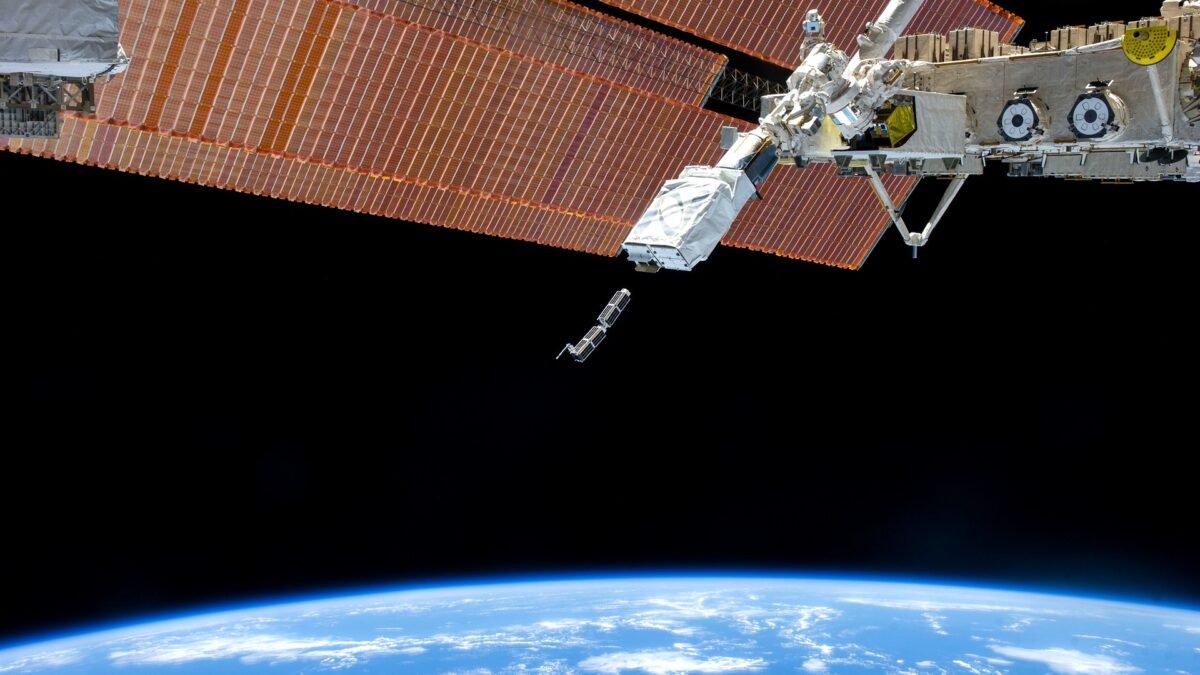
An artificial intelligence chip in orbit has answered its first question from Earth — with a poem. Google said on 30 October that its Project Suncatcher prototype satellite, carrying the same kind of processor that powers its data centres on the ground, ran its first AI prompt in space and sent the answer back down to a ground station.
Engineers asked the satellite’s onboard Gemma 4 model, Google’s open AI model, to write a haiku about being in space. As the spacecraft passed over Svalbard, Norway, it sent back its reply: “Blue marble below / Data streams in silent grace / Starlight feeds my core.”
Google calls the moment its “Hello World” milestone for computing in orbit — the first-ever AI response from a data-centre-class Tensor Processing Unit, or TPU, in space. It is a small test, deliberately so: three lines of poetry, about 20 tokens of text, generated by a chip running for a few minutes on a satellite that produces barely enough electricity to run a hair dryer. But it is also the first proof that the chips behind modern AI can work at all beyond Earth’s atmosphere, and the opening step in Google’s long bet that data centres could one day run in space.
“After launching our prototype satellite a few weeks ago, we’ve now successfully sent a command up to orbit, booted up the TPU, ran the prompt, and received our first complete response back on earth — a haiku!” Google chief executive Sundar Pichai wrote on X on 30 October.
The first prompt from orbit
The Suncatcher prototype launched on 1 October 2026 aboard a SpaceX Falcon 9 rocket, on the Transporter-18 rideshare mission that carried more than 100 spacecraft into low Earth orbit. The satellite was built in partnership with Planet, the satellite-imaging company, which confirmed initial contact after launch and began commissioning the spacecraft.
For about three weeks, Google’s team worked through that commissioning: powering up the satellite’s host computer and its TPU trays, then running early machine-learning tests. Only then, during a pass over a ground station, did engineers uplink the first prompt. Travis Beals, senior director of Google’s interdisciplinary Paradigms of Intelligence research team, wrote in a Google blog post that with the host and TPU trays powered up and machine-learning tests completed, the onboard Gemma 4 model achieved its “Hello World” milestone by sending an inference response from orbit.
The prompt itself, as quoted by The Register, asked for a haiku “from the perspective of a TPU orbiting Earth, with the wonderful world spinning beneath you”. Beals’ own account describes it more simply: the team asked Gemma 4 “to generate a haiku about being in space”. Either way, the answer that came down over Svalbard was the same three lines, and a Google spokesperson told TechCrunch that the satellite was operating nominally.
After the haiku, the team tried more. Beals said they tested space-themed limericks and prompts that asked the payload to report its own technical status — telemetry prompts in which the model described the state of the systems carrying it. Those tests matter more than the poetry: they show the model can do useful work, reporting on the spacecraft itself, rather than merely producing a party trick.
The haiku itself would have cost almost nothing to generate on Earth. The Register calculated that the roughly 20 tokens would cost about $0.000012 through Google Cloud’s pricing for Gemma 4. Add a satellite weighing perhaps 500 kilograms, based on the mass of SpaceX’s Starlink satellites, and a retail launch price of around $7,000 per kilogram, and the same poem becomes, in the publication’s words, a very expensive haiku. That contrast is the point of the whole project: the poetry is cheap, but getting the computer into orbit is not — yet.
Twenty minutes at a time
The prototype carries four of Google’s TPUs, the chips the company designs to run its AI models, but it can switch on only one of them at a time. The satellite generates up to 1 kilowatt of electricity, and the power demands of a single TPU mean it can run for only about 20 minutes per session, according to TechCrunch. That tight budget shapes everything about the mission: each contact with the ground must be carefully timed, each test squeezed into a short window while the chip is awake.
That constraint is also the reason the test matters. A data centre earns its keep by running around the clock, and a machine that can work for 20 minutes at a time is a laboratory, not a service. Google says so itself: the prototype is an experiment, and the hard tests — how the chips handle heat and radiation in orbit — come next.
Radiation is the harder of the two. A particle strike in space can flip a stored bit, corrupting data without setting off the usual checks, a phenomenon known as silent data corruption. Google has already done some laboratory testing of its Trillium Cloud TPU and an AMD host server against a 67 MeV proton beam, and the results, published in a paper earlier this month, were cautiously encouraging. The system’s high-bandwidth memory showed the most sensitivity to the total ionising dose, exhibiting irregularities after a cumulative dose of 2 krad(Si) — about three times Google’s minimum requirement for survival of 750 rad(Si).
For typical transformer workloads, Google’s researchers estimated that the observed silent-data-corruption rate, of approximately one event per 17 rad at an estimated orbital dose of 150 rad(Si) per year, translates to a failure probability on the order of 1 per 3 million inferences, assuming one inference per second. “While this error rate is likely acceptable for inference, the impact of SEEs on training jobs, and the efficacy of system-level mitigations, requires further study,” the researchers wrote. In other words: answering questions in orbit looks survivable; training models there is a different question, and it has not been answered yet.
The ground tests also suggested that radiation matters less for running a finished model — inference — than for training one, and the orbital test campaign will now check whether that holds in real conditions. Thermal stress is the other half of the programme: chips designed for air-conditioned data-centre halls must now shed their heat in a vacuum, where there is no air to carry it away.
Why Google wants computers in space
Project Suncatcher is a long-term research effort that Google first outlined in November 2025. Its premise is straightforward: satellites in the right orbit sit in near-constant sunlight, so their solar panels could run AI computing on clean power around the clock, without the land, water and grid connections that data centres on Earth increasingly struggle to secure. The pitch is not that orbit is cheaper today — it plainly is not — but that the economics could flip if launch costs fall far enough.
Google’s own calculations, published on arXiv, put a number on that flip. If the cost of getting a satellite into low Earth orbit can be brought down to $200 per kilogram, the launch cost amortised over the satellite’s useful life — roughly $810 to $7,500 per kilowatt per year — could be comparable to current electricity spending for terrestrial data centres in the United States, roughly $570 to $3,000 per kilowatt per year. Google predicts that SpaceX could achieve that launch price by 2035, more or less, and considers it strategically beneficial to prototype well in advance of that actually happening, according to The Register.
That is a bet on the 2030s, and Google is building toward it in stages. The prototype now in orbit is a single satellite. Next year, the plan is to launch two interconnected satellites with higher power generation and inter-satellite optical links, to test whether AI computations can be distributed across multiple spacecraft. Rather than lofting large satellites, Google anticipates sending a constellation of many smaller satellites that communicate with one another, running coherent distributed workloads across close-flying machines — an approach TechCrunch notes is unusual in planning high-speed links between satellites for exactly that purpose.
The project also sits inside a much larger contest. The world’s biggest technology companies are spending hundreds of billions of dollars a year on AI infrastructure, and the binding constraints are increasingly physical: electricity, land, cooling water, and the time it takes to connect a new data centre to the grid. Space offers none of those things for free — launching hardware is expensive, power is scarce, and a broken satellite cannot be repaired — but it offers something Earth cannot: sunlight that never sets, and room to grow without neighbours objecting. Whether that trade is ever worth making is the question Suncatcher exists to answer.
Analysis: Why It Matters
A haiku is a boot test, not a benchmark
The first thing to be clear about is what this milestone does and does not prove. A haiku shows that a TPU survived launch, powered up, ran a small open model from prompt to answer, and got the reply to a ground station. It shows nothing about speed, cost, or how long the chips last, and Google’s announcement gives no figures for any of them. That is not a criticism of the test — every computer system in history has had a “Hello World” moment, and the point of one is to prove the plumbing works, not to set records. But readers should not mistake a successful boot test for a working orbital data centre. The distance between the two is measured in the radiation and thermal tests now beginning, and in the economics of launch costs that Google itself says may not arrive until the mid-2030s. The honest reading is the modest one: the experiment is alive, the chips work, and the hard questions are still open.
The 20-minute limit is the detail to hold on to
Of all the numbers in this story, the most revealing is 20 minutes. A satellite that generates 1 kilowatt can run one TPU for about 20 minutes at a time, and that single constraint explains both why the test was a haiku and why orbital data centres remain a distant prospect. A data centre is valuable because it is always on; a machine that works in short bursts, scheduled around ground-station passes, is a research instrument. The 2027 twin satellites are meant to address this with higher power generation, and a constellation would multiply capacity, but the physics does not change: every watt in orbit must be generated by solar panels, stored in batteries, and spent carefully. Until the power budget grows by orders of magnitude, orbital AI will be a niche — useful for processing data where it is collected, in space, rather than for replacing the data centres on the ground.
Radiation, not rocketry, is the real test
Getting a chip into orbit is now routine; keeping it honest there is not. A single high-energy particle can flip a bit in memory, and if that bit sits inside a model or its calculations, the corruption can be silent — no alarm, no crash, just a wrong answer. Google’s laboratory tests suggest the risk for inference is small, on the order of one failure per 3 million inferences, but that estimate rests on assumptions about dose rates and workloads that only orbital testing can validate. The distinction the researchers draw, between inference and training, is important: a wrong word in a haiku is harmless, but a corrupted gradient during training could poison a model in ways that are hard to detect. If Suncatcher’s orbital tests confirm the lab results, the case for inference in space strengthens considerably. If they do not, the project will need shielding, redundancy, or error-correction that eats into the already tight power budget. Either way, the answer will be empirical, and it will come from this satellite.
Google is buying an option on the 2030s, not a product
The most interesting thing about Suncatcher is its time horizon. Google is prototyping now for a launch market it expects to mature around 2035, a decade ahead of the payoff. That is unusual discipline in an industry that usually chases the next quarter, and it is also a hedge: if launch costs fall as Google predicts, the company that already knows how to run AI chips in orbit will have a head start; if they do not, the cost of the experiment is small relative to Google’s AI spending. The $200-per-kilogram threshold is the number to watch. At today’s roughly $7,000 per kilogram, orbital computing is a curiosity; at $200, Google’s arithmetic says it could compete with terrestrial electricity costs. The gap between those two numbers is the whole bet, and it depends almost entirely on SpaceX’s launch cadence and pricing, not on Google. Suncatcher is, in that sense, a bet on someone else’s roadmap as much as its own.
The poetry is the point, and that is fine
It is easy to be cynical about a haiku. Three lines of verse, generated at enormous expense, look like a stunt. But stunts have a function: they make an abstract engineering milestone legible. Nobody outside the industry would read a press release about a successful TPU boot sequence; everybody understands a poem beamed down from space. The haiku also does something a benchmark cannot: it demonstrates the full chain — prompt up, inference in orbit, answer down — in a form anyone can verify. Google’s engineers then did the unglamorous work, the limericks and telemetry prompts, that actually tests the system. The poetry got the attention; the telemetry will decide whether the project lives. Both were necessary, and neither should be mistaken for the other.
What to Watch Next
- The radiation and thermal tests. Google says the next phase examines how its TPUs handle thermal stress and radiation exposure in orbit. The results — especially whether the laboratory estimate of roughly one failure per 3 million inferences holds up — will decide whether orbital inference is genuinely viable.
- The 2027 twin satellites. Google plans to launch two interconnected satellites with higher power generation and optical links between them, to test distributed AI computation across spacecraft. Watch for whether they fly on schedule and what workloads they run.
- Launch costs. The entire economics of the project rests on launch prices falling toward $200 per kilogram, which Google predicts SpaceX could reach by about 2035. Any movement in SpaceX’s pricing or cadence changes the arithmetic for Suncatcher.
- What the satellite actually does next. Beyond poetry and telemetry, watch for the first real workload — for example, processing Earth-observation imagery in orbit rather than sending it to the ground. That would be the first sign of a practical use, not just a demonstration.
- Competitors’ answers. Google is not the only company looking at computing in space. Watch for rival announcements — from satellite operators, cloud providers and chipmakers — and for whether any of them put a competing system in orbit.
Sources
- TechCrunch — Google’s first data center satellite is online and writing poetry (30 October 2026)
- The Register — Google’s AI satellite sends a very expensive haiku to Earth (31 October 2026)
- Skimwire — Google Project Suncatcher satellite sends first AI response (30 October 2026)
- TechWorthIt — Google’s Suncatcher satellite returns first AI response from orbit (31 October 2026)
- Yuphora — Project Suncatcher: Google TPU satellite answers first prompt (31 October 2026)

About the Author — advmannan1
Related Articles

4.1-Billion-Year-Old Martian Meteorite Found in the Sahara Offers New Clues to a Wetter, Warmer Early Mars
A rosy rock picked up in the Sahara in 2022 turns out to be a 4.1-billion-year-old piece of…
The $6.3 Billion Heist: How North Korea’s Hackers Robbed Binance in Twenty Minutes — and What It Means for Your Money
North Korea's Lazarus hackers stole $6.3 billion from Binance in 20 minutes — the largest crypto heist in…
ISRO’s GSLV-F18 Puts NVS-03 Navigation Satellite in Orbit, Restoring India’s NavIC to Four Satellites
India's GSLV-F18 rocket placed the NVS-03 navigation satellite into its intended transfer orbit on Friday night, restoring the…