
Voyager 1 Goes Silent for Two Days in Deep Space, Then Returns as NASA Counts Down to a Light-Day From Earth

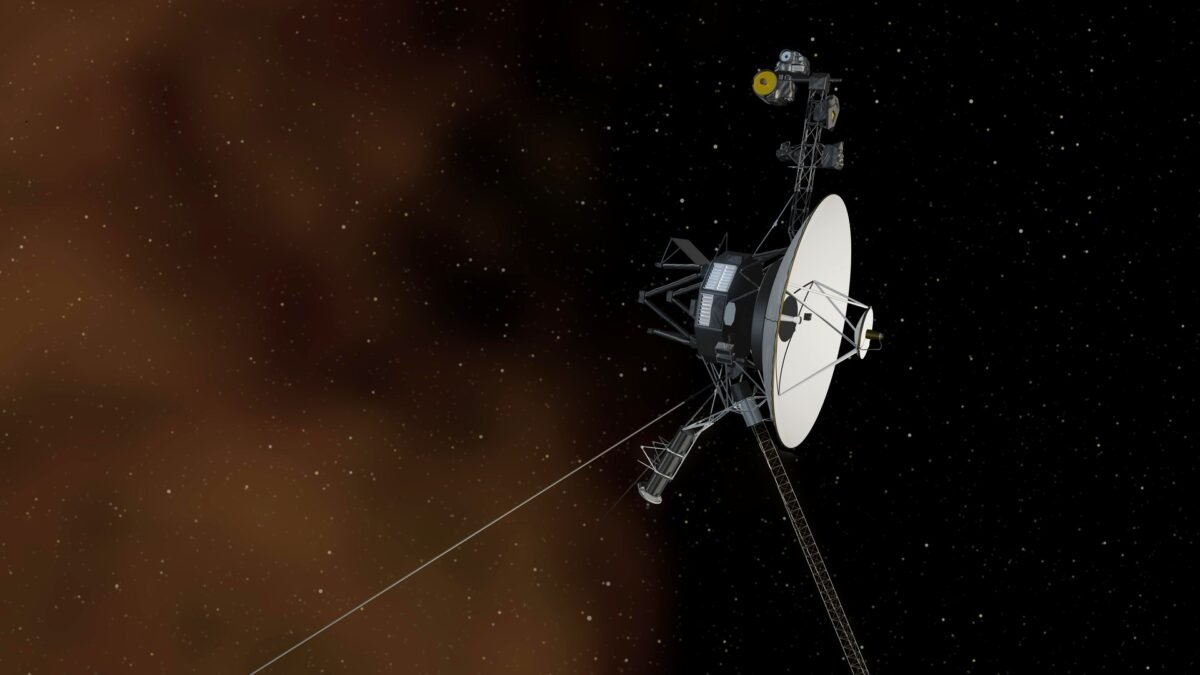
Forty-nine years after it left Earth, the most distant machine humanity has ever built has gone quiet — and then spoken again. NASA’s Voyager 1 spacecraft fell silent for two days in October, vanishing from the radio sky during two scheduled listening attempts, before its faint signal returned on 20 October. The scare came just weeks before the probe is due to cross a boundary no human-made object has ever reached: on 18 November 2026, Voyager 1 will become the first spacecraft a full light-day from Earth.
According to NASA’s Jet Propulsion Laboratory (JPL), which operates the mission, the spacecraft’s radio signal could not be detected during two scheduled contact attempts on 18 and 19 October. The Deep Space Network — the system of giant antennas in California, Spain and Australia that talks to deep-space missions — heard nothing. On 20 October, the signal reappeared, and contact has held steady since. Engineers are still investigating what caused the outage, and they are braced for more trouble. “This is the first time we’ve seen the spacecraft do something like this, but we are also at a point in the mission where we have to expect the unexpected,” Kareem Badaruddin, the Voyager mission manager at JPL, said in a statement reported by NASA. “We’re relieved to be back in contact with Voyager 1 and are eager to understand what happened.”
What the team does know is that a group of the spacecraft’s thrusters went offline during the episode, and Voyager 1 responded exactly as its designers intended nearly half a century ago: it switched to its backup thrusters and put itself into safe mode, a protective state known as fault protection that pauses science operations until the problem is understood. The spacecraft is now more than 16 billion miles — about 25.8 billion kilometres — from Earth, according to NASA, and every one-way radio signal takes almost 24 hours to reach it. A command sent today arrives tomorrow; the answer comes back the day after that. Diagnosing a fault across such a gap is less like fixing a machine than like conducting surgery by letter.
The timing of the scare could hardly be more poignant. On 18 November, at 10:16:07 UTC (05:16:07 EST), Voyager 1 will cross the one-light-day mark — a distance of 25.89 billion kilometres, or 16.09 billion miles, from Earth — and from that moment a radio signal will take a full 24 hours to reach it. NASA has set up a countdown clock to mark the moment, and the agency’s own November sky-watching notes, published on 30 October, describe the milestone as “the farthest humanity has ever explored”. Voyager 1 is already the most distant human-made object in existence, a title it has held since February 1998, when it overtook Pioneer 10. On 18 November it adds another first: no machine built by human hands has ever been a full day’s worth of light away from home.
The two days of silence
The October outage began after the mission team had just completed a months-long effort to stretch the spacecraft’s fading power supply — an operation the engineers nicknamed the “Big Bang”. In early September 2026, they switched off three power-hungry devices aboard Voyager 1 and substituted lower-power alternatives, redistributing heat and electricity so the remaining instruments could keep working. Without that effort, NASA said, Voyager 1 might have had to shut down another instrument by the summer of 2027. The same measure has been applied to Voyager 2, which now has just three instruments online.
Then, in October, the spacecraft’s signal vanished during two scheduled listening attempts, 24 hours apart. The Deep Space Network picked up nothing. The cause is still under investigation, and NASA has not linked the loss of contact to the September power swap. What is known is that a group of thrusters went offline and the spacecraft’s fault protection kicked in, switching to backup thrusters and pausing science. It was the first time the spacecraft had behaved in quite this way, according to Badaruddin — and, he warned, engineers are expecting more such glitches between now and the summer of 2027.
The episode is a reminder of how extraordinary it is that Voyager 1 is talking to us at all. The spacecraft runs on three radioisotope thermoelectric generators, which convert heat from decaying plutonium-238 into electricity. That power fades by about four watts every year, and output is now roughly half what it was at launch. To keep the probe alive, NASA has been switching its instruments off one by one; the most recent casualty was the Low-Energy Charged Particle instrument, powered down in April 2026. Only two of its science instruments still work: the magnetometer, which measures the magnetic field of interstellar space, and the plasma wave instrument, which listens to the faint oscillations of charged particles between the stars. Commands travel up to the spacecraft at 16 bits per second; science data trickles home at about 160 bits per second — slower than the dial-up modems of the 1990s, across a distance that light itself needs a day to cross.
And yet the machine keeps going. In 2023, a failed memory chip began garbling all of Voyager 1’s telemetry into nonsense, and engineers spent five months relocating the affected code by radio, with a 45-hour round trip for every exchange, before bringing the science back online. In November 2017, backup thrusters that had lain dormant since 1980 fired perfectly on command, buying years of extra pointing ability from hardware built in the early 1970s. The spacecraft’s three onboard computers share roughly 68 kilobytes of memory between them, according to BBC Sky at Night Magazine — less than a single photograph from a modern phone. It has not fired an engine to change course since its Saturn flyby in 1980; everything since has been ballistic, one long, uninterrupted fall away from the Sun.
What a light-day actually means
A light-day is not a measure of time but of distance: the distance light travels in 24 hours, about 25.9 billion kilometres, or roughly 173 times the distance from Earth to the Sun. Nothing physical waits at that line. There is no boundary, no dust, no change in the dark. The milestone belongs entirely to radio time. From 18 November, a command sent from Earth takes a full day to arrive, and its reply takes another full day to come home. Say good morning on Monday, and the answer lands on Wednesday.
The precise date is itself a curiosity of orbital mechanics. The milestone is measured from Earth, and Earth does not sit still: our planet circles the Sun at roughly 30 kilometres per second, faster than Voyager 1 is leaving the solar system, so for part of every year the gap between the two actually shrinks as Earth swings toward the probe. That is why the crossing has a time stamp to the second — 10:16:07 UTC on 18 November — rather than a vague “sometime this autumn”. It also explains why different outlets have quoted slightly different dates: BBC Sky at Night Magazine put the crossing at around 13 November, while NASA’s own figure is the 18th. After 18 November, Voyager 1 stays more than a light-day away for good, because it is moving away faster than Earth can swing back toward it — about 17 kilometres every second, or roughly 61,000 kilometres per hour.
For scale, consider how long a radio signal takes to reach familiar places. The Moon is 1.3 seconds away. The Sun is about 8 minutes and 19 seconds. Neptune, the most distant planet, is about four hours. Voyager 1, from 18 November, is a full 24 hours — the whole day. It is about 170 times farther from us than the Sun, and sunlight where it travels is about 30,000 times fainter than at Earth. And still it has covered less than a tenth of one per cent of the distance to the nearest star. Proxima Centauri lies 4.24 light-years away; Voyager 1 has been travelling for 49 years and has not yet covered a single light-day.
Forty-nine years, one trajectory
Voyager 1 launched on 5 September 1977 from Cape Canaveral, sixteen days after its twin, Voyager 2, which lifted off on 20 August. The pair took advantage of a once-every-175-year alignment of the four largest planets, using gravity assists to fling themselves outward in a “Grand Tour” of the outer solar system. Voyager 2 took the slower route, visiting all four giant planets and becoming the only spacecraft ever to fly past Uranus and Neptune. Voyager 1 took the short, steep route: it reached Jupiter first, in March 1979, where it revealed erupting volcanoes on the moon Io — the first active volcanism ever seen beyond Earth — and then Saturn in November 1980, where a close pass over the moon Titan bent its trajectory about 35 degrees up and out of the plane of the planets. That was the final course change Voyager 1 would ever make.
The mission was designed to last five years. It has now run for nearly ten times that long. In February 1990, at the urging of the astronomer Carl Sagan, the cameras turned back one last time and photographed Earth from six billion kilometres away: a fraction of a pixel caught in a sunbeam, the “Pale Blue Dot”. The cameras were then switched off to save power, and they have never been used again. In December 2004, Voyager 1 crossed the termination shock, the region where the solar wind abruptly slows against interstellar gas — the first direct measurement of the heliosphere’s inner boundary. On 25 August 2012, it passed the heliopause and became the first spacecraft to sample the plasma between the stars, still calling home from beyond the Sun’s protective bubble. Voyager 2 followed into interstellar space in November 2018.
Today, Voyager 1 is heading toward the constellation Ophiuchus, and its trajectory points it, in the very long term, toward a star called Gliese 445, also known as AC +79 3888, in Ursa Minor. In about 40,000 years it will drift within about 1.7 light-years of that star. By then it will have been silent for tens of thousands of years: NASA expects the signal to grow too faint for its antennas to pick up by around 2036, and the plutonium power source will have faded beyond usefulness in the early 2030s. The spacecraft will keep falling through the galaxy long after it stops talking.
The message in a bottle
Bolted to the side of each Voyager is a 12-inch gold-plated copper phonograph record — a message in a bottle for the interstellar ocean. A committee chaired by Carl Sagan chose its contents: greetings in 55 languages, including the words “Hello from the children of planet Earth”, 116 pictures, the sounds of surf, wind, whale song and a human heartbeat, and 90 minutes of music from Bach to Chuck Berry. The record’s cover is an instruction manual written in physics: a pulsar map giving Earth’s address in the galaxy, and the spin-flip transition of the hydrogen atom as a unit of time. The cover was electroplated with an ultra-pure sample of the isotope uranium-238, which has a half-life of 4.468 billion years. Sheltered from erosion in interstellar space, the record is expected to remain playable for a billion years — comfortably the longest-lasting thing humans have ever made.
It is worth pausing on what that means. The spacecraft itself will die within a decade or so, its transmitter fading into the noise. The record will outlive not only the mission but, in all likelihood, the civilisation that launched it. Voyager 1’s twin, meanwhile, trails by about 3.2 billion kilometres and moves a little more slowly; NASA does not expect Voyager 2 to reach its own one-light-day milestone until November 2035, and it may well fall silent before it gets there.
Analysis: Why It Matters
A machine that outlived its mission by 44 years
Voyager 1 was built for a five-year tour of Jupiter and Saturn, and it has now operated for 49 years — nearly ten times its design life. That is not luck; it is the product of engineering margins, redundancy and a willingness to keep adapting a spacecraft that was never meant to do what it is doing now. Every year of extra operation is a year of data from a region no other instrument can reach: the space between the stars. The October silence is a warning that this cannot go on forever, but the fact that a 1970s machine recovered from a two-day blackout at 16 billion miles is itself a measure of how well it was built. The lesson for the space agencies planning the next generation of deep-space missions is blunt: the hardware that survives is the hardware that was built to be repaired from a distance, by people who never expected to need to.
Silence at 16 billion miles is normal — and terrifying
Spacecraft lose contact all the time, and most of the time it is routine: a scheduled gap, a solar conjunction, an antenna taken offline for maintenance. What made October different was the combination of a real fault — thrusters going offline, safe mode engaging — and the sheer distance involved. At nearly a full light-day away, every question and answer costs two days. The engineers who fixed the 2023 memory fault spent five months on a repair that would have taken an afternoon in a laboratory, because each exchange of instructions took 45 hours. As the distance grows, the cost of every fault grows with it, and the mission’s margin for error shrinks. The October episode shows that Voyager 1’s end, when it comes, is likely to arrive not as a single dramatic failure but as a slow accumulation of small ones — a thruster here, a heater there — until one day the signal simply does not come back.
The power problem is the real countdown
The one-light-day milestone is a date on a calendar; the power budget is the clock that actually matters. Voyager 1’s generators lose about four watts a year, and the spacecraft is already running on roughly half its original power. NASA has kept it alive by switching instruments off one by one — the Low-Energy Charged Particle instrument was the latest, in April 2026 — and by the “Big Bang” power swap in September, which bought time by trading power-hungry devices for leaner ones. But there is nothing left to trade forever. With only two science instruments still running, the next shutdown will cut the science return in half again, and after that there will be little left to switch off except the transmitter itself. The milestone on 18 November is worth celebrating precisely because the window is closing: by the early 2030s, the plutonium will have faded too far, and by around 2036 the signal will be too faint to hear at all.
A light-day is a human milestone, not a physical one
Nothing changes for Voyager 1 on 18 November. It will not register any change in its surroundings, and nothing on board will alter. The heliopause, crossed in 2012, was a physical boundary; a light-day is a unit of human time, a measure of how far light — and therefore a radio signal — can travel in a day. That is exactly why it matters. Space exploration has always been measured in human terms: days of travel, hours of signal delay, years of mission life. A light-day is the first time the delay has become a full day, and it marks the point at which the spacecraft passes beyond the reach of anything resembling a conversation. From 18 November, talking to Voyager 1 is not a phone call but an exchange of letters, each one taking two days to complete. It is a threshold that makes the scale of interstellar space tangible in a way that billions of kilometres never quite do.
What Voyager teaches about building things that last
There is a broader lesson in a machine that has kept working for 49 years. Voyager 1 was designed before the personal computer, before the internet, before the engineers who now run it were born — and it is still sending useful science home. It survived because its designers built in redundancy, because they gave it the ability to protect itself when something went wrong, and because the people running it have been willing to improvise: waking thrusters that had slept for 37 years, rewriting code across a 45-hour round trip, swapping power-hungry hardware for leaner alternatives. Modern missions are more capable and more complex, but complexity is also fragility. The next generation of interstellar probes, whenever they fly, will be judged not only by what they can do on launch day but by whether they can still do something useful half a century later, when the people who built them are gone and the only thing standing between the mission and silence is the quality of the engineering.
What to Watch Next
- The milestone moment — 18 November, 10:16:07 UTC: NASA’s countdown clock reaches zero as Voyager 1 crosses one light-day from Earth. Expect the agency to mark the moment with new tracking data and, most likely, a fresh statement on the spacecraft’s health after the October outage.
- The cause of the October outage: JPL is still investigating why a group of thrusters went offline and the spacecraft entered safe mode. Whether the fault is traced to ageing hardware, a software issue or something else will shape how much confidence the team has in the months ahead.
- More glitches before summer 2027: Engineers have warned openly that further faults are expected between now and the summer of 2027. Each one will test the spacecraft’s fault protection — and the team’s ability to diagnose a fault across a two-day round trip.
- The power cliff in the early 2030s: With only the magnetometer and the plasma wave instrument still running, the next instrument shutdown will halve the science return. Watch for NASA’s decisions on which instrument goes next, and when the transmitter itself becomes the last thing left to power.
- Voyager 2’s own light-day — November 2035: The twin trails by about 3.2 billion kilometres and travels more slowly. It may fall silent before it reaches the same milestone, which would make 18 November 2026 the only light-day crossing humanity ever witnesses from the Voyager programme.
Sources
- NASA Science — “November’s Night Sky Notes: Light-Day Away” (30 October 2026)
- Starlust — “Voyager 1 Comes Back Online After Mystery Glitch in Interstellar Space” (NASA JPL statement, 30 October 2026)
- Hardware Busters — “Voyager 1 Hits One Light-Day From Earth on November 18, 49 Years After Launch” (NASA timing via EarthSky)
- Seriously Scientific — “Voyager 1 One Light-Day Milestone: Countdown & Golden Record” (NASA JPL milestone data)
- NextTechWorld — “Voyager 1’s Two-Day Silence and NASA’s Power Fix” (October 2026)

About the Author — advmannan1
Related Articles
Google’s AI Satellite Writes Its First Haiku From Orbit as Project Suncatcher Passes Its ‘Hello World’ Test
Google's Project Suncatcher satellite has sent back its first AI response from orbit — a haiku written by…

4.1-Billion-Year-Old Martian Meteorite Found in the Sahara Offers New Clues to a Wetter, Warmer Early Mars
A rosy rock picked up in the Sahara in 2022 turns out to be a 4.1-billion-year-old piece of…

The $6.3 Billion Heist: How North Korea’s Hackers Robbed Binance in Twenty Minutes — and What It Means for Your Money
North Korea's Lazarus hackers stole $6.3 billion from Binance in 20 minutes — the largest crypto heist in…