
Nasdaq 100 Enters Correction as Chip Rout Deepens and Apple Slides on Margin Warning

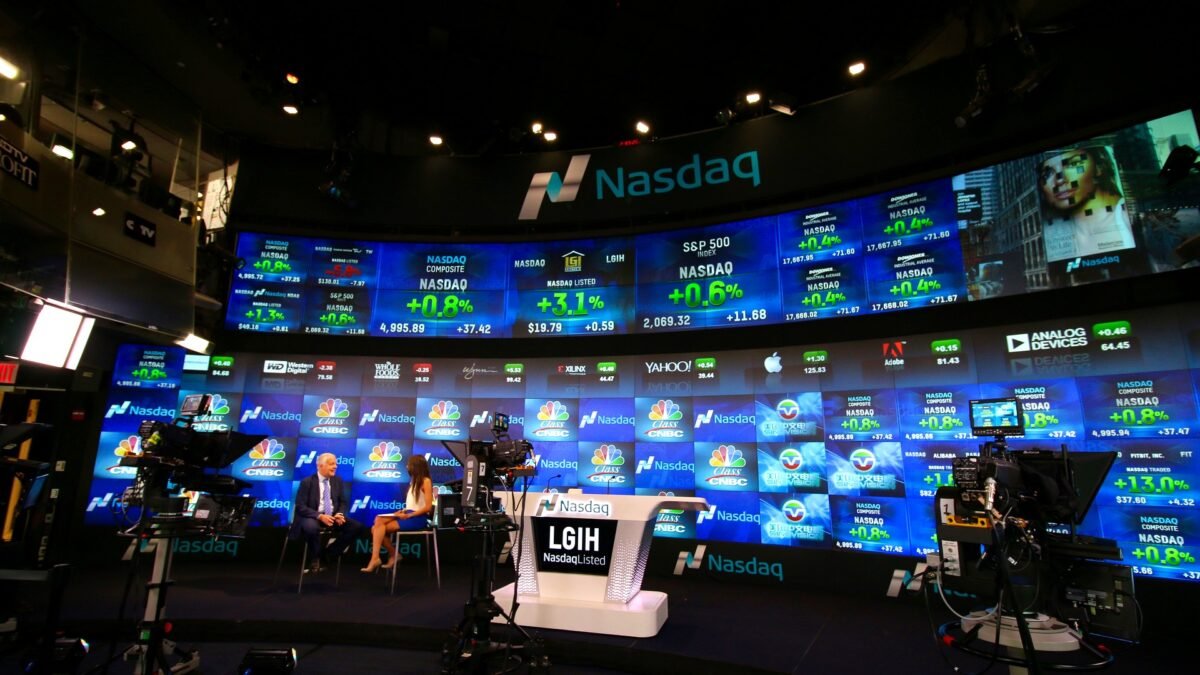
The Nasdaq 100 has entered a correction. The technology-heavy index closed on Monday more than 10 per cent below its all-time closing high, according to Reuters, as a brutal sell-off in semiconductor stocks deepened and two of the market’s biggest names reported results that Wall Street punished despite beating forecasts. It was the third time in 2026 that the index has fallen into correction territory, and the clearest sign yet that investors are no longer willing to price the artificial intelligence boom on promise alone.
The Nasdaq 100 fell 1.39 per cent on Monday to 27,989.82 points, leaving it about 10.4 per cent below the record closing high it set on 6 October, according to market data. The S&P 500 fell 0.51 per cent to 7,541.40, and the Nasdaq Composite dropped 1.07 per cent to 25,164.36. The Dow Jones Industrial Average, by contrast, rose 0.41 per cent to 51,983.98, as money rotated out of technology and into the defensive and consumer-facing stocks that have been left behind by the AI trade.
The selling was led, once again, by the chipmakers at the centre of the AI boom. A gauge of United States chipmakers extended a three-day rout to 12 per cent, according to Bloomberg, while the Philadelphia Semiconductor Index fell 3.4 per cent on Monday alone. Advanced Micro Devices fell 7.5 per cent, Intel dropped 8.8 per cent and Micron Technology declined 5.8 per cent, according to market data, while Nvidia, the company whose chips power most of the world’s AI systems, lost about 1.3 per cent. Microsoft fell 2.8 per cent and Apple lost 1.8 per cent before its own results landed after the closing bell.
Tuesday morning brought no relief. Apple fell about 4 per cent in premarket trading after warning that the rising cost of memory chips would squeeze its profit margins in the all-important holiday quarter, according to Reuters. Palantir Technologies, the AI-powered analytics company, fell more than 6 per cent even after forecasting revenue above estimates for the final three months of the year. The message from the market was blunt: beating the quarter is no longer enough. Investors now want proof that the spending behind the AI boom will actually pay.
Apple beats the quarter — and falls anyway
Apple’s results, reported after the market closed on Monday, were by any ordinary measure a triumph. The company reported revenue of $114.48 billion for its fiscal fourth quarter, up 12 per cent from a year earlier and above the $113.39 billion analysts had expected, according to Reuters, citing LSEG data. Earnings per share came in at $2.10, against expectations of $1.99. Net income rose to $30.71 billion from $27.47 billion a year earlier. It was the first earnings report under John Ternus, who took over as chief executive from Tim Cook on 1 September, and Ternus described it as Apple’s “best fiscal year ever”, with full-year revenue of $478.83 billion.
iPhone sales, which included the new iPhone 18 Pro models but not the iPhone Duo, reached $57.58 billion, up more than 17 per cent from a year earlier and above the $56.54 billion analysts expected, according to Reuters. Services — the App Store, Apple Music, iCloud, Apple TV and payments — hit an all-time record of $31.57 billion. Mac sales surged almost 24 per cent. The quarter’s gross margin was 47.9 per cent, above the 47.5 per cent analysts had forecast.
None of it mattered. What moved the shares was the outlook. Apple forecast a gross margin of 45 to 46 per cent for the December quarter, below the 46.3 per cent analysts expected, and warned that the cost of memory chips would continue to rise, pressuring its holiday-quarter profitability. The company also said services revenue growth would slow, and it forecast overall revenue growth of 7 to 10 per cent for the quarter, even as it expects the period to be its best ever. Greater China revenue of $17.54 billion fell short of the $18.75 billion analysts had projected.
The shares fell about 3 per cent in after-hours trading on Monday, according to reports, and dropped a further 4 per cent in premarket trading on Tuesday. It was a remarkable reversal for a company that only last week overtook Nvidia to retake its position as the world’s most valuable listed company, with a market capitalisation above $5 trillion. The episode also carried a small caveat for anyone reading the headline numbers too literally: Apple’s reported margin and earnings were flattered by tariff refunds worth about one percentage point of margin and five cents of earnings per share. Strip those out, and the underlying picture was softer still.
Apple’s warning about memory costs matters far beyond Cupertino. Memory chips are the unglamorous plumbing of the AI boom, and their prices have surged as data-centre builders have hoarded supply. When the world’s most valuable company says those costs are eating into its margins, every hardware maker in the market hears the same warning. It is one reason the chip sell-off has been so broad: the same shortage that lifts chipmakers’ revenues today is squeezing their customers’ profits tomorrow, and investors are struggling to decide which side of that trade to be on.
Palantir and the new rule of earnings season
Palantir’s experience on Tuesday morning told the same story in miniature. The company topped third-quarter expectations and forecast revenue above estimates for the last three months of the year. Its shares fell anyway — by more than 6 per cent in premarket trading, according to Reuters, and by more than 8 per cent in extended trading, according to market data — as investors focused on a sharp deceleration in new contract bookings.
The pattern has repeated itself across this earnings season. Companies have beaten forecasts and fallen; they have raised guidance and fallen; they have reported record quarters and fallen. The reason is that the bar has moved. After two years in which AI spending was treated as an investment that would pay for itself, investors have started asking the question that always arrives eventually: when, exactly, does the money come back?
That question has acquired a sharper edge in recent weeks because several large technology companies have tapped the bond market to finance their AI investments, raising concerns that debt-funded spending will become harder to justify as borrowing costs rise, according to Reuters. Oracle’s $20 billion capital raise revived worries about how the AI build-out is being paid for. The fear is not that AI spending stops — nobody seriously expects that — but that it is increasingly funded with borrowed money at a moment when the returns are still largely theoretical.
The numbers behind the anxiety are enormous. Goldman Sachs estimates that the big technology companies, known as hyperscalers, will spend about $800 billion on capital expenditure in 2026 and $1.2 trillion in 2027. Those figures are so large that they have become a macroeconomic fact in their own right: AI infrastructure is now one of the biggest drivers of American investment. But the same scale makes the market nervous. If even a fraction of that spending turns out to have been misdirected, the losses will be measured in hundreds of billions of dollars.
A correction, not a crash — yet
It is worth keeping the scale of the sell-off in perspective. A correction, in market language, is a fall of 10 per cent from a recent high. It is a technical marker, not a verdict that the wider economy is in trouble. The Nasdaq 100 remains up about 11 per cent for the year, according to market analysis, and the S&P 500 is still trading near record levels. The index has now corrected three times in 2026 — and recovered each time.
October was nonetheless a bruising month. The Nasdaq Composite fell almost 7 per cent in October, its worst month since the tariff-driven rout of April 2025, according to Reuters, and the Nasdaq 100 lost more than $2.5 trillion in market value. The month ended with a violent session on Friday 30 October, when the Nasdaq fell 2.9 per cent in its worst day since June and the semiconductor index dropped more than 7 per cent, with Intel suffering its worst one-day fall since the 1980s. Monday’s early rebound — the story that dominated the morning’s coverage — faded within hours, and by the close the market was falling again.
The pain has not been confined to Wall Street. South Korea’s Kospi, the world’s most chip-exposed major stock market, slid more than 3 per cent on Tuesday, and the MSCI Asia Pacific Index dropped almost 1 per cent, according to CoinDesk. Bitcoin fell 2 per cent to just under $77,000 in Asian morning trading on Tuesday, erasing Monday’s rebound, as the chip rout dragged down risk assets across the board. Zcash tumbled nearly 10 per cent, Hyperliquid fell 5 per cent and Solana dropped 3 per cent, while Ether traded just above $2,250 and BNB slipped below $700, according to CoinDesk data.
Bitcoin’s slide has its own drivers. United States spot Bitcoin exchange-traded funds recorded $399 million in net outflows on 2 November, following $643 million in outflows on 30 October — the largest single-day withdrawal since June. The cryptocurrency has now closed four consecutive weeks in the red. But the timing of its latest fall, in lockstep with the chip sell-off, underlines how tightly the whole risk complex has become bound together: when the AI trade sneezes, everything from Seoul to crypto catches a cold.
There were, however, signs of life on Tuesday morning. Chip stocks were among the top gainers in premarket trading, with Nvidia climbing 2.8 per cent after falling for four consecutive sessions, AMD gaining 4.2 per cent ahead of its quarterly earnings due after the closing bell, and Marvell and Intel rising 4.6 and 4.3 per cent respectively, according to Reuters. The Nasdaq 100 futures were up 0.71 per cent by mid-morning. Whether that is a genuine turn or another brief bounce inside a larger decline is the question every trader on Wall Street is now asking.
The economy behind the market
The market’s nerves are not only about technology. The Federal Reserve is expected to raise interest rates again in December, with traders pricing about a 74 per cent chance of a quarter-point increase, according to market analysis, and the yield on the benchmark 10-year Treasury note stood at 4.91 per cent on Tuesday. Higher rates make it more expensive for companies to borrow to fund AI data centres, and they make the future earnings that justify today’s valuations worth less in present terms.
Tuesday brings the September Job Openings and Labor Turnover Survey, known as JOLTS, at 10 a.m. Eastern Time, with economists expecting around 7.1 million openings. Friday brings the October jobs report, with the FactSet consensus expecting 55,000 jobs added and unemployment steady at 4.2 per cent. A strong labour market would support the case for another rate rise; a weak one would raise the opposite fear, that the economy is cooling faster than expected. Either way, the data will move markets that are already on edge.
And then there is the election. Americans voted on Tuesday in midterm elections for all 435 seats in the House of Representatives, 35 Senate seats and 36 governorships, with polls and nonpartisan analysts favouring Democrats to wrest control of the House from the Republicans while control of the Senate remains uncertain, according to Reuters. The first results were expected to arrive as Asian markets opened on Wednesday. Morgan Stanley analysts said in a note earlier this week that the elections should help remove a major market overhang, and that the United States market correction that began in June is in its “final innings”. J.P. Morgan analysts said they view any dip in the markets due to geopolitical tensions as a buying opportunity.
“A divided government seems to be very good for markets because no new legislation can get put through,” Kim Forrest, chief investment officer at Bokeh Capital Partners, told Reuters. It is a view with a long history behind it: between 1980 and 2024, the S&P 500 rose an average of 13.7 per cent in the year following midterm elections, according to Bloomberg data cited in market newsletters.
One geopolitical thread helped the market on Tuesday. Brent crude fell a further 2.4 per cent, extending Monday’s sharp 7.6 per cent plunge, as investors monitored developments on a possible peace deal between the United States and Iran. Brent had settled at $104.77 a barrel on Tuesday in Asian trading after tumbling on Monday, while West Texas Intermediate traded below $97. The fall in energy prices helped ease inflation concerns and dragged longer-dated Treasury yields lower. Gold, which had rebounded 1.85 per cent on Monday to $3,969.60 an ounce after touching its lowest level in a year, held its gains as investors weighed the competing pulls of cheaper oil and political uncertainty.
President Donald Trump added to the sense of a shifting picture on Monday when he said “no” when asked by reporters whether he would strike Iran after the midterm elections, and said he had made a deal with Israeli Prime Minister Benjamin Netanyahu under which Washington would no longer provide military aid to Israel after the end of this year, according to Reuters. Both claims, if they hold, would mark significant shifts. The market’s reaction — oil down, stocks tentatively up — suggests traders are inclined, for now, to take the calmer version of events at face value.
Analysis: Why It Matters
The AI trade has entered its “show me” phase
For two years, the logic of the AI boom was simple: spend whatever it takes, because the returns would be larger still. That logic carried the Nasdaq 100 to record after record and turned Nvidia into the world’s most valuable company. What changed this autumn is not the spending — that continues to grow — but the patience of the people funding it. When Apple, the most valuable company on earth, beats expectations on every line and still falls 4 per cent, the market is saying something precise: the quarter is no longer the test. The test is the business model. Investors want evidence that the hundreds of billions flowing into data centres, chips and power will come back as profit, and not merely as bigger revenue lines that cost more to produce than they earn. That is a healthy question, and it is also a dangerous one for valuations built on the assumption that it would never be asked.
Memory costs are the quiet tax on the whole boom
Apple’s warning deserves more attention than it has received, because it exposes a fault line running through the entire technology sector. The AI boom has created a scramble for memory chips so intense that prices have surged, and that surge is now a cost for every company that builds devices or runs data centres. For chipmakers, it is a windfall today; for their customers, it is a margin squeeze tomorrow. The two cannot both win indefinitely. What makes the dynamic so volatile is that the same companies sit on both sides of it — Nvidia sells the chips and buys the memory, Apple buys the chips and sells the devices — so a single price move ripples through the whole chain in opposite directions at once. Expect memory prices, not just AI demand, to become a central earnings-season theme from here on.
A correction is a price, not a prophecy
It is easy, in a week like this, to mistake a technical event for an economic one. A 10 per cent fall is a definition, not a diagnosis. The Nasdaq 100 has corrected three times this year and recovered each time; it is still up about 11 per cent in 2026; the S&P 500’s earnings are growing at more than 30 per cent year on year, with 82 per cent of companies beating estimates, according to FactSet. The American economy added jobs, grew at an annualised 3.4 per cent in the third quarter, and is not, on any available evidence, in recession. What is genuinely at risk is not the economy but a particular set of valuations — the premium the market placed on a small group of companies on the assumption that AI spending would grow forever without ever being questioned. That premium is now being repriced. It is painful for shareholders, but it is not the same thing as an economy in trouble, and confusing the two is how investors make their worst mistakes.
The rotation is the story Wall Street is missing
Look past the Nasdaq’s red ink and a second, quieter story is unfolding: money is not leaving the market, it is moving within it. The Dow rose on Monday while the Nasdaq fell. Defensive and consumer-facing stocks — Sherwin-Williams, Home Depot, Walmart — led the gainers. Gold rebounded from a one-year low. Even within technology, the selling has been selective: Amazon rose 2.3 per cent on Monday while Microsoft fell 2.8 per cent. This is the behaviour of a market that is re-underwriting risk, not abandoning it. The practical consequence matters for ordinary savers: a portfolio spread across sectors has felt this correction very differently from one concentrated in a handful of AI names. The lesson of October and November is the oldest one in investing, and the one the AI boom made easiest to forget — diversification is not a hedge against returns, it is the price of surviving the days when a single theme turns.
Politics is now a market variable, not background noise
The midterm elections, the Federal Reserve’s December decision, and the fate of the United States’ confrontation with Iran are all landing in the same fortnight, and the market is pricing all three at once. A divided government has historically been good for stocks, but the route to it is volatile: results arrive overnight, futures trade through the night, and the first readings will move Asian markets before most Americans have finished their breakfast. Add a Federal Reserve that may raise rates into a correction, and a White House that has threatened new strikes on Iran after the election while simultaneously talking about peace deals and ending military aid to Israel, and the range of plausible outcomes for the next month is unusually wide. That width is itself the story. Markets do not fear bad news so much as they fear unpriceable news — and right now, Washington is supplying a great deal of it.
What to Watch Next
- AMD’s earnings after Tuesday’s close: The chipmaker fell 7.5 per cent on Monday and reports after the bell. Its guidance on data-centre demand — and on memory costs — will be read as a verdict on the whole AI hardware trade.
- The midterm results: The first results arrive as Asian markets open on Wednesday. A Democratic House, a Republican Senate, or a surprise in either direction will move futures overnight — and set the tone for the rest of the week.
- Friday’s jobs report: The October payrolls data and the 4.2 per cent unemployment rate will shape expectations for the Federal Reserve’s December meeting, where traders currently price about a 74 per cent chance of another rate rise.
- Memory chip prices: Apple’s warning put memory costs at the centre of the story. Watch what Micron, SK Hynix and Samsung say about pricing in the coming weeks — and whether device makers can pass the costs on.
- Whether the chip bounce holds: Nvidia, AMD, Marvell and Intel all rose in premarket trading on Tuesday. If the bounce fades by the close, the correction has further to run; if it holds, Monday may be remembered as the bottom.
Sources
- Reuters, via Kitco — S&P 500, Nasdaq set for higher open as oil prices extend declines, midterm results awaited
- Reuters — Apple results beat Wall Street expectations on strong iPhone sales
- CoinDesk — Bitcoin drops below $77,000 as chip rout deepens ahead of U.S. midterm vote
- Bloomberg, via Moneyweb — Oil steadies after tumbling 8% on optimism over US-Iran talks
- 9to5Mac — Apple reports Q4 2026 earnings: $114.5 billion in revenue, up 12%

About the Author — Abdul Mannan
Related Articles
Marvell’s $115 Billion Lumentum Deal Tests Wall Street’s Faith in the AI Boom as Chip Stocks Slide
Marvell agreed to buy optical-components maker Lumentum in a $115 billion all-stock deal on Monday, but both shares…

US Strips South Africa and Rwanda of Duty-Free Trade Access in AGOA Shake-Up
Washington will suspend South Africa and Rwanda from the AGOA duty-free programme from 1 January 2027, ending 26…
Wall Street Rebounds as Apple Retakes World’s Most Valuable Crown After Brutal October Tech Rout
Wall Street steadied on Monday as the Dow climbed more than 400 points and Apple overtook Nvidia as…