
North Korea Fires Multiple Missiles Hours After Kim Yo Jong Rules Out Talks With Washington

North Korea fired multiple missiles toward the sea off its eastern coast on Wednesday, South Korea’s military said, in the latest show of force from Pyongyang — and one timed, unmistakably, to deliver a message to Washington.
According to South Korea’s Joint Chiefs of Staff, the missiles were launched from the Sondok area on North Korea’s eastern coast and flew toward the Sea of Japan. The military said South Korean and United States authorities were analysing the details of the launches and that Seoul remained ready to repel any potential provocation, according to Reuters.
The launches marked North Korea’s fourth weapons test in a month, according to Reuters, and came only hours after Kim Yo Jong — the powerful sister of North Korean leader Kim Jong Un and a senior official in the ruling Workers’ Party — issued a statement ruling out any resumption of dialogue with the United States.
In that statement, carried by the North’s official Korean Central News Agency (KCNA) on Wednesday, Kim accused Washington of pursuing what she called an “invariable hostile policy” toward Pyongyang and said North Korea saw no reason to sit down with American officials under current conditions.
“It is our clear stand that we have no need to sit face to face with such unreliable and hostile persons,” she said, according to Reuters. “The choice for peace includes dialogue of course, but this is not surely equated with national interests for us.”
The immediate trigger for her statement was an announcement by the FBI that North Korean hackers were behind the theft of more than $6 billion in crypto assets from Binance, the world’s largest cryptocurrency exchange — an attack the bureau attributed to a hacking group known as TraderTraitor.
Kim dismissed the FBI’s accusation as “a trite provocation” in a statement on Tuesday, and returned to the subject on Wednesday, describing the announcement as “an extension of Washington’s invariable hostile policy toward” North Korea.
The missile launches, the rejection of talks and the furious response to the hacking accusation arrived together — and together they amount to the clearest signal yet that Pyongyang has no interest, for now, in the diplomatic opening that President Donald Trump has been trying to revive.
What happened on Wednesday
South Korea’s Joint Chiefs of Staff said it detected the launches of several missiles fired from the Sondok area toward North Korea’s eastern waters, according to the Associated Press. The military did not immediately disclose how many missiles were fired, what type they were, or how far they flew, saying only that South Korean and US authorities were analysing the details.
Seoul’s defence ministry said the two allies were closely examining the launch and remained ready to respond to any potential provocation, according to Reuters.
The launches came as votes were still being counted in the US midterm elections, according to the Associated Press — a moment when Washington’s political attention was fixed firmly at home.
North Korea’s state media did not immediately report the launches. Pyongyang typically confirms missile tests a day later, often with photographs and a statement from KCNA describing the weapons involved and the purpose of the test.
Also on Wednesday, KCNA released a photograph showing parts of a warship under construction that would probably be North Korea’s biggest naval vessel, according to the Associated Press. Kim Jong Un had expressed satisfaction during a visit to the Nampho Shipyard this week over the warship, which KCNA said was “incomparably huge” relative to the North’s 5,000-ton destroyers. Kim has previously said North Korea planned to build a 10,000-ton strategic guided missile cruiser.
The twin announcements — missiles in the morning, a warship photograph the same day — underlined a point Pyongyang has been making with increasing insistence through 2026: its weapons programmes are advancing on land and at sea, and it intends the world to notice.
The Binance accusation at the heart of the row
The diplomatic dispute now dominating relations between Washington and Pyongyang began on Friday, when Binance said hackers had stolen more than $6 billion in crypto assets in what appears to be the largest cryptocurrency heist on record.
The FBI said on Saturday that the theft had been orchestrated by North Korean hackers, attributing the attack to TraderTraitor, a hacking group the bureau said was also behind a $1.5 billion hack of the Bybit exchange last year.
According to Reuters, Kim Yo Jong’s rejection of dialogue with the United States comes amid speculation about a possible summit between President Trump and Kim Jong Un later this month. Trump had raised the possibility of a meeting during his November tour of Asia, but Pyongyang had given no positive signal, according to reports.
Kim’s statement on Wednesday made the North’s position explicit. “We have already and repeatedly clarified that the US abandonment of its hostile policy toward the DPRK is a major premise and key to solving all problems,” she said, according to Reuters, using the initials of North Korea’s official name, the Democratic People’s Republic of Korea.
She added that North Korea had “no need to sit face to face with such unreliable and hostile persons who refuse to abandon their policy of confrontation.”
Observers quoted by the Associated Press said North Korea was probably pressuring the United States to drop what it calls its hostility against the North and offer concessions if Washington wanted to restore ties between Trump and Kim Jong Un.
The Binance heist itself has already been extensively covered, including in this publication’s earlier reporting on the theft and the FBI’s attribution. What is new is how Pyongyang has chosen to use it: not merely as an accusation to deny, but as the stated reason to close the door — for now — on diplomacy with the United States.
A year of accelerating tests
Wednesday’s launch was the latest entry in a testing calendar that has grown steadily busier through 2026. According to Reuters, it was North Korea’s fourth weapons launch in a month.
The most recent previous test came on 12 October, when North Korea fired multiple ballistic missiles toward the sea off its east coast from the Pyongyang area. According to South Korea’s Joint Chiefs of Staff, one of the missiles flew more than 900 kilometres (559 miles) before falling into the sea. Japan’s defence ministry said it had detected at least two missiles, launched 17 minutes apart — the first flying about 220 kilometres and the second more than 910 kilometres on what Japanese officials described as an “irregular” flight path, a term previously used to describe hypersonic weapons.
Both missiles landed in waters outside Japan’s exclusive economic zone, and the US Indo-Pacific Command said the launches posed no immediate threat to US personnel, territory or allies.
South Korean military officials framed that launch as a show of force following Seoul’s own test of a domestically developed hypersonic weapon days earlier. President Lee Jae Myung had overseen South Korea’s first test-firing of a hypersonic glide vehicle on 8 October — a rare public showcasing of a missile test by a South Korean president.
Nine days before that, on 3 October, North Korea said it had tested a hypersonic intermediate-range missile designed to evade missile defences in South Korea and Japan, with Kim Jong Un supervising the test, according to state media.
The October launches were the 16th missile test of 2026 at that point, according to reports, and the tempo has not slowed since. Analysts say the frequency of testing suggests something more systematic than signalling alone.
Lee Choon-geun, a missile expert and board member at the Korea Advanced Institute of Science and Technology, told Reuters that North Korea’s frequent missile tests this year suggested Pyongyang might be nearing completion of preparations for mass production — potentially including weapons for export to Russia.
“Before mass production and deployment, you typically need many tests,” Lee said. “Or they may be looking to export missiles in bulk to Russia, in which case they would need to run a lot of tests before shipping.”
North Korea has also conducted other missile tests and live-fire drills this year and commissioned a new warship, according to the Associated Press, as Kim continues to display his nuclear weapons programme while rejecting offers from the United States and South Korea to resume long-stalled diplomacy.
Ballistic missile tests by North Korea are banned under United Nations Security Council resolutions, which have been in place for years and which Pyongyang has repeatedly defied. Each new launch is therefore both a technical exercise and a deliberate challenge to the international sanctions regime built around those resolutions.
Tensions on the border
The missile launches come against a background of deepening tension between the two Koreas that extends well beyond the test ranges.
Tensions have deepened since mine blasts at the inter-Korean border in September wounded three South Korean soldiers, according to the Associated Press. Seoul accused North Korea of burying the mines south of the border and demanded an apology. Pyongyang denied responsibility for the explosions and warned of retaliation if provoked.
North Korea later threatened to resume propaganda loudspeaker broadcasts along the border and to place new weapons systems there, according to the Associated Press.
The mine incident and the threats that followed it marked a sharp deterioration in a relationship that had already been frozen for years. South Korea’s President Lee Jae Myung has spoken of a new approach to the North, but Pyongyang has shown little interest in engagement with Seoul either — its statements and its missiles alike are aimed, first and foremost, at Washington.
The diplomacy that never restarted
The central question hanging over Wednesday’s events is whether the diplomatic opening Trump has pursued with Kim Jong Un has any life left in it at all.
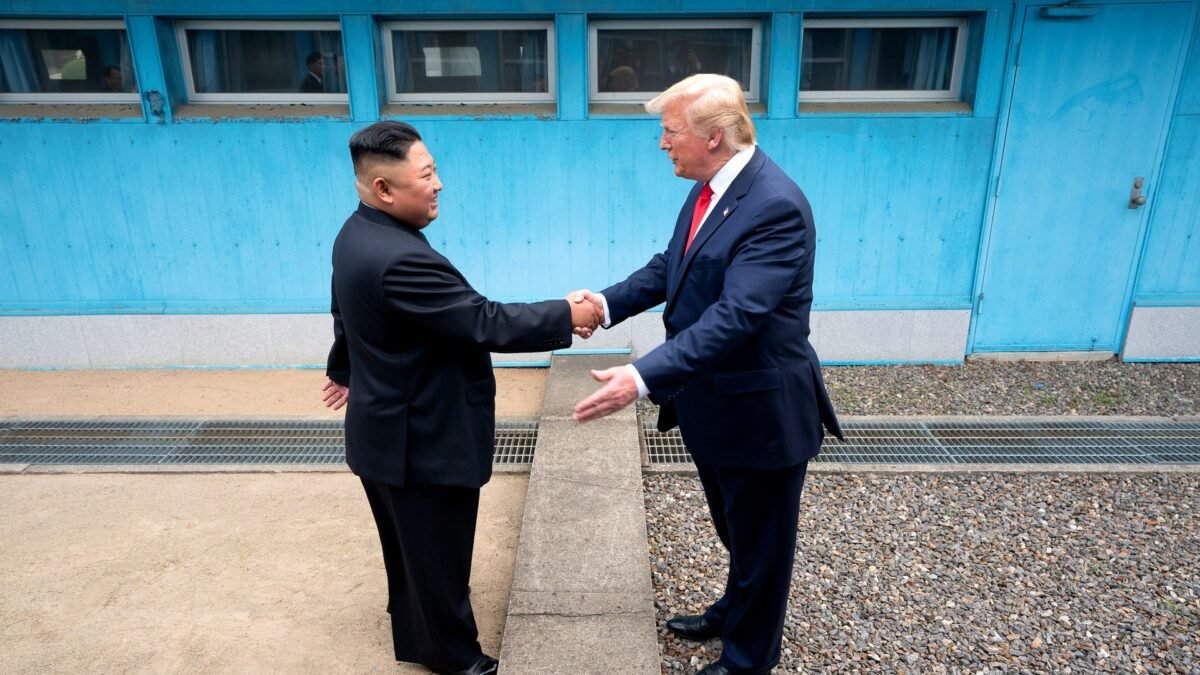
Trump has expressed his eagerness to restore diplomacy with Kim, according to the Associated Press. The two leaders met three times during Trump’s first term — in Singapore in June 2018, in Hanoi in February 2019, and at the Demilitarized Zone in June 2019, when Trump briefly stepped across the border into North Korea. The Hanoi summit collapsed without agreement, and talks have been stalled ever since.
Since returning to the White House, Trump has repeatedly spoken warmly of Kim and of their personal relationship, and has raised the possibility of a further meeting. Kim, for his part, has shown no public enthusiasm. North Korea has accelerated its weapons tests in recent months in what observers describe as a likely bid to increase its leverage in any potential diplomacy — testing first, talking later, and only on its own terms.
Kim Yo Jong’s statement on Wednesday fits that pattern precisely. It does not rule out dialogue forever. It rules out dialogue under current conditions, and it names the condition: the abandonment of what Pyongyang calls Washington’s hostile policy — a phrase that covers, in North Korean usage, everything from sanctions and joint US-South Korean military exercises to public accusations such as the FBI’s Binance attribution.
That is a condition Washington is unlikely to meet in the form Pyongyang demands. Sanctions are imposed by the United Nations as well as by the United States, and the FBI’s attribution of the Binance theft was a law-enforcement finding, not a negotiating position. The result is a familiar stalemate, now restated in sharper language and punctuated by missiles.
The timing matters too. The launches came as Americans were voting in midterm elections that have now delivered control of both chambers of Congress to the Democrats — a result that will constrain Trump’s freedom of action for the remaining two years of his second term. Pyongyang will have watched the outcome closely. A president facing a hostile Congress has less room to offer the kind of sweeping concessions — sanctions relief, security guarantees, a formal end to the Korean War — that North Korea has historically demanded as the price of denuclearisation talks.
At the same time, the midterm result may have strengthened Pyongyang’s hand in a different way. A divided Washington is a Washington that finds it harder to sustain a coherent, long-term North Korea policy — and North Korea has always been adept at exploiting the gaps between American administrations, Congresses and allies.
Analysis: Why It Matters
1. The message is the medium
North Korea rarely fires missiles by accident, and it rarely fires them without a message attached. Wednesday’s launches came within hours of Kim Yo Jong’s statement rejecting dialogue, and the pairing was plainly deliberate: the words said no to talks, and the missiles supplied the punctuation. Pyongyang wanted Washington to understand that its refusal is not a negotiating tactic dressed up as indifference, but a position backed by hardware. The launches also served a domestic purpose. North Korean state media presents each test as proof of the country’s strength and of Kim Jong Un’s leadership, and the timing — alongside the warship photograph from Nampho — gave the domestic audience a full day of evidence that the military is advancing on every front.
2. The Binance accusation has become a diplomatic weapon
The FBI’s attribution of the Binance theft to North Korean hackers was, on its face, a law-enforcement matter: more than $6 billion stolen, a hacking group identified, exchanges urged to freeze the assets. But in Pyongyang’s hands it has become something else — a grievance, a pretext and a test. By treating the accusation as proof of American hostility, Kim Yo Jong has converted a criminal investigation into a diplomatic condition: drop the accusation, drop the policy it supposedly represents, and then — only then — will talks be possible. The move is characteristic of North Korean diplomacy, which has always preferred to negotiate from a position of grievance, with the other side cast as the party that must make the first move. Whether Washington can or should accommodate that framing is a separate question. What is clear is that the cyber-theft allegation has now been woven into the nuclear diplomacy file, and it will not be easily unwound from it.
3. Testing is becoming production
The most consequential observation in Wednesday’s reporting may not be about diplomacy at all, but about industry. Lee Choon-geun’s assessment — that the sheer frequency of North Korean tests this year suggests preparations for mass production, possibly including exports to Russia — points to a shift in what the missile programme is for. A programme that tests to signal is one thing; a programme that tests to qualify weapons for manufacture and sale is another. North Korea’s reported supply of munitions to Russia for the war in Ukraine has already made it a participant in a European war. If missiles join that flow in bulk, Pyongyang becomes not just a regional threat but a node in a wider network of arms supply — and its testing tempo becomes a matter of concern far beyond the Korean peninsula. The warship under construction at Nampho points in the same direction: a North Korea building a navy to match its missile force is a North Korea planning for a larger military role than it has played before.
4. The inter-Korean freeze is now a confrontation
The mine blasts of September, the demands for an apology, the threats to resume loudspeaker broadcasts and deploy new weapons along the border — these are not the gestures of a frozen conflict, but of one that is warming in the wrong direction. For years the inter-Korean border was a place of ritualised hostility: loudspeakers, leaflets, occasional gunfire, but a shared understanding that escalation served nobody. The events of the past two months suggest that understanding is fraying. South Korea’s hypersonic test in October was itself a response to the North’s advances, and the North’s missile launch four days later was a response to that. Each side is now testing in reply to the other, and the cycle has a momentum of its own. The danger is not that either side wants a war — neither does — but that a cycle of reciprocal demonstrations can produce an accident, a miscalculation, or a test that lands somewhere it was not meant to.
5. Trump is running out of road — and time
For President Trump, Wednesday’s events are a reminder that his North Korea policy faces the same constraint as the rest of his second-term agenda: a clock that is now ticking faster. The midterm results have handed Congress to the Democrats, narrowing his room for manoeuvre on sanctions relief or any grand bargain with Pyongyang. His personal rapport with Kim Jong Un, real as it may have been in 2018 and 2019, has not survived seven years of stalemate, and Kim Yo Jong’s statement makes clear that Pyongyang now regards American overtures with open contempt rather than cautious interest. The president may still hope for a summit later this month, but the North’s message is unambiguous: no meeting without a change in policy, no change in policy without concessions Washington has not offered. Unless something shifts — in Washington, in Pyongyang, or in the wider geopolitics of the region — the most likely outcome is more of the same: more tests, more statements, and a peninsula that grows more heavily armed by the month.
What to Watch Next
- Pyongyang’s own account: KCNA typically confirms missile tests a day later, with photographs and details of the weapons involved. Its account will show whether Wednesday’s launches involved new systems — and whether the North chooses to claim a technical advance or present the test as routine.
- The warship at Nampho: Kim Jong Un’s visit to the shipyard and the photograph of the vessel under construction suggest a naval announcement may be coming. A 10,000-ton guided missile cruiser would be a major step for a navy that has long been the weakest arm of North Korea’s military.
- Washington’s response: The United States has not yet commented publicly on Wednesday’s launches. Any statement from the White House, the State Department or US Indo-Pacific Command will be watched for whether it treats the launches as routine provocation or as a response to the Binance accusation.
- The summit question: Trump has raised the possibility of meeting Kim Jong Un later this month. Kim Yo Jong’s statement makes a meeting look unlikely in the near term — but Pyongyang has reversed course before, and quickly, when it suited its interests.
- The border: The mine-blast dispute from September remains unresolved, and North Korea’s threats to resume loudspeaker broadcasts and deploy new weapons along the border have not been withdrawn. Any movement there will be an early indicator of whether tensions are stabilising or escalating.
Sources
- Reuters — “North Korea fires multiple missiles in fourth weapon launch in a month, Seoul says”, 4 November 2026
- Associated Press via Military.com — “North Korea Launches Missiles Toward the Sea as Pyongyang Protests Against US Claims on Binance Hack”, 4 November 2026
- Reuters — “North Korea denies Binance accusation, refuses dialogue with Washington”, 4 November 2026
- Al Jazeera — “N Korea fires multiple missiles, denies US claims on Binance hack”, 4 November 2026
- Britannica — “North Korea fires multiple ballistic missiles, adding to streak of weapons tests”, 12 October 2026

About the Author — Abdul Mannan
Related Articles

Herzog Opens Coalition Talks as Israel’s Election Fraud Claims Collapse and Netanyahu’s Future Hangs in the Balance
Israel's President Isaac Herzog opened coalition consultations on Wednesday after the elections committee certified the 27 October results…

Russia Bombs Aid Centre and Power Grid in Deadliest Week of the War as Abu Dhabi Peace Talks Loom
At least 33 people were killed when Russian bombs hit a humanitarian aid centre in Komyshuvakha, hours before…

Russian Glide-Bomb Strike on Ukraine Aid Centre Kills at Least 31 in One of the War’s Deadliest Attacks on Civilians
At least 31 people were killed when Russian glide bombs hit a school doubling as a humanitarian aid…