
At 38, Virat Kohli Is Still Writing History — and the World Is Still Watching

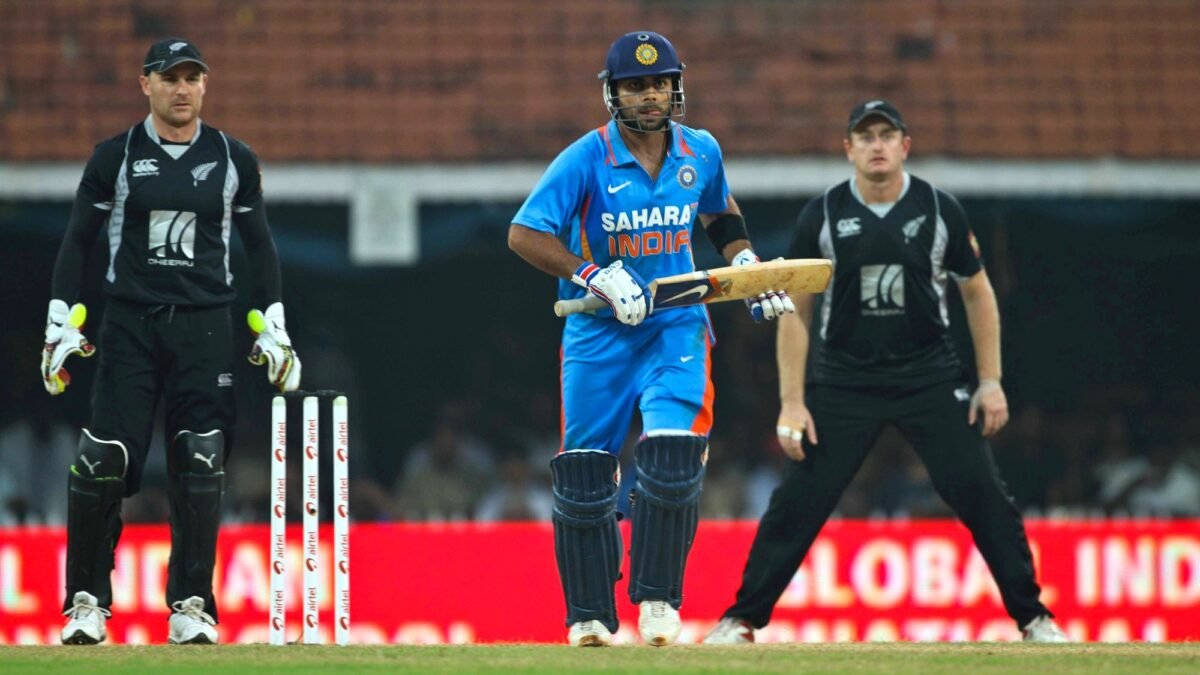
What Do You Call a Man Whom Time Itself Seems Afraid to Touch?
There are innings that merely win matches, and then there are innings that answer a question. On a rain-washed evening at Eden Park, Auckland, on the eve of his 38th birthday, Virat Kohli played an innings that answered the only question the cricket world has been asking about him for two years now: how much longer can he do this? The answer, delivered in 51 balls of cold, glittering authority, was simple. As long as he wishes.
India had been set a revised target of 143 in 32 overs under the Duckworth-Lewis-Stern method, after rain had repeatedly interrupted a chase that began with New Zealand bowled out for 185 in 40.2 overs. Rohit Sharma was gone for a duck. The sky was grey, the ball was moving, and the occasion — the first of a five-match one-day series — carried all the weight of a contest between two proud teams. Kohli walked in, and within the hour the match was effectively over. Seventy-four runs off 51 balls, thirteen fours and a six, a fifty raised in just 35 deliveries, and India home by five wickets with more than nine overs to spare. It was his 80th half-century in one-day internationals. It was, by any honest measure, a masterclass.
But numbers, as any student of this game knows, are only the skeleton of the story. The flesh of it was in the manner: the cover drive struck on the rise, the pull that seemed to arrive before the ball did, the calm with which a 37-year-old — now 38, as of today, 5 November — treated a bowling attack as though it were a net session. New Zealand’s Jacob Duffy, the man who eventually dismissed him, paid the finest tribute an opponent can offer. “There’s not many holes in that man’s game,” he said. There are no holes. That is the point.
History Holds Up a Mirror
I have always believed that the present is only properly understood when history holds up a mirror to it. And history, in this case, is generous with its parallels.
Consider Sachin Tendulkar at 38. In April 2011, at precisely the age Kohli reaches today, Tendulkar lifted the World Cup in Mumbai, a tournament he had chased for twenty-two years, and a billion people wept with him. The doubters had written him off a dozen times by then. They always do, with the great ones. Time, they said, had caught him. Time had done no such thing. Tendulkar simply refused to negotiate with it.
Consider Don Bradman, who walked away from the game at 39 with an average of 99.94 — a number so absurd that eight decades of cricket have not come close to touching it. Consider Viv Richards, who at 37 was still dismantling attacks with a disdain that bordered on insult. The history of this sport teaches one lesson above all others: greatness does not fade the way ordinary talent fades. It does not decline in a straight line. It burns, it dims for a season, and then — just when the obituaries are being drafted — it returns, because the fire was never the body. It was the mind.
Kohli retired from Test cricket in May 2025, and many read that decision as the beginning of the end. They misread it entirely. What he did was what the wise generals of history have always done: he shortened his front so that he could defend it forever. Freed from the five-day game, he has turned his whole being to the fifty-over format — and the results mock every prediction of decline. In 2026 alone he has played ten one-day internationals and scored 626 runs at an average of 69.55, striking at 120.61, with two centuries and four fifties. These are not the numbers of a man in twilight. These are the numbers of a man in his prime, wearing the mask of a veteran.
The Records That Refuse to Stop
There is a particular cruelty in the way Kohli collects records — he breaks them almost as an afterthought, somewhere between the second and third boundary of an innings nobody expected to be historic. At Eden Park he became the first batter in the history of one-day cricket to score 13,000 runs batting at number three, finishing the evening on 13,062. He recorded his fiftieth score of fifty or more in away one-day internationals, another first. He moved to second place on the list of most runs scored at a single batting position in the format. And he did it all while taking a stunning catch in the field, plucking a thick edge off the bowling of young Anshul Kamboj to dismiss Nathan Smith — a reminder that his contribution to this team has never been measured in runs alone.
Let me speak plainly to you, the reader, because this matters beyond the scorecard. We live in an age that worships the new and discards the proven. Every season brings a younger model, a fresher face, a louder promise. The crowd moves on quickly, and the commentators move on quicker. But there is a difference between the new and the true, and sport — like life — eventually exposes it. The new excites you for an evening. The true sustains you for a generation. Kohli belongs to the second category, and Eden Park was merely the latest proof.
When Football’s Finest Bowed to Cricket’s King
And then, as if the cricketing world needed a reminder of how far this man’s shadow falls, came the story from another sport entirely. Just over a week ago, Harry Kane lifted the Ballon d’Or in London — the first Englishman to win football’s greatest individual honour since Michael Owen in 2001, after a season of 73 goals for club and country. Asked which of the flood of congratulatory messages had left him most star-struck, the Bayern Munich striker named David Beckham, Tom Brady, Ed Sheeran — and Virat Kohli.
Think about that for a moment. The best footballer on the planet, on the greatest night of his life, counts a cricketer’s message among the ones that mattered most. Kohli had written to him the day after the ceremony: “Harry my friend, you deserve every bit of this award for your resilience, hard work and honesty with which you’ve carried yourself through all these years playing football at the top.” The two men have admired each other since 2016, when Kane publicly praised Kohli’s unbeaten 82 against Australia in the T20 World Cup; they met in person at Lord’s during the 2019 World Cup. A decade later, the respect has only deepened. Greatness recognises greatness across boundaries, across sports, across continents. It always has. The rest of us merely get to watch it happen.
The Cake, the Crowd, and the Chase
There was something almost tender about the scenes at Eden Park. The crowd, knowing the birthday was a day away, celebrated early — placards, postcards, songs, a stadium rising to a man who has given them a decade and a half of memories, many of them at their own team’s expense. Eden Park’s chief executive, Nick Sautner, presented Kohli with a birthday cake after the match. A viral video from the team bus showed Kohli sharing a warm, laughing exchange with head coach Gautam Gambhir — two Delhi men, one journey, the past and the present of Indian cricket sitting side by side.
This is the part of the story the scorecards never capture. The crowd does not sing for statistics. It sings for the feeling a man gives you when you watch him — the sense that you are witnessing something that will not come again in your lifetime, and that you had better pay attention while it lasts. That is what Kohli has always offered, and what he offered again in Auckland: the feeling that the chase is still on, that the mountain still has a summit, that the best may yet be ahead.
The series moves to Wellington on Saturday, 7 November, for the second one-day international, and beyond it looms the horizon every Indian fan is already staring at: the 2027 World Cup. Kohli will be 38 going on 39 by then. The doubters are already clearing their throats. They were clearing their throats before Eden Park, too. And Eden Park answered them.
The Verdict of Time
So let me end where I began, with the question the cricket world keeps asking. How much longer can he do this?
History suggests the question is the wrong way round. The question is not how long Virat Kohli can keep going. The question is how long the rest of us will take to understand what we are watching. Empires fall, champions fade, and every record is eventually broken — Kohli himself has built his career on breaking the records of men greater than him, and one day someone will break his. That is the law of the game, and the law of life. But there are some men who do not merely play within time. They argue with it, they defy it, and for a little while — for one rain-hit evening in Auckland, for one fifty raised in thirty-five balls — they win the argument.
Virat Kohli turned 38 today. The cake has been cut, the songs have been sung, and the records have been rewritten once more. The rest of us can only do what the Eden Park crowd did: stand, applaud, and be grateful that we were here to see it.
Happy birthday, King. The chase is not over. It never was.
Sources & References
- Cricket Australia — “Kohli in the runs as India thrash New Zealand in first ODI”, 4 November 2026
- ESPNcricinfo — Match report, New Zealand vs India, 1st ODI, Eden Park, 4 November 2026
- Sportskeeda — Expert reactions to Kohli’s 74, including the 13,000 runs at No. 3 milestone, 5 November 2026
- myKhel — Sports Bulletin, 5 November 2026 (Kohli’s second-fastest away ODI fifty)
- The Sports Tak — Harry Kane on Kohli’s Ballon d’Or message, 3 November 2026
- IANS — Jacob Duffy on Kohli after the Auckland ODI, 4 November 2026
- Cricket Addictor — Eden Park birthday surprise for Kohli, 4 November 2026

About the Author — Abdul Mannan
Related Articles

Rafael Nadal Joins Real Madrid Board of Directors as Tennis Legend Takes Seat in the Bernabéu Boardroom
Real Madrid have appointed 22-time Grand Slam champion Rafael Nadal to their board of directors, with the tennis…

Yamal Breaks Mbappé’s Teenage Champions League Record as Raphinha Brace Seals Barcelona’s 3-0 Win Over Aston Villa
Lamine Yamal became the highest-scoring teenager in Champions League history and Raphinha struck twice as Barcelona ended Aston…

Tenerife Striker Jesús de Miguel Dies at 30 After On-Pitch Collision as Spanish Police Open Manslaughter Inquiry
CD Tenerife striker Jesús de Miguel has died aged 30 after suffering a cardiac arrest in a collision…